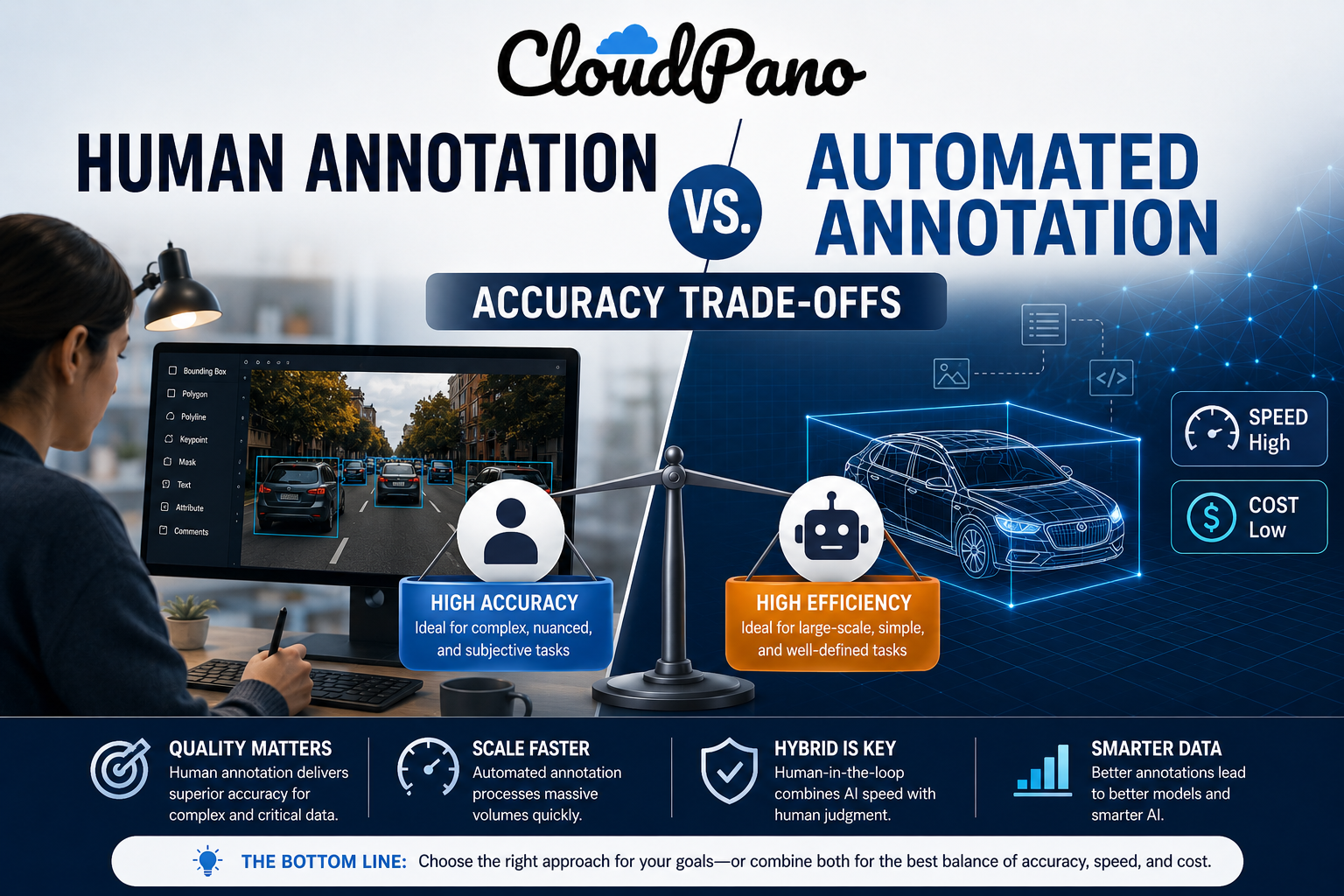
Human Annotation vs. Automated Annotation: Accuracy Trade-Offs

Cloudpano
July 17, 2026
5 min read
Share this post

Human vs. Automated Data Annotation: Accuracy Trade-Offs Explained

Every annotation project eventually forces the same decision: use human annotators, automate the labeling, or build something in between. The debate over human vs automated data annotation isn't really about which method is "better" — it's about which method fits a specific task, dataset, and risk tolerance.

This guide walks through where each approach holds up, where it breaks down, and how AI-assisted data annotation and human-in-the-loop workflows combine the strengths of both without inheriting either one's worst weaknesses.

Why It Matters

The accuracy gap between human and automated labeling isn't constant — it shifts depending on task difficulty. On simple, well-defined classification tasks, automated data labeling tools can match human accuracy at a fraction of the time and cost. On ambiguous, high-stakes, or long-tail data, that gap widens fast.

IEEE research on machine learning data pipelines has long emphasized that label noise — errors introduced during annotation — propagates directly into model error, and that noise sources differ meaningfully between human and automated annotation. Human errors tend to cluster around fatigue and inconsistency; automated errors tend to cluster around edge cases the model hasn't seen before.

Bar chart comparing human and automated data annotation accuracy by task complexity

This matters most in industries where a mislabeled data point isn't just a minor accuracy hit:
  • Healthcare AI, where a missed anomaly in a segmented scan carries real clinical risk
  • Autonomous vehicles, where an unlabeled edge case (an unusual pedestrian pose, an occluded object) can translate directly into a safety failure
  • Government & defense, where labeling errors may need to be defensible under audit, not just statistically acceptable

How It Works

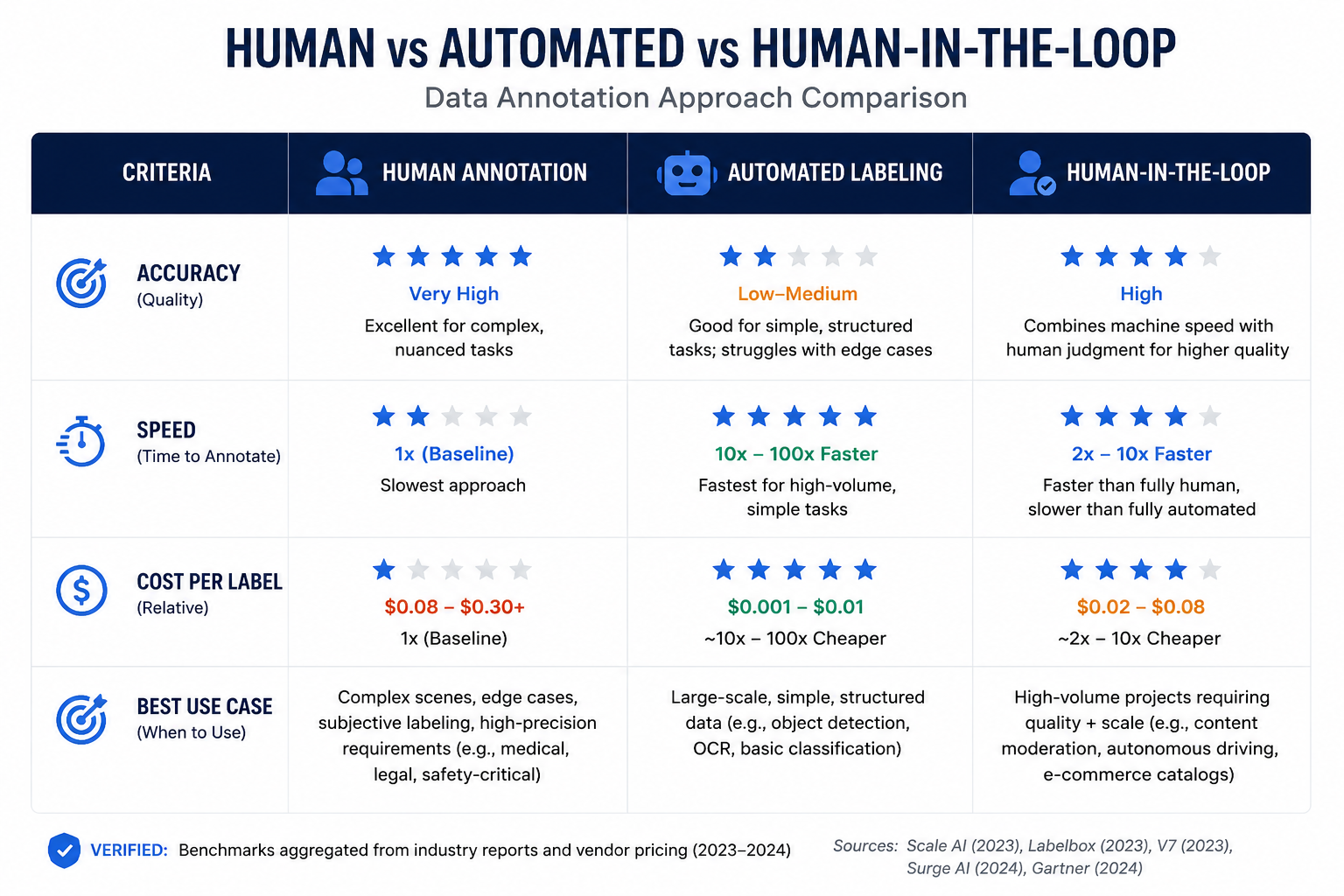
Comparison table of human vs automated data annotation across accuracy, cost, and speed

Comparison table of human vs automated data annotation across accuracy, cost, and speed

Human annotation relies on trained people applying judgment to each data point, guided by a taxonomy and edge-case guidelines. It's slower per unit but handles ambiguity, context, and novel scenarios that a model hasn't encountered before.

Automated data labeling tools use a pre-trained model — sometimes the same architecture being trained, sometimes a separate labeling model — to generate labels directly or to pre-label data for human correction. Speed and cost drop sharply, but accuracy depends entirely on how well the model's training distribution matches the new data.

Human-in-the-loop annotation sits between the two: a model generates initial labels, and humans review, correct, or approve them rather than labeling from scratch. This is how these workflows operate in most production annotation pipelines today, because it captures most of the speed benefit of automation while keeping a human accuracy check on the output.

🎯 Where Each Approach Tends to Win Compare

Human annotation, fully automated labeling, or human‑in‑the‑loop — each has a clear sweet spot.

Approach Strongest On Weakest On
🧠 Human annotation Ambiguous, novel, high‑stakes data ⚠️ Volume, consistency at scale, cost per label
🤖 Fully automated labeling High‑volume, well‑defined, repetitive tasks ⚠️ Edge cases, novel scenarios, ambiguous context
🔄 Human‑in‑the‑loop Balancing accuracy and throughput ⚠️ Requires tooling that supports fast review/correction, not just raw labeling

Step-by-Step Workflow

A typical human-in-the-loop annotation pipeline moves through these stages:

  1. Pre-label with a model. Run the dataset through an existing model or off-the-shelf labeling model to generate draft labels.
  2. Score model confidence. Flag low-confidence predictions for mandatory human review; route high-confidence predictions to a lighter spot-check.
  3. Route to human reviewers. Annotators correct, confirm, or reject the pre-labels — this is typically far faster than labeling from scratch.
  4. Measure inter-annotator agreement. Run a subset through multiple reviewers to catch inconsistency before it scales.
  5. Feed corrections back into the model. Use the corrected labels to retrain or fine-tune the pre-labeling model, improving pre-label accuracy over time.
  6. Re-evaluate the automation threshold. As pre-label accuracy improves, shift more of the confidence spectrum from mandatory review to spot-check only.
Branching flowchart diagram, one input box splitting into two confidence-based paths that merge back together, one feedback loop arrow, flat corporate design, blue and gray palette, white background

Industry Use Cases

  • Autonomous vehicles: Automated pre-labeling handles routine lane and object detection at scale, while human annotators focus review time on occlusions, unusual weather, and rare object classes.
  • Healthcare AI: Human annotation (often by clinically trained annotators) remains dominant for diagnostic imaging, with automated tools used mainly to flag likely regions of interest for human review rather than to label independently.
  • Retail AI: Automated data labeling tools handle high-volume shelf and inventory image classification, with human-in-the-loop review reserved for new product categories the model hasn't seen.
  • Robotics: Human annotation is typically required for novel manipulation tasks, while automated labeling scales well once a task's motion patterns are well established.
  • LLM development: Human-in-the-loop annotation is central to preference labeling and RLHF-style comparison tasks, where nuanced judgment calls are difficult to automate reliably.
  • Government & defense: Human annotation often remains mandatory for cleared, sensitive, or legally auditable datasets, regardless of what automation could technically achieve.

Stanford HAI's AI Index has tracked the growing use of model-assisted annotation across industry, while consistently noting that human review remains the accuracy backstop for high-stakes deployment decisions — reinforcing that automation and human judgment are complementary, not competing, resources.

Benefits

Choosing the right mix of human and automated annotation delivers benefits neither extreme achieves alone:

  • Cost efficiency without an accuracy cliff — automation handles volume, humans handle risk
  • Faster iteration since pre-labeling removes the "blank page" problem for annotators
  • Better long-term model performance, since human-corrected edge cases feed back into future pre-labeling accuracy
  • Scalable QA, since confidence scoring lets teams focus human attention where it matters most instead of reviewing everything uniformly

Common Mistakes

  • Automating first, measuring accuracy second. Teams deploy automated data labeling tools at full scale before establishing a real accuracy baseline against human-labeled ground truth.
  • Treating human-in-the-loop as "review everything." Without confidence-based routing, human-in-the-loop annotation just becomes slow, full manual review with extra steps.
  • Ignoring where automation quietly fails. Automated labeling error rates tend to rise on data that looks similar to training data but isn't — teams often don't test for this drift until it shows up in production.
  • Underinvesting in human annotator training for edge cases. If human reviewers aren't trained on the specific edge cases the model struggles with, review quality suffers as much as the automation it's meant to check.
  • Never revisiting the automation threshold. Confidence thresholds set at project kickoff often go stale as the model improves, leaving too much data in mandatory human review long after it's warranted.

Best Practices

  • Start with human annotation on a pilot batch to establish ground truth before evaluating any automated data labeling tools against it
  • Use confidence scoring to route data, rather than a blanket "review everything" or "automate everything" policy
  • Track accuracy separately for automated-only, human-in-the-loop, and human-only subsets so you can see where each method actually stands
  • Retrain or fine-tune pre-labeling models on human-corrected data on a regular cadence, not just once at project start
  • Reserve full human annotation for genuinely high-stakes or low-volume datasets where the cost of an error outweighs the cost of manual labeling

Gartner's guidance on AI data operations has emphasized that organizations pairing automated tooling with structured human review cycles see more reliable long-term data quality than those relying on either fully manual or fully automated pipelines — a pattern consistent with what most production annotation teams find in practice.

FAQ

Is human annotation always more accurate than automated labeling?

Not universally. On simple, well-defined tasks with abundant training examples, automated data labeling tools can match or approach human accuracy. The gap widens mainly on ambiguous, novel, or high-stakes data.

What does "human-in-the-loop annotation" actually mean in practice?

It means a model generates initial labels and humans review, correct, or approve them, rather than labeling every item from scratch. The human effort shifts from labeling to verification, which is typically faster.

How do I know when data is ready for full automation?

Track accuracy on automated-only labels against a human-labeled ground truth set. When automated accuracy consistently meets your threshold across representative edge cases — not just average-case data — that subset is a candidate for reduced human review.

Does AI-assisted data annotation replace the need for human annotators?

No — it shifts their role rather than eliminating it. Annotators spend more time reviewing and correcting model output and less time labeling from a blank slate.

What industries still rely almost entirely on human annotation?

Healthcare imaging, legal document review, and cleared government/defense datasets tend to require human annotation due to accuracy stakes, regulatory requirements, or chain-of-custody documentation.

How often should confidence thresholds be re-evaluated in a human-in-the-loop pipeline?

There's no universal cadence, but thresholds should be revisited whenever the underlying pre-labeling model is retrained, and periodically even without retraining, since data distribution can shift over time.

Can automated labeling introduce bias that human annotators wouldn't?

Yes — an automated labeling model reflects the biases and blind spots of its own training data, which can differ from the biases a human annotator might introduce. This is a key reason human review remains valuable even as automation scales.

Is a hybrid human-automated approach more expensive than choosing one method?

Not typically over the full project lifecycle. While it requires more upfront tooling investment, it usually costs less than full human annotation and produces higher accuracy than full automation, especially at scale.

Conclusion

The human vs automated data annotation debate isn't a binary choice — it's a task-by-task allocation decision. Automation should absorb the volume; human judgment should absorb the risk. Teams that build a deliberate hybrid workflow, rather than defaulting to one extreme, consistently get better accuracy per dollar spent than teams that pick a single method and apply it everywhere.

🚀 Your All‑In‑One Virtual Experience Stack
🎬
PhotoAIVideo
Turn photos into scroll‑stopping AI videos.
Get Started →
🏡
Pictastic
Instantly stage listings with AI.
Try Staging →
🌀
CloudPano
Create stunning 360° tours in minutes.
Launch Tour →
💰
VirtualTourProfit
Build a profitable virtual tour business.
Learn More →
🤝
CloudPano Reseller
Resell AI visual software without building it.
Become a Reseller →
🚗
Auto CloudPano
Sell more vehicles with 360° experiences.
Explore Auto →
🖼️
AutoBackgrounding
Replace backgrounds instantly with AI precision.
Try it Now →
📐
3D Measure
Capture accurate floor plans & 3D measurements.
Measure Now →
🧠
AI Training Data
Custom AI training data services.
Learn More →
Share this post
Cloudpano

Choose The Right 360° Camera

Insta360 ONE RS 1-Inch 360 Edition

  • Compact, ready to go anywhere

  • Interchangeable lens that’s upgradeable

  • Dual 1-inch sensors for improved clarity and low light performance

  • Dynamic range and 6K 360° capture

  • 360° photo resolution at 21MP

Learn More

Insta360 X4

  • 8K 360° video recording for ultra-detailed visuals.

  • 4K single-lens mode for traditional wide-angle shots.

  • Invisible selfie stick effect for drone-like perspectives.

  • 2.5-inch touchscreen with Gorilla Glass protection.

  • Waterproof up to 33ft for underwater shooting.

Learn More

Ricoh Theta Z1

  • 360° photo resolution in 23MP

  • Slim design at 24 mm thick

  • Built-in image stabilization for smooth video capture.

  • Internal 19GB storage for photo and video storage.

  • Wireless connectivity for remote control and sharing.

Learn More

Ricoh Theta X

  • 60MP 360° still images for high-resolution photography.

  • 5.7K 360° video recording at 30fps.

  • 2.25-inch touchscreen for intuitive control.

  • USB Type-C port for fast charging and data transfer.

  • MicroSD card slot for expandable storage.

Learn More
Property Marketing
Allows potential buyers to explore properties in detail from anywhere, enhancing the real estate marketing process.
Automotive Spins
Create an interactive virtual showroom and engage affluent digital buyers with live 360º video calls, all through the CloudPano mobile app for a complete automotive sales solution.
Interactive Floor Plans
Create 2D and 3D floor plans with measurements in 4 minutes or less, all from your phone. Download the Floor Plan Scanner app and get your first scan free.

360 Virtual Tours With CloudPano.com. Get Started Today.

Try it free. No credit card required. Instant set-up.

Try it free
Latest posts

See our other posts

Interviews, tips, guides, industry best practices, and news.

How to Choose a Data Annotation Partner (Buyer's Checklist)

To choose a data annotation company, evaluate domain expertise, quality assurance methodology, data security certifications, tooling flexibility, and scalability under your expected volume. The best data annotation company for one project may not fit another — the right partner matches your specific annotation type, industry compliance needs, and growth timeline, not just price per label.
Read post

Human Annotation vs. Automated Annotation: Accuracy Trade-Offs

Human vs automated data annotation is the choice between manual labeling by trained annotators and model-driven labeling with minimal human input. Human annotation is more accurate on ambiguous or high-stakes data but slower and costlier per label. Automated data labeling tools are faster and cheaper at scale but need human-in-the-loop review to catch edge-case errors.
Read post

Data Annotation 101: Types, Tools, and Best Practices

Data annotation types and tools are the labeling methods and software platforms teams use to prepare raw data for machine learning. Common types include bounding boxes, semantic segmentation, and named entity recognition; tools range from open-source labelers to managed platforms with built-in quality control, workflow routing, and pricing tied to annotation complexity.
Read post