What Is a Head-Mounted Camera Dataset?

Cloudpano
November 26, 2026
•
5 min read
Share this post

What is a head-mounted camera dataset, and what does it capture that other methods miss?

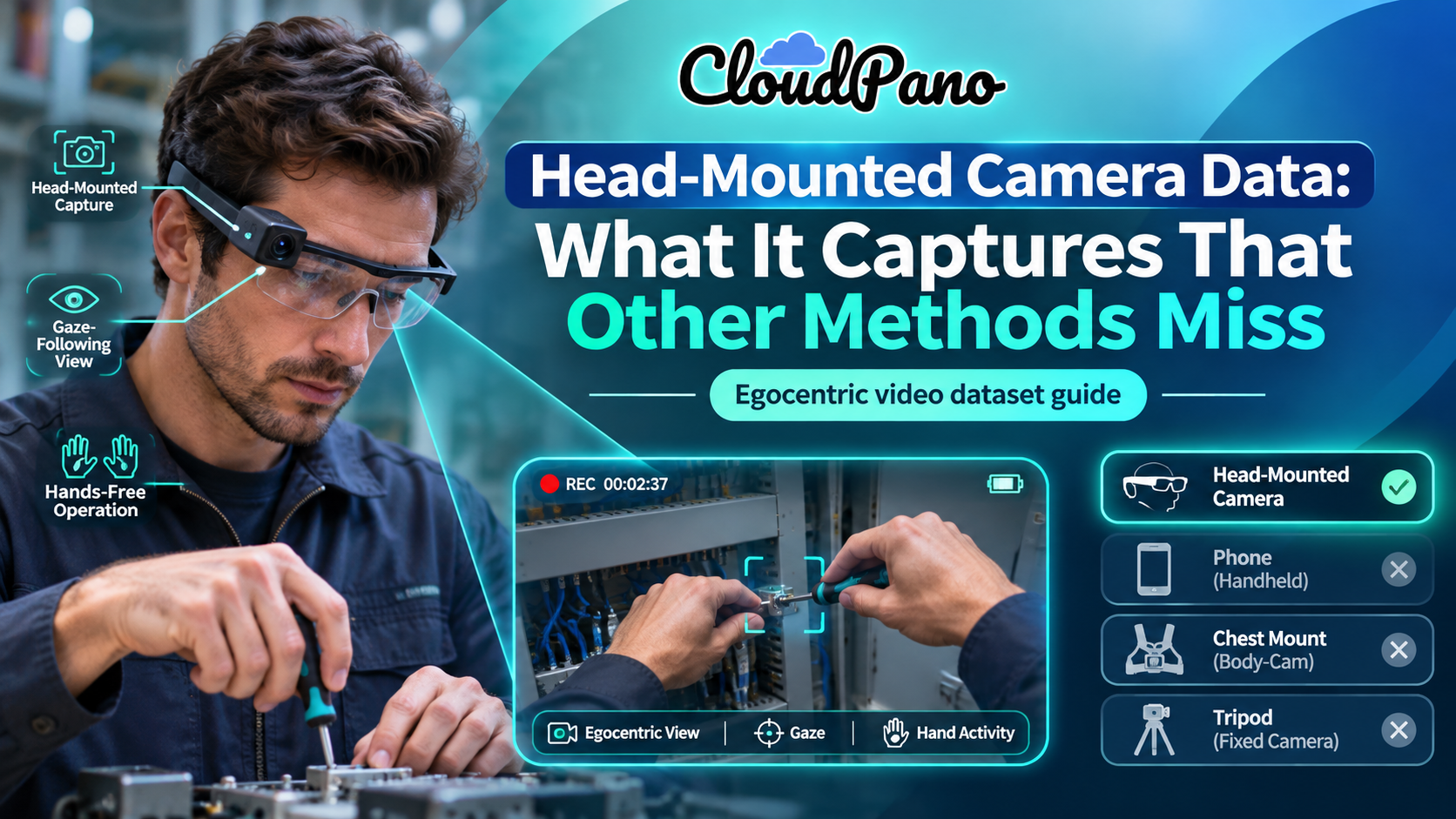
A head-mounted camera dataset is first-person video recorded by a camera worn on the head, so the viewpoint follows the wearer's gaze and both hands stay free. That gives you the eye-line a robot or wearable device will have at inference, plus unbroken footage of hands working. Ego4D, EPIC-KITCHENS and Ego-Exo4D were all collected this way.

Key Takeaways

  • A head-mounted camera follows the wearer's gaze, so the frame moves to whatever the task needs attention on — a chest or tripod mount cannot do that.
  • Head mounting keeps both hands free, so the footage shows the task performed normally rather than one-handed around a phone.
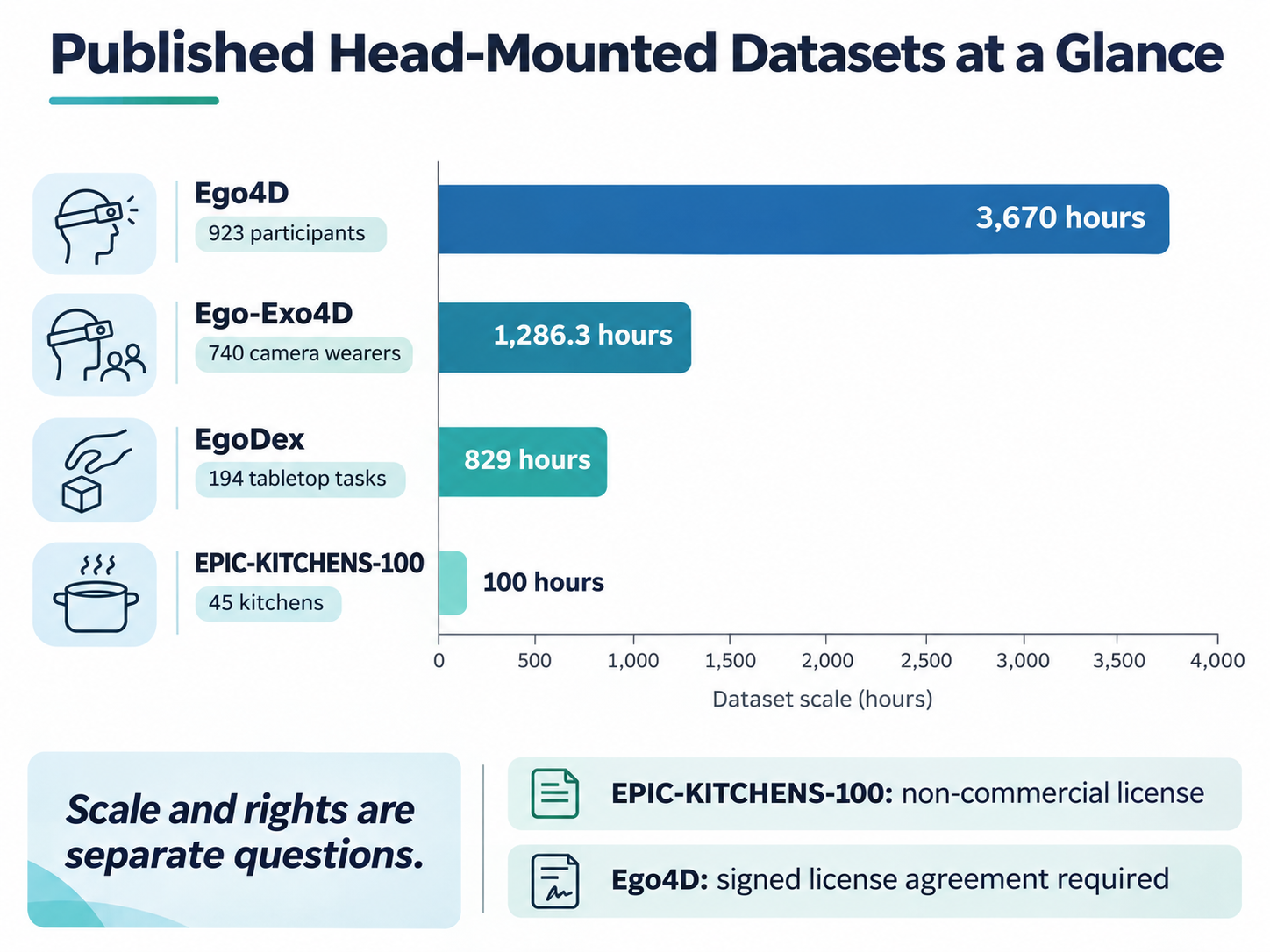
  • The largest published egocentric datasets are head-mounted: Ego4D (3,670 hours, 923 participants), Ego-Exo4D (1,286.3 hours, 740 camera wearers) and EgoDex (829 hours, 194 tasks).
  • Scale does not mean you can ship it: EPIC-KITCHENS-100 is released under a non-commercial licence, and Ego4D requires signing a licence agreement before download.
  • Head-only capture has real blind spots — it loses the hands whenever the wearer looks away, and it cannot give the close-in wrist view that manipulation policies often want.

What Is a Head-Mounted Camera Dataset?

If you are choosing how to collect first-person footage, the mount is not a detail — it decides what ends up in frame. Ego4D, still the largest openly released egocentric dataset, was collected with seven different off-the-shelf head-mounted cameras across 74 locations in 9 countries, not with phones on tripods. Every major egocentric dataset since has made the same choice.

That is because a head-mounted camera answers a specific question: what did the person look at while they were doing this, and what were their hands doing at the time? A phone in a stand records the room. A chest mount records the torso's direction. Only a head mount tracks attention. This guide covers what head-mounted camera data captures, what the published datasets actually contain, and — just as usefully — what head mounting on its own will miss.

What counts as head-mounted camera data?

Head-mounted camera data is video recorded by a camera worn on the head — a helmet or headband rig, an action camera on a strap, or smart glasses — so the frame moves with the wearer's head. It is a subset of egocentric video, which is any footage shot from the actor's own point of view, including chest and wrist mounts.

The hardware is less exotic than people expect. Ego4D's 3,670 hours were captured on GoPro, Vuzix Blade, Pupil Labs, ZShades, OR-DRO EP6, iVue Rincon 1080 and Weeview units — consumer gear, listed by name on the dataset's own site. At the other end, Ego-Exo4D used Meta's Aria glasses, with an 8 MP RGB camera and two SLAM cameras, plus seven microphones, two IMUs running at 800 Hz and 1000 Hz, a barometer and a magnetometer. EgoDex, an ICLR 2026 paper, used an Apple Vision Pro to pair 829 hours of first-person video with 3D hand and finger tracking.

So "head-mounted" spans a $300 action camera and a research headset with a full sensor stack. What they share is the mounting point, and that is what shapes the data.

What does a head-mounted camera capture that a handheld phone can't?

Three things: a viewpoint that follows attention, two working hands, and a consistent eye-line. A phone gives you none of them reliably.
Four of them set the benchmark for scale, and each one is head-mounted. The figures below are the ones each dataset states on its own page.

  • A viewpoint that follows attention. When someone reaches past a jar to get the one behind it, their head turns first. A head-mounted camera turns with it, so the frame contains whatever the task currently needs. A phone on a stand holds one fixed view of the counter, and a phone in the other hand points wherever that arm happens to be. For a model learning which object matters at which moment, head motion is signal, not shake.
  • Two working hands. If one hand is holding the camera, the task is being performed one-handed — which is not how the task is done, and not what you want a policy to imitate. Head mounting leaves both hands in frame doing the real motion. This is why hand-focused datasets go head-mounted: EgoDex collected 829 hours across 194 tabletop tasks with paired 3D hand and finger tracking, which only works when both hands are free and in view.
  • A consistent eye-line. The camera sits roughly where the eyes sit, every session, for every contributor. That consistency matters at training time, because the viewpoint is comparable across hours of footage, and at inference time, because a humanoid's head camera or a pair of smart glasses will see the world from about the same place.

That last point is the one buyers underrate. Collecting from a viewpoint that matches deployment is the whole argument for real-world video data over scraped internet footage, and the mount is how you control it.

What do the published head-mounted datasets actually contain?

Four of them set the benchmark for scale, and each one is head-mounted. The figures below are the ones each dataset states on its own page.

  • Ego4D — 3,670 hours, 923 participants. Daily-life activity across 74 worldwide locations in 9 countries, captured on seven off-the-shelf head-mounted camera models. Released 17 February 2022. Access requires reviewing and accepting a licence agreement first, and the site notes that most video was de-identified before release.
  • EPIC-KITCHENS-100 — 100 hours, 45 kitchens, 4 cities. Head-mounted capture in participants' own kitchens, annotated into 90K action segments across 20M frames, with 97 verb and 300 noun classes. It is published under a Creative Commons Attribution-NonCommercial 4.0 licence, with commercial licences available by request.
  • Ego-Exo4D — 1,286.3 hours, 740 camera wearers, 13 cities. Skilled human activities recorded with Aria glasses for the first-person stream, time-synchronised with four to five stationary GoPros for third-person views, over 5,035 takes. Released 13 December 2023. Nearly all of it is available without de-identification because the scenarios are closed environments.
  • EgoDex — 829 hours, 194 tabletop tasks. Egocentric video with paired 3D hand and finger tracking, captured on Apple Vision Pro using its multiple calibrated cameras and on-device SLAM.

Two patterns are worth pulling out of that list. First, head mounting is not a budget compromise — it is what the best-funded collections chose. Second, the hours do not tell you whether you can use them. EPIC-KITCHENS-100's default licence is non-commercial, and Ego4D's download is gated behind a signed agreement with a stated approval wait. Scale and rights are separate questions, and the second one is what stops most commercial wearable camera video data projects.

Where does head-mounted capture fall short?

In four places, and you should plan around all of them rather than discover them at annotation time.

  • It loses the hands whenever the wearer looks away. The same gaze-following behaviour that makes the viewpoint useful also means that a contributor who glances at the door mid-task takes the hands out of frame. Over long sessions this produces real gaps in exactly the footage a manipulation policy wants.
  • It cannot give you a close-in wrist view. Head height is too far from the fingers for fine contact detail. If the model needs to see the grasp itself, a wrist stream has to be added alongside the head stream.
  • Consumer action cameras are rolling-shutter devices. Fast head motion is where rolling shutter does the most damage, and head-mounted capture is nothing but motion. If you need streams that genuinely describe the same instant, that is a hardware question, not a post-processing one — we covered what hardware sync actually buys you separately.
  • A head rig is more intrusive to wear. Contributors accept it for scripted sessions; it is harder to sustain for long unscripted days, which is partly why phone-and-chest-mount tiers exist at all.

One thing we should say plainly: none of the dataset results above were measured on Firsthand data. Ego4D, EPIC-KITCHENS, Ego-Exo4D and EgoDex are other teams' collections, cited here because they are the public evidence for how first-person data gets captured, not as claims about our own output. Our own egocentric collection page does not publish a total hour count or a contributor count, and our entry-level tier is a phone in a chest mount, not a head rig — a chest mount is cheaper and steadier, but it does not follow gaze, which is the whole point of this article. If gaze-following is what your model needs, say so when you spec the project.

How do you spec a head-mounted collection?

Decide the mount, the companion streams, and the rights — in that order, before anyone starts filming. Each of these is cheap to settle up front and expensive to retrofit.

  • Match the mount to the deployment viewpoint. A humanoid's head camera or a smart-glasses product wants head-mounted footage. A fixed-base arm with an overhead camera does not, and paying for gaze-following data you will never use is waste.
  • Decide whether you need wrist or depth alongside. Head-only is fine for scene understanding and action recognition. Contact-level manipulation usually needs a synchronised wrist stream, and that pushes you into a multi-camera rig on a shared hardware clock.
  • Set the task script before capture, not after. The published datasets all work because the activity was specified — 194 tabletop tasks in EgoDex, kitchen activity in EPIC-KITCHENS. Unstructured hours are much harder to annotate into anything a model can learn from.
  • Settle the licence at the start. Decide whether you need perpetual commercial rights, who holds contributor releases, and what de-identification happens before delivery. A dataset you cannot legally train on commercially is not cheaper, it is unusable.
  • Agree the delivery format. RLDS, LeRobot, WebDataset and plain MP4 plus JSONL are the common options. Pick one that your training stack already reads.

If you want this run as a managed project rather than built in-house, that is what our egocentric video data collection service does — phone, head-rig and multi-camera tiers, with contributor releases documented and faces, plates and screens blurred at ingest.

The bottom line

Head-mounted camera data earns its place by capturing attention and leaving both hands free — two things a handheld phone, a chest strap or a tripod cannot deliver at the same time. That is why Ego4D, EPIC-KITCHENS, Ego-Exo4D and EgoDex were all collected from the head. It is also not a complete answer on its own: head-only capture loses the hands when the wearer looks away, and gives you no close-in view of the grasp. Spec the mount against where your model will actually run, add wrist or depth streams if contact matters, and settle the licence before the first hour is recorded.

🚀 Your All‑In‑One Virtual Experience Stack
🎬
PhotoAIVideo
Turn photos into scroll‑stopping AI videos.
Get Started →
🏡
Pictastic
Instantly stage listings with AI.
Try Staging →
🌀
CloudPano
Create stunning 360° tours in minutes.
Launch Tour →
💰
VirtualTourProfit
Build a profitable virtual tour business.
Learn More →
🤝
CloudPano Reseller
Resell AI visual software without building it.
Become a Reseller →
📹
iFirstHand
Custom first‑person video & sensor data for AI & robotics.
Get Data →
🏗️
AI Floor Plan Builder
Generate detailed floor plans with AI.
Build Now →
📐
3D Measure
Capture accurate floor plans & 3D measurements.
Measure Now →
🧠
AI Training Data
Custom AI training data services.
Learn More →

Frequently Asked Questions

What does a head mounted camera do?

It records video from the wearer's own point of view, with the frame moving as the head turns. That gives first-person footage of what the person looked at and what their hands were doing, without anyone holding a camera. It is the standard capture method for egocentric datasets.

What does egocentric data mean?

It means video and sensor data recorded from the actor's own viewpoint rather than from a fixed camera in the room. Head, chest and wrist mounts all count. Head-mounted data is the subset where the viewpoint follows the wearer's gaze, which is closest to how a person actually sees a task.

How to collect egocentric data?

Pick a mount that matches your deployment viewpoint, write a task script so the activity is specified rather than random, record with consented contributors on documented releases, and blur faces and screens before delivery. Most teams either buy a licensed dataset or commission a managed collection rather than building a rig in-house.

What cameras do robots use?

Head-mounted collections have used consumer action cameras and research headsets alike. Ego4D names GoPro, Vuzix Blade, Pupil Labs, ZShades, OR-DRO EP6, iVue Rincon 1080 and Weeview. Ego-Exo4D used Meta's Aria glasses with an 8 MP RGB camera and two SLAM cameras, and EgoDex used an Apple Vision Pro.

How do robots collect data?

Mostly by recording humans doing the task. Contributors wear head, chest or wrist cameras while performing real work, and the footage is annotated into actions, hand poses and objects. Teleoperation and simulation add more, but human first-person video is the cheapest way to cover many tasks and environments.

Sources

Share this post
Cloudpano

Choose The Right 360° Camera

Insta360 ONE RS 1-Inch 360 Edition

  • Compact, ready to go anywhere

  • Interchangeable lens that’s upgradeable

  • Dual 1-inch sensors for improved clarity and low light performance

  • Dynamic range and 6K 360° capture

  • 360° photo resolution at 21MP

Learn More

Insta360 X4

  • 8K 360° video recording for ultra-detailed visuals.

  • 4K single-lens mode for traditional wide-angle shots.

  • Invisible selfie stick effect for drone-like perspectives.

  • 2.5-inch touchscreen with Gorilla Glass protection.

  • Waterproof up to 33ft for underwater shooting.

Learn More

Ricoh Theta Z1

  • 360° photo resolution in 23MP

  • Slim design at 24 mm thick

  • Built-in image stabilization for smooth video capture.

  • Internal 19GB storage for photo and video storage.

  • Wireless connectivity for remote control and sharing.

Learn More

Ricoh Theta X

  • 60MP 360° still images for high-resolution photography.

  • 5.7K 360° video recording at 30fps.

  • 2.25-inch touchscreen for intuitive control.

  • USB Type-C port for fast charging and data transfer.

  • MicroSD card slot for expandable storage.

Learn More
Property Marketing
Allows potential buyers to explore properties in detail from anywhere, enhancing the real estate marketing process.
Automotive Spins
Create an interactive virtual showroom and engage affluent digital buyers with live 360º video calls, all through the CloudPano mobile app for a complete automotive sales solution.
Interactive Floor Plans
Create 2D and 3D floor plans with measurements in 4 minutes or less, all from your phone. Download the Floor Plan Scanner app and get your first scan free.

360 Virtual Tours With CloudPano.com. Get Started Today.

Try it free. No credit card required. Instant set-up.
Try it free
Latest posts

See our other posts

Interviews, tips, guides, industry best practices, and news.

How Much Does Egocentric Video Data Cost Per Hour?

Understanding AI training data pricing is essential for businesses developing robotics, computer vision, and multimodal AI models. This guide explores the cost of egocentric video data per hour, including raw footage, curated datasets, annotated video, and specialized robotics data. It also examines pricing factors, provider comparisons, public versus custom datasets, licensing requirements, and the true cost per usable hour. Learn how to optimize your data collection budget without compromising data quality or model performance.
Read post

Dataset Rejection Criteria Explained: 10 Essential Quality Checks for AI Training Data

Not every dataset is ready for AI training. Discover 10 essential dataset rejection criteria, from missing information and inaccurate annotations to poor sensor quality and insufficient documentation. Learn how to establish acceptance standards, manage rejected data, and improve dataset quality.
Read post

What Is a Head-Mounted Camera Dataset?

Head-mounted camera data is the capture method behind most major egocentric datasets. This guide explains what a head-mounted rig records that a phone or chest mount can't, what the published datasets actually contain, and where head-only capture falls short.
Read post