What Are Data Labeling Services? A Complete Guide for Enterprise AI

Cloudpano
July 20, 2026
5 min read
Share this post

What Are Data Labeling Services? A Complete Guide for Enterprise AI

Enterprise teams researching data labeling services for the first time usually run into a wall of vendor marketing before they find a clear, neutral explanation of what the category actually covers. That gap makes it hard to evaluate anyone objectively.

At the enterprise level, this category isn't just about labeling data — it's about security posture, compliance documentation, dedicated account management, and workforce networks that can scale with an organization's actual volume and risk tolerance, not just a single project's needs.

Why It Matters

Getting this category right matters more at enterprise scale because the consequences of getting it wrong are larger and slower to surface. Google Research's "Data Cascades" study documented how small, unaddressed data quality issues compound over time into expensive, hard-to-trace production failures — a dynamic that plays out at a much larger scale in enterprise AI systems than in a small pilot (Sambasivan et al., Google Research).

NIST's AI Risk Management Framework treats data quality and provenance as foundational to trustworthy AI, and enterprise organizations in particular are increasingly expected to demonstrate this kind of data governance to regulators, auditors, and customers (NIST AI RMF).

The pace of enterprise AI adoption adds urgency. Stanford HAI's AI Index has tracked how quickly organizations are deploying models into production (Stanford HAI, AI Index Report), and enterprise teams often need to move from an initial pilot to a full-scale program faster than their labeling infrastructure was originally designed for.

How It Works

At the enterprise level, data labeling services typically combine several elements that go beyond a smaller-scale offering. Understanding how these workflows operate at this scale helps frame what to expect from a provider conversation.

Workforce networks. Enterprise-grade providers maintain larger, often geographically distributed annotator pools, sometimes with dedicated teams assigned specifically to one account for consistency across a long-term engagement.
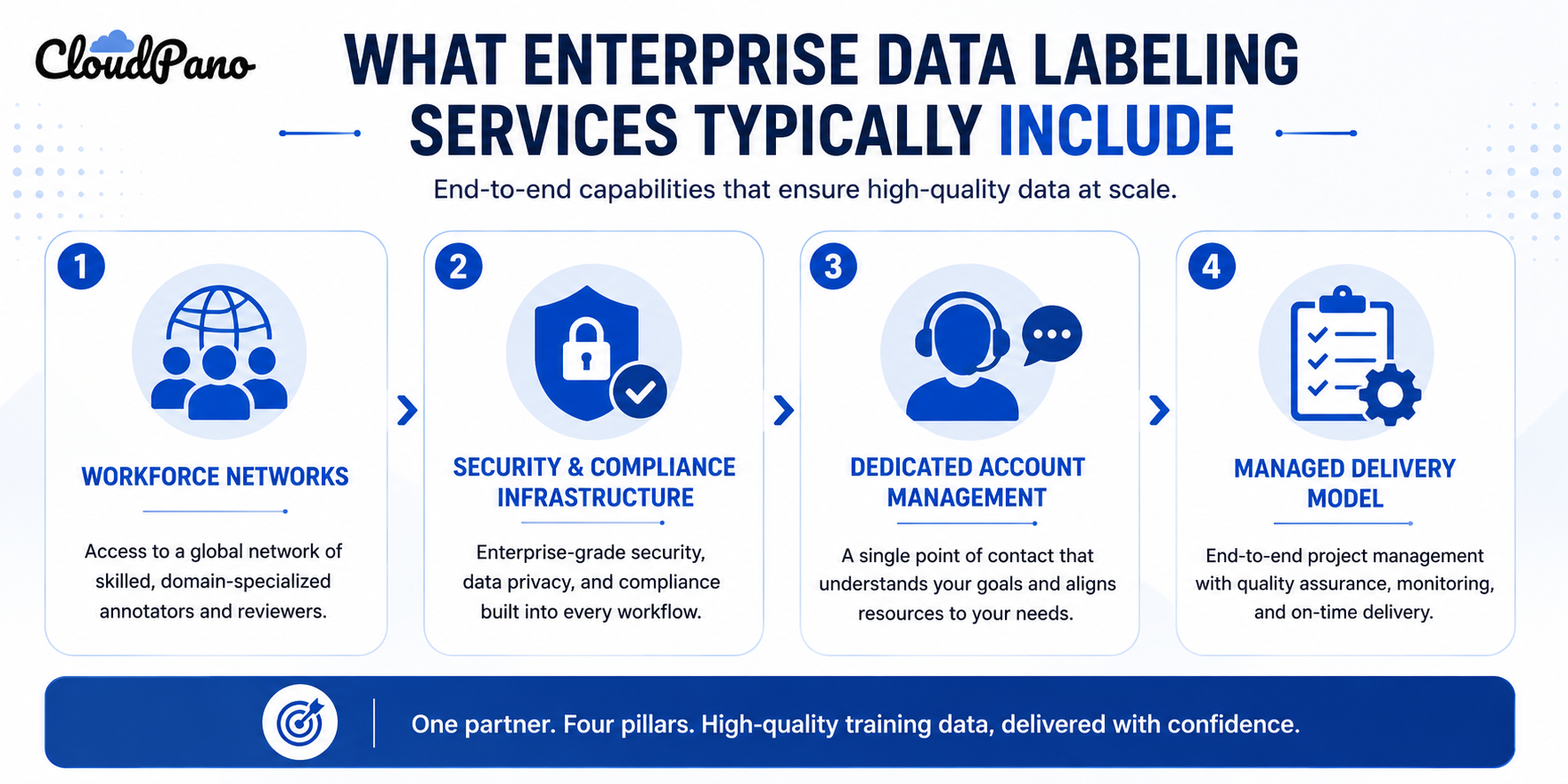
 Infographic of what enterprise data labeling services typically include

Security and compliance infrastructure. This includes data handling certifications, defined data residency options, access controls, and audit trails — documentation an enterprise procurement or legal team will typically require before any sensitive data changes hands.

Dedicated account and project management. Rather than a shared support queue, enterprise engagements typically include a named account team responsible for taxonomy design, throughput planning, and escalation.

Managed data labeling as the default model. Most enterprise engagements run as fully managed offerings — workforce, tooling, and QA bundled together — since the internal management overhead of running component services at enterprise volume is usually higher than most teams want to absorb.
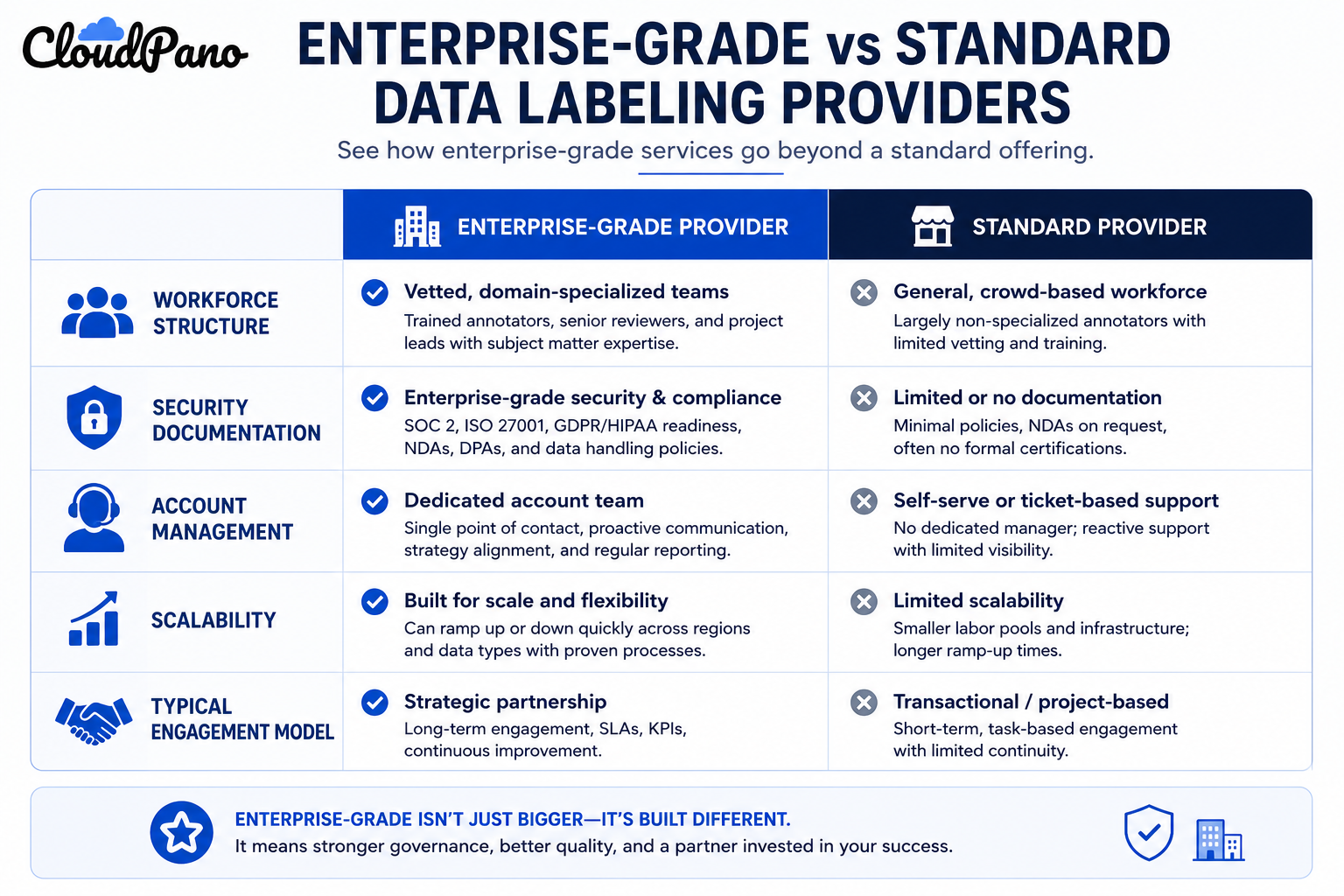
Comparison table of enterprise-grade vs standard data labeling providers

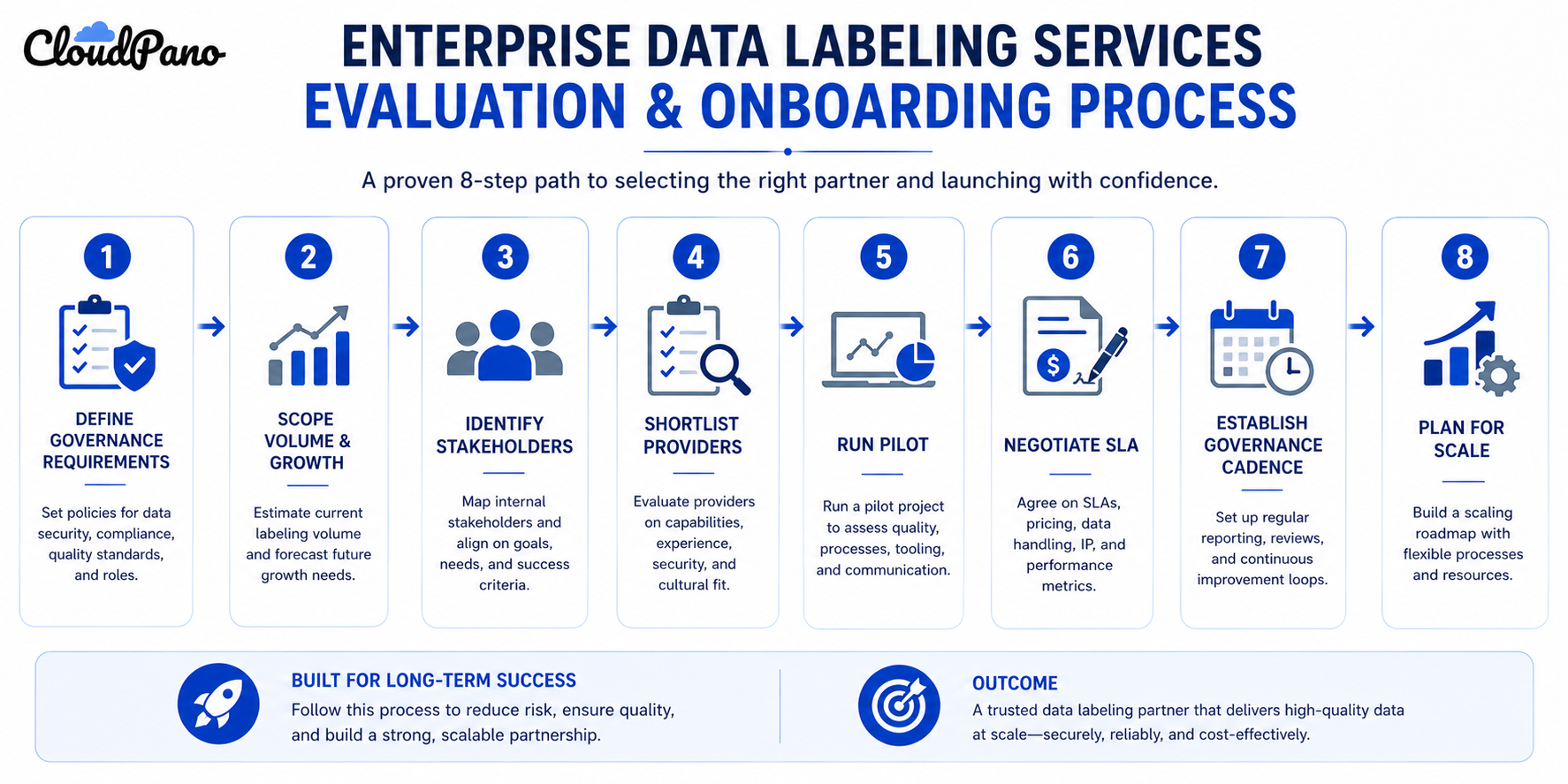
Step-by-Step Workflow for Getting Started

  1. Define your data governance requirements first. Before evaluating any provider, document your organization's security, compliance, and data residency requirements.
  2. Scope your actual volume and growth trajectory. Enterprise providers plan differently for a project growing from 100,000 to 5 million items than for a fixed, one-time volume.
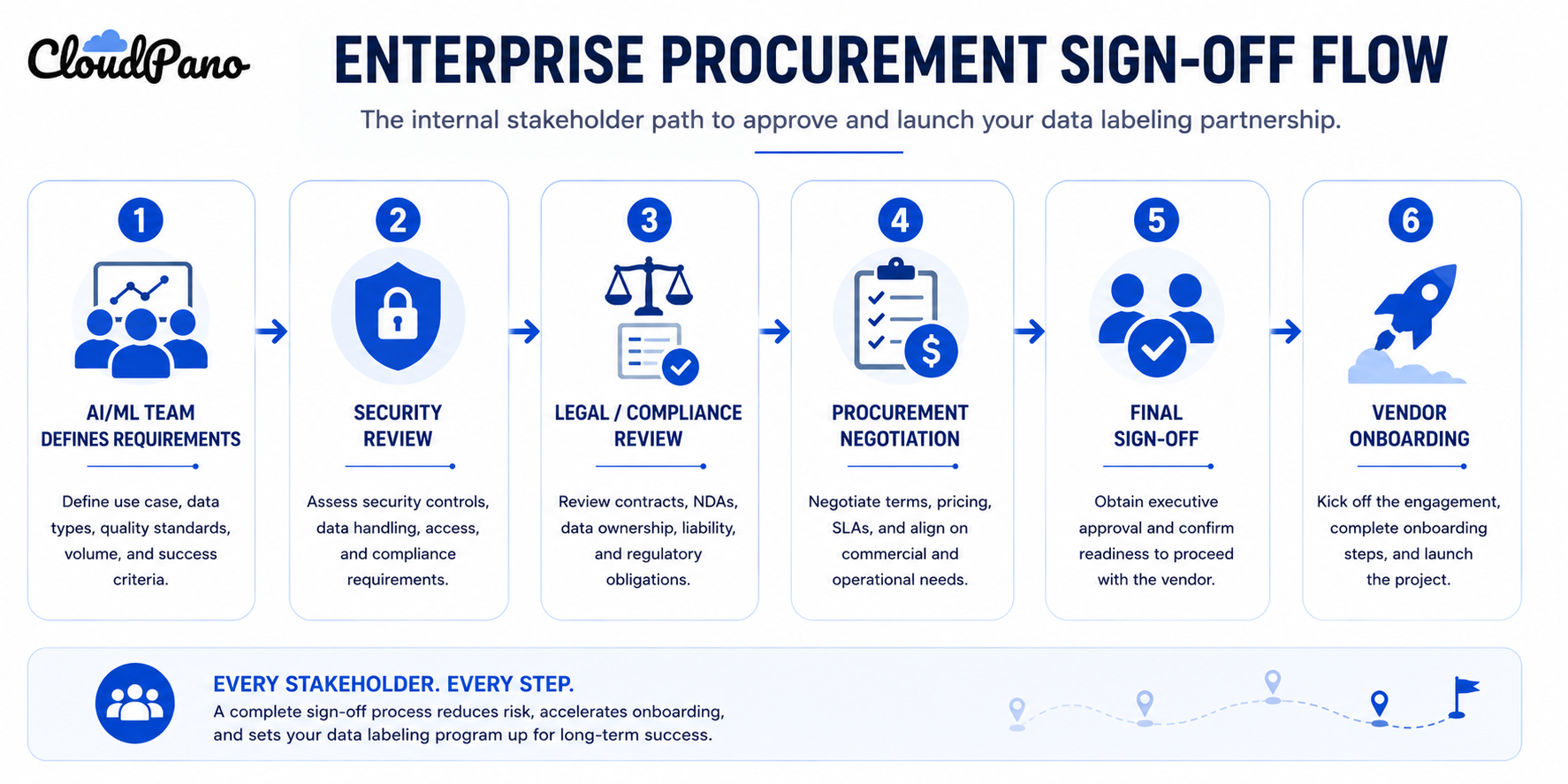
  3. Identify the right internal stakeholders. Procurement, legal, security, and the AI/ML team typically all need a voice in an enterprise-scale vendor decision.
  4. Shortlist providers based on documented enterprise capability. Look specifically for security certifications, account management structure, and references from organizations at a similar scale.
  5. Run a paid pilot with your actual data and taxonomy. Enterprise scale doesn't exempt a project from this step — if anything, it makes it more important.
  6. Negotiate an enterprise-grade SLA. Accuracy commitments, turnaround guarantees, security terms, and escalation paths should all be part of a written agreement, not a verbal understanding.
  7. Establish an ongoing governance cadence. Regular quality reviews, security audits, and account check-ins should be built into the relationship, not left to chance.
  8. Plan for scale from day one. Structure the engagement so throughput can grow without renegotiating the entire relationship every time volume changes.

Industry Use Cases

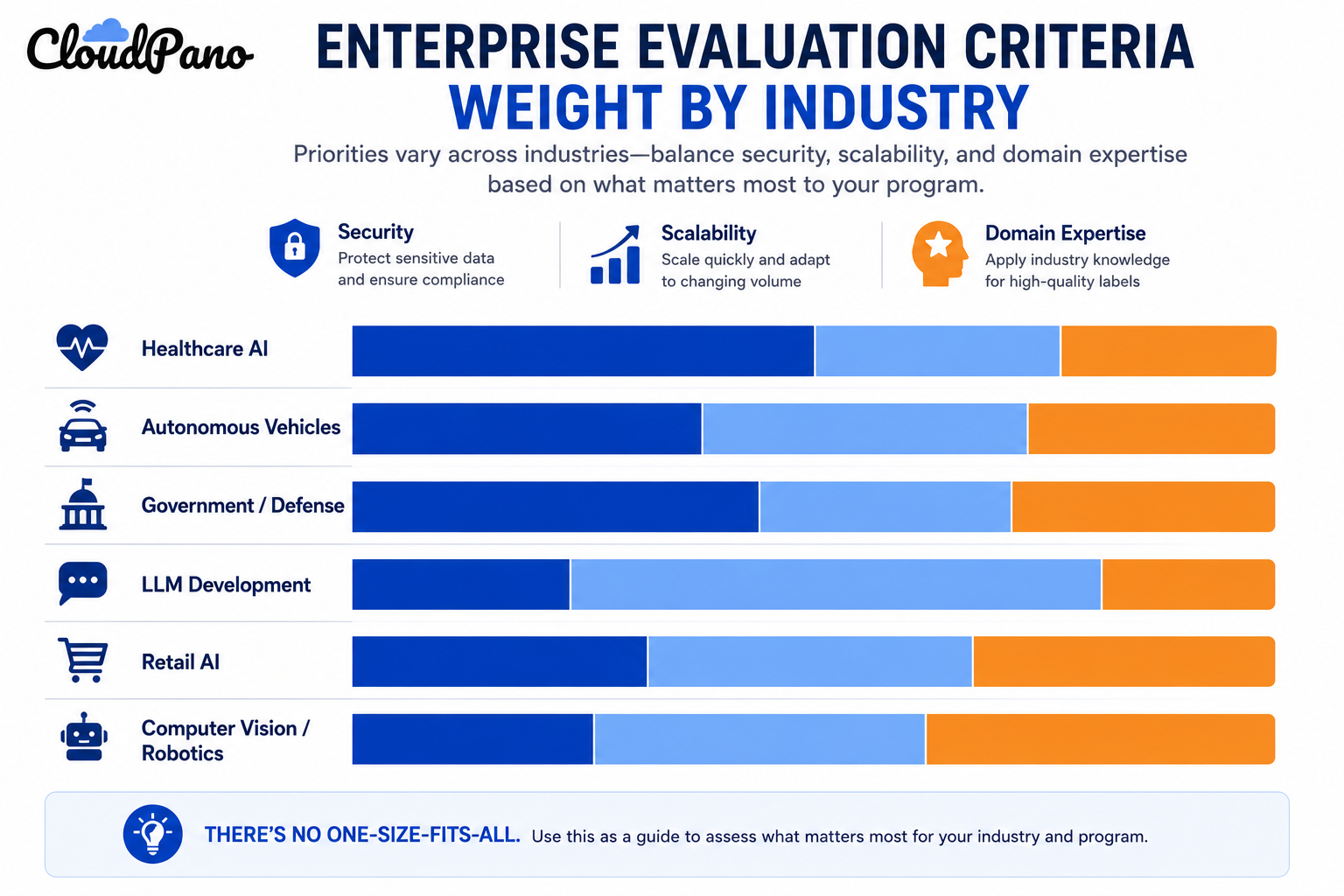
Bar chart showing enterprise data labeling evaluation priorities by industry
  • Computer vision / robotics: Enterprise programs typically need workforce networks large enough to sustain continuous, high-volume image and video annotation across long product development cycles.
  • Autonomous vehicles: Security, chain-of-custody documentation, and dedicated account management matter as much as raw throughput, given the safety and liability stakes involved.
  • Healthcare AI: Enterprise healthcare organizations typically require providers with clinical annotator networks and compliance documentation specific to patient data handling.
  • Retail AI: Large retail enterprises often need providers that can absorb seasonal volume spikes in product catalog labeling without a long ramp-up period.
  • LLM developers: Enterprise LLM programs frequently need dedicated teams trained specifically on a company's own preference and safety guidelines, maintained consistently across a long engagement.
  • Government & defense: Security clearance requirements and data residency constraints often narrow the enterprise provider field to a small, specifically vetted set of options.

Benefits of an Enterprise-Grade Data Labeling Services Provider

  • Consistency at scale. Dedicated account teams and workforce continuity reduce the quality variability that can come from rotating annotators across a long program.
  • Reduced compliance risk. Documented security certifications and data handling processes reduce the burden on internal legal and security teams during vendor onboarding.
  • Faster response to volume changes. Enterprise-grade workforce networks can typically absorb growth or seasonal spikes faster than a smaller-scale provider or an internal team.
  • Clearer accountability. A named account team and formal SLA make it easier to escalate issues and hold a provider to measurable commitments.
  • Reduced internal management burden. Managed data labeling at the enterprise level shifts day-to-day annotation operations off an internal team that would otherwise need to build that capacity from scratch.

Common Mistakes

Flowchart of the internal stakeholder sign-off path for enterprise data labeling procurement
  • Evaluating providers on price before governance fit. Skipping security and compliance review early, then discovering a preferred vendor can't meet requirements after significant time has already been invested.
  • Underestimating the internal stakeholder list. Leaving procurement, legal, or security out of the evaluation until late in the process, which can stall or reverse a decision that seemed finalized.
  • Assuming enterprise scale means less need for a pilot. Skipping a real pilot because the relationship "feels" more formal or vetted than a smaller vendor engagement.
  • Not planning for growth in the initial agreement. Structuring a contract around current volume only, then facing a renegotiation every time throughput increases.
  • Treating the SLA as a formality. Signing an agreement without specific, measurable accuracy and turnaround commitments written into it.
  • Assuming one dedicated account team eliminates the need for internal oversight. Reducing internal quality monitoring because a provider has a dedicated team, rather than maintaining independent audits.

Best Practices

  • Document data governance requirements before starting vendor conversations, not during them.
  • Include procurement, legal, security, and the AI/ML team in the evaluation from the start.
  • Treat the paid pilot as non-negotiable regardless of how established or well-referenced a provider is.
  • Build growth and scaling terms into the initial agreement rather than assuming they can be added later.
  • Maintain independent quality monitoring even with a dedicated account team and strong SLA in place.
  • Revisit the relationship on a regular cadence rather than assuming performance holds steady indefinitely. McKinsey's research on generative AI adoption notes that data readiness — including how enterprises structure and govern their annotation partnerships — remains one of the most consistently underestimated factors in AI program outcomes (McKinsey, "The economic potential of generative AI").

FAQ

What are data labeling services, in simple terms?

They're outsourced or managed offerings that provide the workforce, tooling, and quality assurance needed to apply labels or structure to raw data so a machine learning model can learn from it.

What makes a data labeling services provider "enterprise-grade"?

Documented security and compliance infrastructure, dedicated account management, workforce networks that scale with volume, and a formal SLA with measurable accuracy and turnaround commitments.

How is managed data labeling different from a component service?

Managed data labeling bundles workforce, tooling, and QA into a single offering with a provider handling day-to-day operations, while component services let an internal team retain more direct control over one or more of those elements.

What security considerations matter most for enterprise data labeling?

Data handling certifications, defined data residency options, access controls, audit trails, and contractual terms for data deletion after project completion.

How much do enterprise data labeling services typically cost?

Cost depends heavily on volume, data complexity, and the security or compliance requirements involved; [VERIFY] before citing specific enterprise pricing benchmarks, since these vary significantly by provider and industry.

Which internal teams should be involved in selecting a provider?

Procurement, legal, security, and the AI/ML team responsible for the project typically all need a voice, especially at organizations where data governance and vendor risk review are formal processes.

Do enterprise engagements still need a pilot before full rollout?

Yes. Scale and a provider's reputation don't substitute for verifying quality on your actual data and taxonomy — a pilot remains an essential step regardless of engagement size.

What's the difference between data labeling services and data annotation services at the enterprise level?

The terms are generally interchangeable; enterprise buyers should focus on what a provider actually includes — workforce, tooling, security, and account structure — rather than which term appears in their marketing.

Conclusion

Data labeling services at the enterprise level involve more than workforce and tooling — security posture, compliance documentation, dedicated account management, and scalability all become part of the evaluation. Getting a clear, neutral understanding of the category before talking to vendors makes it far easier to ask the right questions and avoid a decision driven by whichever provider pitched first.

🚀 Your All‑In‑One Virtual Experience Stack
🎬
PhotoAIVideo
Turn photos into scroll‑stopping AI videos.
Get Started →
🏡
Pictastic
Instantly stage listings with AI.
Try Staging →
🌀
CloudPano
Create stunning 360° tours in minutes.
Launch Tour →
💰
VirtualTourProfit
Build a profitable virtual tour business.
Learn More →
🤝
CloudPano Reseller
Resell AI visual software without building it.
Become a Reseller →
🚗
Auto CloudPano
Sell more vehicles with 360° experiences.
Explore Auto →
🖼️
AutoBackgrounding
Replace backgrounds instantly with AI precision.
Try it Now →
📐
3D Measure
Capture accurate floor plans & 3D measurements.
Measure Now →
🧠
AI Training Data
Custom AI training data services.
Learn More →
Share this post
Cloudpano

Choose The Right 360° Camera

Insta360 ONE RS 1-Inch 360 Edition

  • Compact, ready to go anywhere

  • Interchangeable lens that’s upgradeable

  • Dual 1-inch sensors for improved clarity and low light performance

  • Dynamic range and 6K 360° capture

  • 360° photo resolution at 21MP

Learn More

Insta360 X4

  • 8K 360° video recording for ultra-detailed visuals.

  • 4K single-lens mode for traditional wide-angle shots.

  • Invisible selfie stick effect for drone-like perspectives.

  • 2.5-inch touchscreen with Gorilla Glass protection.

  • Waterproof up to 33ft for underwater shooting.

Learn More

Ricoh Theta Z1

  • 360° photo resolution in 23MP

  • Slim design at 24 mm thick

  • Built-in image stabilization for smooth video capture.

  • Internal 19GB storage for photo and video storage.

  • Wireless connectivity for remote control and sharing.

Learn More

Ricoh Theta X

  • 60MP 360° still images for high-resolution photography.

  • 5.7K 360° video recording at 30fps.

  • 2.25-inch touchscreen for intuitive control.

  • USB Type-C port for fast charging and data transfer.

  • MicroSD card slot for expandable storage.

Learn More
Property Marketing
Allows potential buyers to explore properties in detail from anywhere, enhancing the real estate marketing process.
Automotive Spins
Create an interactive virtual showroom and engage affluent digital buyers with live 360º video calls, all through the CloudPano mobile app for a complete automotive sales solution.
Interactive Floor Plans
Create 2D and 3D floor plans with measurements in 4 minutes or less, all from your phone. Download the Floor Plan Scanner app and get your first scan free.

360 Virtual Tours With CloudPano.com. Get Started Today.

Try it free. No credit card required. Instant set-up.
Try it free
Latest posts

See our other posts

Interviews, tips, guides, industry best practices, and news.

What Are Data Labeling Services? A Complete Guide for Enterprise AI

Data labeling services are outsourced or managed offerings that provide the workforce, tooling, and quality assurance needed to turn raw data into labeled training data for machine learning. For enterprise AI teams, they typically add security certifications, dedicated account management, and volume-scalable workforce networks beyond what a smaller-scale provider offers.
Read post

How to Decide Between In-House and Outsourced Data Labeling

To decide between in-house and outsourced data labeling, answer four questions first: how sensitive is the data, how steady is your volume, how much internal management capacity do you have, and how fast do you need to scale. The answers point toward in-house, outsourced, or a hybrid model more reliably than cost alone.
Read post

Common Data Labeling Mistakes That Hurt Model Performance

The most common data labeling mistakes include inconsistent guidelines, skipping inter-annotator agreement checks, letting quality drift go unaudited, and treating automated pre-labeling as error-free. Each one degrades training data quality silently, showing up later as edge-case model failures that are difficult to trace back to their source.
Read post