Data Labeling Services: What They Include and How to Use Them Effectively

Cloudpano
July 18, 2026
5 min read
Share this post

Data Labeling Services: What They Include and How to Use Them Effectively

Searching for data labeling services usually means one of two things: a team is about to scope its first outside annotation project and doesn't fully know what's included, or an existing project has hit a volume or quality wall that internal resources can't clear.

Either way, the term covers more ground than most people assume going in. It's not just "people who label data" — a full offering includes workforce, tooling, quality assurance, and project management working together, and knowing what each piece actually does changes how you scope and evaluate a project.

Why It Matters

Labeled data is the direct input a model learns from, and problems introduced at the labeling stage don't announce themselves — they surface later as edge-case failures that are hard to trace back to their source. Google Research's "Data Cascades" study is one of the clearest documented accounts of how small, unaddressed data issues compound into expensive production problems (Sambasivan et al., Google Research).

NIST's AI Risk Management Framework treats data quality and provenance as foundational to trustworthy AI systems, which is a useful reminder that choosing and scoping data labeling services is a risk decision, not just a staffing one (NIST AI RMF).

The pace of AI deployment adds pressure here too. Stanford HAI's AI Index has tracked how quickly organizations are moving models from research into production (Stanford HAI, AI Index Report), and annotation capacity is frequently the constraint that determines whether a team hits that timeline.

How It Works

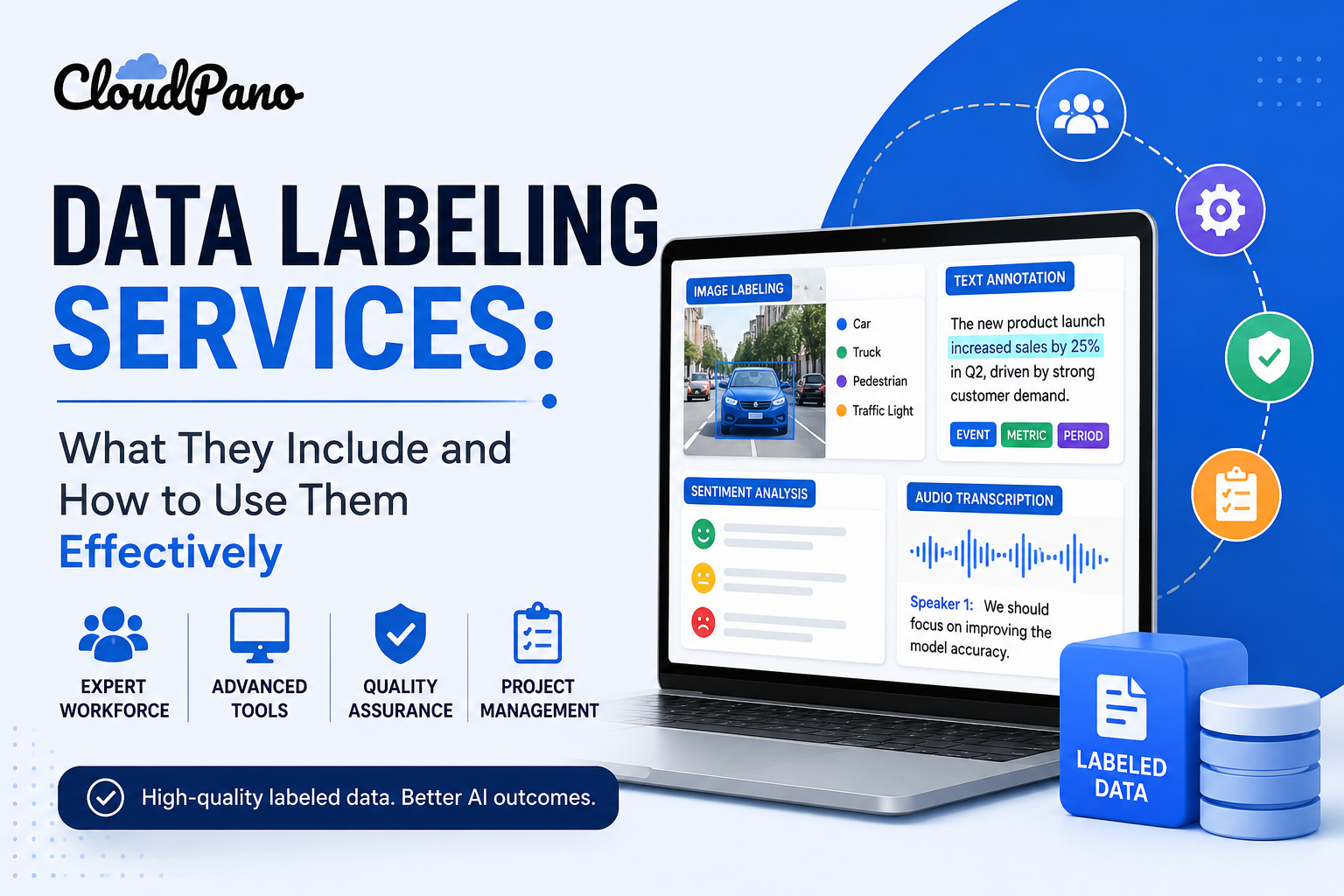
Most data labeling services are built from four components, and understanding how these workflows operate makes it much easier to evaluate what a provider is actually offering.
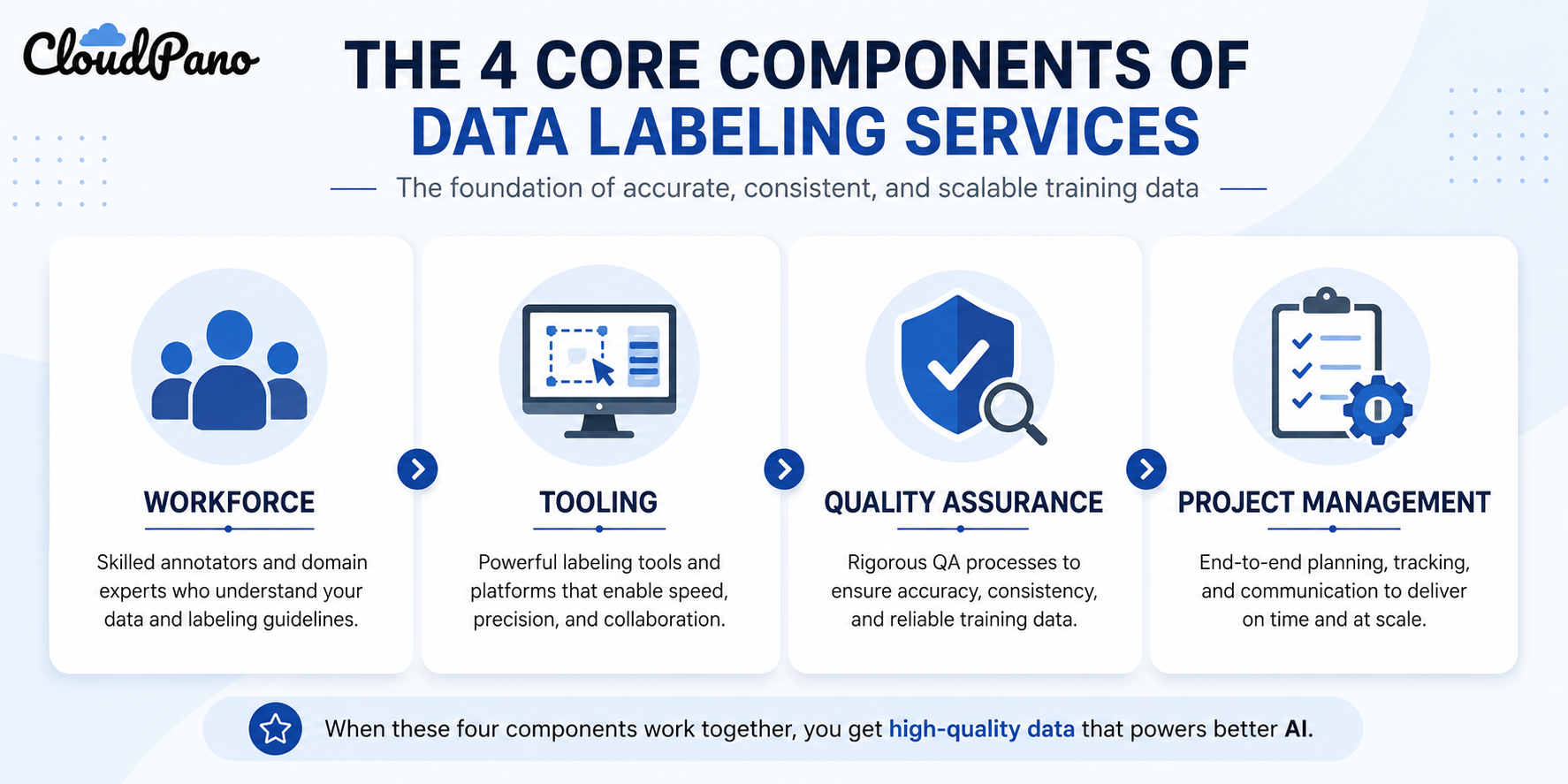
Workforce: Trained annotators — general-purpose, crowdsourced, or domain-specialized depending on the data type — who apply your taxonomy and guidelines to raw data.

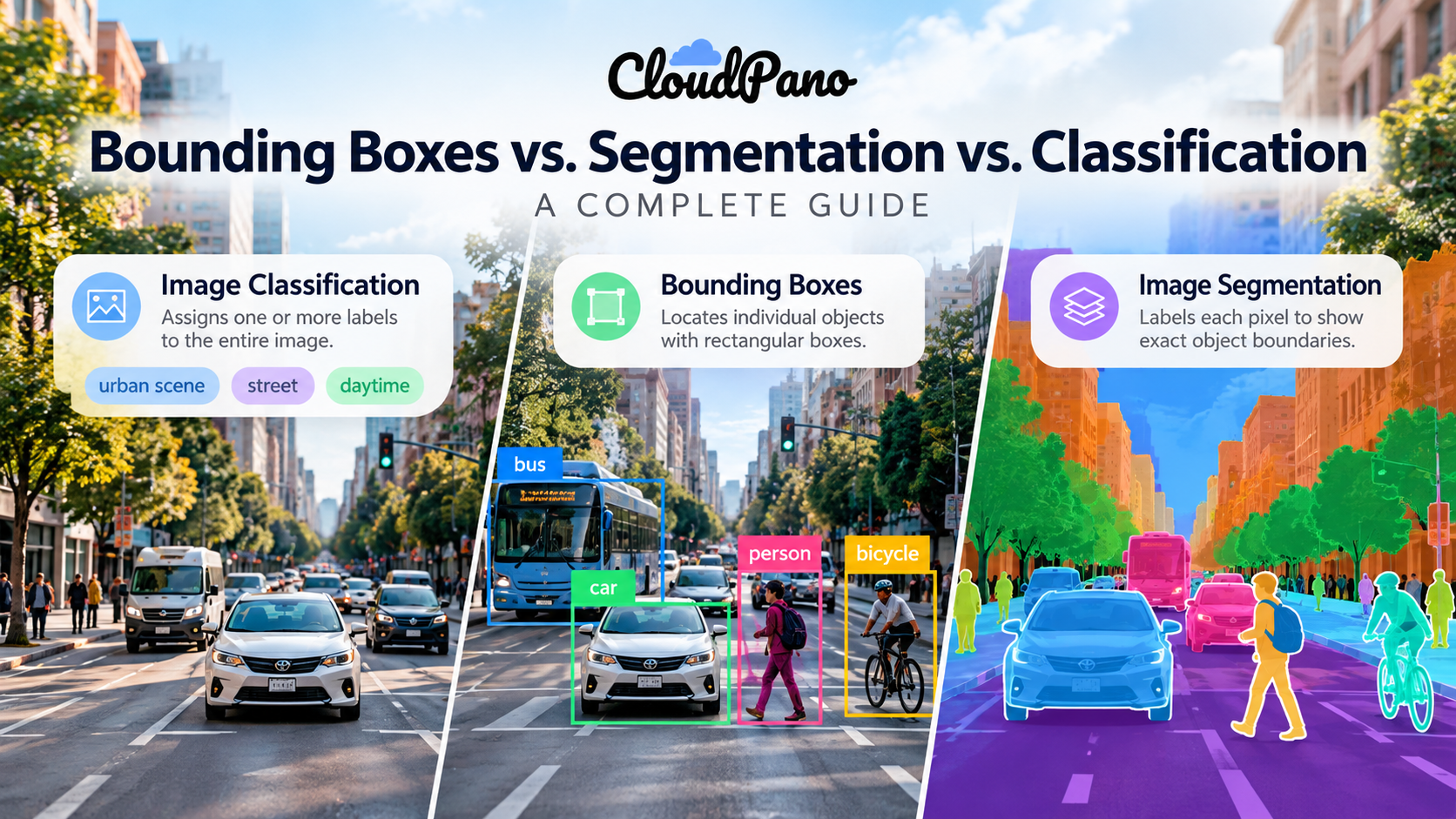
Tooling: The platform used for task assignment, annotation itself (bounding boxes, transcription, classification, etc.), and export in a format your model pipeline can consume.

Quality assurance: Consensus labeling, gold-standard test sets, inter-annotator agreement tracking, and audits — the processes that catch errors before they reach your model.

Project management: Someone coordinating taxonomy design, guideline revisions, throughput, and communication between your team and the annotation workforce, so you're not managing day-to-day labeling operations yourself.

Managed data labeling typically bundles all four into a single engagement, while some providers offer components à la carte — workforce only, or tooling only — for teams that want to run parts of the process themselves.
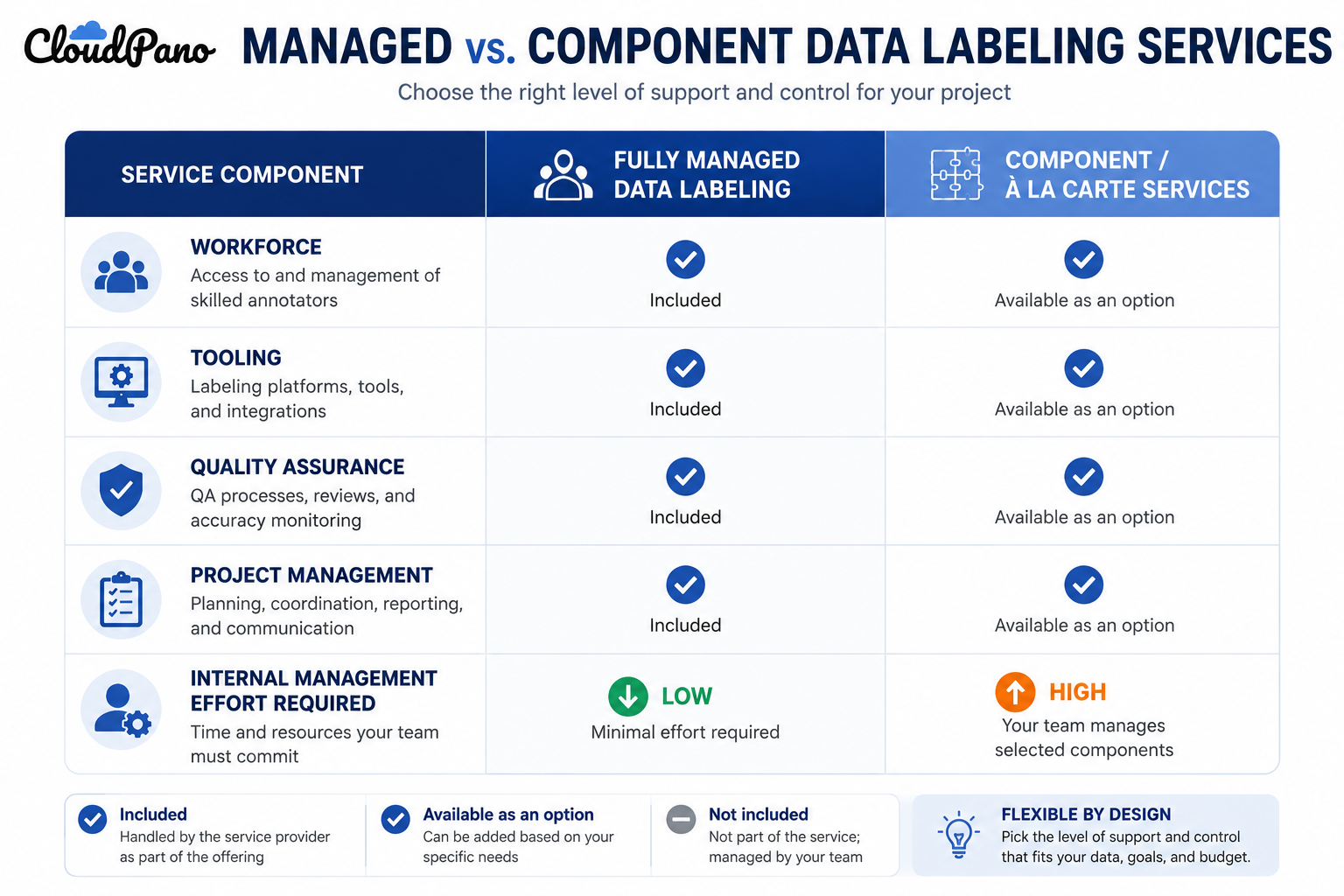
Comparison table of managed vs component data labeling services

Step-by-Step Workflow

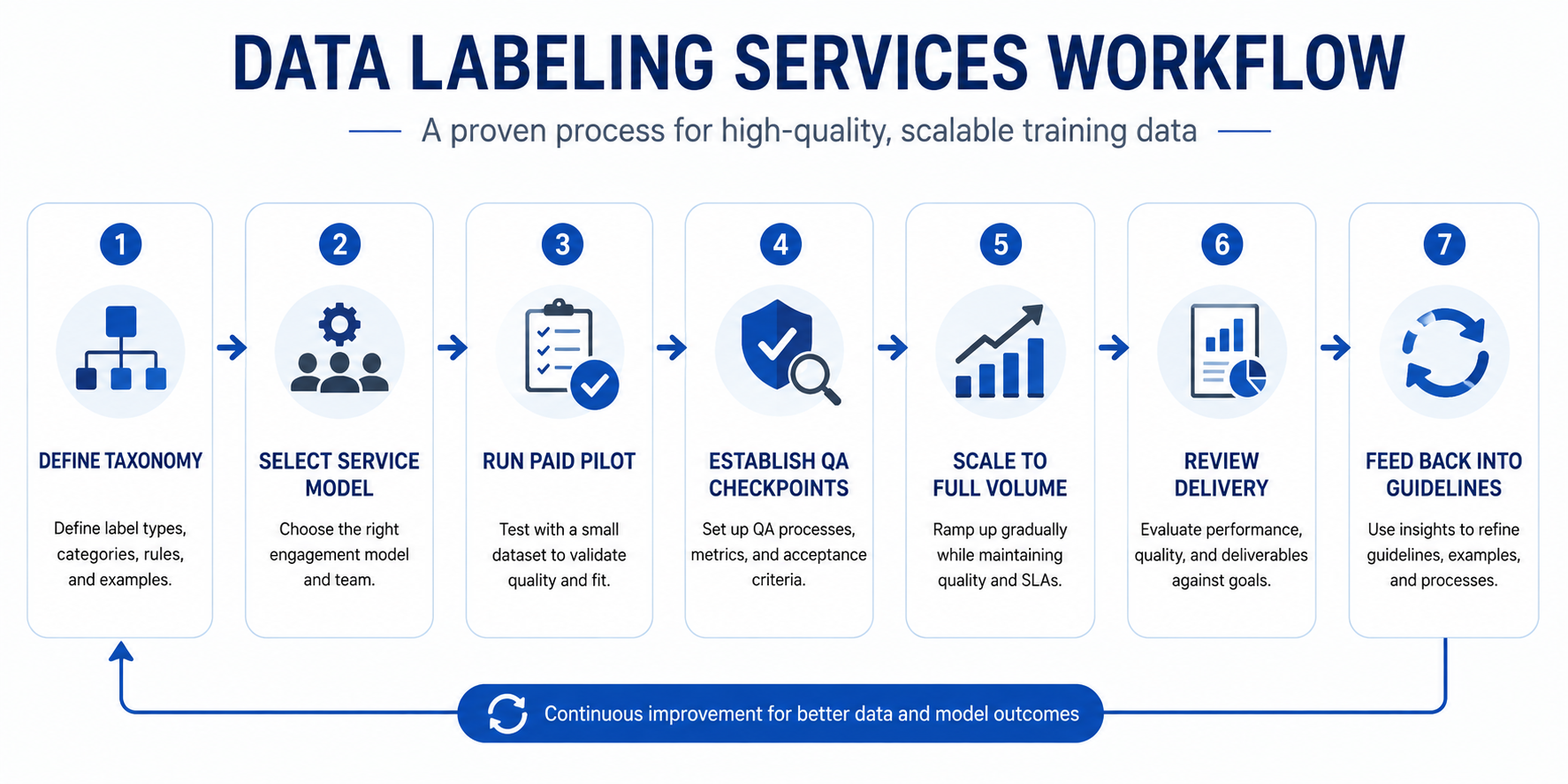
  1. Define your taxonomy and annotation guidelines. Be specific enough that two different annotators would label the same item the same way.
  2. Select the service model that fits your needs. Fully managed data labeling for end-to-end support, or component services if your team wants to retain more control.
  3. Run a paid pilot on your actual data. Before scaling to full volume, confirm quality and turnaround on a representative sample, not a vendor's demo dataset.
  4. Establish quality assurance checkpoints. Agree on gold-standard testing, consensus labeling thresholds, and audit frequency before the main labeling phase begins.
  5. Scale to full volume with a defined escalation path. Make sure disagreements and edge cases have a clear route to resolution, not an ad hoc one.
  6. Review delivered data against your acceptance criteria. Don't treat delivery as the final step — audit a sample before it enters your training pipeline.
  7. Feed corrections and edge cases back into guidelines. Treat every recurring issue as a signal to refine the taxonomy, not just a one-off fix.
Diagram of the data labeling services workflow from taxonomy to delivery

Industry Use Cases

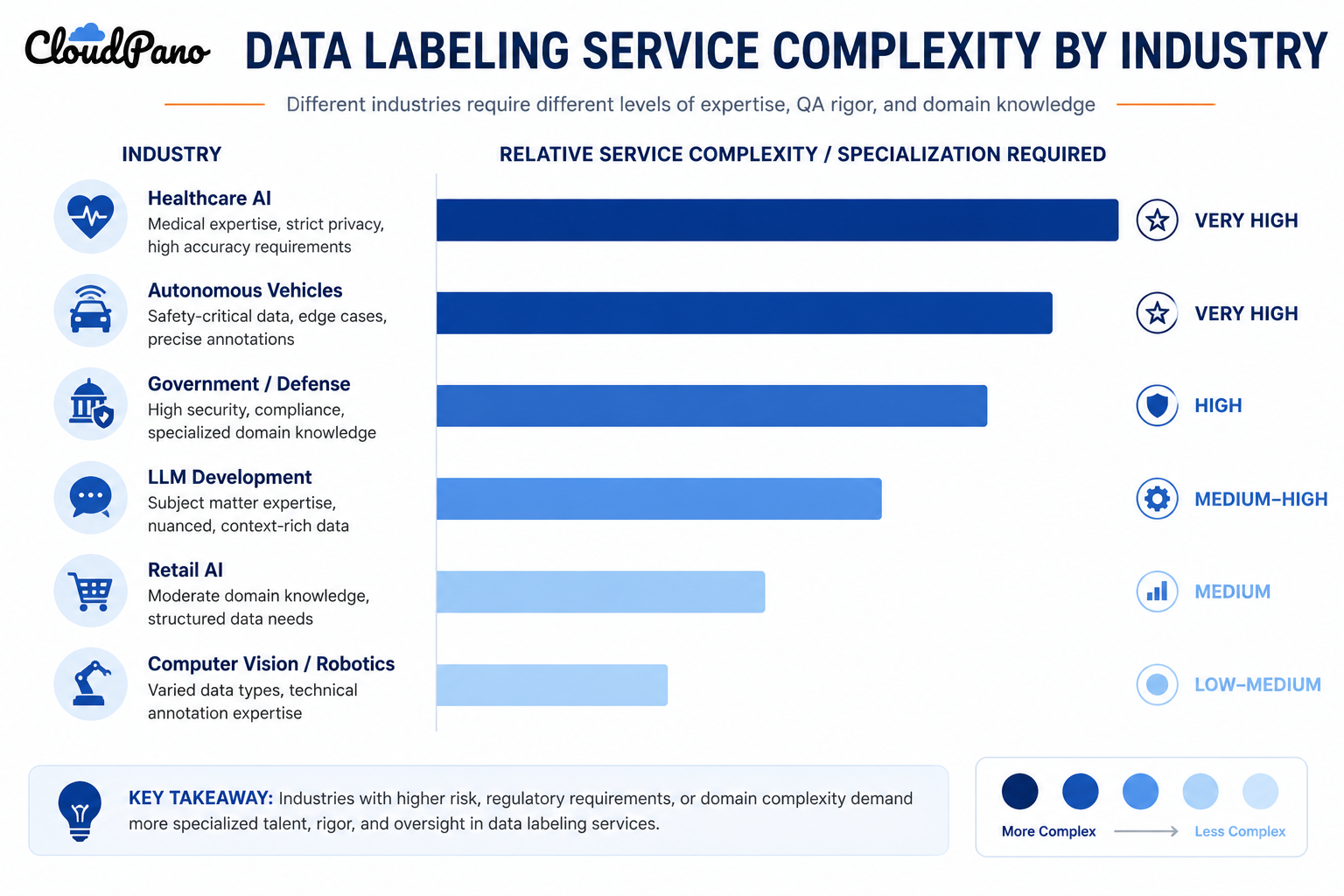
  • Computer vision / robotics: Bounding box, segmentation, and keypoint annotation at production volume, often the highest-volume use case for data labeling services.
  • Autonomous vehicles: Multi-pass, safety-critical annotation with strict QA requirements, where the service provider's escalation process matters as much as raw throughput.
  • Healthcare AI: Clinically trained annotators for diagnostic imaging and clinical text, where domain expertise and compliance are non-negotiable parts of the service.
  • Retail AI: High-volume product categorization and catalog tagging, where speed and cost efficiency typically outweigh the need for deep domain specialization.
  • LLM developers: Preference labeling, red-teaming, and instruction-following annotation — services requiring nuanced human judgment rather than straightforward classification.
  • Government & defense: Security clearance, data residency, and audit-trail requirements that narrow which providers are viable regardless of price or throughput.
Bar chart showing data labeling service complexity needs across industries

Benefits

  • Faster time to labeled data. A provider with existing trained workforce and tooling can ramp up faster than building an internal team from scratch.
  • Access to specialized expertise. Domain-trained annotators for clinical, technical, or safety-critical data that would be expensive to hire and train internally for a single project.
  • Built-in quality assurance. Established providers bring proven consensus labeling, gold-standard testing, and audit processes rather than requiring you to design QA from zero.
  • Scalability without proportional management overhead. Volume can scale up or down without your team having to hire, train, or manage annotators directly.
  • Freed-up internal capacity. Your team focuses on model development and evaluation instead of day-to-day annotation operations.

Common Mistakes

  • Assuming all data labeling services are equivalent. Workforce quality, tooling, and QA rigor vary significantly between providers, even at similar price points.
  • Skipping the pilot phase. Scaling straight to full volume without testing quality and turnaround on real data first is a common and costly mistake.
  • Not defining acceptance criteria upfront. Without agreed quality metrics, "done" becomes whatever the provider delivers, not what your model actually needs.
  • Treating delivery as the finish line. Skipping an independent audit of delivered data before it enters your training pipeline.
  • Underestimating onboarding time for specialized taxonomies. Complex guidelines take longer for any workforce — internal or outsourced — to learn than teams typically expect.
  • Ignoring data security requirements when selecting a provider. Assuming general compliance claims cover your specific regulatory needs without verifying them contractually.

Best Practices

  • Clarify exactly which of the four components — workforce, tooling, QA, project management — a provider includes before comparing pricing.
  • Always pilot on your actual data before committing to full-volume delivery.
  • Put quality assurance methodology and acceptance criteria in writing as part of the engagement, not as a verbal understanding.
  • Build a feedback loop so recurring issues in delivered data lead to guideline revisions, not just repeated corrections.
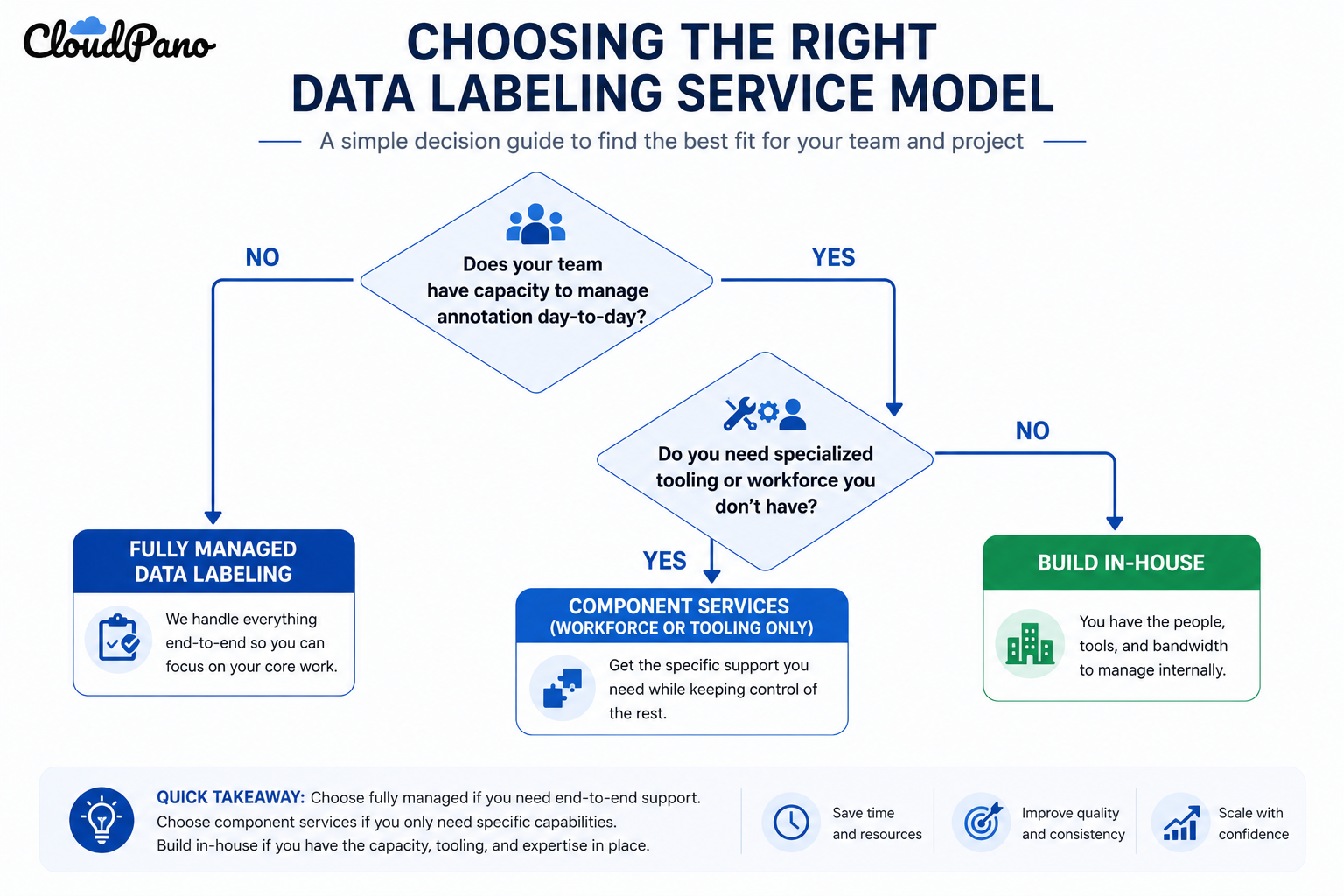
  • Match the service model — fully managed versus component services — to how much internal capacity your team actually has to manage the process.
  • Treat provider selection as an ongoing relationship to monitor, not a one-time decision. McKinsey's research on generative AI adoption notes that data readiness — including how organizations resource and manage annotation work — remains one of the most consistently underestimated bottlenecks to AI performance (McKinsey, "The economic potential of generative AI").

FAQ

What do data labeling services actually include?

A full offering typically includes a trained annotation workforce, tooling for task assignment and annotation, quality assurance processes like consensus labeling and audits, and project management to coordinate the work.

What's the difference between data labeling services and data annotation services?

The terms are largely used interchangeably in practice; both refer to the process of applying labels, tags, or structure to raw data so a machine learning model can learn from it.

What is managed data labeling?

It's a service model where a provider handles the full annotation process end-to-end — workforce, tooling, and QA — so your team defines requirements and reviews output rather than managing day-to-day labeling operations.

How do I know if I need data labeling services or should build in-house?

It depends on your data volume, sensitivity, and how much internal management capacity you have; steady, sensitive, or highly specialized data often favors in-house, while high-volume or variable projects often favor outsourced services.

How much do data labeling services cost?

Cost varies significantly by data type, task complexity, and required annotator expertise

How is quality assured in data labeling services?

Through methods like gold-standard test sets, consensus labeling on ambiguous items, inter-annotator agreement tracking, and rolling audits — ideally used together rather than relying on any single method alone.

Can data labeling services handle specialized or regulated data?

Yes, provided the provider has domain-trained annotators and documented compliance processes for your specific regulatory requirements — this should be verified before any sensitive data changes hands, not assumed.
Conclusion

Data labeling services work best when you understand exactly what's included before you scope a project — workforce, tooling, quality assurance, and project management aren't interchangeable, and skipping the diligence on any one of them tends to show up later as a quality problem in your training data.

🚀 Your All‑In‑One Virtual Experience Stack
🎬
PhotoAIVideo
Turn photos into scroll‑stopping AI videos.
Get Started →
🏡
Pictastic
Instantly stage listings with AI.
Try Staging →
🌀
CloudPano
Create stunning 360° tours in minutes.
Launch Tour →
💰
VirtualTourProfit
Build a profitable virtual tour business.
Learn More →
🤝
CloudPano Reseller
Resell AI visual software without building it.
Become a Reseller →
🚗
Auto CloudPano
Sell more vehicles with 360° experiences.
Explore Auto →
🖼️
AutoBackgrounding
Replace backgrounds instantly with AI precision.
Try it Now →
📐
3D Measure
Capture accurate floor plans & 3D measurements.
Measure Now →
🧠
AI Training Data
Custom AI training data services.
Learn More →
Share this post
Cloudpano

Choose The Right 360° Camera

Insta360 ONE RS 1-Inch 360 Edition

  • Compact, ready to go anywhere

  • Interchangeable lens that’s upgradeable

  • Dual 1-inch sensors for improved clarity and low light performance

  • Dynamic range and 6K 360° capture

  • 360° photo resolution at 21MP

Learn More

Insta360 X4

  • 8K 360° video recording for ultra-detailed visuals.

  • 4K single-lens mode for traditional wide-angle shots.

  • Invisible selfie stick effect for drone-like perspectives.

  • 2.5-inch touchscreen with Gorilla Glass protection.

  • Waterproof up to 33ft for underwater shooting.

Learn More

Ricoh Theta Z1

  • 360° photo resolution in 23MP

  • Slim design at 24 mm thick

  • Built-in image stabilization for smooth video capture.

  • Internal 19GB storage for photo and video storage.

  • Wireless connectivity for remote control and sharing.

Learn More

Ricoh Theta X

  • 60MP 360° still images for high-resolution photography.

  • 5.7K 360° video recording at 30fps.

  • 2.25-inch touchscreen for intuitive control.

  • USB Type-C port for fast charging and data transfer.

  • MicroSD card slot for expandable storage.

Learn More
Property Marketing
Allows potential buyers to explore properties in detail from anywhere, enhancing the real estate marketing process.
Automotive Spins
Create an interactive virtual showroom and engage affluent digital buyers with live 360º video calls, all through the CloudPano mobile app for a complete automotive sales solution.
Interactive Floor Plans
Create 2D and 3D floor plans with measurements in 4 minutes or less, all from your phone. Download the Floor Plan Scanner app and get your first scan free.

360 Virtual Tours With CloudPano.com. Get Started Today.

Try it free. No credit card required. Instant set-up.
Try it free
Latest posts

See our other posts

Interviews, tips, guides, industry best practices, and news.

Matterport vs CloudPano Storage & Hosting Costs Compared

Storage and hosting are where virtual tour platforms quietly diverge in cost — long after the sales call is over. Here's how Matterport and CloudPano actually compare once your tour library starts to grow.
Read post

Matterport vs CloudPano: Full Comparison Guide

Matterport and CloudPano solve the same basic problem, but they're built around different priorities — one leans on brand familiarity, the other on flexibility and predictable scaling. Here's how they actually compare once you look past the marketing.
Read post

Data Labeling Services: What They Include and How to Use Them Effectively

Data labeling services combine a trained workforce, annotation tooling, and quality assurance processes to turn raw data into labeled training data for machine learning models. They typically cover project management, taxonomy design, annotation, review, and delivery — either as a full managed offering or an à la carte component.
Read post