


.png)


Most people evaluating matterport vs cloudpano storage don't start there — they start by comparing headline plan prices. Storage and hosting only become the real conversation later, usually around the time a bill arrives that's higher than expected, or a warning appears saying you're approaching a storage cap. If you're trying to understand what actually drives cost over time rather than what's advertised on a pricing page, this is the part of the comparison that matters most.
That's because virtual tour platforms don't really sell you software — they sell you ongoing storage and delivery of 3D content, which behaves more like a utility than a one-time purchase. And utilities are exactly where pricing structures quietly diverge.
A monthly plan price is easy to compare across vendors. Hosting costs virtual tour platforms in ways that are much harder to compare at a glance, because the real cost depends on how each company treats your library as it grows — not just what a single tour costs to host today.
Matterport's model has historically tied plan tiers to the number of "active" spaces you're hosting, with storage consumption factoring into which tier you need. This creates a specific pattern: every new tour you produce adds to your footprint, and older tours don't automatically shrink your bill just because they're rarely viewed. If your business produces tours regularly — real estate listings, retail walkthroughs, hospitality spaces — this can mean your storage footprint, and therefore your bill, keeps climbing even for content that's no longer actively driving business value.
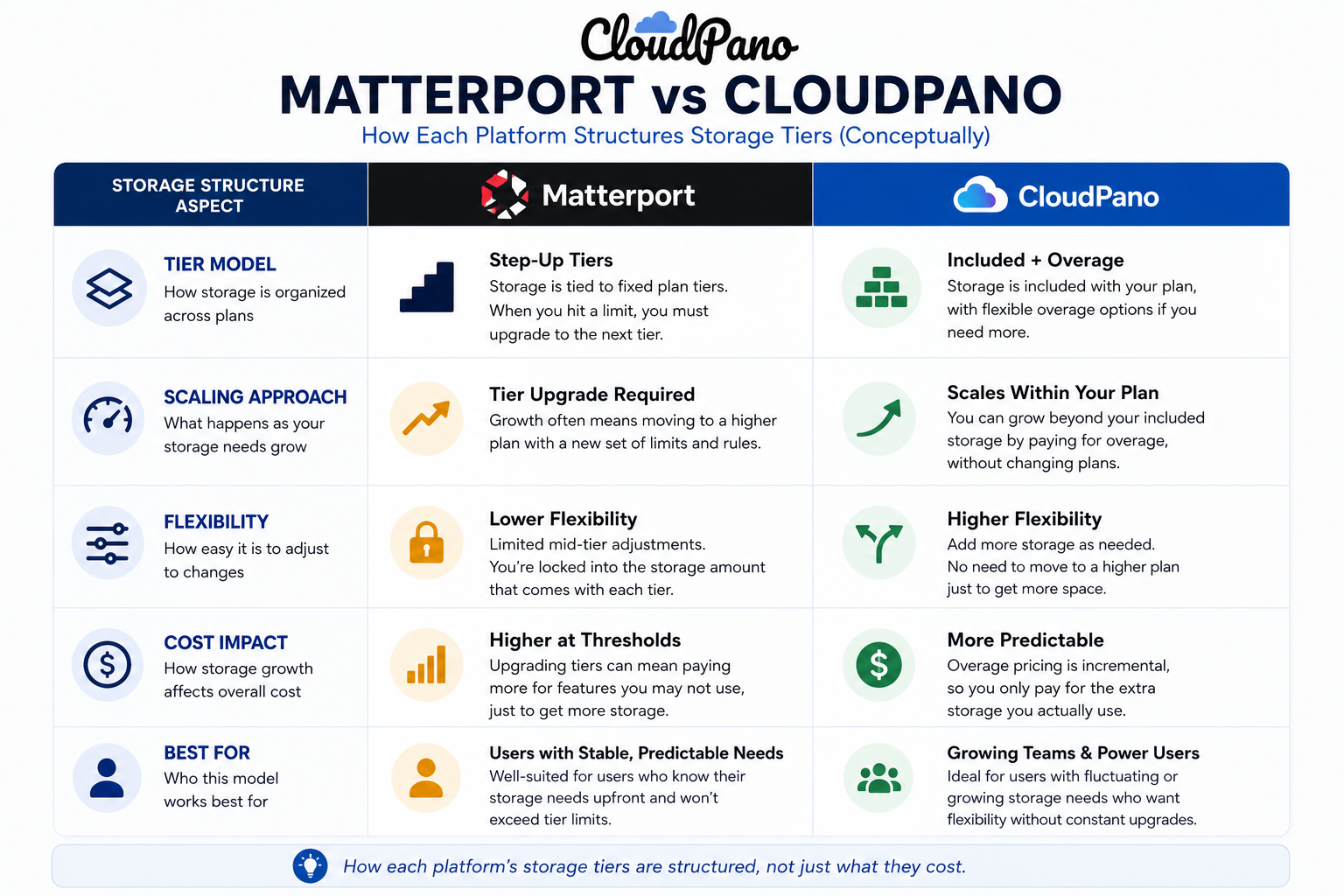
CloudPano's approach has generally been built around clearer thresholds for what's included at each tier, without the same penalty for holding onto older content. For businesses with a large or constantly growing library, this tends to produce a more predictable cost curve rather than one that climbs steadily regardless of whether older tours are still useful.
Matterport storage limits are usually expressed as a cap tied to your plan tier, with additional cost (or a forced upgrade) once you exceed it. The practical issue isn't the existence of a limit — every platform has some version of one — it's how predictably that limit interacts with your actual usage pattern.
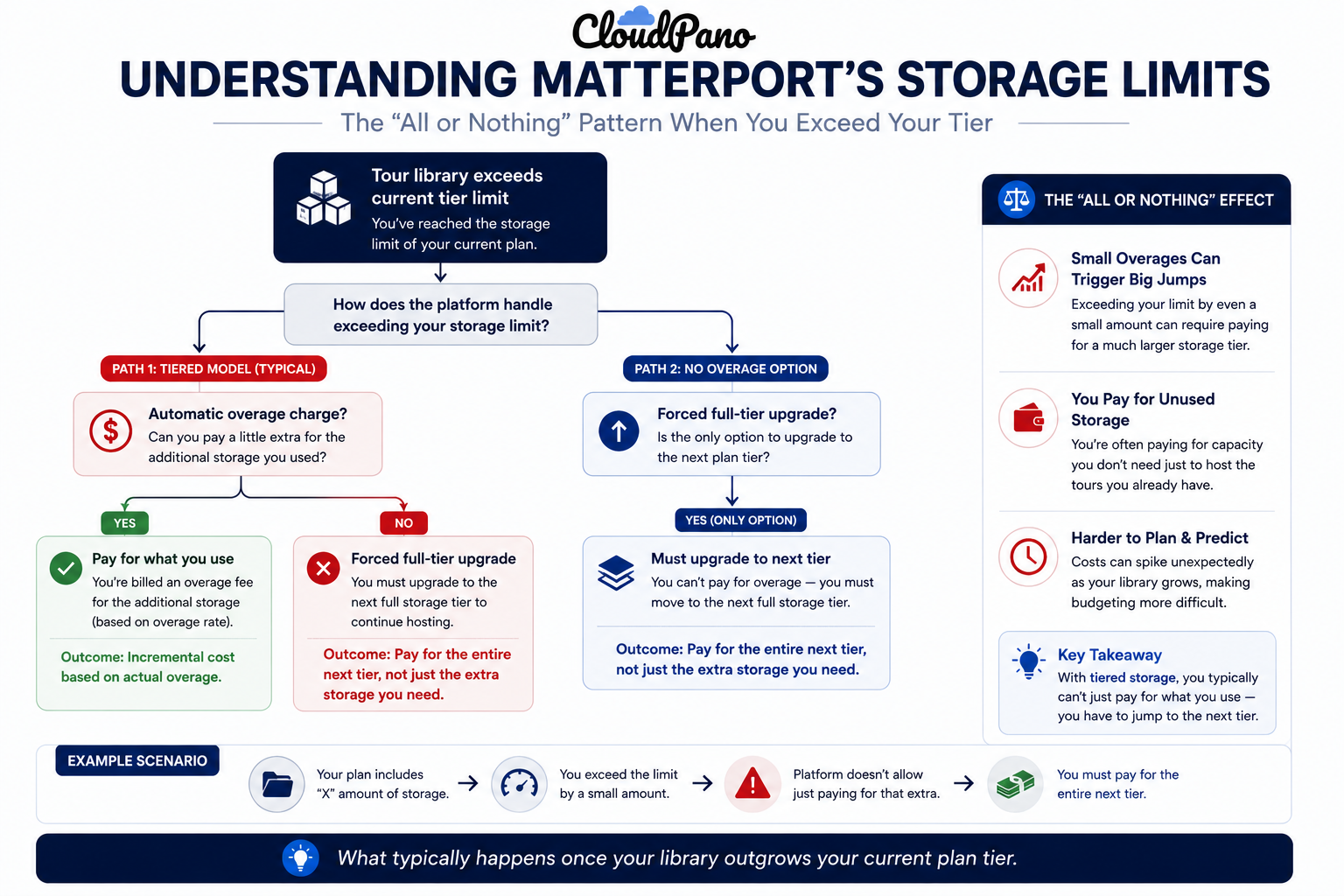
A business producing a handful of tours a year rarely bumps against these limits. A business producing tours weekly, or an agency hosting tours on behalf of multiple clients, is much more likely to hit a ceiling — and the resulting upgrade often comes with a jump to the next full tier, rather than a smaller incremental charge for the extra storage actually used. This "all or nothing" tier structure is one of the more common frustrations referenced in independent reviews on G2's virtual tour software category page, where reviewers describe needing to upgrade a full plan tier just to accommodate a modest increase in tour volume.
Storage is only half the equation — the other half is cloudpano bandwidth and delivery: what it costs to actually serve a tour to a visitor, especially at scale or with high-traffic properties.
This matters more than it might seem. A tour embedded on a high-traffic listing page, or shared widely on social media, can generate meaningfully more bandwidth usage than a tour that only gets a handful of views. Platforms differ in whether that bandwidth is bundled generously into a plan, metered separately, or capped with overage fees. CloudPano has generally positioned bandwidth as bundled more generously across its tiers, which matters most for businesses whose tours get real traffic rather than sitting mostly unseen.
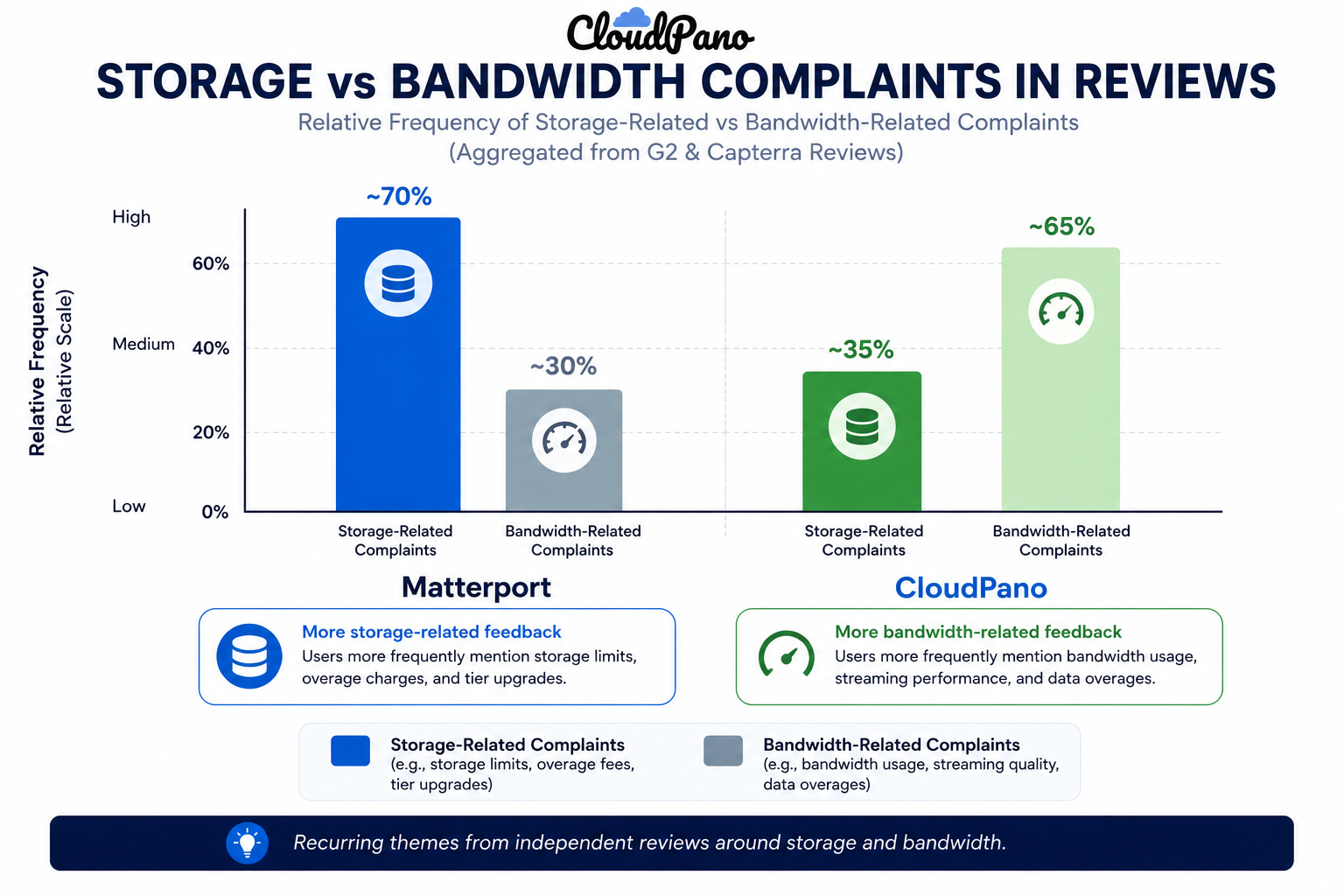
Capterra's virtual tour software listings are a useful place to cross-check this — not for any single review, but for spotting whether "bandwidth" or "overage fees" come up repeatedly across multiple reviewers for a given platform, which is a stronger signal than an isolated complaint.
The clearest way to see the difference is to stop thinking in terms of a single tour and start thinking in terms of a library. A single tour's hosting cost is rarely the issue — the issue is what happens to your total bill as that single tour becomes ten, then fifty, then whatever your business needs a year from now.
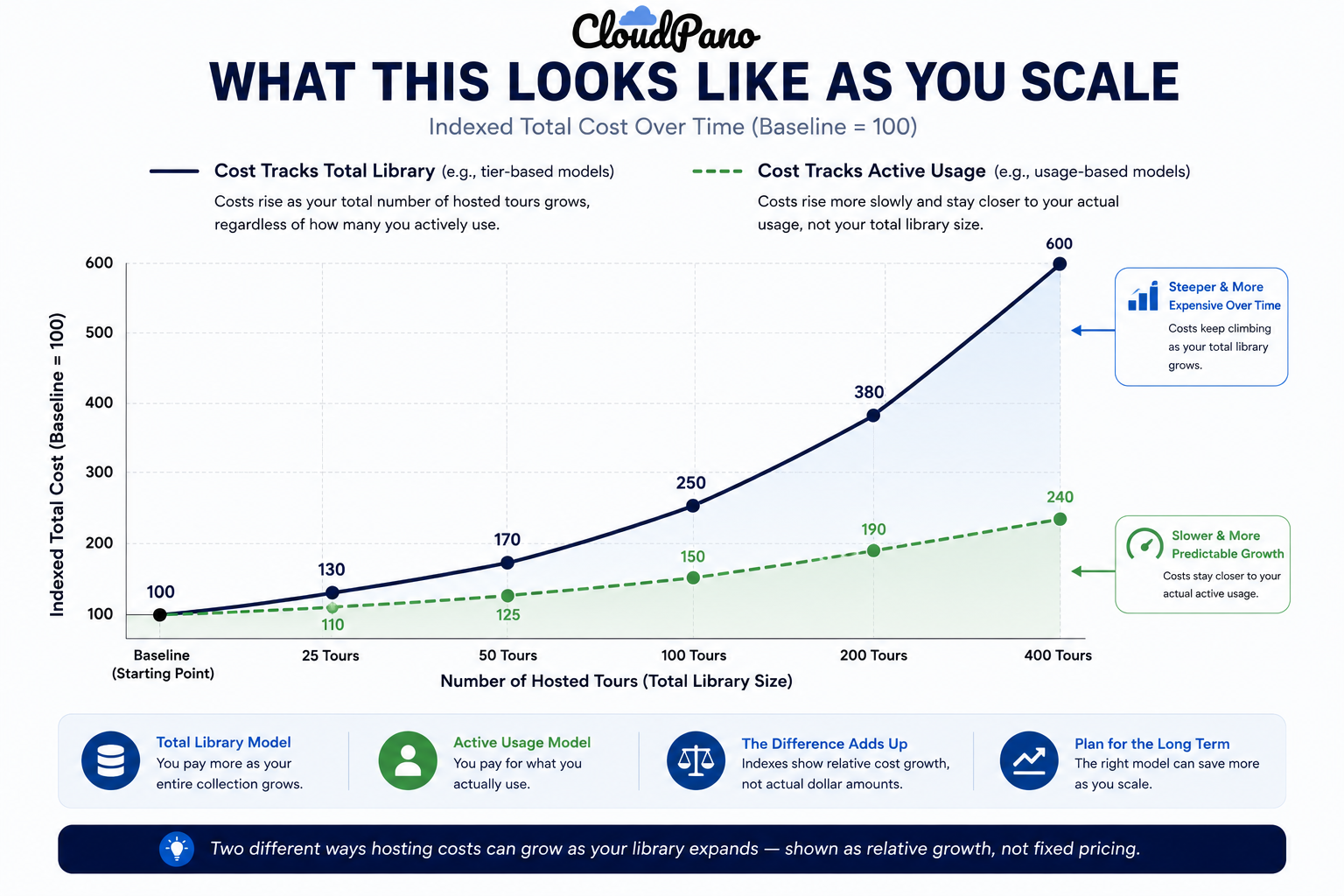
Under a model where every additional tour adds ongoing storage cost regardless of how often it's viewed, your bill effectively grows in step with your total historical output, not your current active workload. Under a model with more generous bundled storage and clearer thresholds, your bill tends to track more closely with your actual current usage. Neither structure is objectively wrong, but they represent very different bets depending on whether your business produces tours steadily over time or in occasional bursts.
It's worth reading the actual overage language in each platform's terms, not just the headline tier description, because this is where hosting costs virtual tour businesses don't expect tend to appear. Some platforms charge overage per additional unit of storage used past your tier; others simply block further uploads or force a tier upgrade until you're back under the cap. The difference matters a lot depending on how your business operates — a per-unit overage charge is predictable and scales gradually, while a hard block or forced upgrade can arrive at an inconvenient moment, like the week before a big client presentation.
Similarly, when checking matterport storage limits against your own usage, don't just look at the total cap — look at how the platform handles the transition once you're near it. A platform that warns you well in advance and offers a small incremental add-on is a very different experience from one that only notifies you after you've already been blocked from uploading a new tour.
The same applies on the delivery side. If cloudpano bandwidth allowances are bundled generously per tier, a short-term traffic spike (a listing going viral, a press mention) is far less likely to trigger an unexpected charge than it would be under a strictly metered bandwidth model. This is worth testing directly, if possible, rather than taking either company's marketing language at face value — ask support what happens, specifically, during a traffic spike.
"Won't switching mean I lose my existing hosted tours?"
This is the most common hesitation, and it deserves a direct answer: no, not automatically, but it does require a deliberate migration step rather than assuming tours carry over on their own. This is worth planning for rather than worrying about — a dedicated migration walkthrough (linked below) covers exactly what transfers and what needs to be rebuilt.
"Isn't more storage always better, regardless of cost?"
Not necessarily. Unlimited-sounding storage claims are only meaningful if the underlying bandwidth and delivery terms don't quietly cap what you can actually do with that storage. It's worth asking directly what happens once you exceed typical usage, rather than assuming "unlimited" means unlimited in every dimension.
Before deciding anything based on this article or any vendor's pricing page, run your own numbers:
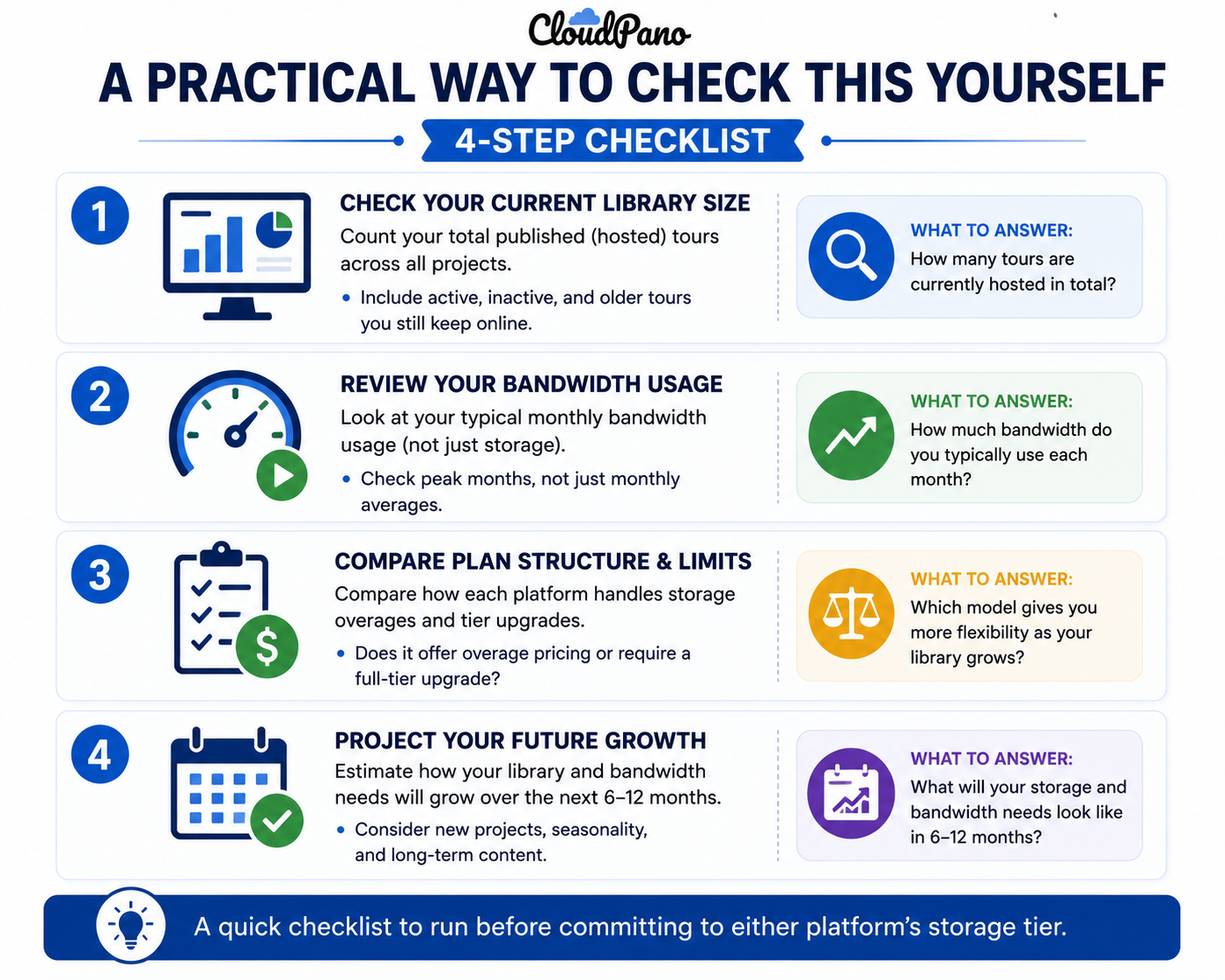
Community discussion threads on r/realtors and r/Matterport are also worth a skim — real users tend to mention storage frustrations specifically when a tier upgrade catches them off guard, which is exactly the scenario worth anticipating in advance.
Storage and hosting costs are the part of a virtual tour platform decision that's hardest to evaluate upfront and most likely to surprise you later. Matterport's tier structure tends to tie cost growth closely to your total accumulated library. CloudPano's approach has generally aimed for a more predictable relationship between what you're actually using and what you're paying.
If your tour library is growing steadily, or if you're managing tours across multiple clients or properties, it's worth running a free CloudPano trial with your own content specifically to see how storage and bandwidth are handled in practice — not just how they're described on a pricing page. If you're also weighing whether to migrate existing tours, our migration guide walks through exactly what transfers and what doesn't.


Compact, ready to go anywhere
Interchangeable lens that’s upgradeable
Dual 1-inch sensors for improved clarity and low light performance
Dynamic range and 6K 360° capture
360° photo resolution at 21MP

8K 360° video recording for ultra-detailed visuals.
4K single-lens mode for traditional wide-angle shots.
Invisible selfie stick effect for drone-like perspectives.
2.5-inch touchscreen with Gorilla Glass protection.
Waterproof up to 33ft for underwater shooting.

360° photo resolution in 23MP
Slim design at 24 mm thick
Built-in image stabilization for smooth video capture.
Internal 19GB storage for photo and video storage.
Wireless connectivity for remote control and sharing.

60MP 360° still images for high-resolution photography.
5.7K 360° video recording at 30fps.
2.25-inch touchscreen for intuitive control.
USB Type-C port for fast charging and data transfer.
MicroSD card slot for expandable storage.
.png)

.png)

Try it free. No credit card required. Instant set-up.






.svg)


.svg)