


.png)


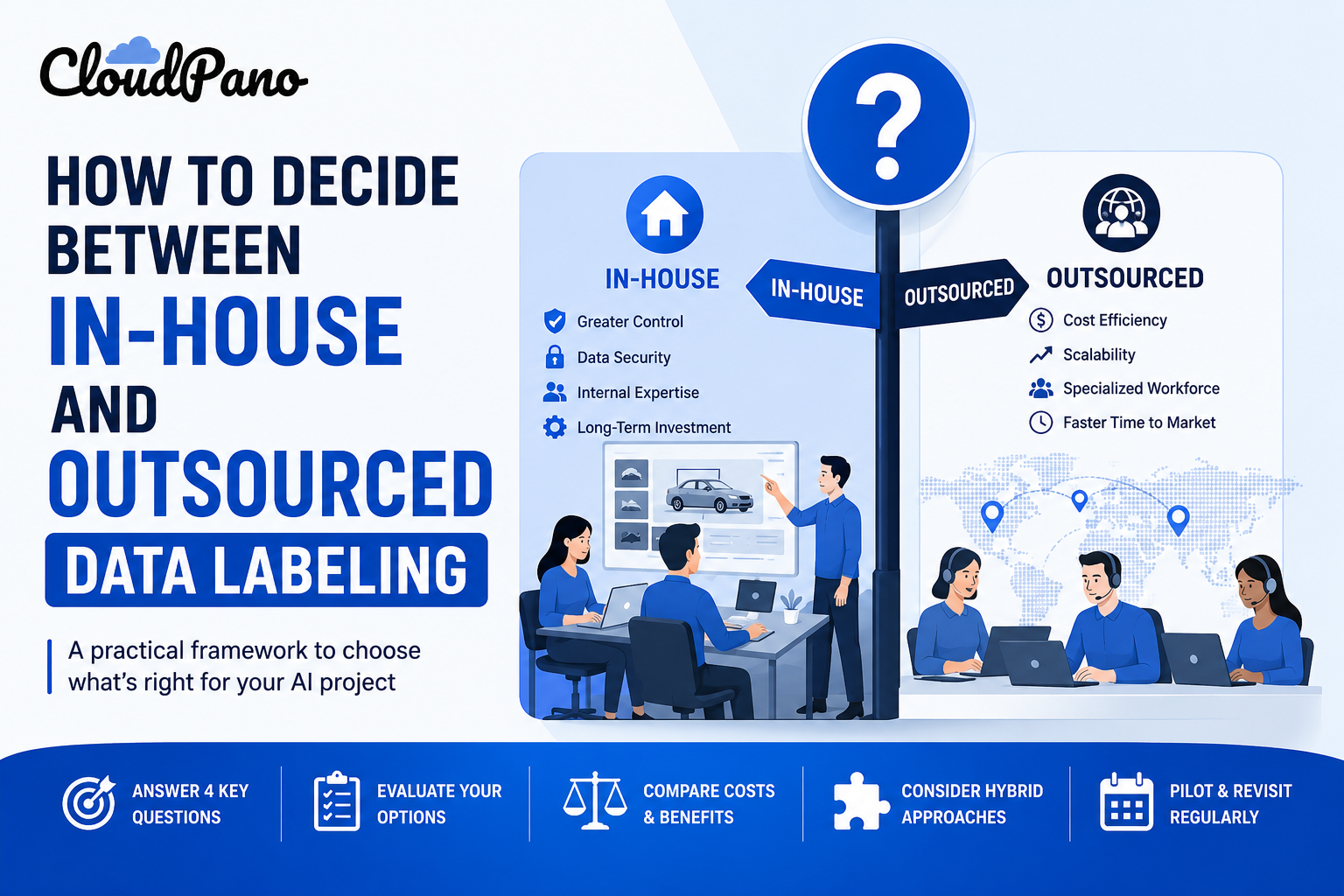
Most teams facing the in-house vs outsourced data labeling decision already understand the general trade-offs — control versus scale, fixed cost versus variable cost. Understanding the trade-offs isn't the hard part. Applying them to an actual project, with a real deadline and a real dataset, is.
This isn't another rundown of pros and cons. It's a framework: four questions, answered honestly about your specific situation, that point toward a decision instead of leaving you circling the same list of trade-offs indefinitely.
A slow or indecisive labeling decision has a real cost — every week spent debating in-house versus outsourced is a week your model timeline slips. But a fast decision made on the wrong criteria (usually price alone) carries a different cost: quality problems that surface only after a model is already in training.
Google Research's "Data Cascades" study documented how small, unaddressed data quality issues compound silently into expensive, hard-to-trace production failures — a pattern that applies whether the flawed process was built in-house or outsourced (Sambasivan et al., Google Research).
NIST's AI Risk Management Framework treats data quality and provenance as foundational to trustworthy AI, which is a useful reminder that this decision isn't purely about speed or cost — it has real implications for how defensible your model's behavior is later (NIST AI RMF).
Timing pressure is real too. Stanford HAI's AI Index has tracked how quickly organizations are moving models from research into production (Stanford HAI, AI Index Report), which is exactly why a clear decision framework matters more than an exhaustive trade-off analysis when a project is already on the clock.
The decision comes down to four questions, and how you answer them determines whether in-house data labeling, outsourced data labeling services, or a hybrid model fits best. Understanding how these workflows operate in practice helps you answer each question with more than a guess.
Question 1 — How sensitive or specialized is the data? Highly regulated, proprietary, or technical data often needs domain expertise and tighter control that favor keeping work in-house, or outsourcing only to a narrowly vetted specialized vendor.
Question 2 — How steady is your volume? Predictable, ongoing volume can justify the fixed cost of an in-house team. Spiky, project-based, or uncertain volume usually favors the variable cost structure of outsourcing.
Question 3 — How much internal management capacity do you have? In-house annotation adds a real management function — someone has to own hiring, training, and QA. If nobody on your team can absorb that, outsourcing shifts that burden to a vendor.
Question 4 — How fast do you need to scale? Outsourced data labeling services can typically ramp workforce faster than internal hiring, which matters when a project's timeline doesn't allow for months of recruiting and training.
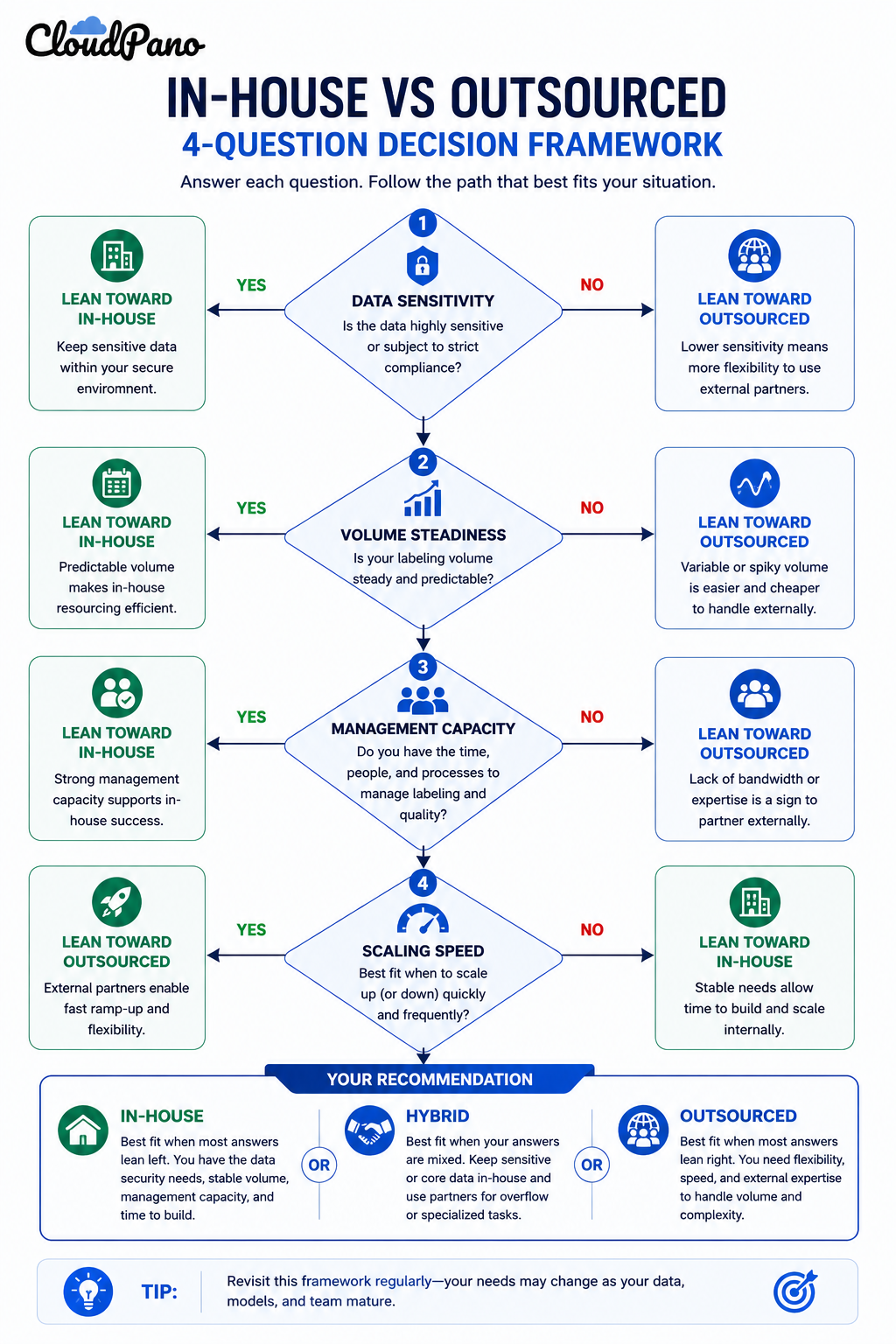
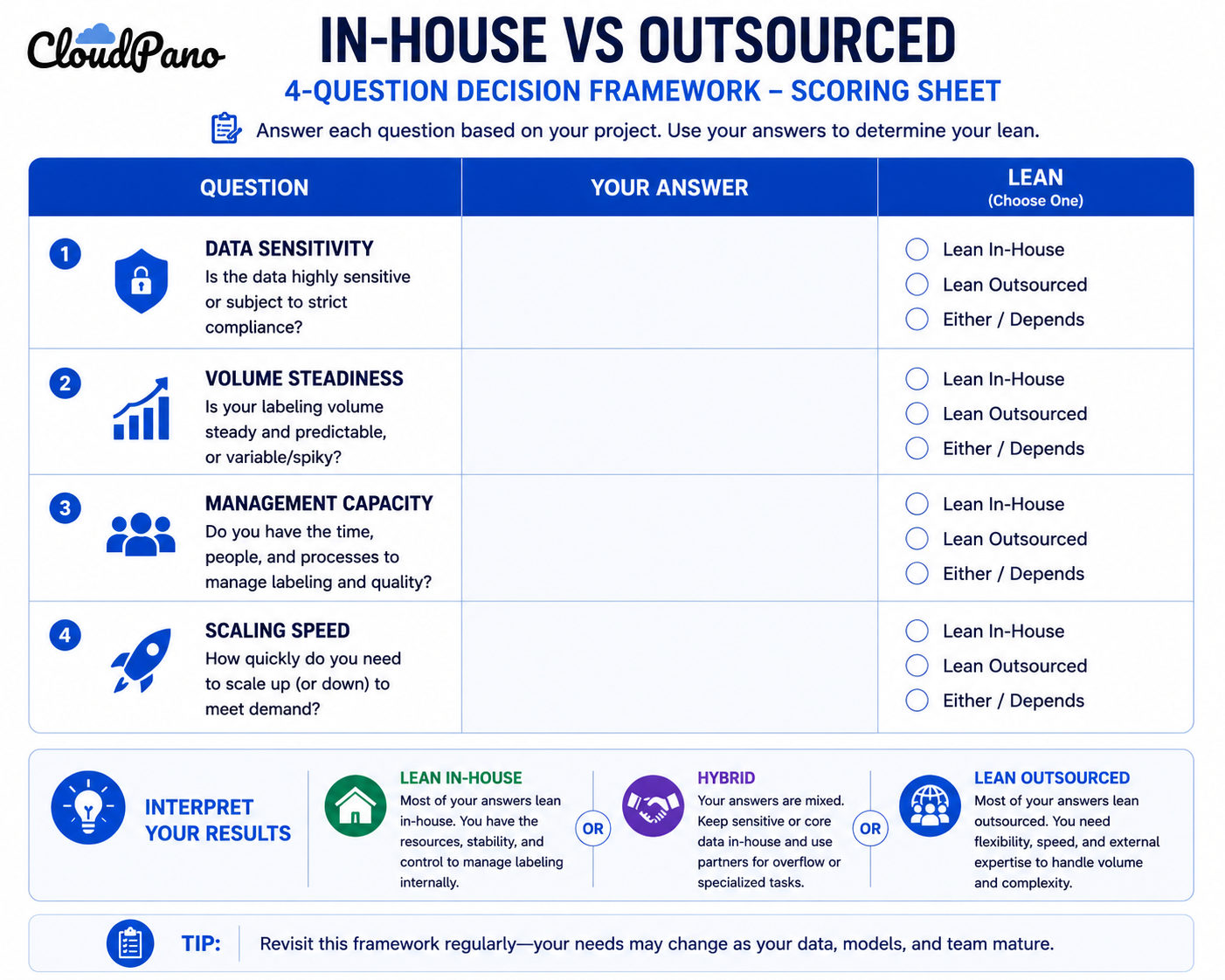
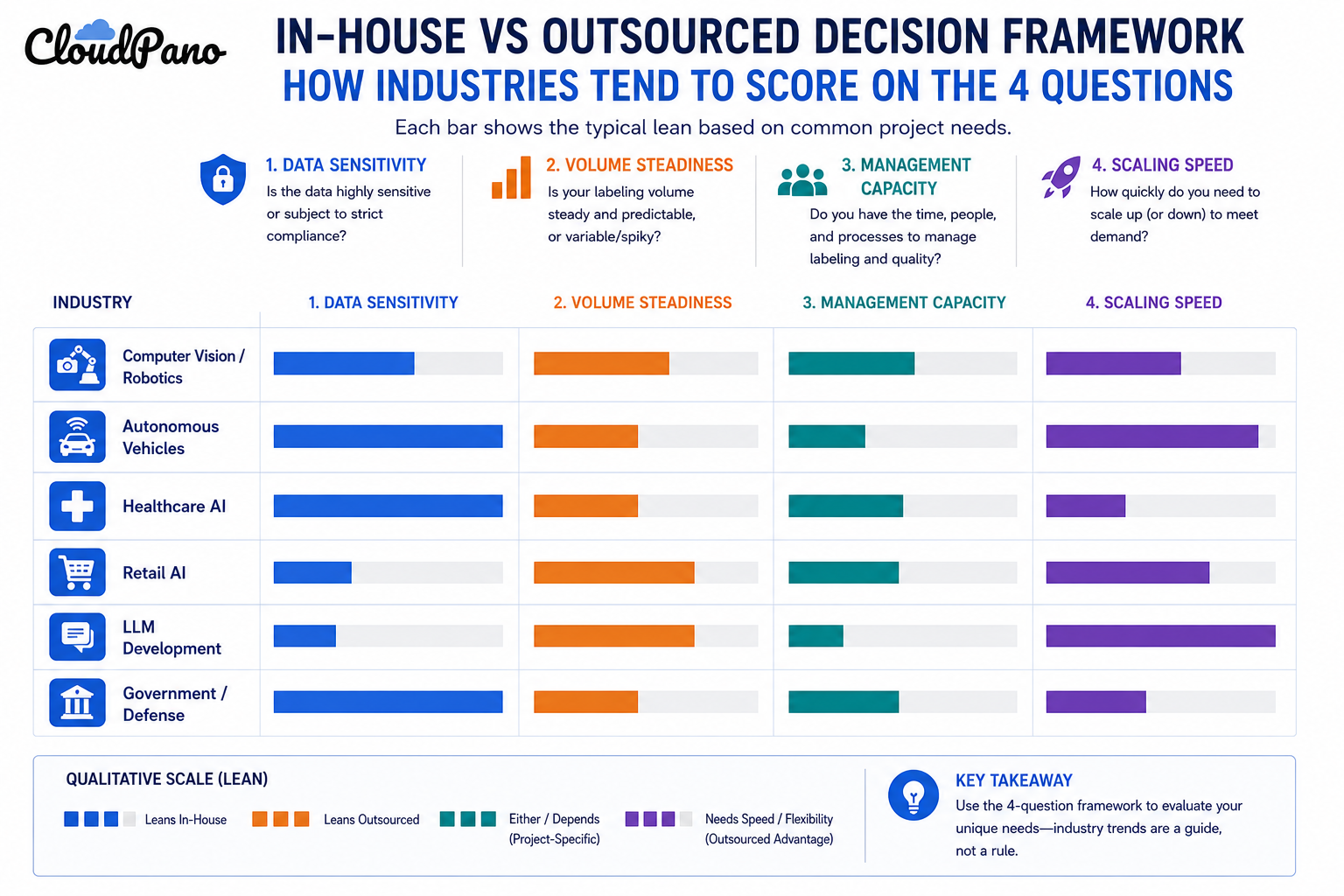
How sensitive or specialized the data is, how steady your annotation volume is, how much internal management capacity you have, and how fast you need to scale — these four questions typically outweigh cost alone in determining the right fit.
No. Cost matters, but data labeling costs alone don't account for data sensitivity, management overhead, or how quickly you need to scale, all of which can outweigh a lower quoted rate if ignored.
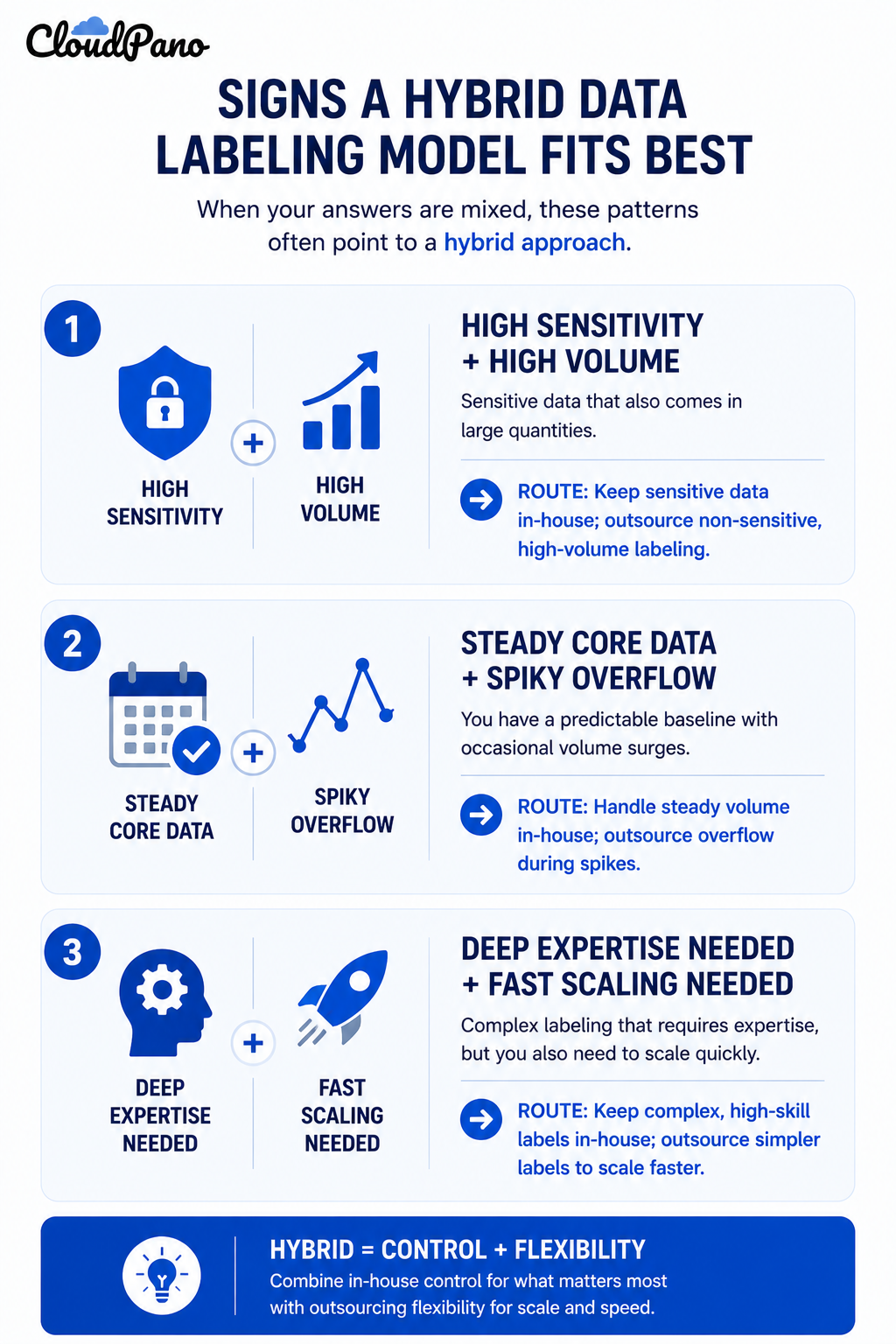
That's usually a signal that a hybrid model — keeping sensitive or high-stakes data in-house while outsourcing higher-volume, lower-ambiguity work — is a better fit than forcing a strict either/or choice.
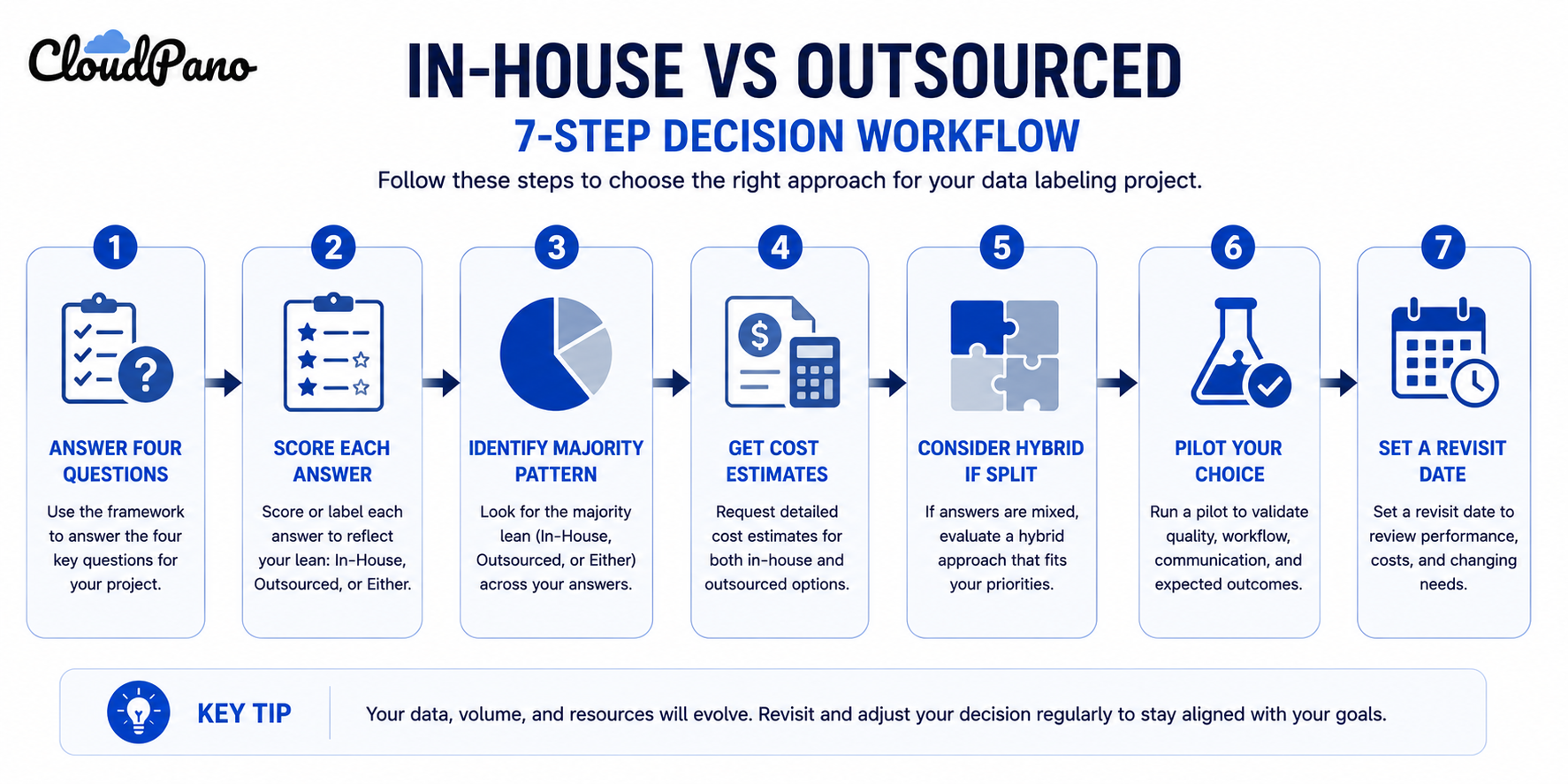
Set a specific date or volume threshold to revisit it, since data sensitivity, volume, and your team's management capacity can all shift enough over a project's life to change the right answer.
No, provided you build clear guidelines and quality assurance commitments into the vendor relationship; quality gaps in outsourced work usually stem from insufficient oversight rather than outsourcing itself.
Include salaries, benefits, management time, tooling, and ramp-up time for hiring and training, not just an hourly labeling rate; [VERIFY] before citing a specific dollar benchmark, since this varies significantly by role, region, and data type.
Decide first using the framework, then pilot whichever approach it points to on real data before committing to full-scale volume — the framework tells you which direction to test, not a guarantee of quality.
Deciding between in-house and outsourced data labeling gets easier once it stops being an open-ended trade-off discussion and becomes four concrete questions about your data, your volume, your team's capacity, and your timeline. Most teams find the answer points clearly enough to move forward — and when it doesn't, that's usually the signal that a hybrid model is the real answer.


Compact, ready to go anywhere
Interchangeable lens that’s upgradeable
Dual 1-inch sensors for improved clarity and low light performance
Dynamic range and 6K 360° capture
360° photo resolution at 21MP

8K 360° video recording for ultra-detailed visuals.
4K single-lens mode for traditional wide-angle shots.
Invisible selfie stick effect for drone-like perspectives.
2.5-inch touchscreen with Gorilla Glass protection.
Waterproof up to 33ft for underwater shooting.

360° photo resolution in 23MP
Slim design at 24 mm thick
Built-in image stabilization for smooth video capture.
Internal 19GB storage for photo and video storage.
Wireless connectivity for remote control and sharing.

60MP 360° still images for high-resolution photography.
5.7K 360° video recording at 30fps.
2.25-inch touchscreen for intuitive control.
USB Type-C port for fast charging and data transfer.
MicroSD card slot for expandable storage.
.png)

.png)

Try it free. No credit card required. Instant set-up.




.svg)


.svg)