Common Data Labeling Mistakes That Hurt Model Performance
Cloudpano
July 19, 2026
•
5 min read
Share this post
Common Data Labeling Mistakes That Hurt Model Performance
Most data labeling mistakes don't announce themselves. A model doesn't fail loudly the day a labeling guideline goes stale — it just quietly underperforms on a specific edge case months later, long after anyone remembers the guideline was ever ambiguous.
That delay is what makes labeling mistakes expensive. By the time they surface as a model problem, they're buried in a dataset that's difficult and costly to re-audit, and nobody's first instinct is to go back and check the labels.
Why It Matters
A model can't learn a distinction its training data never captured correctly, and inconsistent or wrong labels teach it the wrong distinction with just as much apparent confidence as a correct label would. Google Research's "Data Cascades" study documented this pattern directly — small, unaddressed data issues compounding silently until they surface as expensive, hard-to-trace production failures (Sambasivan et al., Google Research).
NIST's AI Risk Management Framework treats data quality as foundational to trustworthy AI, not a downstream concern to revisit after a model is already deployed — which is exactly backwards from how most teams discover labeling mistakes in practice (NIST AI RMF).
The pressure to move quickly makes this worse. Stanford HAI's AI Index has tracked how fast organizations are pushing models from research into production (Stanford HAI, AI Index Report), and that pace is exactly what tempts teams to skip the annotation quality assurance steps that would catch these mistakes early.
How It Works
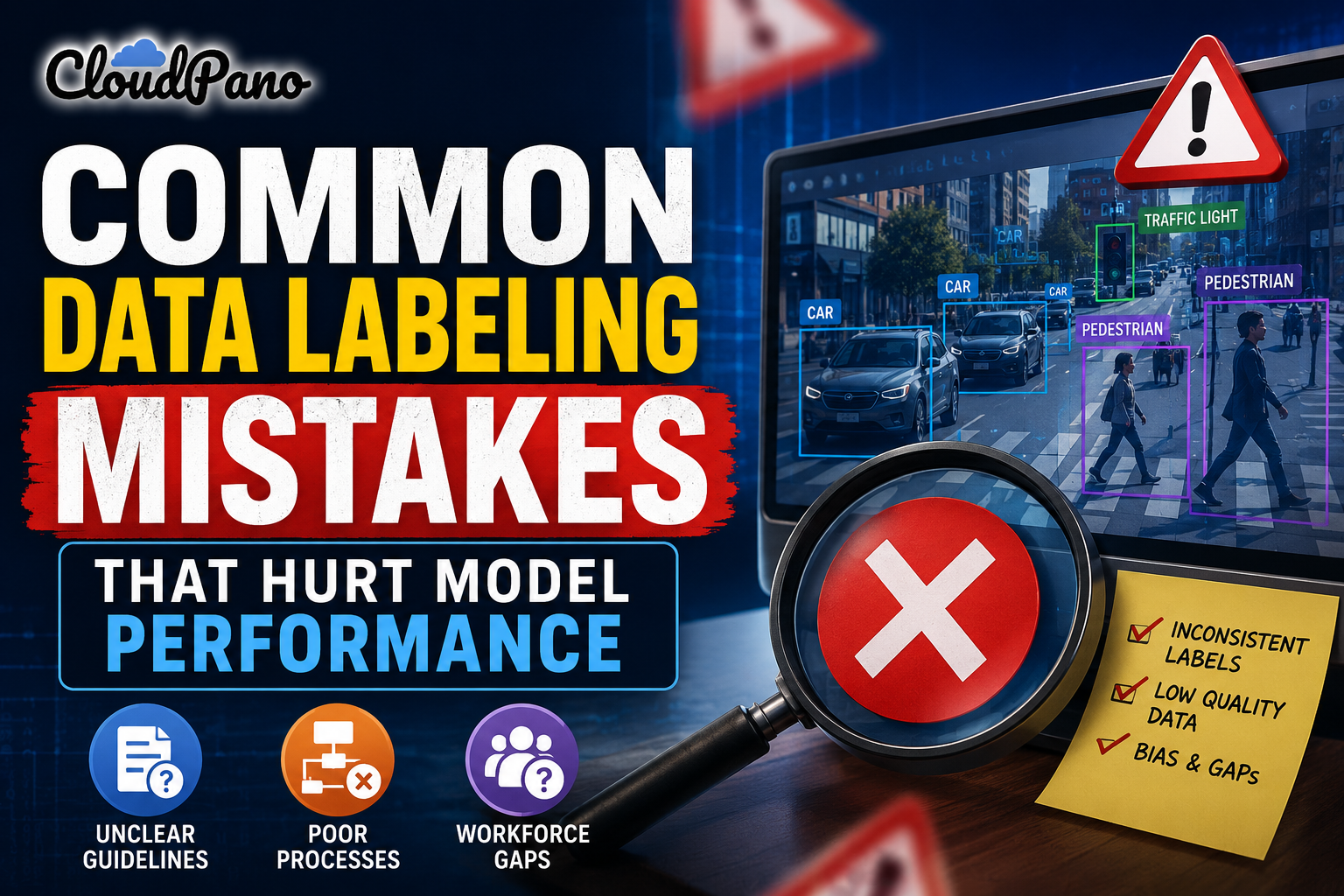
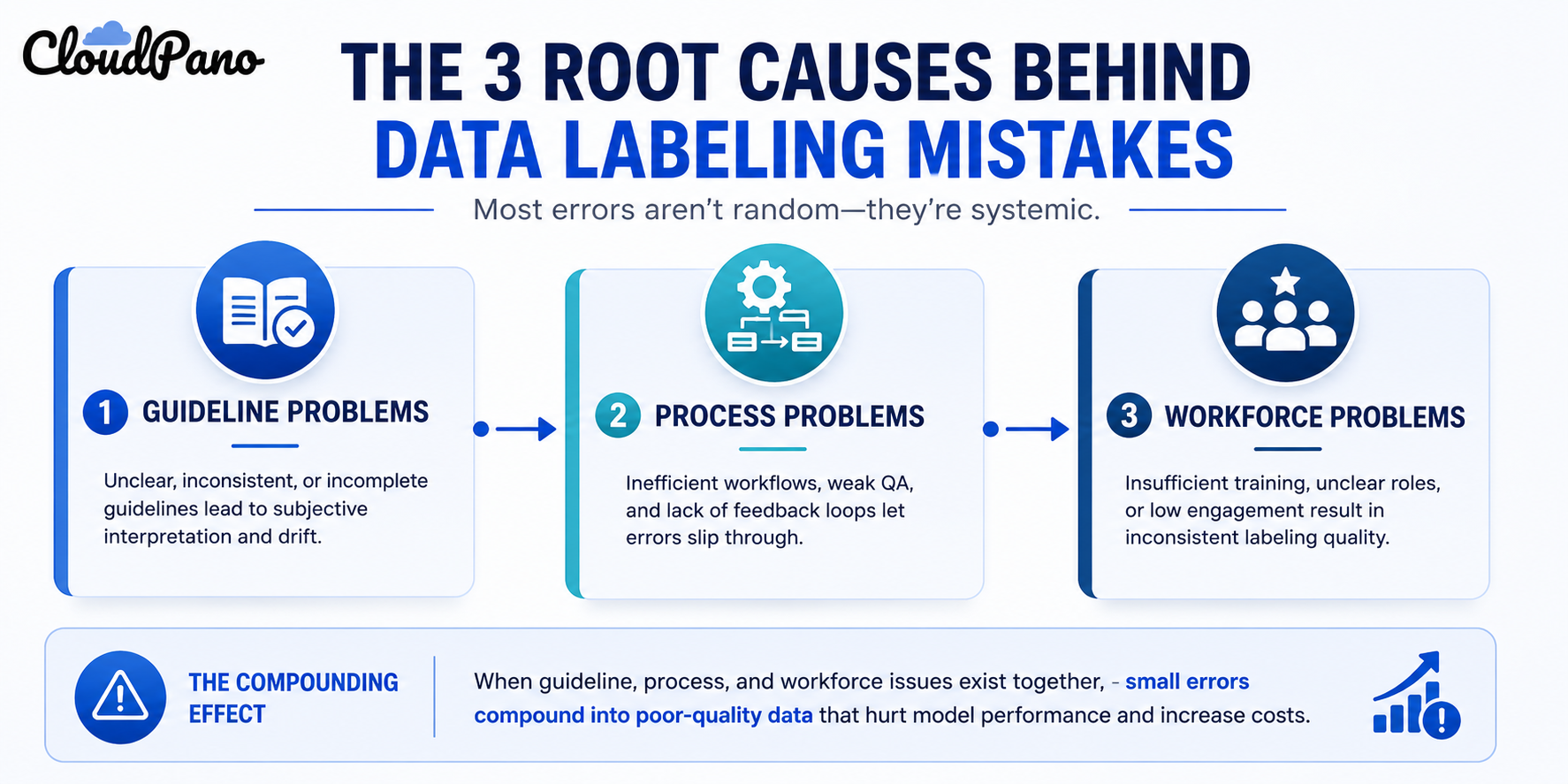
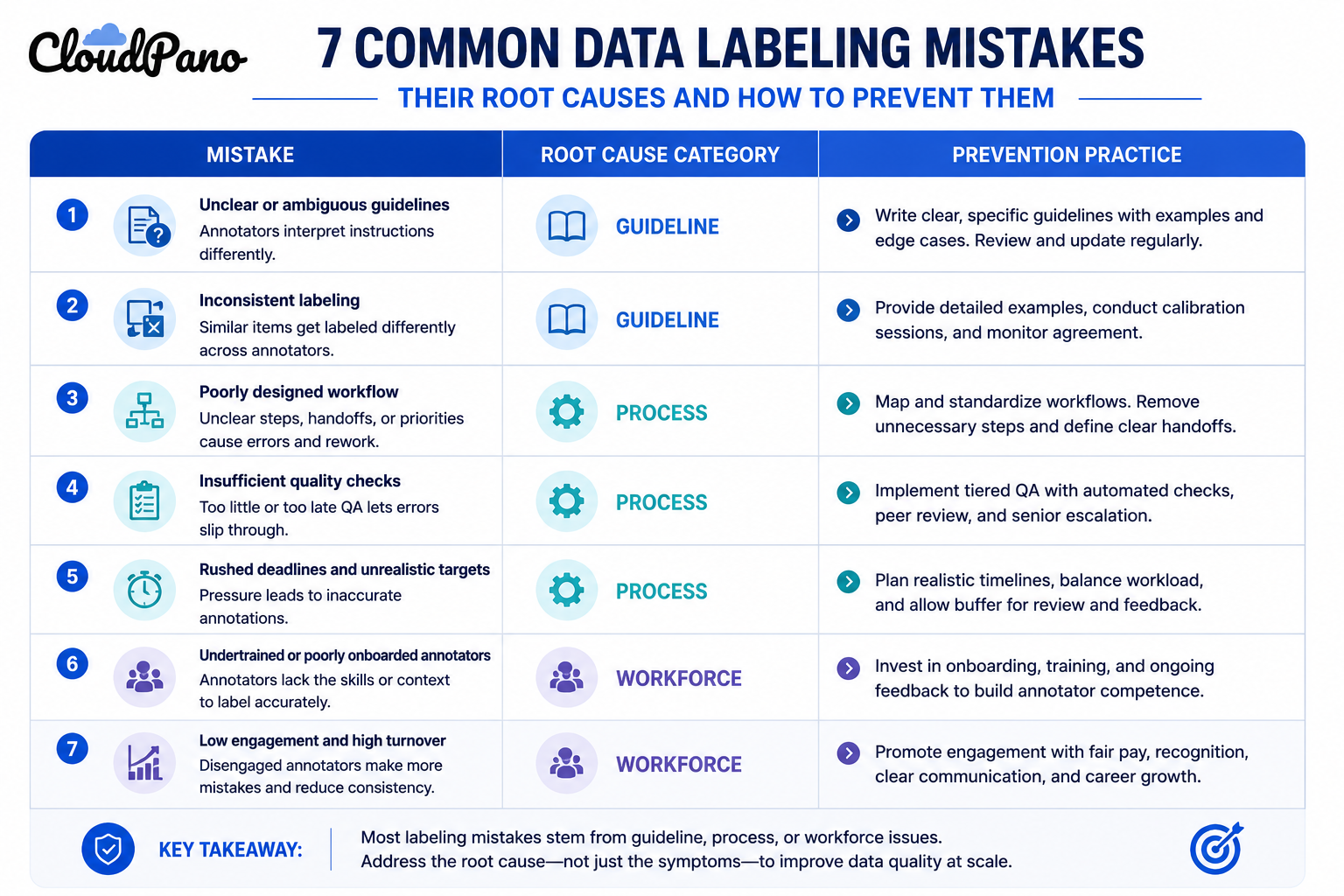
Most data labeling mistakes trace back to one of three root causes, and understanding how these workflows operate makes it easier to diagnose which one is at play in a given project.
Guideline problems. Ambiguous, incomplete, or outdated instructions leave annotators making reasonable but inconsistent judgment calls on the same type of item.
Process problems. Missing or infrequent quality checks — no inter-annotator agreement tracking, no gold-standard testing, no rolling audits — let errors accumulate undetected.
Workforce problems. Annotators without the right domain training, or under pressure to move too fast, introduce errors that a stronger training or pacing structure would have caught.
Training data quality issues rarely come from one of these alone — usually a guideline gap goes unnoticed because there's no process to catch it, and that gap gets applied inconsistently because the workforce wasn't trained to flag it.
Step-by-Step Workflow to Catch and Prevent Mistakes
Audit your current guidelines for ambiguity. Look specifically for instructions that could reasonably be interpreted two different ways.
Check whether inter-annotator agreement is being measured at all. If it isn't, you have no way to know whether inconsistency is even happening.
Review your QA cadence. Confirm whether quality checks happen continuously or only at the start and end of a project.
Sample a batch of already-labeled data against a gold standard. This reveals whether existing training data quality is where you assume it is.
Identify where automated pre-labeling isn't being audited. Automated labels fail silently and consistently, so they need the same scrutiny as human-labeled data.
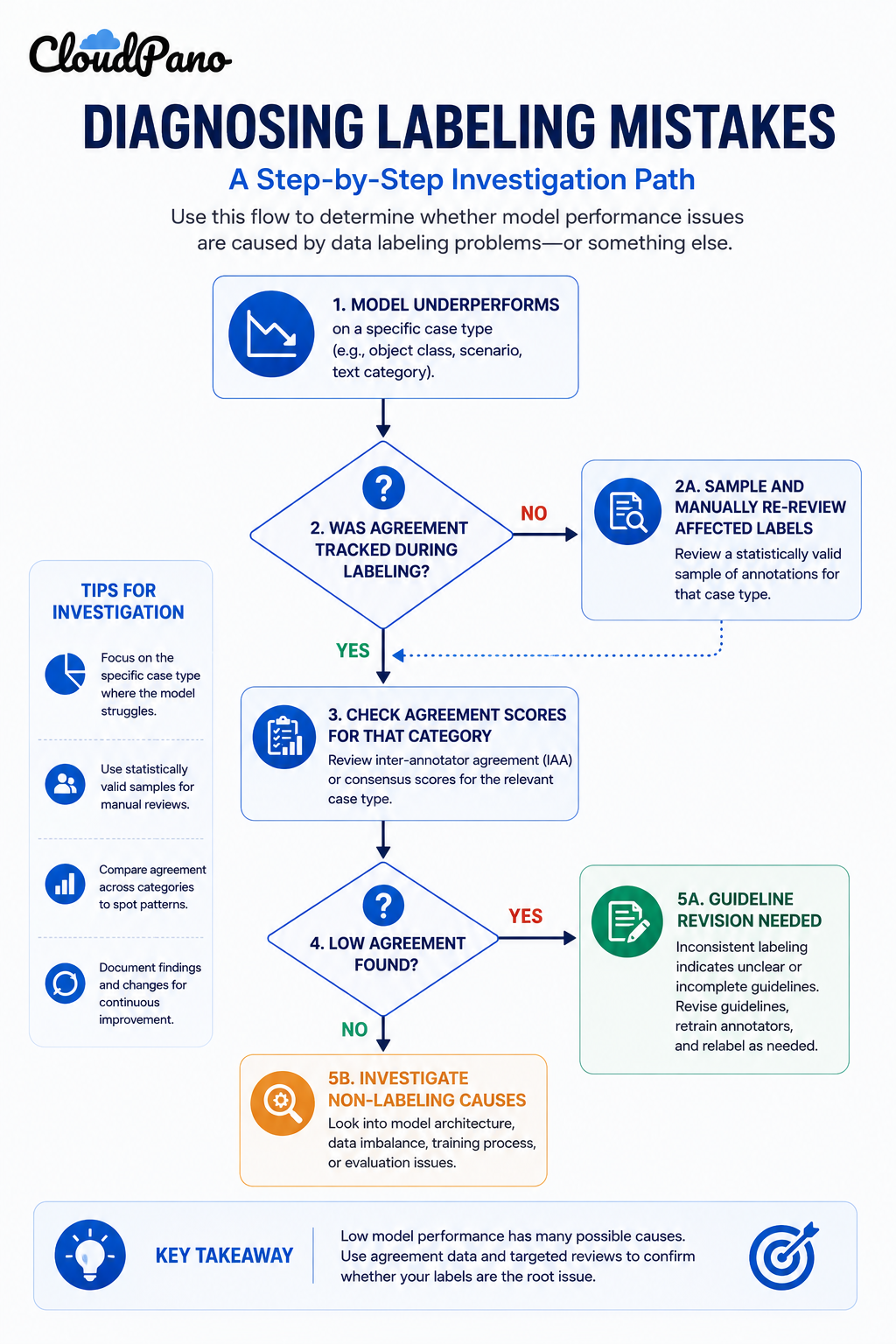
Trace any known model failure back to its labeled data. If a model underperforms on a specific case type, check whether the corresponding labels were consistent and correct.
Fix the guideline, not just the individual mislabeled item. A recurring error usually points to an instruction that needs revision, not an annotator who needs correcting.
Re-run quality checks after every guideline revision. Confirm the fix actually resolved the inconsistency rather than assuming it did.
Industry Use Cases
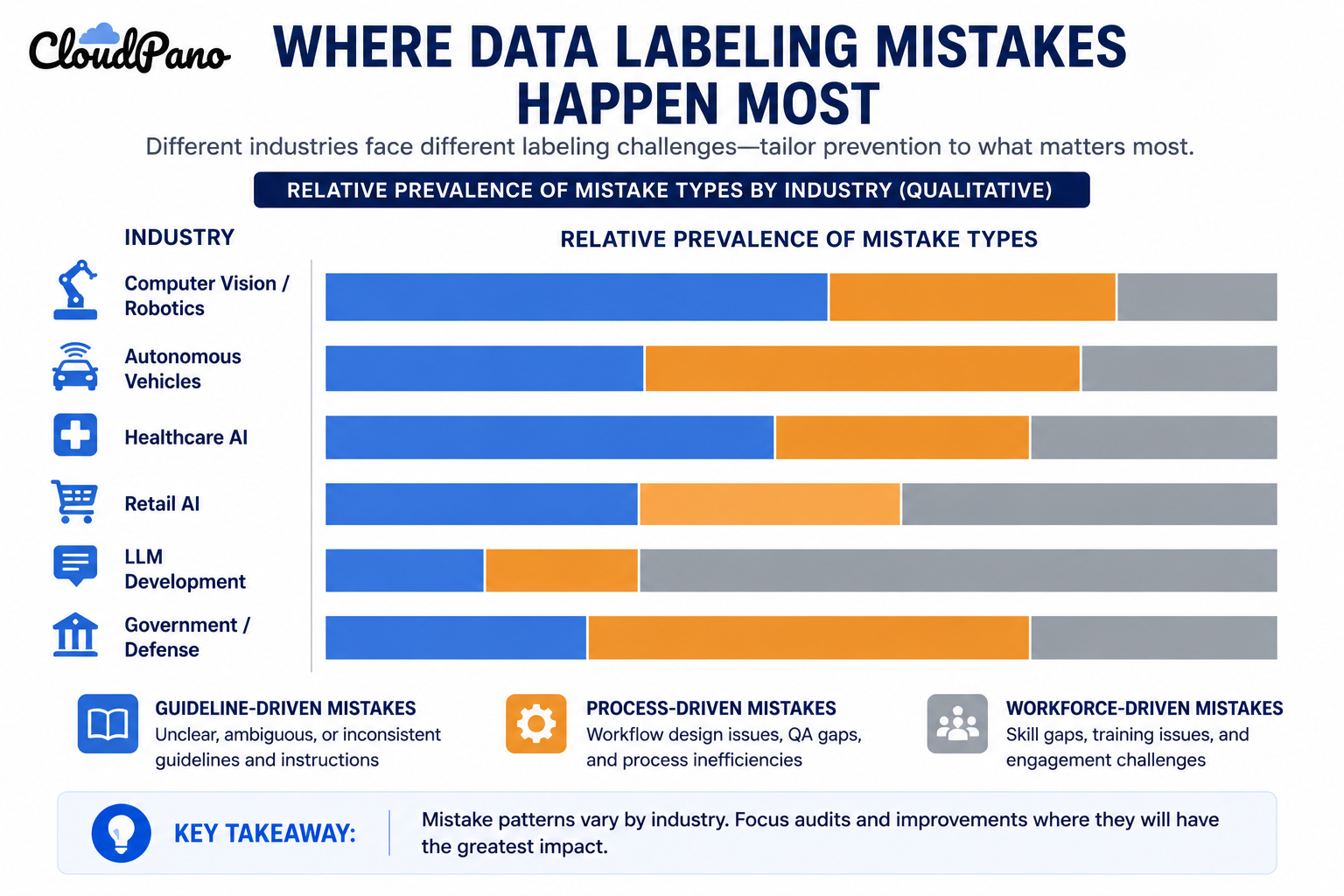
Computer vision / robotics: Boundary placement inconsistency on bounding boxes and segmentation masks is one of the most common and consequential labeling mistakes here.
Autonomous vehicles: Missed or inconsistent labeling of rare edge-case scenarios (unusual pedestrian behavior, construction zones) carries the highest safety cost of any labeling mistake category.
Healthcare AI: Clinical annotation errors from insufficiently trained annotators are a well-documented risk, given the direct link to diagnostic accuracy and patient safety.
Retail AI: Category overlap and inconsistent tagging at high volume compound quickly across large product catalogs, even when each individual error looks minor.
LLM developers: Inconsistent preference or safety labeling — where subjective judgment calls vary annotator to annotator — is a persistent and hard-to-catch mistake category.
Government & defense: Labeling errors on classification-sensitive data carry compliance and audit-trail consequences well beyond the immediate model performance impact.
Benefits of Catching Mistakes Early
Cheaper fixes. Correcting a labeling mistake before training is far less expensive than diagnosing and correcting a model failure that traces back to it months later.
Faster root-cause diagnosis. With inter-annotator agreement and audit data in place, tracing a model issue back to a specific labeling problem takes hours instead of weeks.
More reliable models in production. Training data quality directly caps model reliability, so catching mistakes early raises the ceiling on what the model can achieve.
More defensible AI systems. A documented history of caught and corrected labeling mistakes supports accountability in regulated or high-stakes industries.
Better guidelines over time. Every caught mistake that gets traced to a guideline gap makes the next labeling project's instructions more precise.
Common Mistakes
Writing guidelines once and never revising them. Guidelines that don't evolve as edge cases surface leave annotators reasonably disagreeing on cases the instructions never anticipated.
Skipping inter-annotator agreement tracking. Without measuring agreement, you can't distinguish a labeling problem from an annotator problem, or know that a problem exists at all.
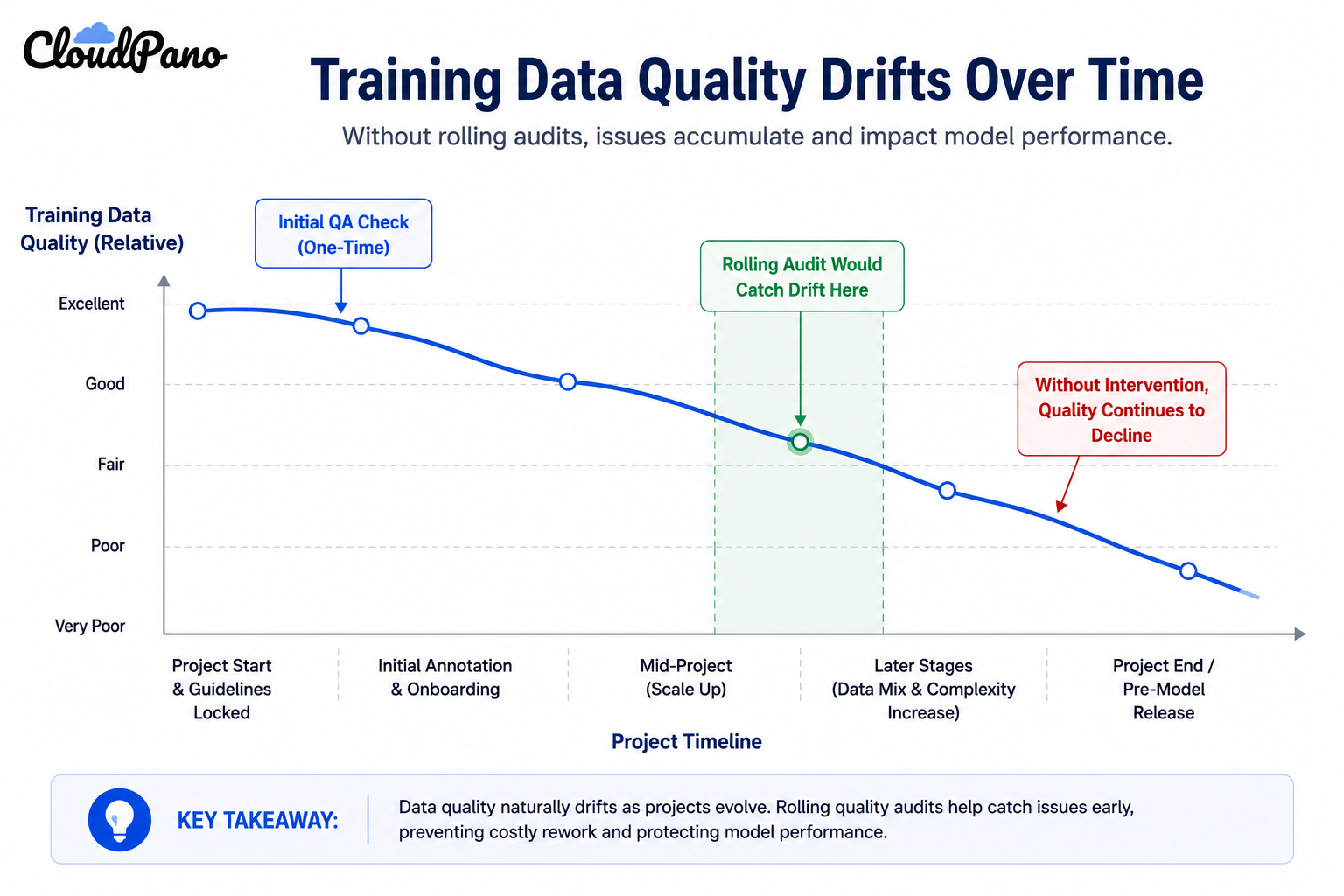
Running quality checks only at project kickoff. Quality can drift over the course of a project — from annotator fatigue, from guideline gaps discovered late, from workforce turnover — and a one-time check misses all of it.
Trusting automated pre-labeling without auditing it. Automated labels fail silently and consistently, and skipping the same rigor applied to human-labeled data lets errors scale before anyone notices.
Resolving annotator disagreements arbitrarily. Defaulting to majority vote or the fastest submission instead of routing disagreements to a defined review process wastes valuable signal about where guidelines are unclear.
Assuming a small labeling error doesn't matter at scale. A minor, seemingly harmless inconsistency in a small pilot can compound into a significant training data quality problem once applied across a full-volume dataset.
Not matching annotator expertise to task complexity. Using generalist annotators for technical, clinical, or safety-critical labeling introduces errors that domain training would have prevented.
Best Practices
Treat annotation guidelines as living documents, versioned and revised every time a new edge case is discovered.
Track inter-annotator agreement continuously, broken down by label category and by annotator, not just as a single project-wide number.
Run rolling quality audits throughout a project rather than only at the beginning or end.
Apply the same audit rigor to automated or pre-labeled data as to human-labeled data.
Route annotator disagreements to a defined escalation path with a senior reviewer, and treat each one as a signal about guideline clarity.
Match annotator expertise to task complexity, especially for technical, clinical, or safety-critical data. McKinsey's research on generative AI adoption notes that data readiness — including the discipline to catch and correct labeling issues early — remains one of the most consistently underestimated factors in AI project outcomes (McKinsey, "The economic potential of generative AI").
FAQ
What are the most common data labeling mistakes?
Ambiguous or outdated guidelines, skipping inter-annotator agreement tracking, one-time-only quality checks, unaudited automated pre-labeling, and mismatched annotator expertise for the task's complexity.
How do data labeling mistakes affect model performance?
Inconsistent or incorrect labels teach a model the wrong pattern with the same apparent confidence as a correct label would, which typically shows up later as unexplained errors on specific edge cases rather than an obvious overall failure.
How can I tell if my model's problem is actually a labeling issue?
Trace the specific case types where the model underperforms back to their corresponding labeled data and check for inconsistency; if inter-annotator agreement wasn't tracked during labeling, this diagnosis is much harder to make.
What annotation quality assurance practices catch these mistakes early?
Inter-annotator agreement tracking, gold-standard test sets, consensus labeling on ambiguous items, and rolling audits — used together rather than relying on any single method.
Do automated labeling systems make the same mistakes as human annotators?
They make different but equally serious mistakes — automated systems fail silently and consistently, which can let errors propagate across a large dataset before anyone notices, unlike human mistakes which tend to show more variability.
What are the most important data labeling best practices to prevent these issues?
Treating guidelines as living documents, tracking agreement continuously, auditing on a rolling schedule, and matching annotator expertise to task complexity are the practices that prevent most common mistakes.
How much does poor training data quality actually cost a project?
Costs vary significantly depending on how late a labeling issue is caught and how large the affected dataset is; [VERIFY] before citing a specific cost multiplier, since this depends heavily on project scale and industry.
Conclusion
Data labeling mistakes are rarely dramatic in the moment — they're small, reasonable-seeming judgment calls that compound quietly until a model's behavior in production makes them impossible to ignore. Catching them early comes down to the same handful of disciplines: clear and current guidelines, continuous quality tracking, and treating every disagreement as information rather than noise.
Create an interactive virtual showroom and engage affluent digital buyers with live 360º video calls, all through the CloudPano mobile app for a complete automotive sales solution.
Create 2D and 3D floor plans with measurements in 4 minutes or less, all from your phone. Download the Floor Plan Scanner app and get your first scan free.
Building a custom computer vision dataset takes more than collecting images and adding labels. Learn how to define annotation requirements, gather representative visual data, maintain labeling quality, and prepare reliable datasets for AI model training.
Bounding boxes, segmentation, and classification are three essential computer vision annotation methods, but they serve different purposes. Discover how each works, where it performs best, and how to choose the right annotation approach for accurate, scalable AI training data.
Home robots and vision models need video from real homes, yet the best-known indoor datasets cover a few dozen kitchens or a few hundred people. This guide explains why home footage is scarce, what public datasets offer, and how custom in-home collection works.


.png)




.png)

.png)








.svg)


.svg)