


.png)


Most teams choose a wearable camera for data collection based on whatever's convenient, popular, or already sitting in a drawer. That approach works until the resulting footage doesn't actually capture what the model needs — wrong field of view, wrong mounting angle, or insufficient battery life for the activities being recorded.
Egocentric Camera Hardware decisions carry more downstream consequence than they seem to at the point of purchase, since the camera's specific characteristics determine what's physically possible to capture, regardless of how well the rest of the collection protocol is designed.
A camera mismatched to the task doesn't fail obviously at the point of purchase — it fails quietly during collection, producing footage that's missing exactly the detail a model needs, discovered only once annotation or training reveals the gap. Google Research's "Data Cascades" study documented how such quality issues introduced early in a pipeline compound into larger, harder-to-diagnose problems later (Sambasivan et al., Google Research), and hardware selection is about as early in the pipeline as a decision gets.
NIST's AI Risk Management Framework treats data fitness for the intended task as foundational to trustworthy AI, directly relevant to First-Person Capture Devices needing specifications genuinely matched to what a model actually needs to learn, not chosen for general convenience (NIST AI RMF).
The stakes rise with how much egocentric vision research and deployment has grown. Stanford HAI's AI Index has tracked increasing interest in wearable sensing and activity recognition applications (Stanford HAI, AI Index Report), and a hardware mismatch discovered after a large collection effort is a far more expensive problem than one caught during initial equipment selection.
A POV Camera for AI Training purposes needs evaluation across a few specific hardware dimensions.
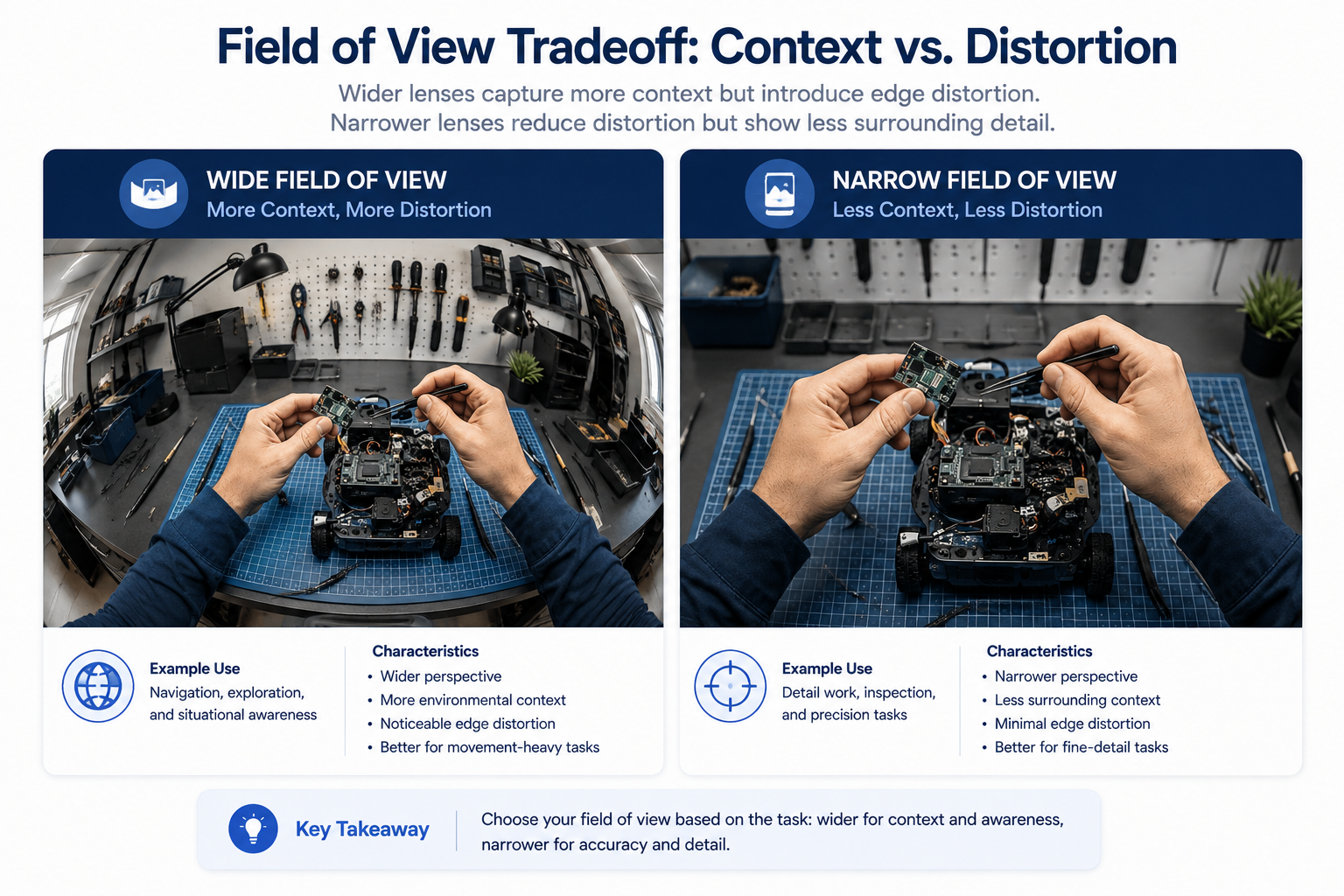
Field of view. Wider fields of view capture more context around an activity but can introduce distortion at the edges; narrower fields of view offer less distortion but may miss peripheral detail relevant to certain tasks.
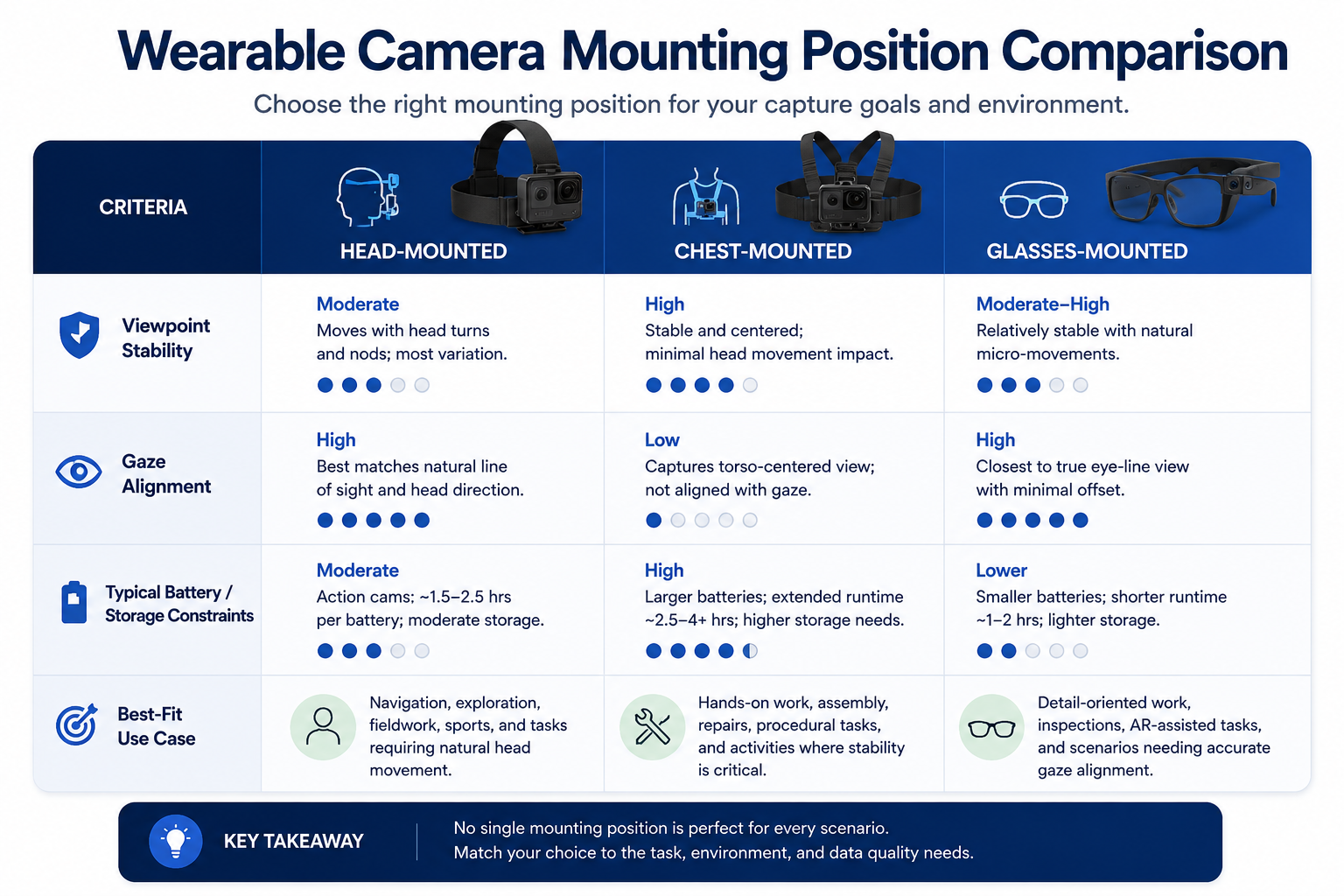
Mounting position. Head-mounted cameras track directly with gaze and head orientation; chest-mounted cameras offer a more stable, less erratic viewpoint but disconnect from where the wearer is actually looking; glasses-mounted cameras sit close to natural eye-line but often carry more constraints on battery and storage.
Resolution and frame rate. Higher resolution captures more visual detail but increases storage and processing demands; frame rate needs to match the speed of activity being recorded, since fast hand movements need a higher frame rate to avoid motion blur or dropped detail.
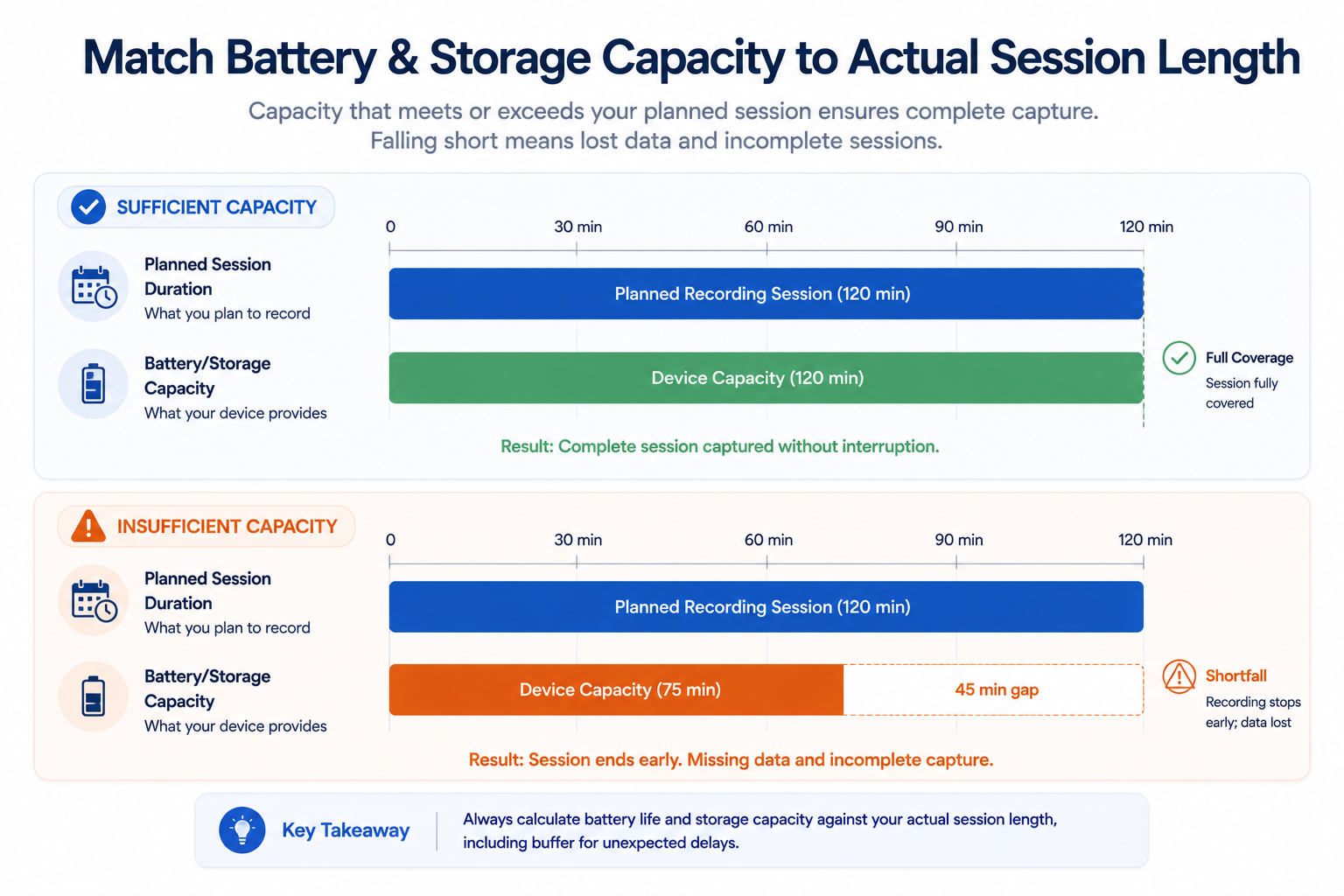
Battery life and storage capacity. Extended data collection sessions require hardware that can sustain recording for the actual duration needed, and running out of either mid-session creates unusable gaps in a demonstration or activity sequence.
Understanding how these workflows operate as a matching exercise between hardware specification and specific task requirement — not a search for the single "best" camera — is what actually produces the right equipment choice for a given project.
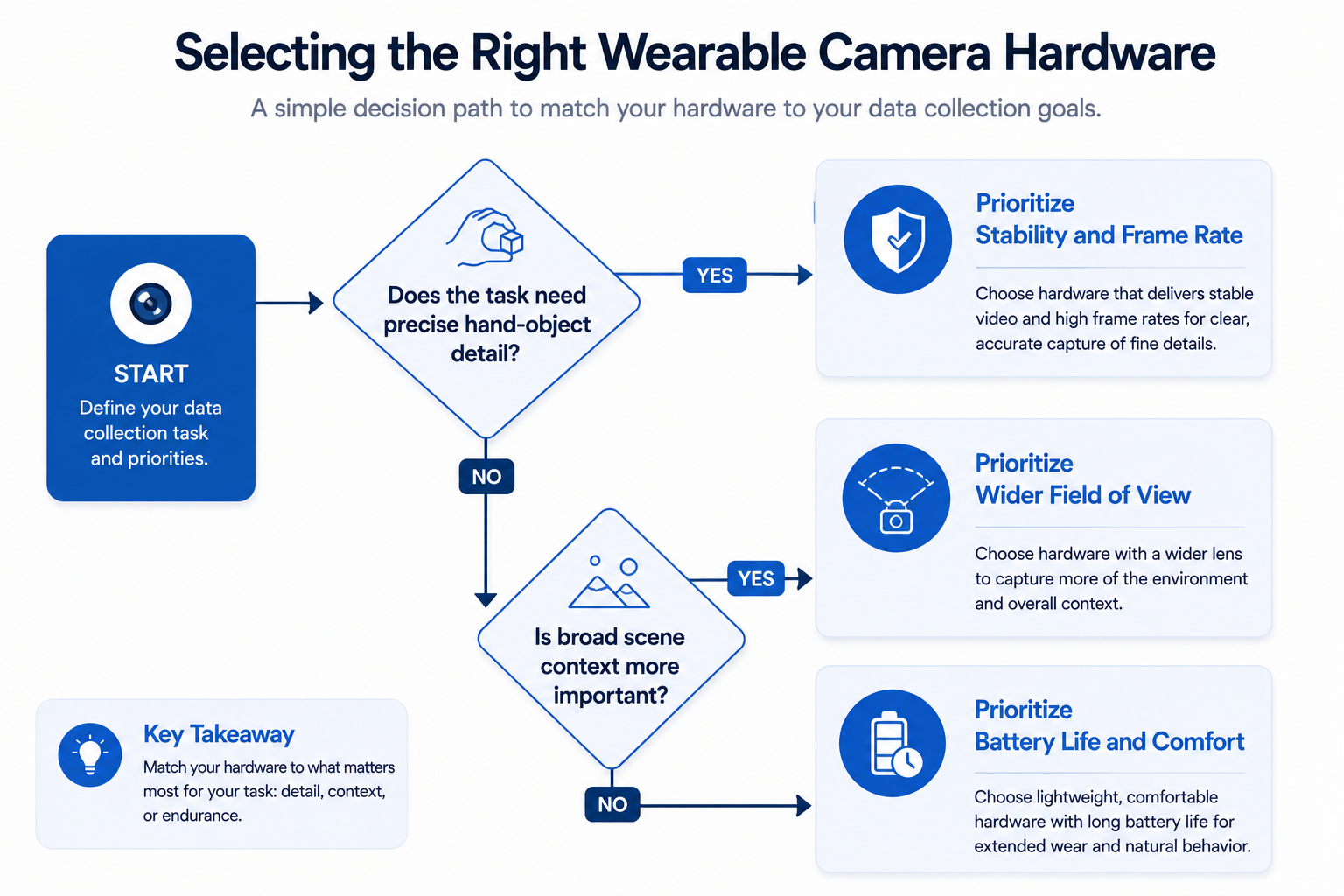
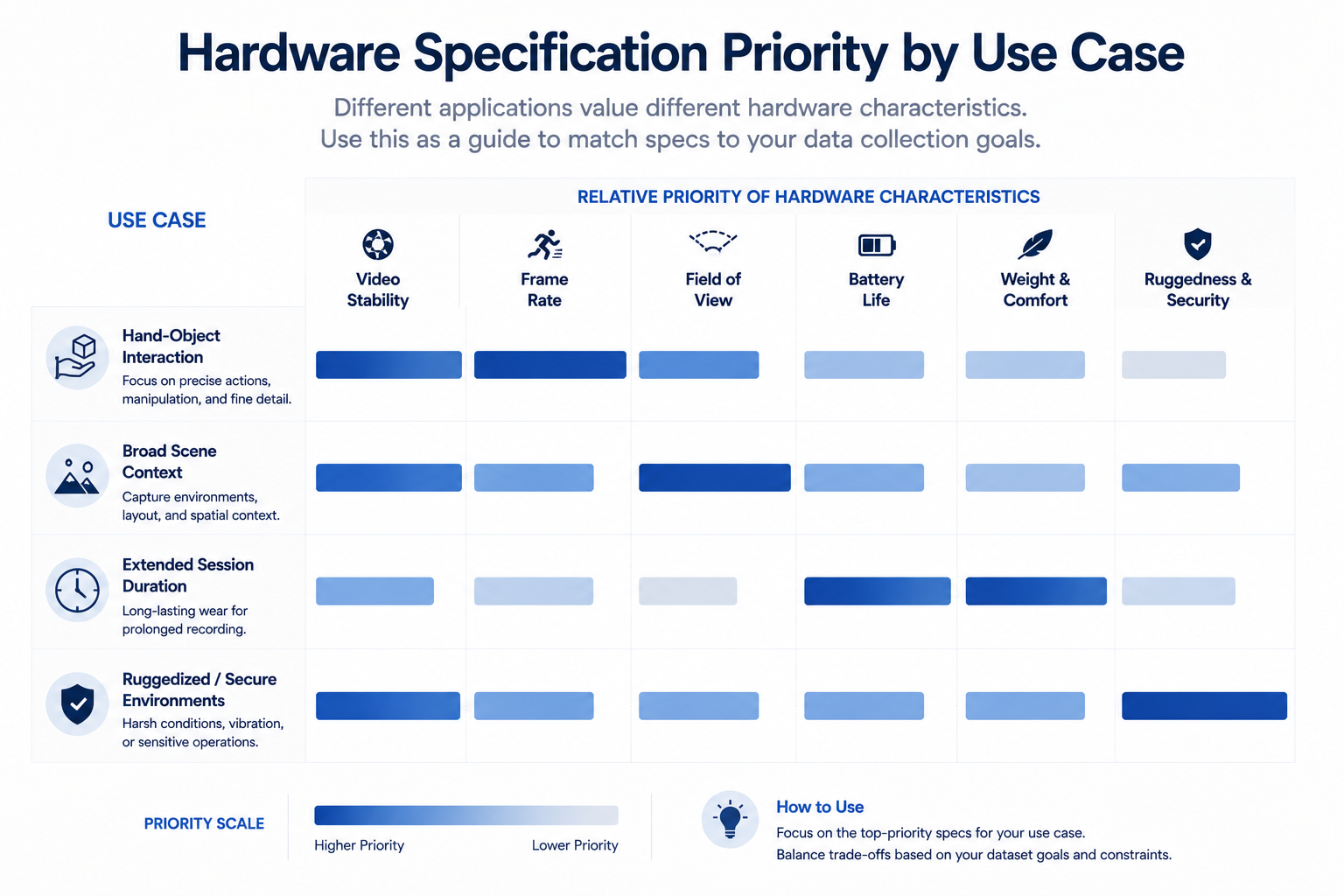
Field of view, mounting position, resolution and frame rate, and battery or storage capacity, each evaluated against the specific model task the resulting footage needs to support.
Head-mounted cameras track with gaze and head movement, chest-mounted cameras offer more stability but disconnect from exact gaze direction, and glasses-mounted cameras sit close to natural eye-line with typically more constrained battery and storage.
It depends on the task: wider fields of view capture more context but risk edge distortion, while narrower fields of view reduce distortion but may miss relevant peripheral detail.
Enough to sustain the actual planned recording session length without interruption; calculating this against real session duration before purchase avoids mid-collection gaps.
Yes. A small-scale pilot confirms the selected camera actually produces usable footage for the specific task before committing budget to full deployment.
No. The right choice depends entirely on matching specific hardware characteristics to a particular model task's requirements, not finding one universally superior camera.
Higher frame rates are needed for fast hand movements or rapid activity to avoid motion blur or dropped visual detail, while slower-paced tasks may not require as high a frame rate.
Choosing a wearable camera for data collection is a task-matching exercise, not a search for one universally best device. Field of view, mounting position, resolution, frame rate, and battery or storage capacity all need to be evaluated deliberately against what a specific model task actually requires, and piloting that choice before full-scale deployment is what keeps a collection project from discovering a costly hardware mismatch after significant investment.


Compact, ready to go anywhere
Interchangeable lens that’s upgradeable
Dual 1-inch sensors for improved clarity and low light performance
Dynamic range and 6K 360° capture
360° photo resolution at 21MP

8K 360° video recording for ultra-detailed visuals.
4K single-lens mode for traditional wide-angle shots.
Invisible selfie stick effect for drone-like perspectives.
2.5-inch touchscreen with Gorilla Glass protection.
Waterproof up to 33ft for underwater shooting.

360° photo resolution in 23MP
Slim design at 24 mm thick
Built-in image stabilization for smooth video capture.
Internal 19GB storage for photo and video storage.
Wireless connectivity for remote control and sharing.

60MP 360° still images for high-resolution photography.
5.7K 360° video recording at 30fps.
2.25-inch touchscreen for intuitive control.
USB Type-C port for fast charging and data transfer.
MicroSD card slot for expandable storage.
.png)

.png)

Try it free. No credit card required. Instant set-up.






.svg)


.svg)