


.png)



Most virtual tour software comparisons treat the category as one undifferentiated market — as if a museum, a hotel, and a real estate agency are all shopping for the same thing. They aren't. Evaluating virtual tour software by industry means recognizing that the features which matter most shift significantly based on your specific use case, and a generic "best overall" ranking often misses exactly the considerations that matter most for your particular business.
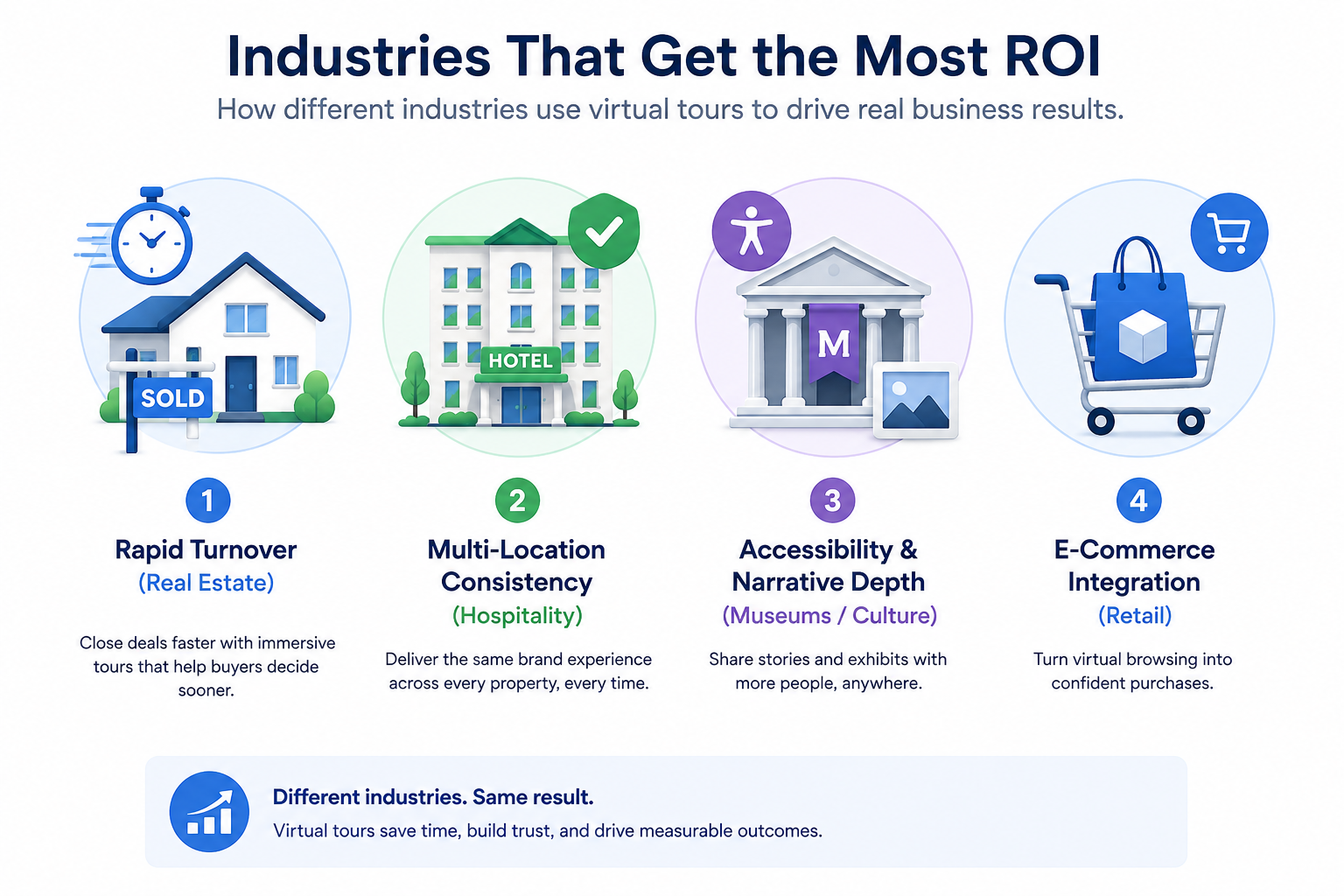
A feature that's essential in one industry can be irrelevant in another. Real estate depends heavily on rapid turnover and listing-specific workflows. Hospitality often needs multi-location brand consistency. Museums and cultural institutions may prioritize accessibility features and multilingual support over rapid tour creation speed. Retail cares about integration with e-commerce or in-store experience tools more than most other categories. Treating all of these as the same evaluation — "which platform has the most features" — misses the fact that different industries are optimizing for fundamentally different outcomes.
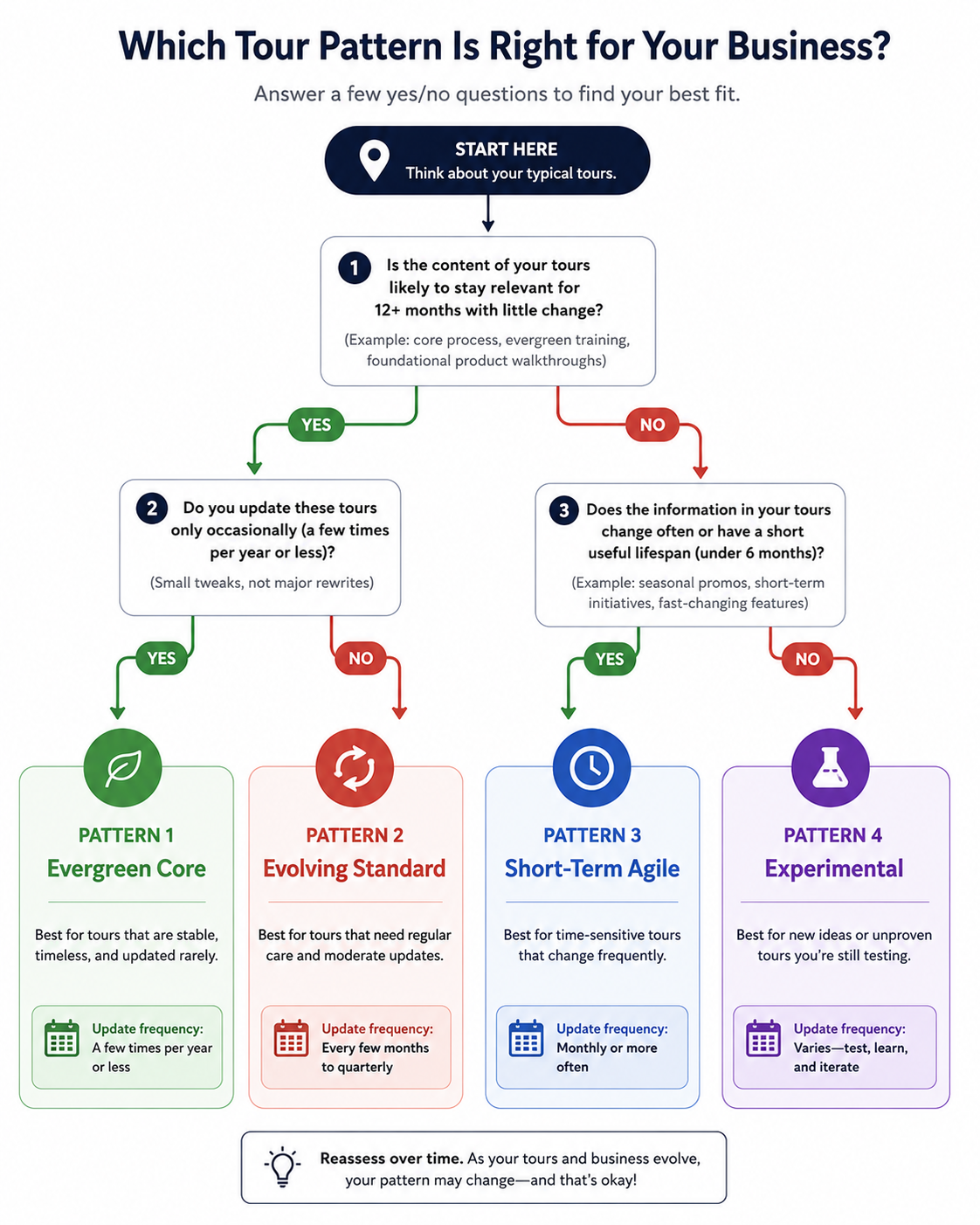
Rather than starting from a generic feature list, finding the best 3D tour software by use case means starting from your specific workflow and working backward to the features that actually support it. A real estate agent's use case (rapid capture, listing-specific publishing, client-facing reliability) points toward different priorities than a hospitality brand's use case (consistent presentation across multiple properties, integration with a booking flow) or a retailer's use case (integration with product catalogs or e-commerce platforms).
This reframing — starting from use case rather than feature count — tends to surface a smaller, more relevant shortlist of platforms than a generic "top 10" comparison would.
Industry specific virtual tours differ in ways that go beyond surface-level branding. A real estate tour is typically built around a single property with a defined lifespan tied to a listing. A hospitality tour often needs to represent an ongoing brand experience across multiple locations, updated less frequently but maintained for longer. A museum or cultural tour may prioritize narrative structure and accessibility (audio descriptions, multilingual text) over rapid production speed, since these tours are typically built once and maintained carefully over a long period rather than churned frequently.
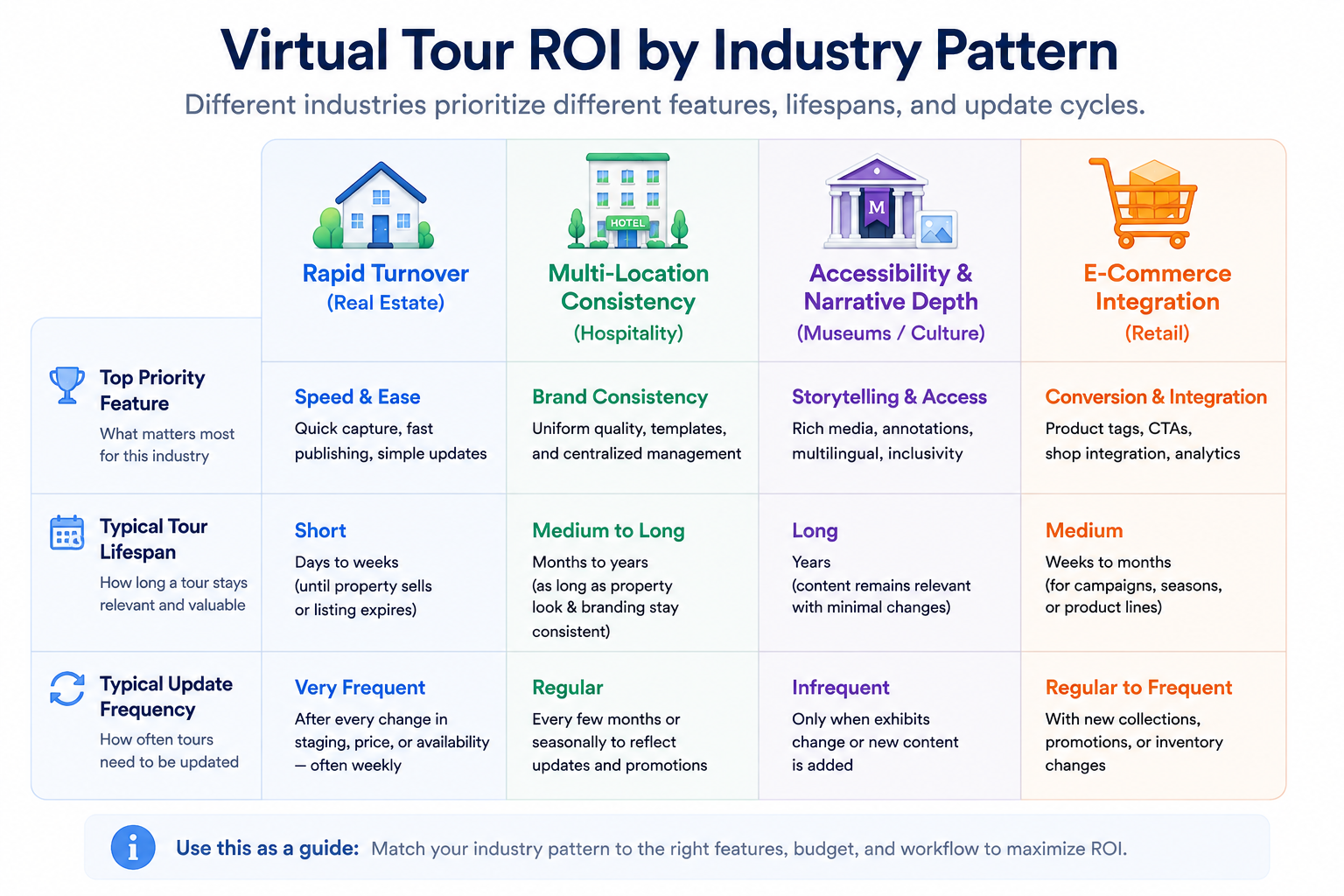
Retail tours increasingly blend virtual walkthroughs with product-level detail, which pushes toward platforms that integrate more easily with existing e-commerce or inventory systems, rather than functioning as a standalone tour tool.
It's worth understanding that platforms in this category generally take one of two approaches: some specialize deeply in a single industry pattern, building features specifically for that use case at the expense of broader flexibility. Others aim to serve multiple industry patterns reasonably well through configurability, without going as deep into any single one as a specialist would.
Neither approach is inherently better, but it's worth knowing which type of platform you're evaluating. A deep specialist in your exact industry may outperform a generalist on the specific features that matter most to you, but a flexible generalist may serve you better if your business spans more than one of these patterns, or if your needs are likely to shift between patterns as your business evolves. Checking which category a platform falls into — specialist or flexible generalist — is a useful early filter before diving into feature-by-feature comparison.
A useful virtual tour platform comparison starts by identifying which of the broad industry patterns above most closely matches your situation, then evaluating platforms specifically against that pattern's priorities rather than a generic feature checklist. If you're in real estate, weight turnover speed and client-facing reliability heavily. If you're in hospitality, weight multi-location consistency and integration with your existing booking systems. If you're a cultural institution, weight accessibility features and long-term content stability.
This industry-first approach to comparison tends to produce a shortlist that's actually relevant to your situation, rather than a generic ranking optimized for an average user who may look nothing like your business.
It's worth understanding why industry-specific evaluation is becoming more relevant over time, not less. As virtual tour software has moved from a novelty into standard practice across many industries, platforms have increasingly specialized rather than converging on one universal feature set. This means a generic "which platform is best" comparison is arguably less useful today than it might have been when the category was newer and every platform was still building out fairly basic core functionality. Recognizing this shift is part of why an industry-first framework matters more now than a simple feature checklist ever did.
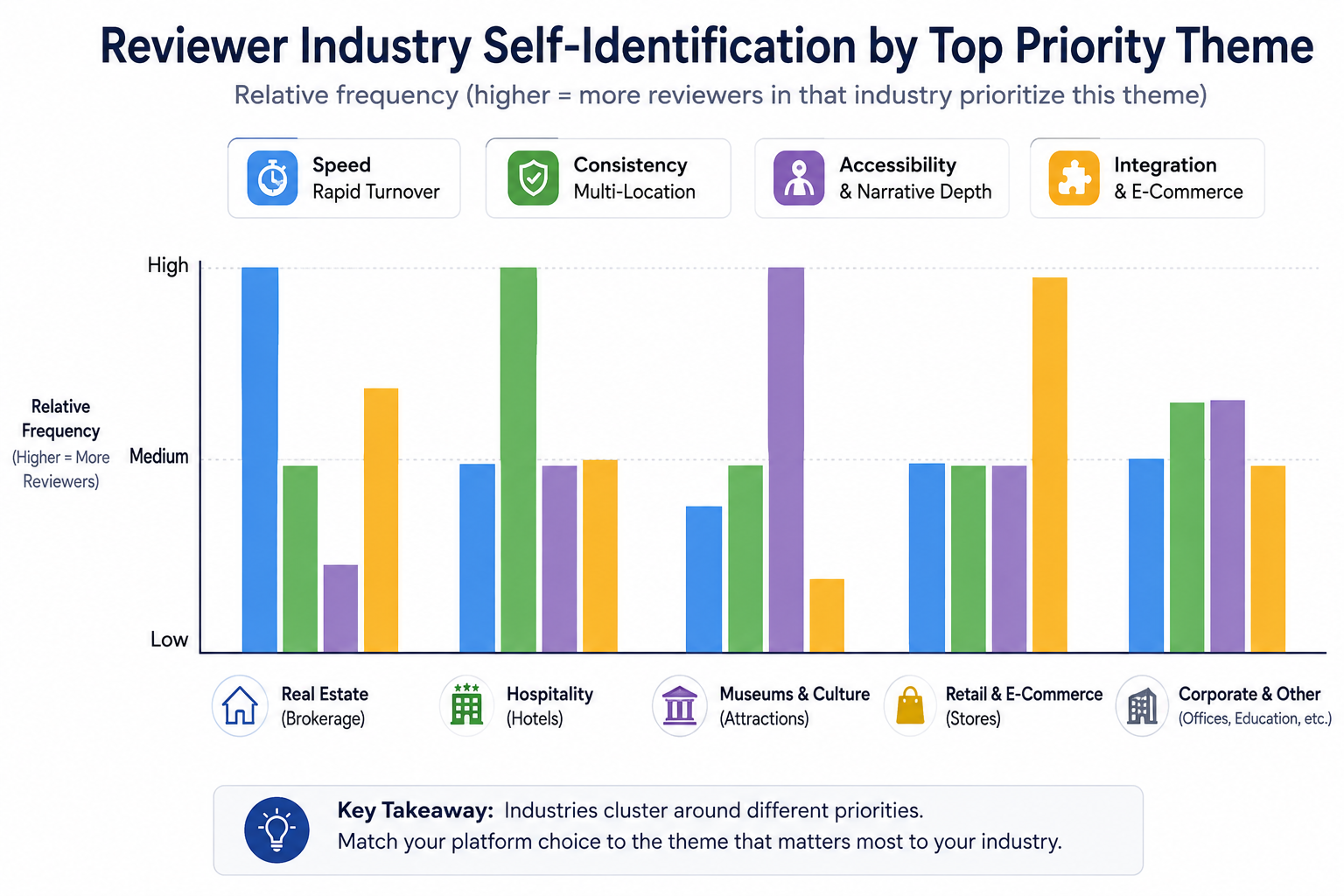
On G2's virtual tour software category page, reviewer patterns cluster meaningfully by industry — real estate reviewers emphasizing turnaround speed, hospitality reviewers emphasizing multi-location consistency — which reinforces that industry context genuinely shapes what "good" looks like in this category.
Industry-specific publications, such as Inman for real estate or hospitality-focused trade press for that sector, often cover virtual tour adoption within the specific context of that industry's broader technology trends, which can surface considerations a general software comparison wouldn't think to include.
Some businesses genuinely straddle more than one of these patterns — a real estate brokerage that also manages a boutique hospitality property, or a museum with an attached retail gift shop. If this describes your situation, it's worth identifying which pattern applies to your primary, highest-volume use case and treating the secondary use case as a smaller, separate consideration rather than trying to find one platform that's simultaneously optimized for both patterns equally well. Forcing a single evaluation to satisfy two different sets of priorities usually produces a worse fit for both than choosing based on your primary need and accepting some compromise on the secondary one.
"Isn't a good platform just good, regardless of industry?"
Baseline quality and reliability matter everywhere, but "good for my specific workflow" is a more useful standard than "generically good." A platform can be excellent at rapid real estate turnover while being a poor fit for a museum's accessibility needs, and neither assessment is wrong — they're just measuring different things.
"What if my business doesn't fit neatly into one of these industry categories?"
That's common, and it's worth identifying which existing category your actual workflow most closely resembles, even if your business doesn't fit a label perfectly. A small business with occasional needs might borrow priorities from multiple categories — turnover speed from real estate's pattern, simplicity from a smaller-scale use case — rather than needing an entirely new framework built just for your situation.
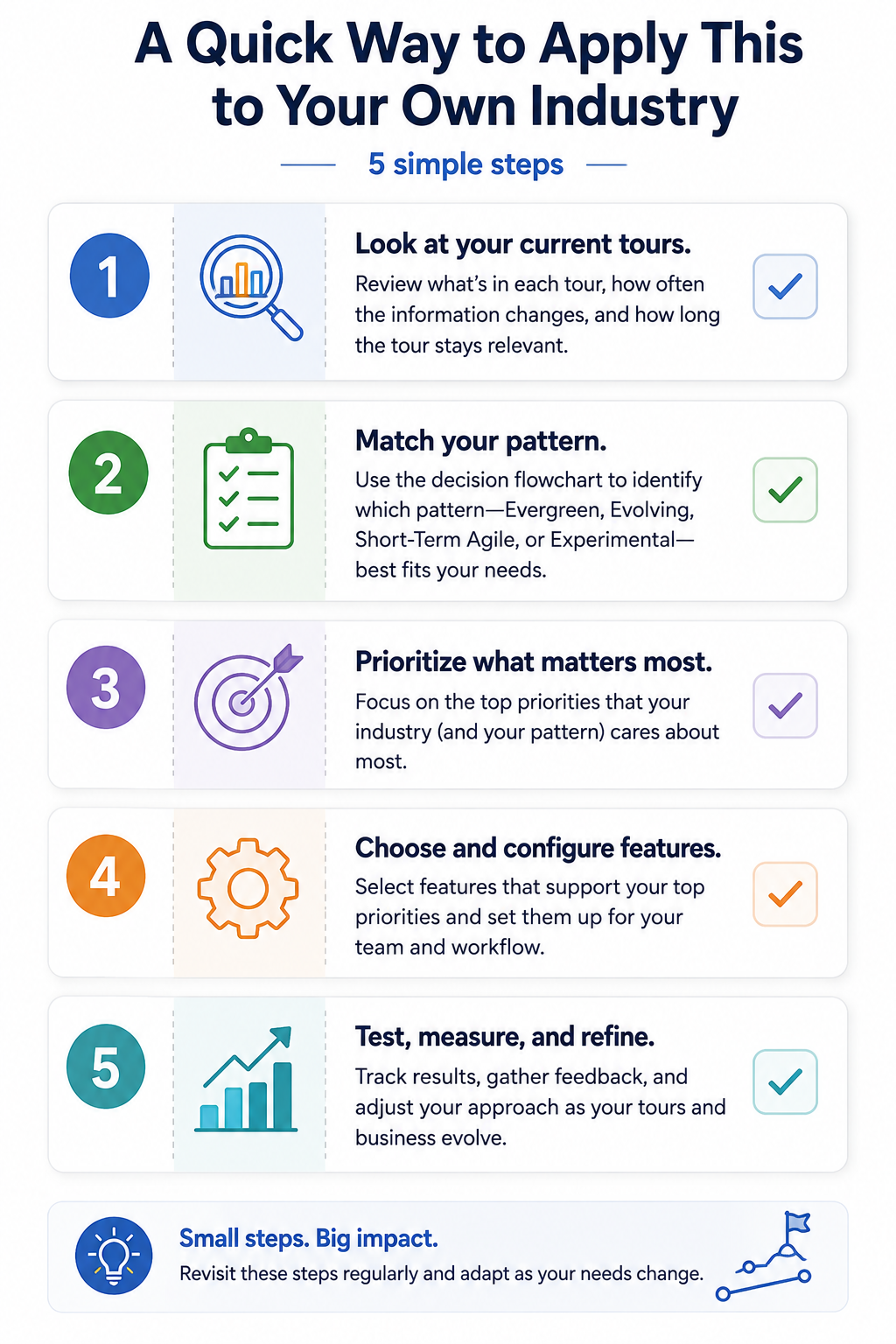
Virtual tour software needs vary meaningfully by industry, and a generic comparison built around an average user misses the considerations that actually matter for your specific business. Starting from your industry's typical pattern — rapid turnover, multi-location consistency, accessibility and narrative depth, or e-commerce integration — and evaluating platforms against that specific pattern produces a far more relevant shortlist than a one-size-fits-all ranking.
If your industry prioritizes flexibility, predictable cost scaling, and straightforward setup, it's worth testing CloudPano directly against your specific industry's typical workflow. And if you want the broader comparison against Matterport specifically, our complete comparison guide covers that ground in full. Whichever direction you go, starting from your industry's actual pattern rather than a generic feature list is the single change most likely to make your eventual comparison genuinely useful rather than superficially thorough.


Compact, ready to go anywhere
Interchangeable lens that’s upgradeable
Dual 1-inch sensors for improved clarity and low light performance
Dynamic range and 6K 360° capture
360° photo resolution at 21MP

8K 360° video recording for ultra-detailed visuals.
4K single-lens mode for traditional wide-angle shots.
Invisible selfie stick effect for drone-like perspectives.
2.5-inch touchscreen with Gorilla Glass protection.
Waterproof up to 33ft for underwater shooting.

360° photo resolution in 23MP
Slim design at 24 mm thick
Built-in image stabilization for smooth video capture.
Internal 19GB storage for photo and video storage.
Wireless connectivity for remote control and sharing.

60MP 360° still images for high-resolution photography.
5.7K 360° video recording at 30fps.
2.25-inch touchscreen for intuitive control.
USB Type-C port for fast charging and data transfer.
MicroSD card slot for expandable storage.
.png)

.png)

Try it free. No credit card required. Instant set-up.






.svg)


.svg)