


.png)




A handshake agreement feels simple until a dispute arises over who owns the finished tour, how long an agent can keep using it, or what happens when a job gets cancelled at the last minute. A clear virtual tour service contract real estate photographers actually use protects both sides of the relationship and heads off exactly these kinds of disagreements before they happen.
Disclaimer: this article explains, in general terms, what these agreements commonly cover and why — it is not legal advice, and it isn't a substitute for a properly drafted contract reviewed by a qualified lawyer. Contract and copyright law can vary, and specific wording matters. Use this as a starting checklist for a conversation with a legal professional, not as a finished, ready-to-sign document.
This guide walks through the core elements worth covering: usage rights and licensing, payment and cancellation terms, revisions, and delivery timelines. If you haven't yet worked through the broader business side of selling this as a service — pitching, pricing, and relationship-building — the complete guide to selling virtual tour services to agents covers that ground in full; this article picks up specifically at the point where you're ready to formalize an agreement. For the pricing side of the relationship specifically, your pricing structure, since payment terms belong in the contract too is worth having settled before you draft any agreement — this article assumes you already have a rough sense of your rates and focuses on the legal and licensing structure around them.
It's tempting to skip a formal agreement for a quick, low-cost job with an agent you already know well, but even simple jobs benefit from a clear written understanding. Verbal agreements are easy to misremember, especially months later when a dispute arises over something neither party wrote down at the time — how long the agent can use the tour, whether it can be shared with a different agency, or what happens if the property is relisted with a different agent later.
A short, simple written agreement doesn't need to be an intimidating legal document. Even a one-page summary covering the essentials — what's being delivered, what it costs, how it can be used, and basic cancellation terms — is far better protection than no written record at all, and most agents appreciate the clarity just as much as you do.
An email confirmation with the key terms spelled out clearly can serve as a reasonable lightweight substitute for a full formal contract on smaller, lower-stakes jobs, provided both parties have agreed to it in writing rather than just verbally. As your business grows and you're handling larger commercial jobs, ongoing agency arrangements, or higher-value work, it becomes worth investing in a more formal, lawyer-reviewed agreement — the level of formality should scale with what's actually at stake in the relationship.
At the center of any photography licensing agreement real estate contract is a fundamental question: who owns the copyright in the finished virtual tour, and what rights does the agent or agency actually receive to use it? In most cases, the photographer retains copyright ownership of the work they create, while granting the client a license to use it for specific purposes — most commonly, marketing that particular property listing.
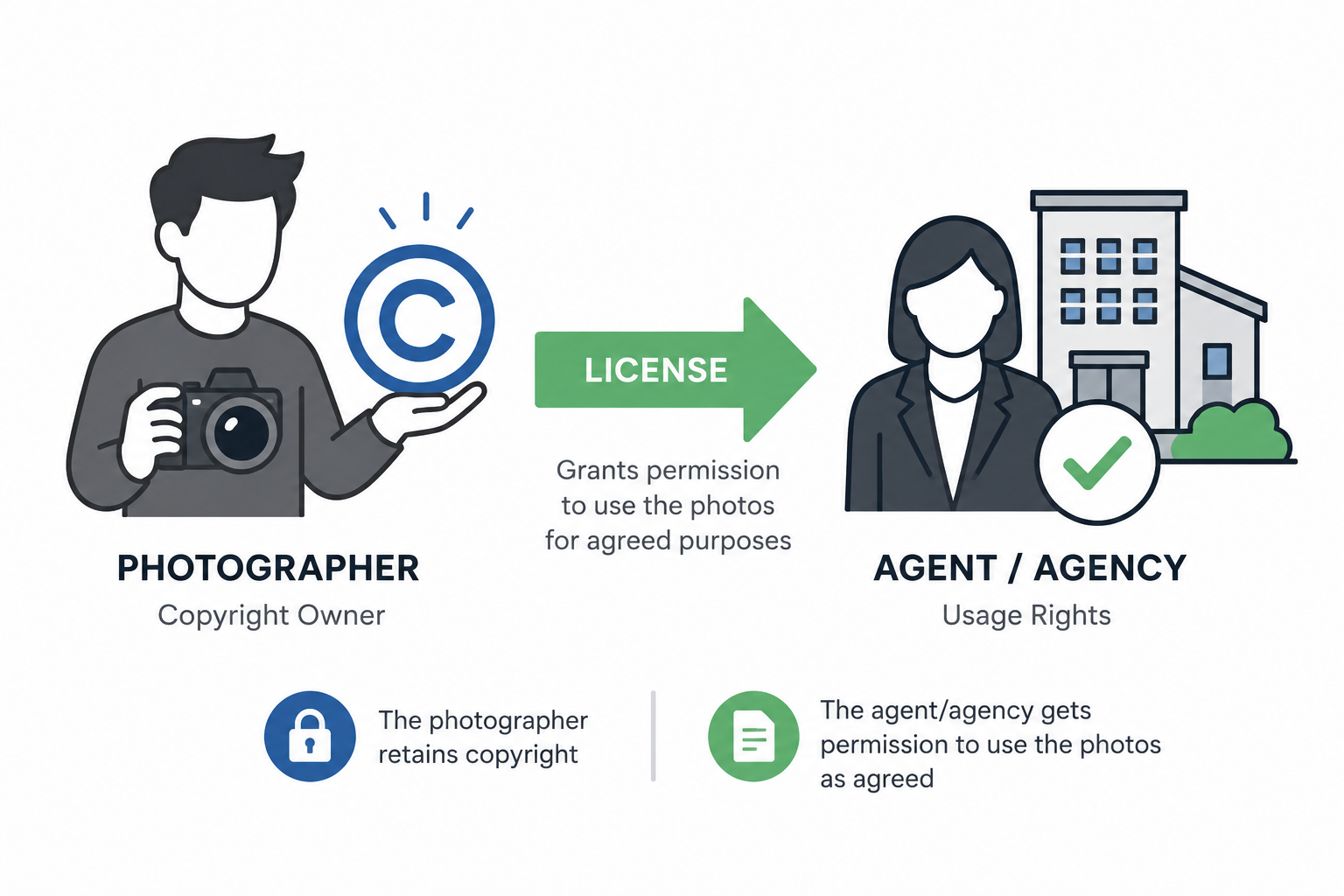
This distinction matters practically. Owning the copyright means you, as the photographer, retain the right to display the work in your own portfolio, control how broadly it's licensed, and potentially charge separately for extended or additional uses beyond what was originally agreed. It's worth stating this ownership structure explicitly in writing, since assuming it's understood without saying so is exactly the kind of ambiguity that leads to disputes later — particularly around whether a tour can be reused for a future listing, a different agent, or a purpose beyond the original property sale.
It's also worth explicitly addressing your own right to use the work in your portfolio and marketing, since this is easy to overlook and occasionally a source of friction if a client assumes exclusivity was implied. Stating clearly that you retain the right to showcase the work as an example of your services — while still respecting reasonable client confidentiality where genuinely warranted, such as a high-profile sale the seller wants kept low-key — avoids an awkward conversation later about whether a piece can appear in your portfolio at all.
A clear virtual tour usage rights contract spells out precisely how the finished work can be used, rather than leaving it as an unstated assumption. Worth specifying explicitly: which specific property or listing the tour is licensed for, whether the license extends to just that one listing or covers relisting if the property doesn't sell within a certain window, whether the agent or agency can use the tour in their own general marketing materials beyond the specific listing, and how long the license lasts before it needs to be renewed or renegotiated.
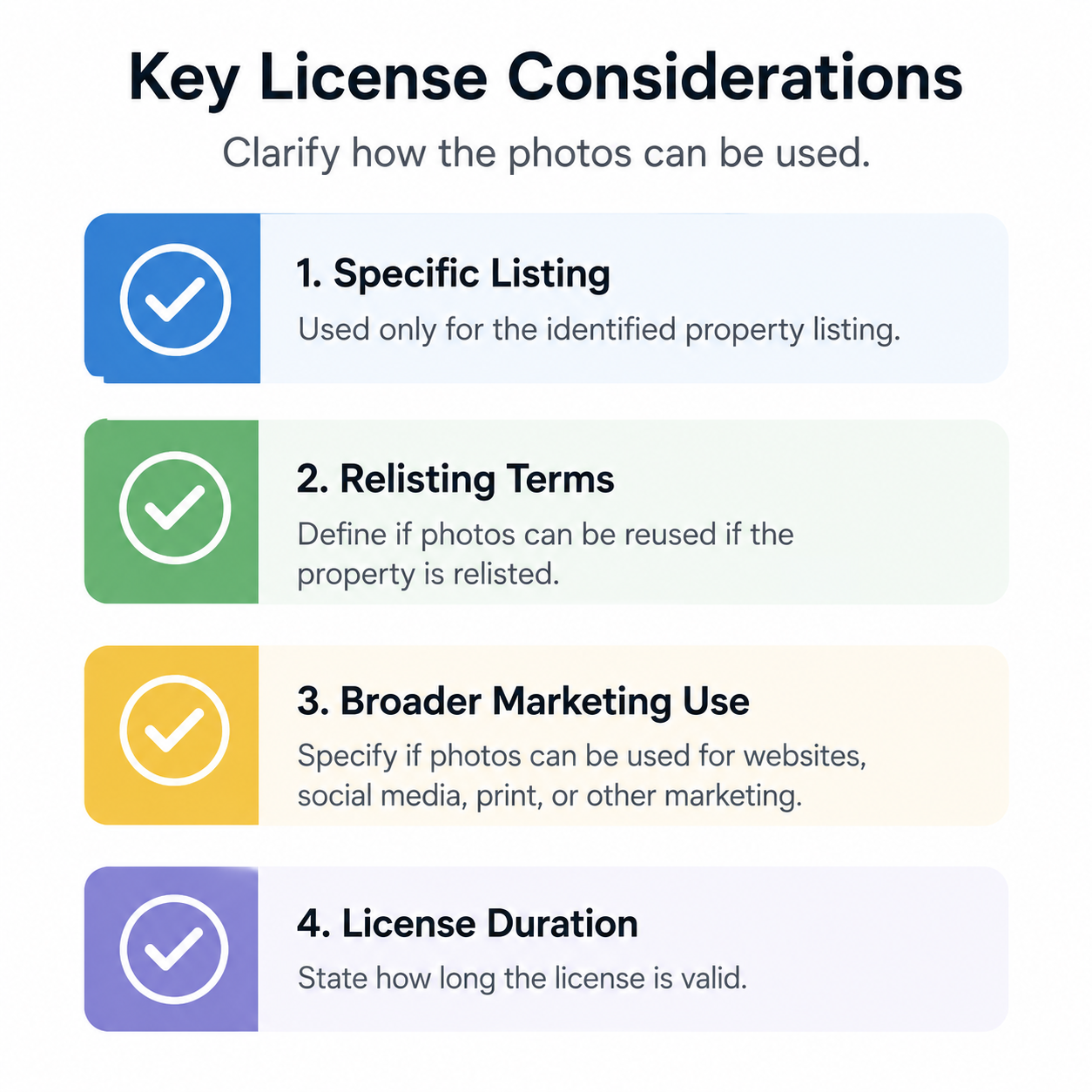
It's also worth addressing what happens if the same tour needs to be used again later — a property that's withdrawn and relisted months afterward, for example. Deciding in advance whether that requires a new agreement, an extension of the original license, or falls under the original terms avoids an awkward conversation happening reactively, under time pressure, after the fact.
Sub-licensing is another point worth clarifying, particularly for agency relationships. If an agent wants to pass the tour along to a marketing team, a franchise head office, or a third-party platform beyond realestate.com.au itself, it's worth specifying whether that's included in the original license or requires separate permission. Being specific here protects you from a tour being used far more broadly than you intended for the price originally agreed, while giving the agent clarity on exactly what they're allowed to do with the finished work.
Beyond usage rights, a solid agreement covers the practical business terms that prevent misunderstandings mid-project. Payment terms should specify when payment is due — on booking, on delivery, or a defined period afterward — and what happens if payment is late. Cancellation terms matter enormously in real estate specifically, since settlements fall through, sellers change their minds, and shoots get rescheduled regularly; deciding in advance whether a cancellation fee applies, and at what notice period, protects your time without souring an otherwise good client relationship over what's usually a genuine change in circumstances rather than bad faith.
Revision policy is worth spelling out too — how many rounds of minor corrections are included at no extra cost, and what counts as a revision versus a request for genuinely new work (like an additional room that wasn't part of the original shoot). Delivery timelines should be clear and realistic, stating your standard turnaround and any agreed rush-delivery terms if the agent needs the finished tour faster than usual.
Rather than drafting a new agreement from scratch for every job, most photographers benefit from a real estate photography contract template they can reuse and lightly customize per client — filling in the specific property, price, and any job-specific details while keeping the core terms consistent. A reusable template covering ownership and licensing, usage rights, payment and cancellation terms, revision policy, and delivery timelines gives you a consistent, professional foundation for every client relationship, rather than reinventing the terms — and potentially forgetting something important — each time.
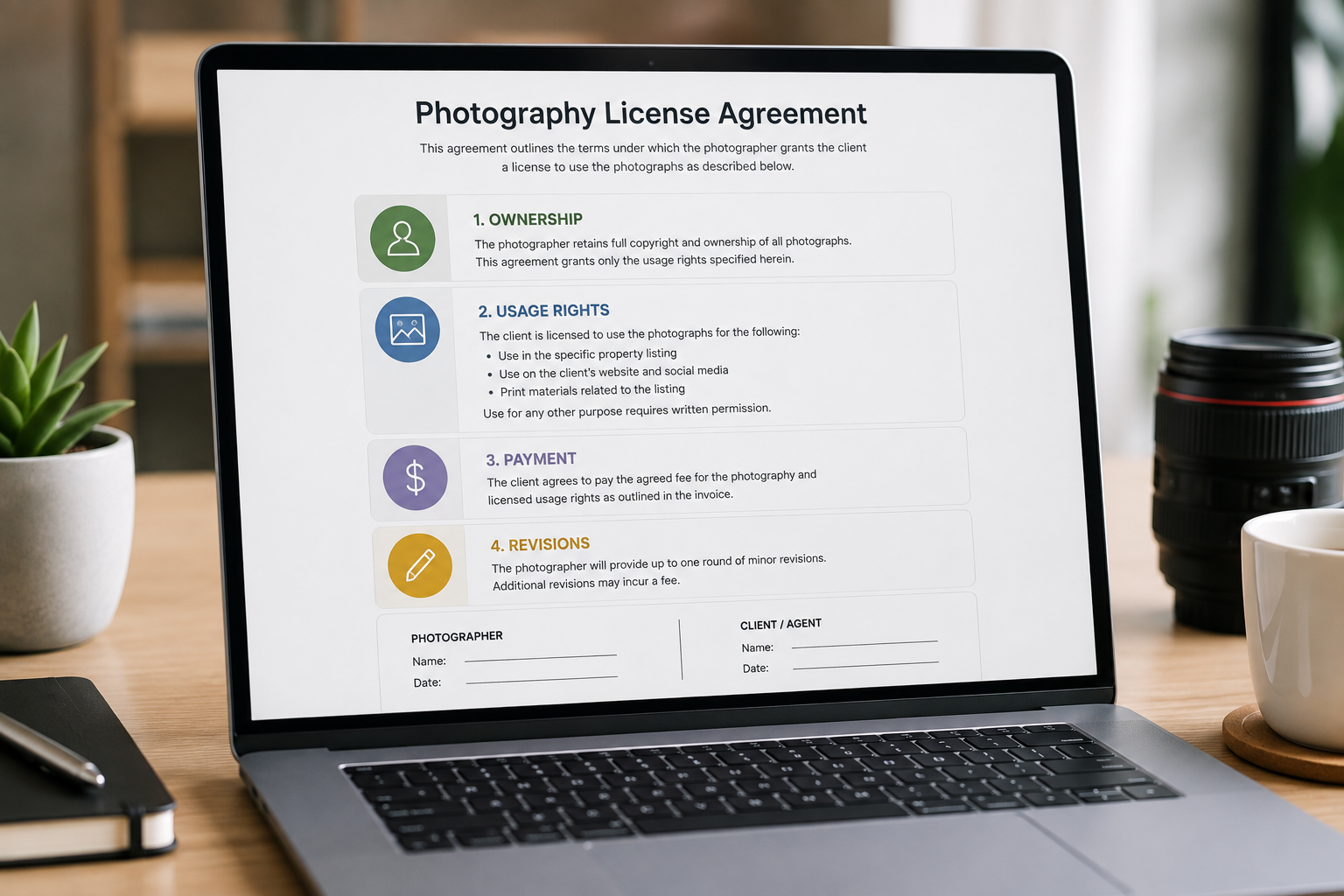
Having a lawyer review this template once, thoroughly, tends to be far more cost-effective than seeking one-off legal advice for every individual job. Once your template is solid, you can reuse it confidently across most standard bookings, reserving individual legal review for genuinely unusual situations — a large commercial contract, an ongoing agency-wide arrangement, or a dispute.
A clear virtual tour service contract real estate professionals can rely on protects both you and your client by making usage rights, payment terms, and expectations explicit rather than assumed. Cover ownership and licensing clearly, specify exactly how the finished work can be used, and settle payment, cancellation, and revision terms upfront so nothing gets negotiated reactively under pressure once a disagreement has already started.
Beyond contracts specifically, the insurance and legal basics every virtual tour photographer needs covers the broader protection worth having in place as you build this into a real business — and remember, this article is a starting point for that conversation with a qualified professional, not a substitute for one.
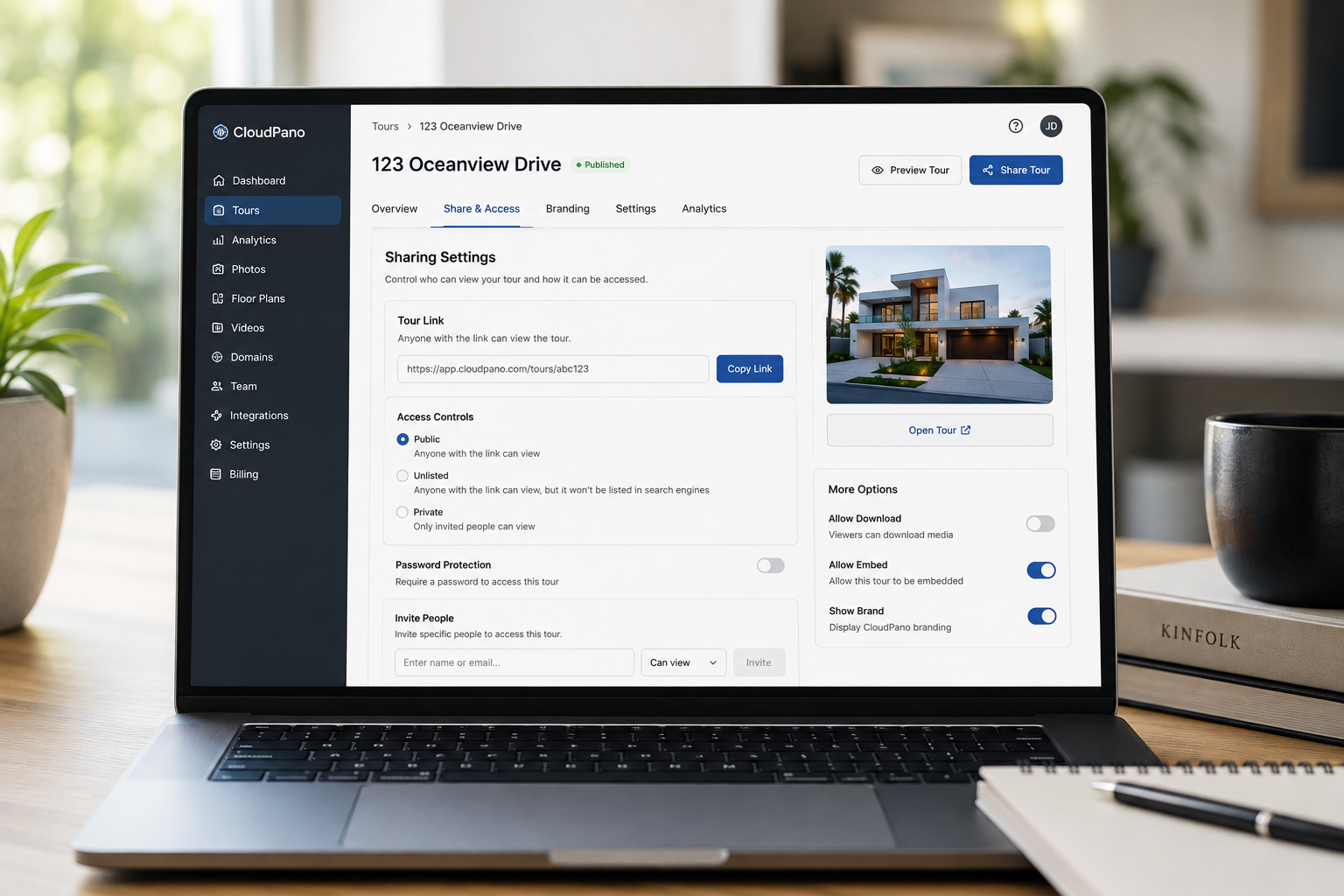
If you're ready to formalize how you deliver and license your work, CloudPano's sharing and delivery tools make it easy to control exactly how and where a finished tour is accessed once your contract terms are in place — turning the terms you've agreed on paper into something you can actually enforce in practice.


Compact, ready to go anywhere
Interchangeable lens that’s upgradeable
Dual 1-inch sensors for improved clarity and low light performance
Dynamic range and 6K 360° capture
360° photo resolution at 21MP

8K 360° video recording for ultra-detailed visuals.
4K single-lens mode for traditional wide-angle shots.
Invisible selfie stick effect for drone-like perspectives.
2.5-inch touchscreen with Gorilla Glass protection.
Waterproof up to 33ft for underwater shooting.

360° photo resolution in 23MP
Slim design at 24 mm thick
Built-in image stabilization for smooth video capture.
Internal 19GB storage for photo and video storage.
Wireless connectivity for remote control and sharing.

60MP 360° still images for high-resolution photography.
5.7K 360° video recording at 30fps.
2.25-inch touchscreen for intuitive control.
USB Type-C port for fast charging and data transfer.
MicroSD card slot for expandable storage.
.png)

.png)

Try it free. No credit card required. Instant set-up.






.svg)


.svg)