


.png)



Being good at shooting virtual tours and being good at selling them are two entirely different skills, and plenty of talented photographers stall out precisely because they never build the second one. Learning how to sell virtual tour services to real estate agents is what turns a hobby or a handful of one-off jobs into an actual business with repeat clients and predictable income.
This guide covers the whole selling side of the equation: how to pitch agents in a way that lands, how to price your services so agents see the value, how to handle common objections, and how to build the kind of relationships that turn a single job into a standing arrangement. If you're still deciding whether to start a virtual tour business real estate professionals will actually pay for, the short answer is yes — agents increasingly expect this as part of a full-service listing, which is exactly why there's room for photographers who sell it well.
Before pitching anyone, it helps to understand what an agent is really buying when they pay for a virtual tour. It's rarely just "a 360° video" in the abstract — it's a tool that helps them win the listing appointment in the first place, market the property more effectively once listed, and look like a full-service operator compared to competing agents pitching the same seller.
That distinction matters because it changes how you frame your pitch. Rather than leading with technical features — resolution, stitching quality, navigation style — lead with outcomes agents actually care about: faster qualified enquiries, a stronger listing presentation, and one less thing they need to coordinate themselves. Agents are busy, and a service that's easy to book, reliably delivered, and clearly valuable wins far more often than one with the most impressive spec sheet.
This is also where pricing your packages so agents see clear value matters as much as the pitch itself. A price that's framed purely as a cost line item invites price-shopping and hesitation, while a price framed around a specific outcome — "this typically increases enquiry volume on a listing" or "this saves you coordinating a separate vendor" — gives the agent a much easier case to make internally, whether that's to their principal, their seller, or simply to themselves when deciding whether it's worth the spend.
Cold-pitching an agent who's never used a virtual tour service for real estate agencies before requires a slightly different approach than pitching one who already understands the value and just needs convincing to use you specifically.
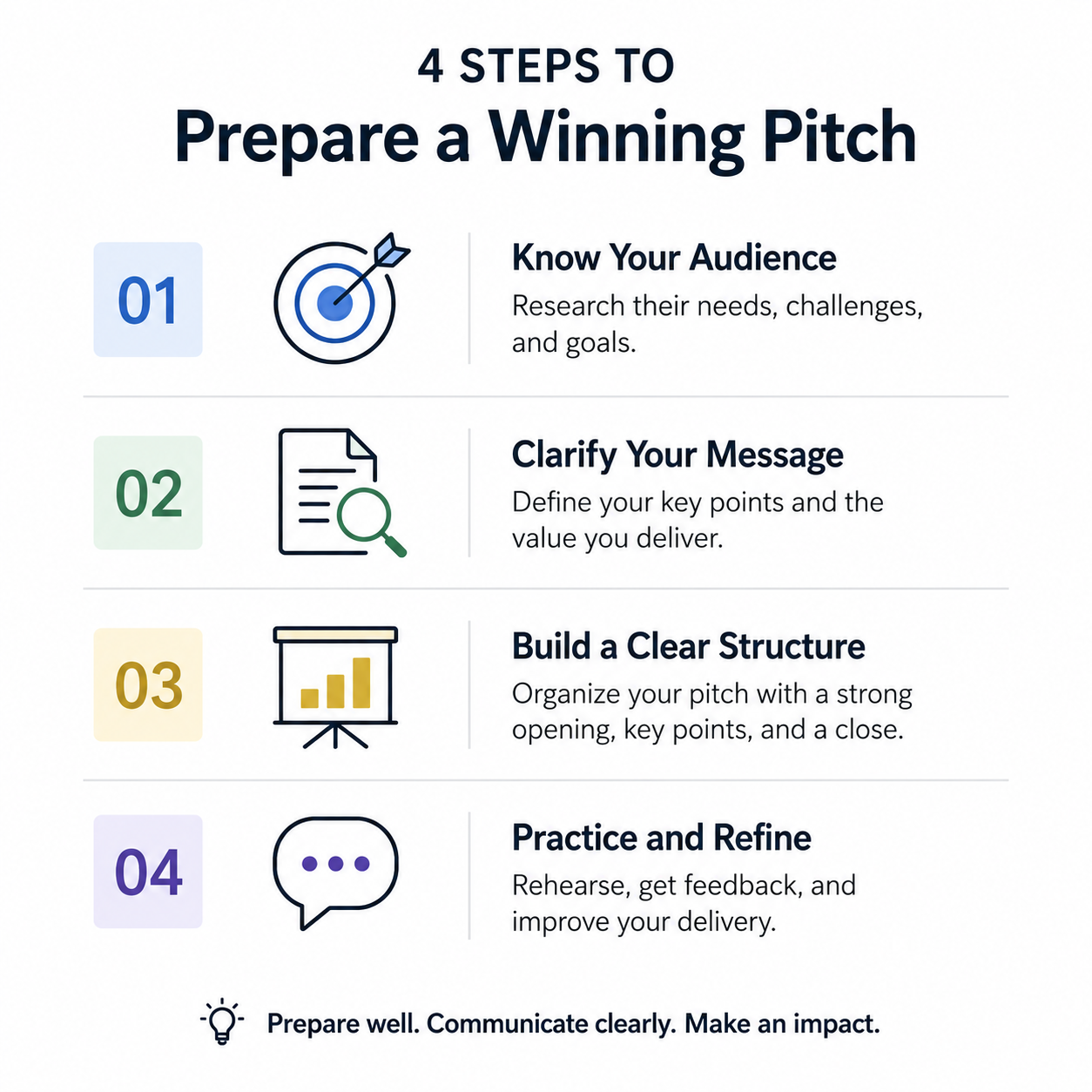
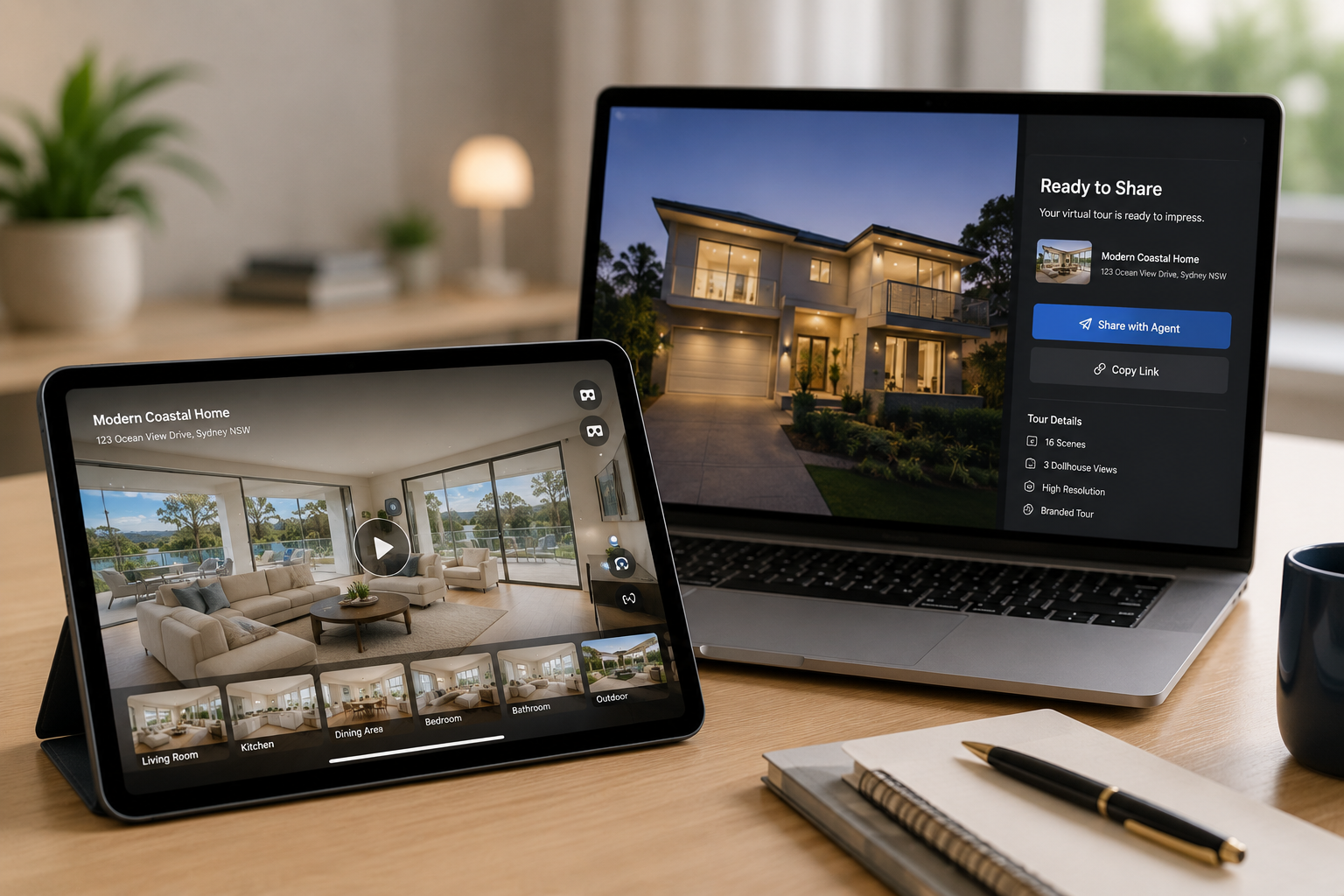
For agents new to virtual tours, focus the pitch on a low-risk first step — offering a discounted or even free tour on their next listing so they can see the result firsthand, rather than asking for a full commitment on faith. Bring a sample tour of a similar property type to the meeting or email, since agents evaluating an unfamiliar service respond far more to seeing an actual example than reading a description of one. Keep the ask specific and easy to say yes to: a particular upcoming listing, a clear price, and a clear turnaround time, rather than a vague "let me know if you're ever interested."
Timing matters more than most new photographers expect. Reaching out right when an agent has just picked up a new listing and is actively planning its marketing is far more effective than a generic introduction email sent with no specific opportunity attached. A short, direct message referencing a real, current listing — "I noticed you've just listed [property] — I'd love to offer a virtual tour for it at no cost so you can see the finished result" — converts noticeably better than a broad services overview, because it gives the agent something concrete and immediate to say yes to rather than a hypothetical future consideration.
A handful of objections come up repeatedly when you're trying to sell 360 tours to realtors, and having a ready, honest response to each makes the difference between a stalled conversation and a booked job.
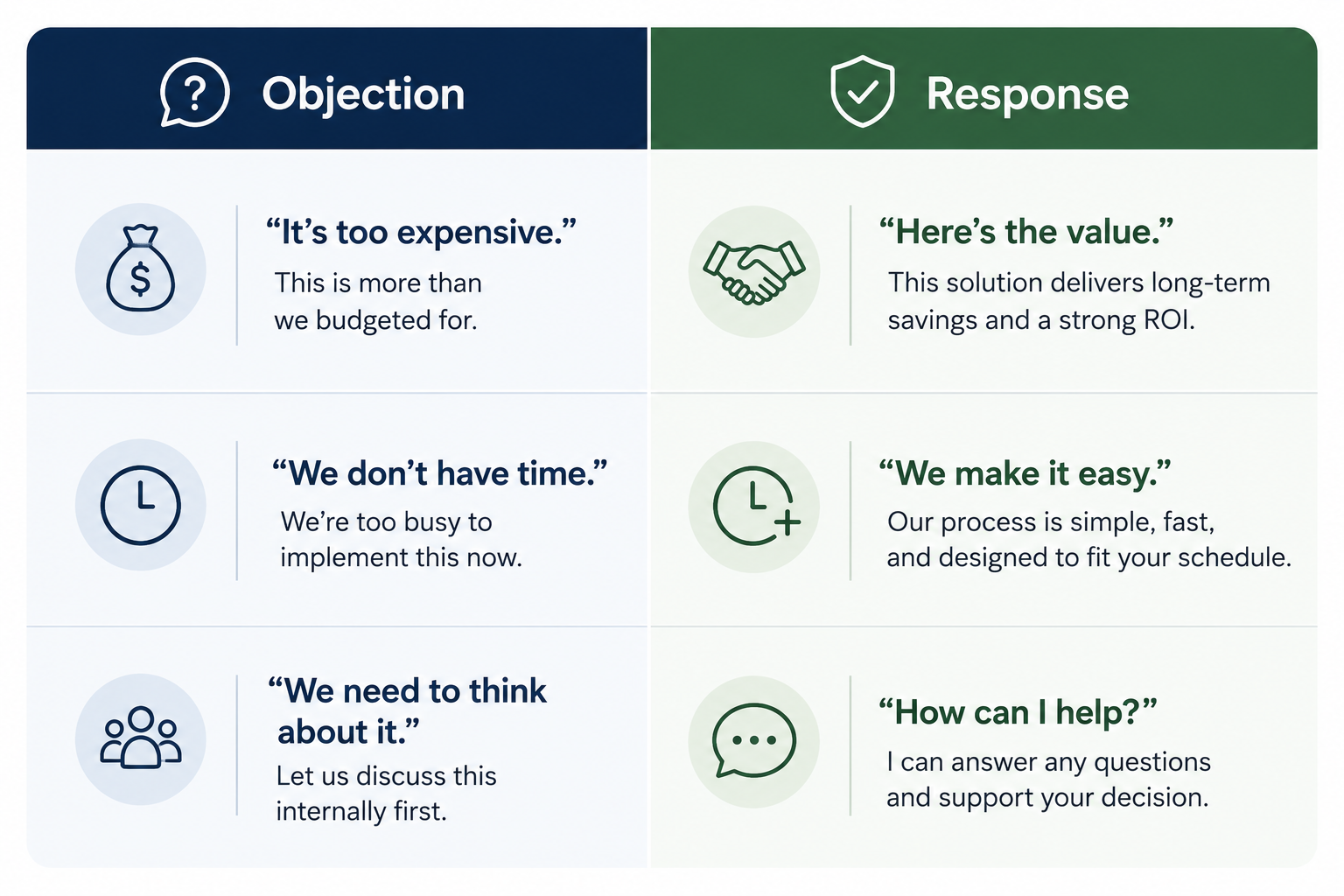
"My photographer already does something similar" is common, and the honest response is to ask what that currently looks like and offer a genuinely comparable sample rather than disparaging a colleague's work — often the existing offering is a basic panorama rather than a proper stitched, navigable tour, and a side-by-side comparison speaks for itself. "I'm not sure sellers will pay for it" shifts the framing: position the tour as part of your marketing package rather than a separate cost passed on to the seller, similar to professional photography or floor plans. "We've tried it before and it didn't help" is worth digging into specifically — often the issue was a poorly produced tour rather than the concept itself, and the data that shows virtual tours improve listing performance is worth having on hand for this exact conversation.
Getting your first few agency relationships is usually the hardest part, since you don't yet have a track record to point to. Real estate photographers who successfully break in tend to start narrow and local — targeting a handful of agencies in a specific area rather than mass-emailing every agency in the state — and lead with a genuinely low-friction offer for a real, current listing rather than a generic cold pitch with no specific opportunity attached.

Attending local real estate industry events, open homes, or agency office visits in person tends to convert better than cold email alone, since agents are more likely to remember and trust someone they've actually met. Once you've delivered a handful of strong results, ask directly for a testimonial or a referral to another agent at the same agency — a warm introduction from a colleague converts at a dramatically higher rate than any cold outreach.
Building a simple, shareable portfolio of your best work early on makes every subsequent pitch easier, since you're no longer relying purely on description or a single sample — you can point to a handful of genuinely strong, varied tours across different property types. It's also worth being patient with the ramp-up period: most photographers underestimate how many conversations it takes before the first booking lands, and overestimate how quickly a steady stream of repeat work follows after that. Treating the first several months as relationship-building rather than immediate volume tends to produce a more durable business than chasing every possible lead at once.
Winning the first job is one thing; becoming the agent's default choice for every future listing is the real goal. Consistency is what separates a one-off vendor from a genuine virtual tour service for real estate agencies rely on repeatedly — the same reliable turnaround time, the same quality bar, and easy, low-friction booking every time, without the agent needing to chase you for updates.
Clear communication compounds this trust over time: confirming bookings promptly, delivering exactly when promised, and flagging any issues before the agent has to ask about them. Agents talk to each other constantly, and a reputation for reliability spreads through referral far faster in this industry than any advertising spend could.
It's also worth formalizing the relationship once it becomes regular, rather than leaving every booking as an informal one-off arrangement. A simple standing agreement — an agreed price list, a standard turnaround time, and a clear booking process — makes it effortless for an agent to keep coming back to you specifically, rather than defaulting to whichever vendor happens to be top of mind when a new listing comes in. The easier you make it to keep choosing you, the less price and convenience become a reason to shop around.
Learning how to sell virtual tour services to real estate agents comes down to understanding what agents are actually buying, pitching in a way that's low-risk for a first-time client, handling objections honestly rather than defensively, and building the kind of consistent, dependable relationship that turns a single booking into a standing arrangement. None of this requires aggressive sales tactics — it requires being genuinely useful and reliable, consistently, over time, which is a far more sustainable foundation for a business than relying on a constant stream of new cold outreach.
Once you're landing consistent client work, turning this into a repeatable business is the next step — from pricing structures to scaling your capacity as demand grows.
If you're ready to make that pitch backed by software built specifically for real estate, CloudPano helps you deliver a consistently professional result agents will want to book again — the kind of reliable, polished outcome that turns a single trial listing into a standing relationship you can build a business around.


Compact, ready to go anywhere
Interchangeable lens that’s upgradeable
Dual 1-inch sensors for improved clarity and low light performance
Dynamic range and 6K 360° capture
360° photo resolution at 21MP

8K 360° video recording for ultra-detailed visuals.
4K single-lens mode for traditional wide-angle shots.
Invisible selfie stick effect for drone-like perspectives.
2.5-inch touchscreen with Gorilla Glass protection.
Waterproof up to 33ft for underwater shooting.

360° photo resolution in 23MP
Slim design at 24 mm thick
Built-in image stabilization for smooth video capture.
Internal 19GB storage for photo and video storage.
Wireless connectivity for remote control and sharing.

60MP 360° still images for high-resolution photography.
5.7K 360° video recording at 30fps.
2.25-inch touchscreen for intuitive control.
USB Type-C port for fast charging and data transfer.
MicroSD card slot for expandable storage.
.png)

.png)

Try it free. No credit card required. Instant set-up.






.svg)


.svg)