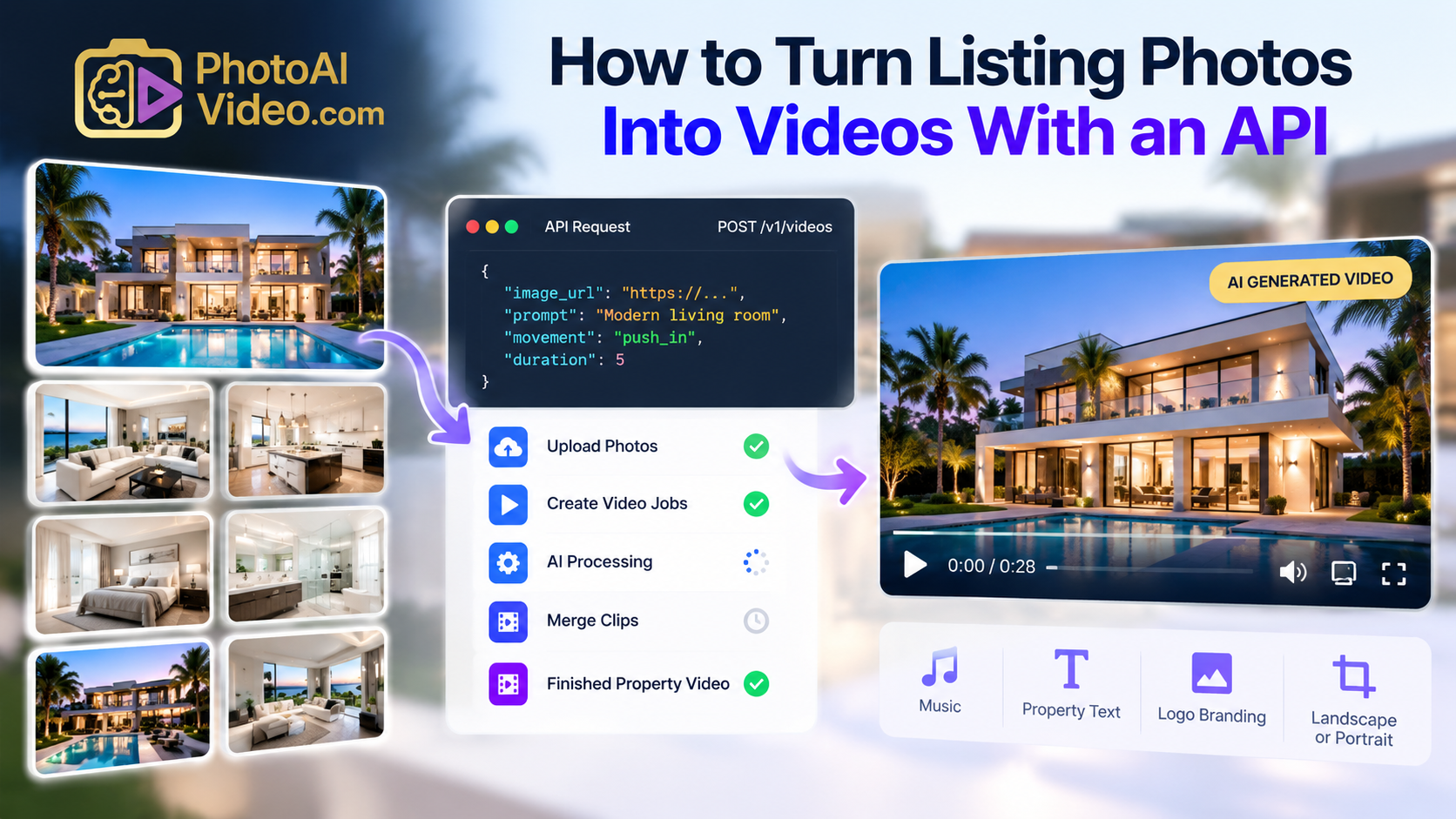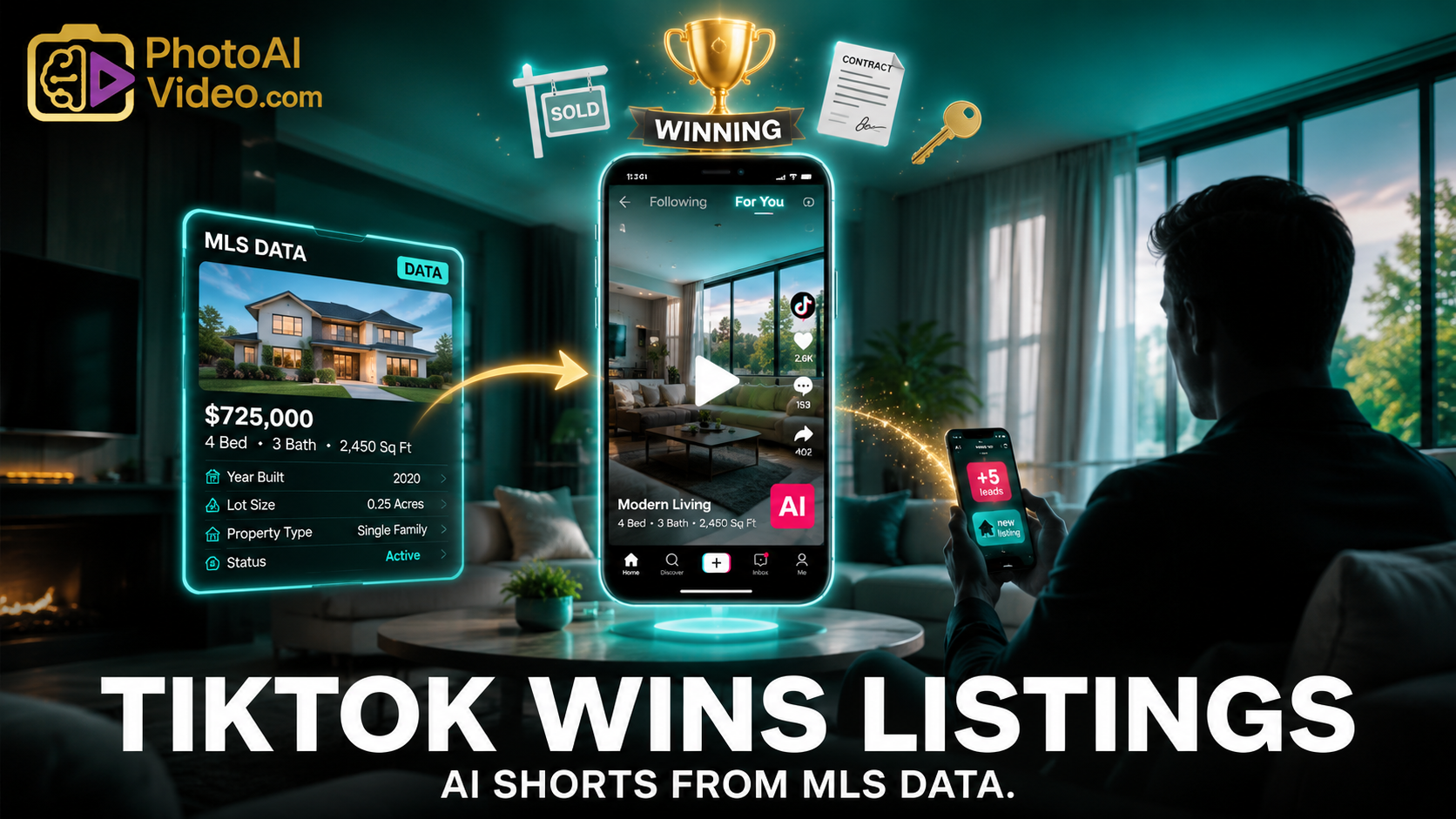
TikTok for Real Estate: How Agents Are Winning Client Listings with AI Shorts from MLS Data

Cloudpano
May 17, 2026
5 min read
Share this post

TikTok for Real Estate: How Agents Are Winning Client Listings with AI Shorts from MLS Data

Let’s be honest about the current state of real estate marketing. Everyone—your broker, that "guru" on YouTube, the successful team across town—tells you that you must be producing high-volume short videos. They say you need a presence on the AI TikTok videos for real estate scene to stay relevant.

But here’s the reality for most active agents: your schedule is already completely underwater. You’re managing active transaction checklists, scheduling residential appraisals, and running local property previews. You don't have empty hours to spend writing marketing scripts, mastering convoluted desktop video editors, or waiting days for production house edits to come back.

This production friction creates a huge bottleneck. If you refuse to upload video items, major network feeds will bury your public profile. According to data layout and user behavior research from the Nielsen Norman Group, modern consumers consume visual data pools via rapid, pattern-based scanning behaviors inside mobile channels. They skip unmoving text boxes and static photo carousels in milliseconds.

This environment leaves you trapped. Hiring specialized camera operators to film high-end cinema walkthroughs for every mid-market listing drains your operational budget. Trying to solve the problem by forcing your sales team to become amateur videographers is a recipe for burn out. You need an automated software framework that generates verified visibility from the assets you already possess.

Shifting Your Daily Workflow: Animating existing Passive Media Assets

To break this media construction logjam and lock down your CRM growth, you must stop treating visual generation as a manual, slow art project. It needs to be approached as a standardized, fast-looping operational task. Look at what’s already sitting in your local database storage. Your team is already investing hundreds of dollars per listing to capture crisp, high-resolution interior and exterior architectural photography. Leaving those premium listing graphics sitting flat on an inventory table is a major missed visual reach opportunity.

This is exactly where PhotoAIVideo.com changes your visual pipeline velocity. Running as an intuitive, browser-based app, it functions as a dedicated real estate Reels app built to remove construction bottlenecks.

Instead of dealing with complicated multi-track timelines or organizing expensive localized filming logistics, you simply drop your raw, static property photos into the processing dashboard. The system translates flat 2D data into full-screen, native 9:16 vertical motion fields instantly. This allows you to publish premium video loop assets for your entire property index simultaneously, sustaining your public presence without draining your calendar or budget.

Visual Transformation Matrix

Verification of raw visual asset activation.

Status: Render Complete
Static Listing Source Asset
Source MLS Layer

Static 2D Framework: Passive architectural perspective. Suppressed by mobile feeds due to lack of pattern interrupt.

Low Pull Index
AI Generated Real Estate Video Preview
Activated Video Frame

Active 3D Parallax: Multilayer depth simulation constructs native motion tracking signals.

Velocity Boosted

The Tech Simplified: How Multi-Plane Calculations Fabricate Depth

The primary psychological reason this loop style triggers such massive viewer focus inside mobile visual fields is rooted in geometric pattern interrupt. Standard desktop templates create fake visual motion by merely zooming in on a single photo layer. This produces an unnatural, generic stretch effect that modern consumers discard as noisy advertisement. Understanding how the program map layout can structure a high-fidelity visual is crucial.

When you slide a property photograph into the render queue, the platform runs advanced computer vision calculations called monocular depth mapping. The algorithm breaks down color data, edge contrast, and spatial lines across the asset. It constructs a relative geometry map, isolating structural items that occupy the near foreground—such as staged marble kitchen counter islands, floating glass railings, or outdoor concrete pool lines—and splits them entirely from deep background fields, like vaulted terrace doors or distant geographic foliage lines.

Once the application splits these distinct graphic planes, it implements a programmed parallax motion matrix. By drifting the near layer along a slightly faster line relative to the backdrop matrix, it accurately duplicates the pattern interrupt cue of human volumetric vision.

The resulting loop file functions as a verified real estate Reels generator AI output that perfectly duplicates an expansive cinematic camera stabilizer sliding gracefull past an architectural feature. Because structural proportions and dimensions remain factually true, homebuyers get an honest perception of spatial layout, cementing real-world credibility before they ever submit an inbound view request.

The Velocity Playbook: MLS Assets to Live Campaigns in 4 Steps

Scaling up your regional influence across all active nets requires strict operational frequency. Implementing aProgrammatic AI social media videos for Realtors production matrix gives your office the capacity to turn unmoving listing folders into active social campaigns in fewer steps than it takes to schedule a physical appraisal:

  1. Passive Media Pull: Collect 3 to 5 clear, high-resolution interior master frames or front exterior views from your local listing folders. Compositions with visible foreground structural components create the deepest volumetric drift.
  2. Instant Translation: Drag your raw files directly into the cloud processing hub. The automated engine separates structural layers and renders full portrait 9:16 files in seconds.
  3. Channel Distribution: Sync your processed parallax video creatives directly into your live visual nets, targeting vertical-first nodes such as Instagram Reels, TikTok, and YouTube Shorts.
  4. Frictionless Conversion: Connect your looping property previews with clean, automated property valuation forms or neighborhood guide downloads to capture verified contact records and feed your CRM on autopilot.

The Real Estate Production Velocity Workflow

1
Load Asset
MLS Photo Import

Drop high-res static images into the browser panel window.

2
Activate geometry
Dimensional Rendering

Neural net computes depth data and maps layer planes.

3
Build funnel
Lead Capture Sync

Pair raw view metrics with automated inbound valuation forms.

Mastering Vertical Feed Dynamics: Overcoming the 3-Second Rule

Consumer media browsing behavior on smart mobile screens has evolved to become fiercely selective. Rigorous research into patterns of human visibility by TechCrunch confirms that mobile users consume visual content streams using rapid cognitive pattern filtering, rejecting predictable branded templates within milliseconds. Inside any highly competitive vertical visual channel, your property creative has exactly three seconds to score a physical thumb-stop and earn user concentration.

If your content opens with slow-fading logos, static introductory text blocks, or unmoving listing shots, your target demographic scrolls right past. Social data auctions measure this early user departure with zero tolerance. When prospects exit your clip within the first two seconds, data systems score your pattern interrupt weight as low, which automatically drops your baseline organic reach and drives up your required advertising costs.

Transitioning to high-motion real estate Reels app output solves this behavioral obstacle entirely. Because the 3D parallax transformation applies smooth, drifting volumetric movement from the literal first frame, you activate a primal human tracking response.

The eyes hold focus on the screen because the brain naturally takes a split second to decode the unfold spatial depth variations. This pattern interrupt hook preserves retention long enough for prospective leads to digest your property value proposition caption and click your inbound inquiry links, optimizing your media funnel ROI.

Paid Feed Optimization Matrix
Live Feed Data API
Profile Retention (3s Hook) +185% vs Static Listings
Cost-Per-Lead (CPL) -42% Feed Auction Balance
Inbound DM Frequency 3.4x Listing Intent Captured

Sustaining Business Momentum: Ramping Frequency Without Visual Fatigue

Paid user acquisition growth demands strict awareness of creative fatigue thresholds. Comprehensive ad diagnostics documented by Meta for Business reveal that modern mobile markets experience visual exhaustion and pattern rejection faster than almost any other regional vertical. If your office depends completely on slow manual filming turnarounds or expensive third-party localized editing contracts, you cannot support creative testing volume. You find yourself running the identical walking walkthrough clip to the same market demographic for weeks, driving your target lead costs up as performance decays.

Shifting construction over to automated cloud rendering tools entirely decouples your account testing speed from your marketing checkbook. Your growth manager can instantly output 15 distinct, high-motion parallax variations from a single property shoot folder in an afternoon, testing out alternative interior perspectives, motion tracks, and drift directions to discover exactly what triggers high geographic response.

This continuous creative output feeds a reliable multi-tier acquisition funnel built to convert lookers into listing contracts:

[Funnel Graphic showing automated social loops at TOFU, Consideration metric pages at MOFU, and Lead capture sheet at BOFU]

  • Top-of-Funnel Distribution (Feed Reach): Immersive 3D parallax vertical video ad units hit wide regional geographic filters, maximizing raw impressions while populating retargeting lists.
  • Middle-of-Funnel Evaluation (Consideration): Home searchers who engaged receive automated remarketing views showcasing secondary rooms—like premium master bathrooms or kitchen islands—paired with neighborhood pricing metrics.
  • Bottom-of-Funnel Direct Capture (Action): High-intent local leads navigate past automated view portals to submit verified contact sheets to confirm open house slots.

Programmatic Social Client Acquisition Funnel

1. High-Velocity Feed Discovery (TOFU)

Automated 3D parallax short-form loops secure massive organic view distribution layers.

2. Visual Community Nurture (MOFU)

Regional prospects analyze deep property spatial architecture data across remarketing views.

3. Direct Inbound Capture (BOFU)

Active regional home buyers submit verified contact sheets to confirm viewing slots.

Technical Visual Failures to Scrub from Your Workflow

Adapting aProgrammatic output pipelineAwards your office a massive tactical advantage, but you must still monitor fundamental structural guardrails to prevent your brand from suffering visual decay across local target territories:

  • Stretched or Low-Resolution Source Files: The background layer depth estimation code requires high-contrast pixel information to map geometric contours cleanly. Uploading low-light mobile files will generate jagged artifact distortions along moving architectural boundaries. Demand uncompressed architectural shots.
  • Text Block Overcrowding: Overcrowding a multi-plane 3D render with giant text boxes, flashing promotion badges, brokerage phone numbers, and flashing emojis completely destroys the pattern interrupt cue. It blocks the volumetric depth information and triggers visual annoyance. Keep text modifications minimal and clear of mobile player safe-zone lines.
  • Wide-Aspect Ratio Distortion: Avoid dropping standard 16:9 horizontal MLS shots into dedicated vertical placements. Wide files leave large empty black visual fields at the top and bottom of mobile interfaces, cutting down your pattern interrupt real estate. Force your outputs to native 9:16 portrait parameters to command the full mobile viewport.

Dominating Your Region with Creative Velocity

The production groups locking down the highest concentration of client contracts across modern real estate markets are not winning purely on brute financial spend. They rule their territories because they choose high creative velocity—the capacity to convert static photographic folders into dozens of moving, conversion-optimized video assets before competitive offices can even clear an appointment slot with a localized third-party videography group.

Instead of burning valuable commission capital on heavy localized localized localized localized localised agency localized localized localized localizedlocalized localized localized localizedlocalized localized localized localised localised localised localised agencyisedlocalized localized agencyised localized localized agency localized localized agent margins or wasting agent time on complex technical technical technical technical technical technical technical technical technical software tutorials, move your visual design pipeline to automated cloud rendering tools. Introduce true dimensional scale to your passive MLS folders, capture immediate consumer blocks, and expand your public reach footprint by injecting cinematic 3D visual motion into your daily inventory listing list.

The AI Listing Video Advantage

Stop selling static listing photos and start creating high-converting AI real estate videos. PhotoAIVideo transforms property images into cinematic reels, social ads, and listing videos optimized for TikTok, Instagram Reels, Facebook, and YouTube Shorts — helping Realtors scale content creation and generate more engagement from every listing.

Turn every MLS listing into a marketing asset with AI-powered video automation designed for modern real estate marketing.

🎬 Book Your Demo Now! →

🚀 Your All-In-One Virtual Experience Stack Starts Here

Share this post
Cloudpano

Choose The Right 360° Camera

Insta360 ONE RS 1-Inch 360 Edition

  • Compact, ready to go anywhere

  • Interchangeable lens that’s upgradeable

  • Dual 1-inch sensors for improved clarity and low light performance

  • Dynamic range and 6K 360° capture

  • 360° photo resolution at 21MP

Learn More

Insta360 X4

  • 8K 360° video recording for ultra-detailed visuals.

  • 4K single-lens mode for traditional wide-angle shots.

  • Invisible selfie stick effect for drone-like perspectives.

  • 2.5-inch touchscreen with Gorilla Glass protection.

  • Waterproof up to 33ft for underwater shooting.

Learn More

Ricoh Theta Z1

  • 360° photo resolution in 23MP

  • Slim design at 24 mm thick

  • Built-in image stabilization for smooth video capture.

  • Internal 19GB storage for photo and video storage.

  • Wireless connectivity for remote control and sharing.

Learn More

Ricoh Theta X

  • 60MP 360° still images for high-resolution photography.

  • 5.7K 360° video recording at 30fps.

  • 2.25-inch touchscreen for intuitive control.

  • USB Type-C port for fast charging and data transfer.

  • MicroSD card slot for expandable storage.

Learn More
Property Marketing
Allows potential buyers to explore properties in detail from anywhere, enhancing the real estate marketing process.
Automotive Spins
Create an interactive virtual showroom and engage affluent digital buyers with live 360º video calls, all through the CloudPano mobile app for a complete automotive sales solution.
Interactive Floor Plans
Create 2D and 3D floor plans with measurements in 4 minutes or less, all from your phone. Download the Floor Plan Scanner app and get your first scan free.

360 Virtual Tours With CloudPano.com. Get Started Today.

Try it free. No credit card required. Instant set-up.

Try it free
Latest posts

See our other posts

Interviews, tips, guides, industry best practices, and news.

Property Manager Video Hub: Scaling Rental Visibility with AI Photo-to-Video Workflows

This article explains how property managers can use PhotoAIVideo to build a property manager video hub: a repeatable system for turning rental photos, amenity images, floor plans, exterior shots, and neighborhood visuals into reusable rental marketing videos. The main idea is that property managers do not just need more listing exposure. They need clearer visual answers that help renters decide whether to schedule a tour. PhotoAIVideo is positioned as a practical tool for creating: Unit availability videos Amenity highlight videos Neighborhood videos Tour reminder clips Leasing follow-up videos Owner marketing proof videos Social media rental teasers Application or availability reminder videos Key takeaways: Property managers already have the media they need; the challenge is organizing it and turning it into reusable video assets. A video hub helps teams create consistent videos across units, floor plans, amenities, communities, and owner updates. Rental videos can reduce friction by answering renter questions about layout, condition, amenities, parking, pet features, and community feel. One rental photo set can become multiple video outputs for listings, social media, email, text follow-up, tour reminders, and owner reporting. Photographers can sell AI rental video packages to property managers as an upsell. Brokerages with property management divisions can use the same workflow to standardize leasing content. The article ends with a step-by-step process, video hub framework, mistakes to avoid, visual recommendations, FAQs, and a CTA encouraging readers to use PhotoAIVideo to turn rental photos into a scalable video system for rental visibility.
Read post

YouTube Shorts Listing Teasers: The 3-Scene Structure for Higher Property Clicks

This article explains how real estate agents, photographers, brokerages, and property managers can use YouTube Shorts listing teasers to drive more property clicks and showing requests. The main idea is that a YouTube Short should not try to show the entire house. Instead, it should use a simple 3-scene structure: Scene 1: Hook — stop the scroll with the strongest property feature. Scene 2: Proof — show the visuals that support the hook. Scene 3: Click Path — tell the viewer what to do next. The article positions PhotoAIVideo as a practical tool for turning listing photos into short vertical videos for YouTube Shorts, Reels, open house promotion, and listing campaigns. Key takeaways: YouTube Shorts should create curiosity, not replace the full listing video. The strongest property feature should appear first, not necessarily the front exterior. Agents should build each Short around one click reason, such as backyard, kitchen, layout, neighborhood, open house, or price point. One listing can become multiple Shorts instead of one generic video. Photographers can offer YouTube Shorts teaser packs as a video upsell. Brokerages can standardize the 3-scene structure across agents. Property managers can use the same structure to promote rentals and tours. The article ends with practical scripts, visual recommendations, FAQs, a visual placement guide, and a CTA encouraging readers to use PhotoAIVideo to create YouTube Shorts listing teasers from property photos.
Read post

Video Retargeting for Listings: Turning Photo-Based AI Videos into Appointment Follow-Up

This article explains how Realtors, photographers, brokerages, and property managers can use photo-based AI videos as follow-up assets after someone shows interest in a listing. The main idea is that most real estate marketing focuses on getting the first click, but many buyers and sellers need multiple touchpoints before booking a showing or appointment. Video retargeting helps agents re-engage people who already clicked a listing, watched a Reel, opened an email, attended an open house, asked about a property, or went quiet after showing interest. PhotoAIVideo is positioned as a practical tool for turning listing photos into short follow-up videos, including: Feature reminder videos Layout explainer videos Neighborhood fit videos Open house recap videos Price update videos Seller proof videos Showing request videos Rental tour recovery videos Key takeaways: A first-touch listing video introduces the property, while a retargeting video answers the next likely question. Follow-up videos should be short, usually 10–30 seconds, and focused on one action. Agents should send different videos based on behavior, such as email clicks, open house attendance, listing views, or showing interest. A good video follow-up feels helpful, not pushy. Photographers can package retargeting video clips as an upsell. Brokerages can standardize video retargeting workflows across agents. Property managers can use the same strategy to recover rental leads and book tours. The article ends with a simple retargeting sequence, visual recommendations, FAQs, and a CTA encouraging readers to use PhotoAIVideo to turn listing photos into appointment-driving follow-up videos.
Read post