


.png)


Almost everyone who eventually decides to switch from Matterport to CloudPano goes through a period of uncertainty first — a nagging sense that something isn't quite right, followed by weeks or months of wondering whether that feeling is a real signal or just a bad week with a familiar tool. This article isn't a generic "signs you should switch" list. It's a more specific attempt to separate a genuine, structural reason to move from a temporary frustration that will pass on its own.
That distinction matters, because switching platforms — even a relatively smooth switch — still takes real time and attention. It's worth reserving for situations where the underlying problem is actually structural, not just a rough patch.
A single frustrating support interaction, one client complaint about load time, or a single unexpectedly high invoice doesn't necessarily mean your platform is wrong for your business — it might just mean this particular week went badly. The signals worth taking seriously are the ones that recur, or that are structural rather than incidental: the same type of frustration showing up again and again, tied to how the platform is fundamentally built rather than a one-off glitch.
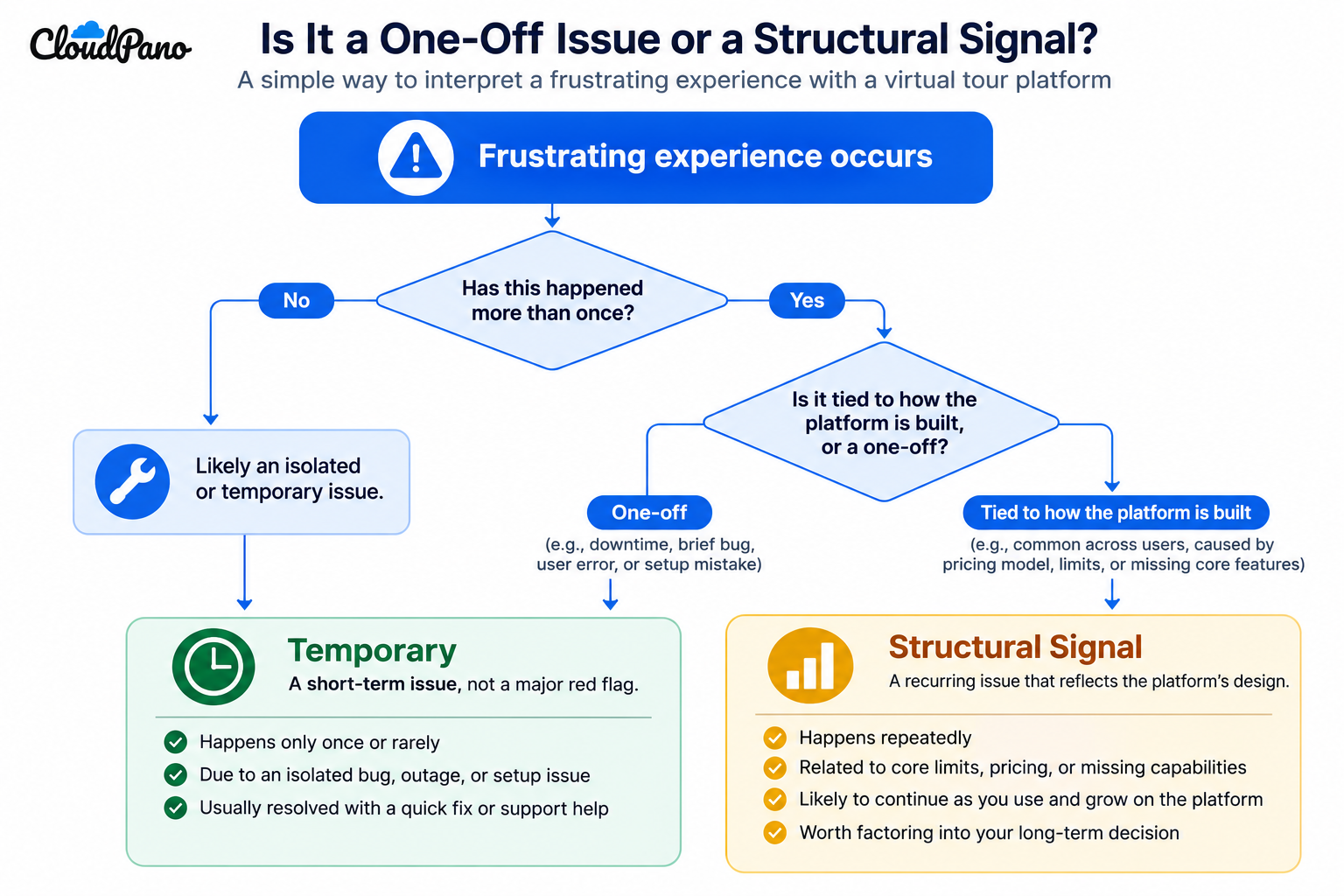
This framing matters because it's easy to either overreact to a single bad experience or underreact to a genuine pattern by explaining each instance away individually. Looking at frequency and root cause, rather than any single event, is the more reliable way to tell the two apart.

If your bill has increased at each renewal without a corresponding increase in the value you're getting — more tours, more features you actually use, better performance — that's a structural signal, not a one-off. This is one of the most commonly cited reasons across matterport alternatives discussions in independent reviews and community threads, and it tends to compound: a small annual increase feels manageable in isolation, but three or four renewals in, the cumulative effect is much larger than most businesses initially planned for.
The test worth applying here: if you can't clearly explain what additional value justified your most recent price increase, that's worth investigating rather than accepting by default.
A second reliable signal is workaround behavior — if you or your team have developed informal habits specifically to avoid a platform limitation (manually tracking storage to avoid a forced tier upgrade, avoiding a specific camera because it's not well supported, maintaining a spreadsheet outside the platform because its permissions don't fit your team structure), that's a sign the tool is shaping your workflow around its constraints rather than supporting your actual process.
This is different from a normal learning curve. A learning curve fades as you get comfortable with a tool. A workaround persists indefinitely because it's compensating for something the platform genuinely doesn't do well for your specific use case.
Sometimes the signal isn't about the platform at all — it's about your business changing in a way the platform wasn't built to accommodate. Adding a second location, standardizing on new camera hardware, taking on agency-style work managing tours for multiple clients, or scaling team size significantly are all legitimate reasons to revisit a platform decision that made sense under different circumstances.
This is a good moment to run a broader virtual tour platform comparison rather than assuming your original choice still fits — the business that chose a platform two years ago may not be the same business making decisions today.
Note: If any of these three signals sound familiar, the practical next step isn't necessarily an immediate switch — it's a structured evaluation, covered in more detail below.
It's worth noting that timing concerns aren't unique to any one business — they show up repeatedly across independent discussion. On G2's virtual tour software category page, a recurring theme among reviewers who eventually switched platforms is regret about not switching sooner, once a structural signal had already been present for a while.

Community threads on r/realtors show a similar pattern: agencies discussing when to make a change tend to describe recognizing the signal months before actually acting on it, usually citing inertia — the effort of switching felt larger than it turned out to be — rather than genuine uncertainty about whether the signal was real.

Even once a structural signal is clearly present, most businesses wait longer than makes sense before acting on it. The reason is rarely genuine uncertainty about whether the signal is real — it's usually a rough, unexamined estimate of how disruptive switching will be, one that tends to be significantly overestimated compared to what a well-planned transition actually involves.
This is worth naming directly, because it's the single biggest gap between recognizing a problem and doing something about it. Businesses researching matterport alternatives often spend more time convincing themselves the signal is real than they later spend on the actual cloudpano migration itself, once they commit to it. The emotional weight of "starting a whole platform search" tends to feel heavier upfront than the practical reality of running a short trial and comparing results directly.
A useful mental shortcut: treat the decision to investigate as separate from the decision to commit. Running a broader virtual tour platform comparison and testing a trial doesn't obligate you to switch — it just replaces a vague sense of frustration with concrete information, which tends to make whatever decision follows much easier to make with confidence.
"What if I switch and the new platform has its own problems?"
This is a fair concern, and no platform is problem-free. The more useful question isn't "will CloudPano be perfect" — it's "does CloudPano's typical tradeoff profile fit my business better than my current structural frustration does." A trial with your own content, tested specifically against the signal that prompted you to look in the first place, is the most direct way to answer that.
"Isn't it easier to just wait and see if things improve?"
Sometimes, yes — if the frustration is genuinely a one-off. But structural signals, by definition, don't tend to resolve on their own, since they're tied to how a platform is built rather than a temporary issue. Waiting on a structural problem usually means absorbing more of the same frustration across additional renewal cycles rather than avoiding a decision.
Rather than relying on gut feeling alone, run through this specifically:

Answering yes to two or more of these is a reasonably strong signal that a cloudpano migration is worth actively evaluating, rather than something to keep deferring. None of these questions require external research to answer honestly — they're specific enough that most business owners can work through them in a single sitting, using only what they already know about their own operation.
The right time to switch platforms isn't defined by a single bad day — it's defined by recurring, structural signals: cost that climbs without corresponding value, workaround habits that compensate for a platform's limitations, or a business that's genuinely outgrown the assumptions your original choice was based on. Most people who eventually switch report recognizing the signal well before they acted on it, usually delayed by the anticipated hassle of the process rather than genuine doubt about whether a change was warranted.
If one or more of the signals above sound familiar, the reasonable next step is a structured evaluation, not an immediate commitment — testing a CloudPano trial with your own content against the specific frustration that brought you here. That single step tends to resolve more uncertainty in an afternoon than months of weighing the decision in the abstract ever will. And if you've already decided the timing is right, our migration guide walks through exactly what the transition involves.


Compact, ready to go anywhere
Interchangeable lens that’s upgradeable
Dual 1-inch sensors for improved clarity and low light performance
Dynamic range and 6K 360° capture
360° photo resolution at 21MP

8K 360° video recording for ultra-detailed visuals.
4K single-lens mode for traditional wide-angle shots.
Invisible selfie stick effect for drone-like perspectives.
2.5-inch touchscreen with Gorilla Glass protection.
Waterproof up to 33ft for underwater shooting.

360° photo resolution in 23MP
Slim design at 24 mm thick
Built-in image stabilization for smooth video capture.
Internal 19GB storage for photo and video storage.
Wireless connectivity for remote control and sharing.

60MP 360° still images for high-resolution photography.
5.7K 360° video recording at 30fps.
2.25-inch touchscreen for intuitive control.
USB Type-C port for fast charging and data transfer.
MicroSD card slot for expandable storage.
.png)

.png)

Try it free. No credit card required. Instant set-up.






.svg)


.svg)