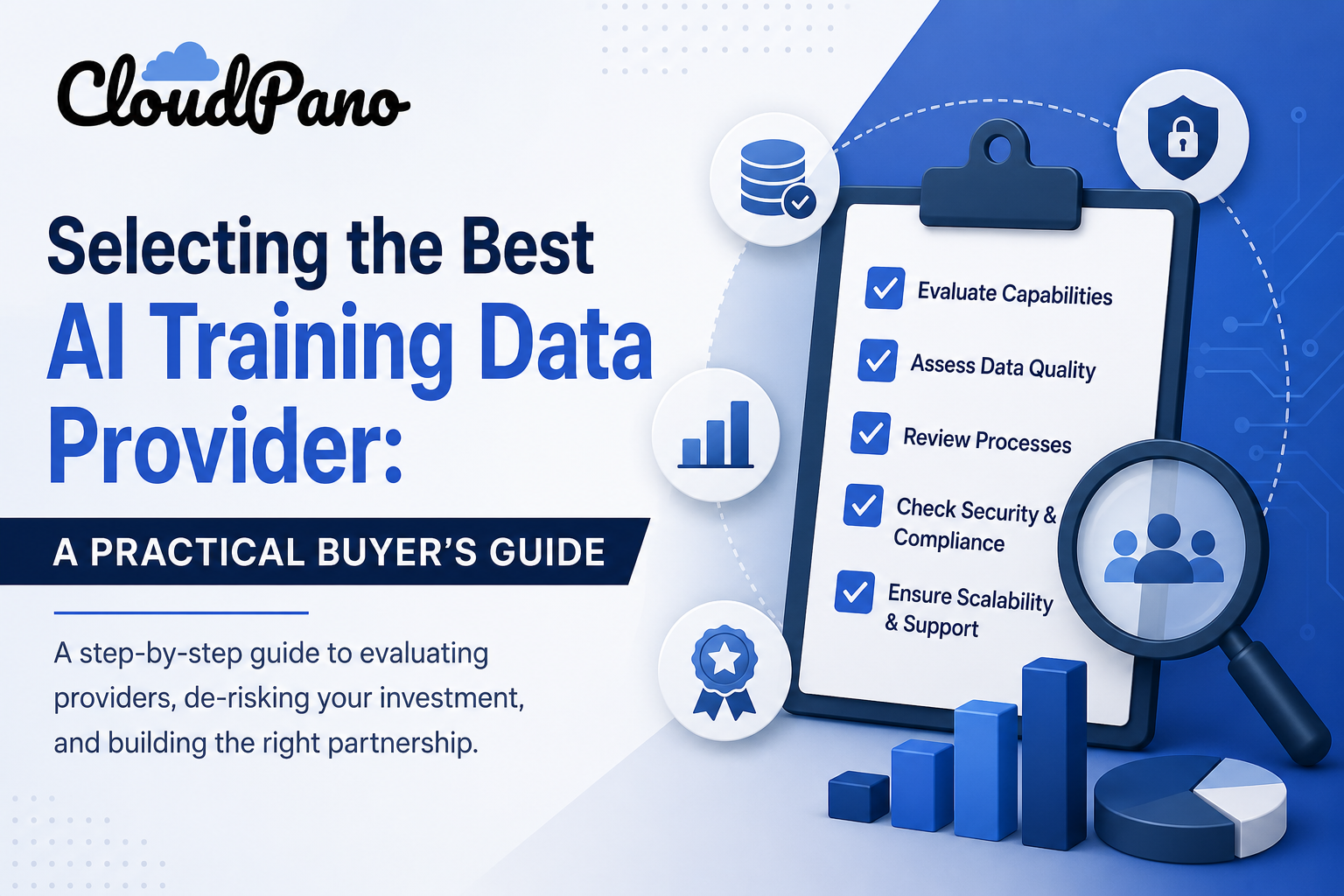
Selecting the Best AI Training Data Provider: A Practical Buyer's Guide

Cloudpano
July 24, 2026
5 min read
Share this post

Selecting the Best AI Training Data Provider: A Practical Buyer's Guide

Most guidance on how to choose AI training data provider options focuses on what to look for — criteria, questions, red flags. Useful, but it assumes you already know where you are in the buying process. In practice, teams often skip stages or do them out of order, and that's a bigger cause of a bad decision than missing any single evaluation criterion.

This is a buyer's guide in the literal sense: the actual sequence of stages a procurement process for this kind of vendor should move through, from recognizing the need through onboarding whoever you choose.

Why It Matters

A disorganized buying process doesn't just take longer — it produces worse decisions, because stages get skipped under time pressure. Google Research's "Data Cascades" study documented how gaps introduced early in a data-related decision compound into larger problems that surface much later, which applies as much to vendor selection as to the data itself (Sambasivan et al., Google Research).

NIST's AI Risk Management Framework treats vendor and data provenance decisions as part of an organization's broader risk posture, not a purely tactical procurement choice — reinforcing that AI data vendor evaluation deserves the same structured rigor as other governance decisions (NIST AI RMF).

The pace of enterprise AI adoption raises the cost of getting this wrong. Stanford HAI's AI Index has tracked how quickly organizations are deploying models into production (Stanford HAI, AI Index Report), which means a stalled or rushed provider selection process directly threatens a team's ability to hit its own timeline.

How It Works

A well-run provider selection process moves through seven distinct stages, each producing the input the next stage needs.

Diagram of the seven-stage AI training data provider buying journey

Needs assessment — defining data type, volume, complexity, and timeline before looking at any vendor.

Market research and shortlisting — identifying candidates whose stated capabilities plausibly match your defined needs.

Proposal requests — asking shortlisted candidates for a written response to the same set of requirements, enabling direct comparison.

Demos and reference checks — seeing the provider's process in action and talking to comparable past clients, not just reading proposal claims.

Paid pilot — testing on your actual data before any final commitment, which is where AI training data quality claims actually get verified.

Contract negotiation — turning verified pilot results into specific, written commitments rather than general assurances.

Onboarding — structuring the start of the relationship deliberately, including how issues get escalated and how the relationship might expand over time.

Table showing what each stage of the AI training data provider buying process verifies

Understanding how these workflows operate as a defined sequence — not a menu of things to check whenever convenient — is what keeps a buying process from stalling or rushing at exactly the stages that matter most.

Step-by-Step Workflow

  1. Complete needs assessment before contacting any vendor. Document data type, volume, complexity, timeline, and any compliance requirements in writing.
  2. Build a shortlist based on that documented need, not general reputation. Narrow to candidates whose capabilities plausibly match your specific requirements.
  3. Send the same proposal request to every shortlisted candidate. Consistent requirements produce comparable responses; inconsistent requests produce apples-to-oranges proposals.
  4. Hold demos and request references from comparable projects. Prioritize seeing the actual process over a general sales presentation.
  5. Run a paid pilot with your top one or two candidates. Treat this as the real evaluation — proposals and demos only narrow the field.
  6. Negotiate a contract reflecting what the pilot actually demonstrated. Written accuracy, turnaround, and security commitments should match verified pilot performance, not initial proposal language.
  7. Structure onboarding with a clear escalation path and review cadence. Define upfront how issues get raised and how the relationship might scale.

Industry Use Cases

Bar chart showing which AI training data provider buying stages matter most by industry
  • Computer vision / robotics: Needs assessment should specify object types and environments in detail, since shortlisting on vague requirements often produces a mismatched candidate pool.
  • Autonomous vehicles: Reference checks and pilots should specifically probe safety-critical scenario handling, not just general labeling accuracy.
  • Healthcare AI: Needs assessment must include compliance and clinical domain requirements upfront, since these often narrow the shortlist significantly before any other criteria apply.
  • Retail AI: Proposal requests should emphasize scalability and cost transparency, given the volume and speed typical of retail labeling projects.
  • LLM developers: Demos and pilots should specifically test nuanced preference or safety labeling capability, not just straightforward classification accuracy.
  • Government & defense: Needs assessment and shortlisting are often driven primarily by security clearance and data residency requirements before any other stage begins.

Benefits of a Structured Buying Process

  • Fewer rushed decisions. A defined sequence prevents skipping the pilot or reference-check stages under time pressure.
  • More comparable vendor responses. Sending identical requirements to every candidate produces proposals that can actually be compared side by side.
  • Verified claims, not assumed ones. Structuring a pilot as a distinct stage ensures AI training data quality claims get tested before a contract is signed.
  • A contract that reflects reality. Negotiating after the pilot, rather than before, means terms are grounded in demonstrated performance.
  • A stronger start to the relationship. Deliberate onboarding reduces the early friction that often comes from an undefined escalation or review process.

Common Mistakes

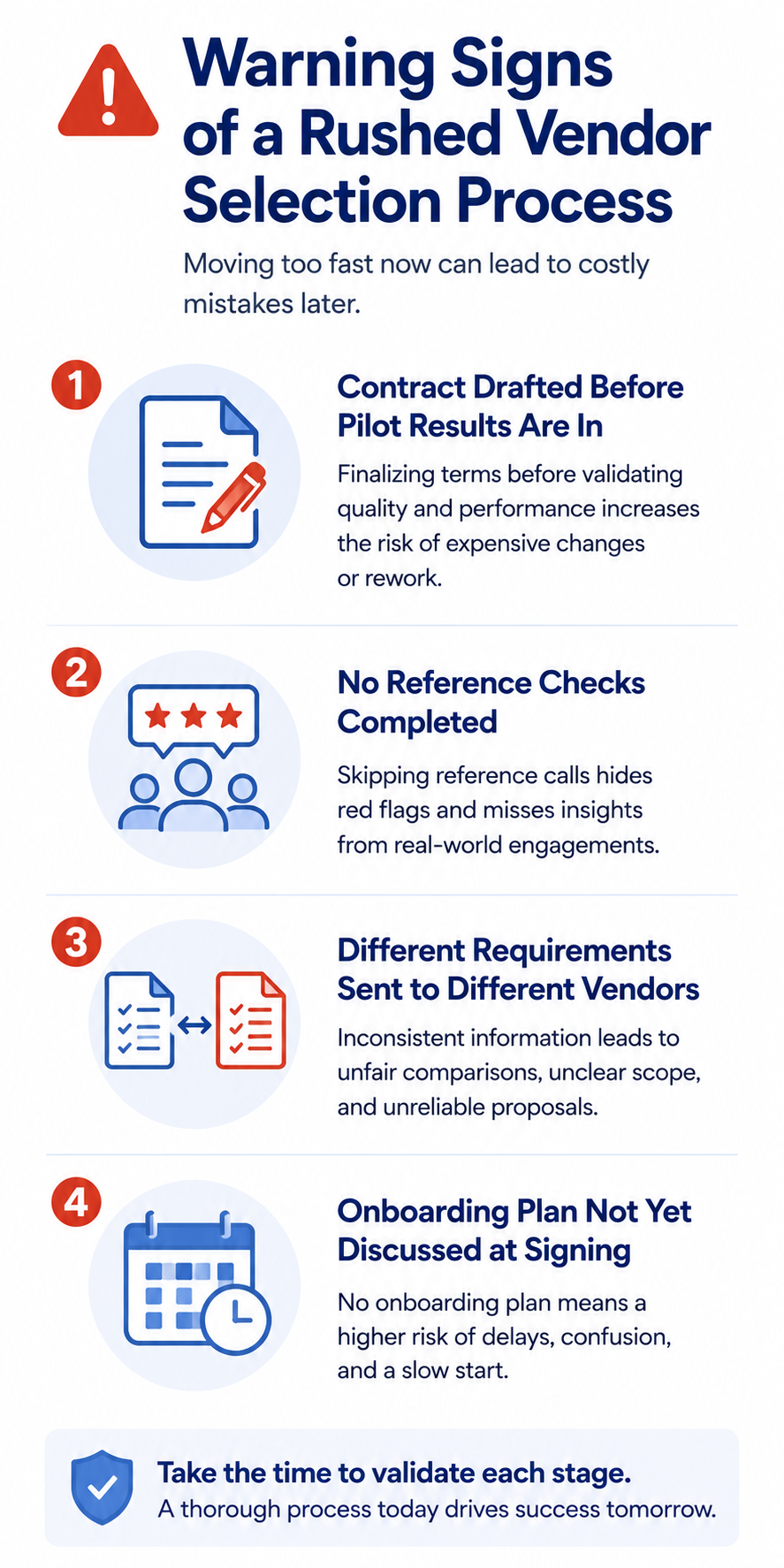
Infographic of signs a team is rushing the AI training data provider buying process
  • Skipping needs assessment and going straight to vendor conversations. Shortlisting without a documented, specific requirement produces a mismatched candidate pool from the start.
  • Sending different proposal requests to different vendors. This produces responses that can't be fairly compared, since each vendor is answering a different question.
  • Treating a demo as sufficient evidence of quality. A polished demo doesn't substitute for a pilot on your actual data.
  • Negotiating a contract before the pilot. Locking in terms based on proposal claims rather than verified pilot performance.
  • Skipping reference checks entirely. Missing the chance to hear directly from comparable past clients about how a vendor performs in practice.
  • Not planning onboarding as its own stage. Assuming a signed contract is the finish line, rather than the start of a relationship that needs its own structure.

Best Practices

  • Complete a documented needs assessment before any vendor conversation begins.
  • Send the same proposal request to every shortlisted candidate to keep comparisons fair.
  • Treat the pilot as the real evaluation stage, not a formality after the decision is effectively already made.
  • Negotiate contract terms based on verified pilot results, not initial proposal language.
  • Structure onboarding deliberately, with a defined escalation path and review cadence from day one.
  • Treat the full process as a genuine enterprise AI partner search, not a transactional purchase, especially for an ongoing or high-stakes relationship. McKinsey's research on generative AI adoption notes that data readiness — including how deliberately organizations structure the process of selecting their data partners — remains a consistently underestimated factor in AI project outcomes (McKinsey, "The economic potential of generative AI").

FAQ

What are the main stages in choosing an AI training data provider?

Needs assessment, shortlisting, proposal requests, demos and reference checks, a paid pilot, contract negotiation, and onboarding — treated as a defined sequence rather than an ad hoc set of steps.

How long should the provider selection process take?

This varies by project complexity and urgency, but skipping stages to move faster — particularly the pilot — tends to cost more time later than it saves upfront.

Timeline graphic of a realistic AI training data provider selection process

Is a demo enough to evaluate a provider's quality?

No. A demo shows a general sales presentation; a pilot on your actual data is what verifies whether a provider's claimed quality actually holds up for your specific project.

When should contract negotiation happen in the buying process?

After the pilot, not before — negotiating based on verified pilot performance produces more accurate and defensible contract terms than negotiating from proposal claims alone.

How do I keep vendor proposals comparable during AI data vendor evaluation?

Send every shortlisted candidate the same written requirements and ask for responses in a consistent format, rather than letting each vendor define the terms of comparison themselves.

What should onboarding include after selecting a provider?

A clear escalation path for issues, a defined review cadence, and an understanding of how the relationship might expand as your needs grow, not just a signed contract and a start date.

How do I know if I'm choosing the right long-term enterprise AI partner versus just a vendor for one project?

Consider whether the relationship needs to scale, evolve, or support ongoing retraining — if so, evaluate account structure and long-term fit during the buying process, not just initial project capability.

Conclusion

How to choose an AI training data provider comes down to running a defined, staged process rather than an ad hoc evaluation — needs assessment, shortlisting, proposals, demos, a real pilot, contract terms grounded in verified results, and deliberate onboarding. Teams that follow this sequence in order consistently make faster, better-supported decisions than those that skip stages under time pressure.

🚀 Your All‑In‑One Virtual Experience Stack
🎬
PhotoAIVideo
Turn photos into scroll‑stopping AI videos.
Get Started →
🏡
Pictastic
Instantly stage listings with AI.
Try Staging →
🌀
CloudPano
Create stunning 360° tours in minutes.
Launch Tour →
💰
VirtualTourProfit
Build a profitable virtual tour business.
Learn More →
🤝
CloudPano Reseller
Resell AI visual software without building it.
Become a Reseller →
🚗
Auto CloudPano
Sell more vehicles with 360° experiences.
Explore Auto →
🏗️
AI Floor Plan Builder
Generate detailed floor plans with AI.
Build Now →
📐
3D Measure
Capture accurate floor plans & 3D measurements.
Measure Now →
🧠
AI Training Data
Custom AI training data services.
Learn More →
Share this post
Cloudpano

Choose The Right 360° Camera

Insta360 ONE RS 1-Inch 360 Edition

  • Compact, ready to go anywhere

  • Interchangeable lens that’s upgradeable

  • Dual 1-inch sensors for improved clarity and low light performance

  • Dynamic range and 6K 360° capture

  • 360° photo resolution at 21MP

Learn More

Insta360 X4

  • 8K 360° video recording for ultra-detailed visuals.

  • 4K single-lens mode for traditional wide-angle shots.

  • Invisible selfie stick effect for drone-like perspectives.

  • 2.5-inch touchscreen with Gorilla Glass protection.

  • Waterproof up to 33ft for underwater shooting.

Learn More

Ricoh Theta Z1

  • 360° photo resolution in 23MP

  • Slim design at 24 mm thick

  • Built-in image stabilization for smooth video capture.

  • Internal 19GB storage for photo and video storage.

  • Wireless connectivity for remote control and sharing.

Learn More

Ricoh Theta X

  • 60MP 360° still images for high-resolution photography.

  • 5.7K 360° video recording at 30fps.

  • 2.25-inch touchscreen for intuitive control.

  • USB Type-C port for fast charging and data transfer.

  • MicroSD card slot for expandable storage.

Learn More
Property Marketing
Allows potential buyers to explore properties in detail from anywhere, enhancing the real estate marketing process.
Automotive Spins
Create an interactive virtual showroom and engage affluent digital buyers with live 360º video calls, all through the CloudPano mobile app for a complete automotive sales solution.
Interactive Floor Plans
Create 2D and 3D floor plans with measurements in 4 minutes or less, all from your phone. Download the Floor Plan Scanner app and get your first scan free.

360 Virtual Tours With CloudPano.com. Get Started Today.

Try it free. No credit card required. Instant set-up.
Try it free
Latest posts

See our other posts

Interviews, tips, guides, industry best practices, and news.

What Is Human-in-the-Loop AI and Why Does It Matter?

Human-in-the-loop AI is an approach where people remain actively involved in an AI system's decisions or training — reviewing outputs, correcting errors, or making final calls on cases the system can't confidently handle alone. It combines the speed of automation with human judgment for situations where accuracy and accountability matter most.
Read post

Human-in-the-Loop AI Services: How the Human Review Process Actually Works

Human-in-the-loop AI services insert structured human review at specific points in a model pipeline — typically for low-confidence predictions, ambiguous cases, or high-stakes decisions — rather than reviewing everything or nothing. The review process feeds corrections back into training data and model evaluation, improving accuracy on exactly the cases automation handles least reliably.
Read post

Selecting the Best AI Training Data Provider: A Practical Buyer's Guide

How to choose an AI training data provider works best as a defined sequence: assess your actual needs, shortlist candidates, request proposals, run demos and reference checks, pilot on real data, negotiate a specific contract, and structure onboarding deliberately. Skipping or reordering these stages is the most common cause of a rushed or mismatched decision.
Read post