What Does an AI Training Data Provider Actually Do?

Cloudpano
July 21, 2026
5 min read
Share this post

What Does an AI Training Data Provider Actually Do?

"Labeling vendor" and AI training data provider get used interchangeably often enough that the distinction gets lost — but they're not always the same thing. A labeling vendor typically starts with data you've already collected. A full training data provider can start earlier than that, helping source or build the dataset itself.

That difference matters most when a team doesn't actually have the raw data yet — a computer vision project needing images of a rare scenario, an LLM project needing domain-specific conversational data, or a robotics project needing sensor data from environments nobody has captured before.

Why It Matters

Choosing a provider based on labeling capability alone, when your actual gap is in the data itself, leads to a mismatched engagement. Google Research's "Data Cascades" study documented how gaps introduced early in data preparation — including sourcing and collection issues — compound into expensive, hard-to-trace downstream problems (Sambasivan et al., Google Research).

NIST's AI Risk Management Framework treats data provenance — where the data came from and how it was collected — as foundational to trustworthy AI, which is a dimension purely labeling-focused vendors don't always address (NIST AI RMF).

Getting this right matters more given how quickly organizations are moving models into production. Stanford HAI's AI Index has tracked this acceleration (Stanford HAI, AI Index Report), and discovering mid-project that a vendor can't actually source the raw data you need is a costly delay to hit partway through a timeline.

How It Works

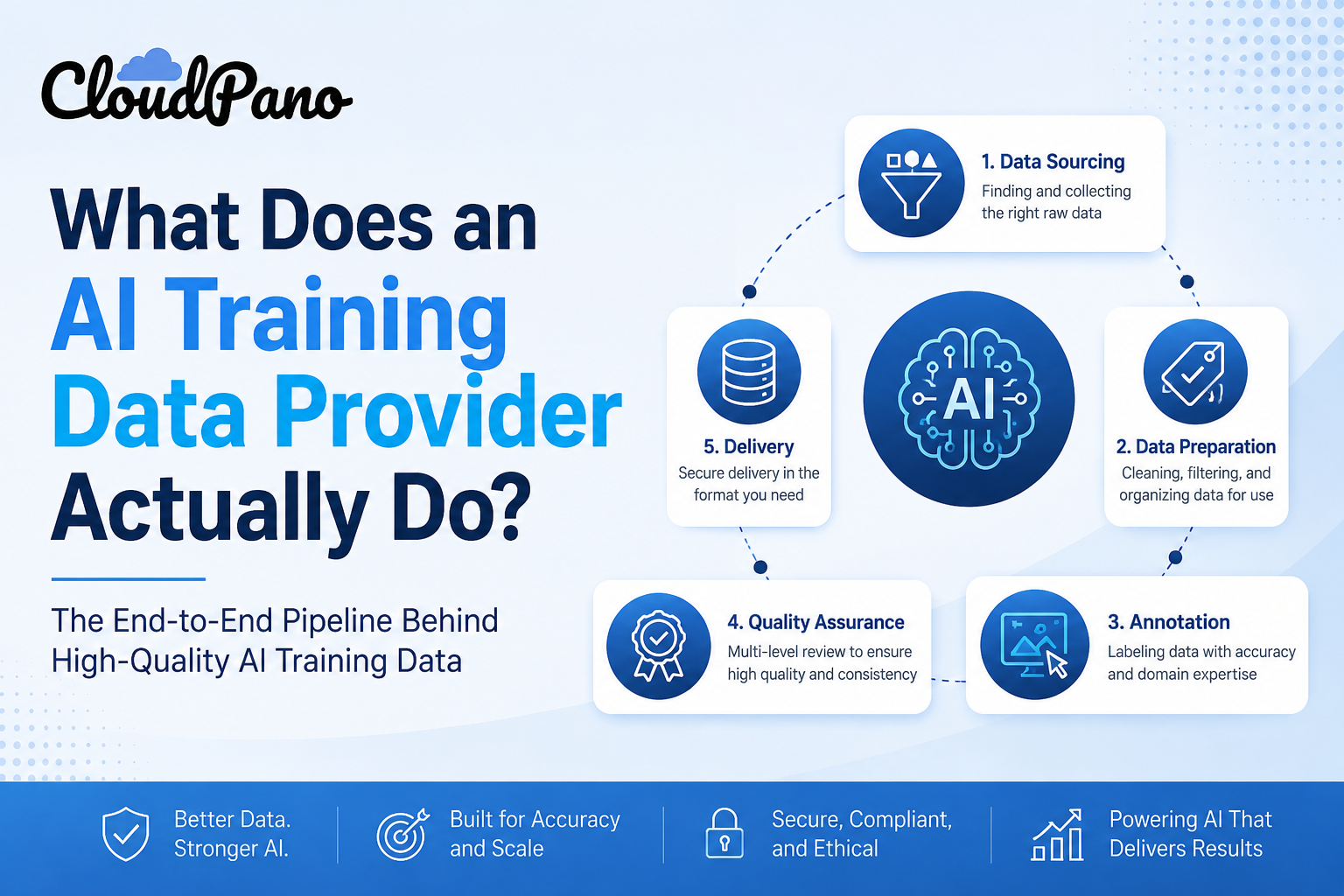
Data sourcing and collection. Some providers help identify, collect, or license raw data — recording new footage, sourcing images under proper rights, or aggregating existing datasets that meet a project's specific requirements.

Synthetic data generation. For scenarios that are rare, expensive, or unsafe to collect in the real world (a specific autonomous vehicle edge case, for example), some providers generate synthetic data that approximates the real distribution.

Comparison table of labeling vendor vs full AI training data provider capabilities

Annotation and labeling. Once raw data exists — sourced, collected, or synthetic — the provider applies the labeling techniques appropriate to the modality, whether classification, bounding boxes, or entity tagging.

Dataset curation and delivery. Assembling labeled data into a structured, validated dataset in the format a model pipeline can actually consume, often including documentation of provenance and licensing.
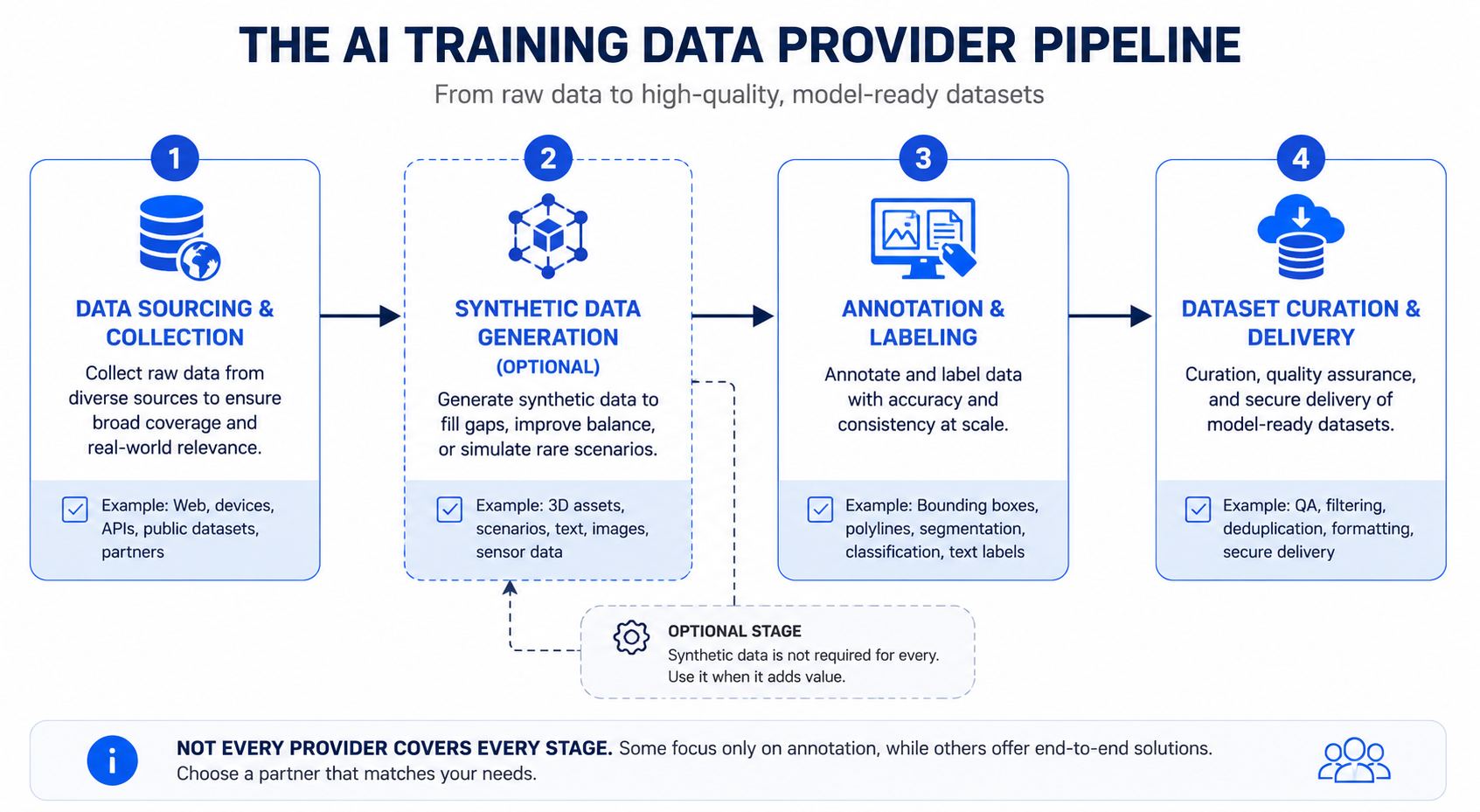
Diagram of the full AI training data provider pipeline from sourcing to delivery

Not every provider covers all four stages. Understanding how these workflows operate end to end — versus which specific piece a given vendor handles — is the key distinction when evaluating an AI data annotation company against a full training data services partner.
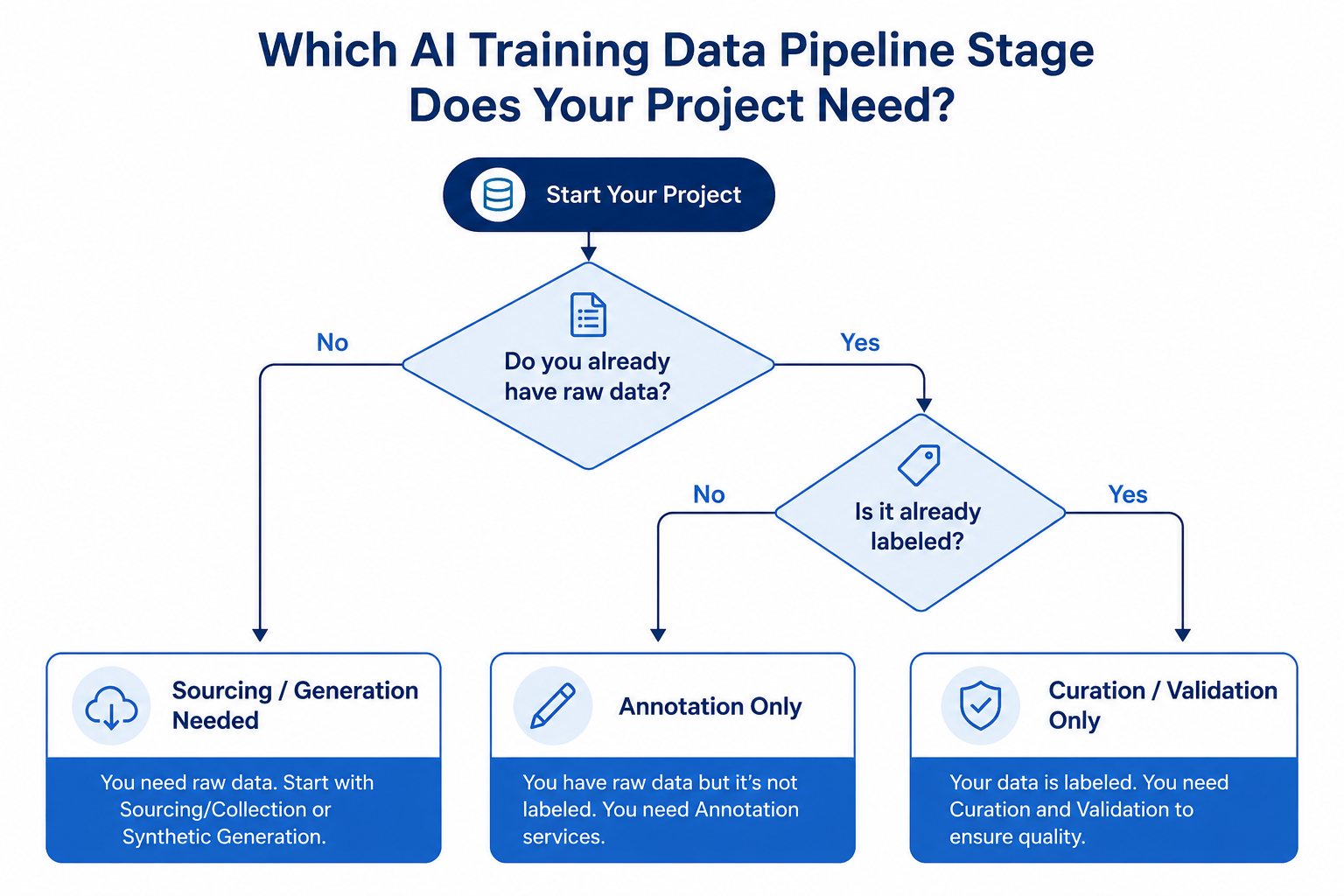
Step-by-Step Workflow

Flowchart for identifying which AI training data pipeline stage your project needs
  1. Identify what stage your project actually needs. Do you have raw data that just needs labeling, or do you need help sourcing, collecting, or generating the data itself?
  2. Scope data provenance and licensing requirements upfront. If sourcing or licensing is involved, confirm rights and usage terms before any data collection begins.
  3. Evaluate providers specifically against the stages you need. A strong labeling vendor isn't automatically equipped for sourcing or synthetic data generation, and vice versa.
  4. Pilot the specific capability you're most uncertain about. If synthetic data generation is new to your project, pilot that stage specifically rather than the full pipeline at once.
  5. Validate custom AI training datasets against your model's actual requirements. Confirm the delivered dataset — however it was built — actually supports what your model needs to learn.
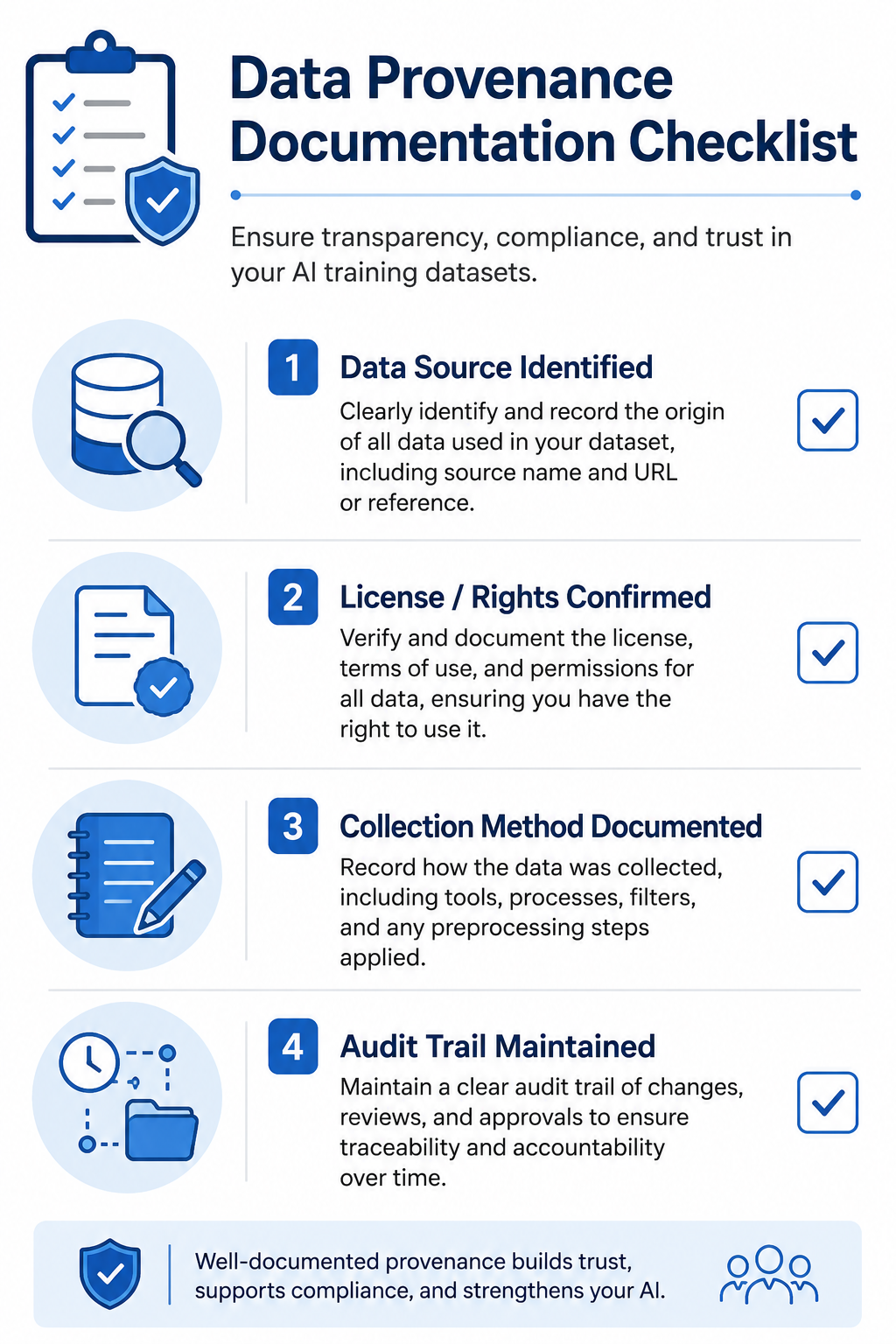
  6. Document provenance for every data source used. Sourced, licensed, synthetic, and human-collected data should each be traceable for governance and audit purposes.
  7. Plan for ongoing data needs, not just an initial build. Most models need refreshed or expanded training data over time as requirements evolve.

Industry Use Cases

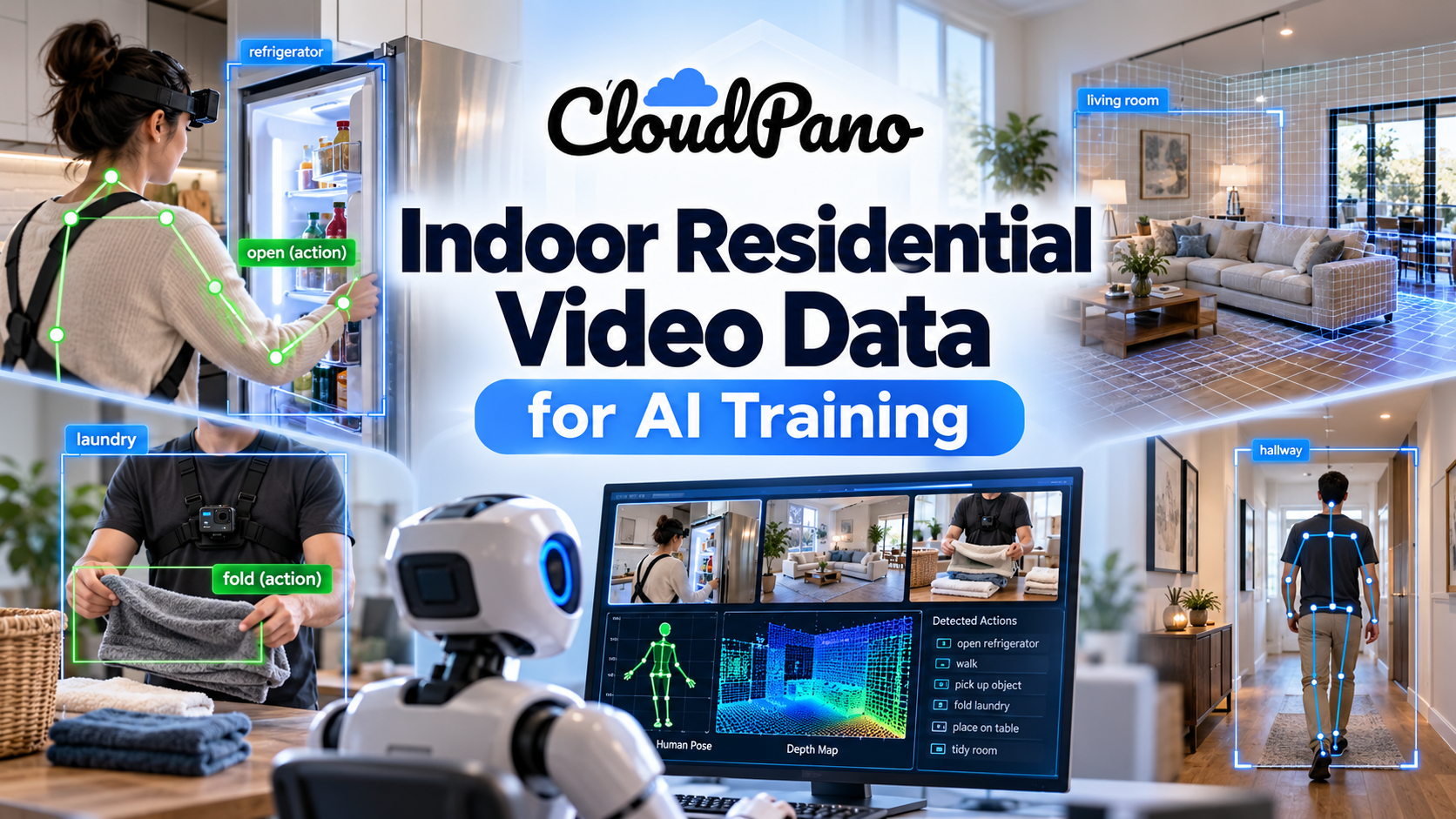
  • Computer vision / robotics: Often needs custom data collection for specific environments or object types that don't exist in off-the-shelf datasets.
  • Autonomous vehicles: Frequently relies on synthetic data generation for rare, dangerous, or hard-to-capture driving scenarios that would be impractical to collect through real-world recording alone.
  • Healthcare AI: Requires careful sourcing and licensing of clinical data given strict regulatory constraints, often making provenance documentation as important as the annotation itself.
  • Retail AI: Frequently uses licensed or aggregated product and customer interaction data rather than data collected from scratch.
  • LLM developers: Often need custom conversational or domain-specific text data that doesn't exist in general web-scraped datasets, making sourcing and generation as important as labeling.
  • Government & defense: Data provenance and chain-of-custody documentation are often as critical as the labeling itself, given security and compliance requirements.
Bar chart showing reliance on synthetic vs real-world training data by industry

Benefits

  • Access to data that doesn't exist yet. A full-service provider can build a dataset for a use case with no existing off-the-shelf equivalent.
  • Better coverage of rare or sensitive scenarios. Synthetic data generation can fill gaps that would be impractical or unsafe to collect in the real world.
  • Cleaner governance and provenance. Providers that manage sourcing and licensing directly can document data lineage more completely than a project assembling data from scattered sources.
  • Faster time to a usable dataset. Combining sourcing, collection, and annotation under one engagement avoids the coordination overhead of managing separate vendors for each stage.
  • Reduced legal and compliance risk. Proper licensing and rights management during sourcing avoids downstream issues with using improperly obtained data.

Common Mistakes

  • Assuming every provider covers the full pipeline. Evaluating a labeling-focused vendor against a project that actually needs data sourcing or generation capability they don't offer.
  • Skipping provenance documentation. Failing to track where data came from and under what license, which creates risk that surfaces later during an audit or compliance review.
  • Underestimating synthetic data validation. Assuming synthetic data automatically transfers well to real-world performance without validating it against actual model requirements.
  • Treating data sourcing as a one-time task. Not planning for how training data needs will evolve as a model or use case matures.
  • Ignoring licensing terms on sourced or aggregated data. Using data without properly verifying usage rights, which can create legal exposure well after a project is complete.
  • Conflating "AI data annotation company" with full data provider capability. Assuming annotation expertise implies sourcing or synthetic data expertise, which frequently isn't the case.

Best Practices

  • Identify exactly which stage of the pipeline — sourcing, collection, synthetic generation, annotation, or all of them — your project actually needs before evaluating providers.
  • Confirm data provenance and licensing terms in writing before any sourced or collected data changes hands.
  • Validate synthetic data against real-world model performance rather than assuming it transfers automatically.
  • Document the lineage of every dataset component, whether sourced, licensed, synthetic, or human-collected.
  • Plan for ongoing data needs rather than treating a custom dataset build as a one-time project.
  • Evaluate training data services providers specifically against the capabilities your project needs, not a generic vendor reputation. McKinsey's research on generative AI adoption notes that data readiness — including how well an organization's data sourcing capability matches its actual model requirements — remains one of the most consistently underestimated factors in AI project outcomes (McKinsey, "The economic potential of generative AI").

FAQ

What's the difference between an AI training data provider and a labeling vendor?

A labeling vendor typically starts with data you've already collected, while a full training data provider can also help source, collect, license, or generate the raw data itself before annotation even begins.

What are custom AI training datasets?

Datasets built specifically for a project's model requirements, often because no suitable off-the-shelf dataset exists — combining sourcing, collection, synthetic generation, and annotation as needed.

When do I need synthetic data instead of real-world collected data?

When the scenario you need is rare, dangerous, expensive, or impractical to collect in the real world, such as unusual driving scenarios for autonomous vehicles or rare defect types in manufacturing inspection.

How do I evaluate an AI data annotation company for data sourcing capability?

Ask directly whether they handle sourcing, licensing, and synthetic data generation, or only annotation of data you already provide — these are distinct capabilities that not every provider offers.

What should I look for in terms of data provenance and licensing?

Documentation of where each piece of data came from, what license or rights apply to it, and a clear audit trail, especially important for regulated industries or any data that was sourced or aggregated rather than originally collected by your team.

How much do custom AI training datasets typically cost?

Cost varies significantly depending on whether sourcing, collection, or synthetic generation is involved in addition to annotation.

Can I combine sourced, licensed, and synthetic data in one training dataset?

Yes, and many real-world projects do, provided each component's provenance is documented and the combined dataset is validated against the model's actual performance requirements.

Conclusion

An AI training data provider can offer far more than annotation — sourcing, collection, licensing, and synthetic data generation are all part of what a full-service provider might handle. Understanding which of these your project actually needs, rather than assuming "training data provider" means the same thing as "labeling vendor," makes for a much more accurate evaluation and a dataset that actually meets your model's requirements.

🚀 Your All‑In‑One Virtual Experience Stack
🎬
PhotoAIVideo
Turn photos into scroll‑stopping AI videos.
Get Started →
🏡
Pictastic
Instantly stage listings with AI.
Try Staging →
🌀
CloudPano
Create stunning 360° tours in minutes.
Launch Tour →
💰
VirtualTourProfit
Build a profitable virtual tour business.
Learn More →
🤝
CloudPano Reseller
Resell AI visual software without building it.
Become a Reseller →
🚗
Auto CloudPano
Sell more vehicles with 360° experiences.
Explore Auto →
🖼️
AutoBackgrounding
Replace backgrounds instantly with AI precision.
Try it Now →
📐
3D Measure
Capture accurate floor plans & 3D measurements.
Measure Now →
🧠
AI Training Data
Custom AI training data services.
Learn More →
Share this post
Cloudpano

Choose The Right 360° Camera

Insta360 ONE RS 1-Inch 360 Edition

  • Compact, ready to go anywhere

  • Interchangeable lens that’s upgradeable

  • Dual 1-inch sensors for improved clarity and low light performance

  • Dynamic range and 6K 360° capture

  • 360° photo resolution at 21MP

Learn More

Insta360 X4

  • 8K 360° video recording for ultra-detailed visuals.

  • 4K single-lens mode for traditional wide-angle shots.

  • Invisible selfie stick effect for drone-like perspectives.

  • 2.5-inch touchscreen with Gorilla Glass protection.

  • Waterproof up to 33ft for underwater shooting.

Learn More

Ricoh Theta Z1

  • 360° photo resolution in 23MP

  • Slim design at 24 mm thick

  • Built-in image stabilization for smooth video capture.

  • Internal 19GB storage for photo and video storage.

  • Wireless connectivity for remote control and sharing.

Learn More

Ricoh Theta X

  • 60MP 360° still images for high-resolution photography.

  • 5.7K 360° video recording at 30fps.

  • 2.25-inch touchscreen for intuitive control.

  • USB Type-C port for fast charging and data transfer.

  • MicroSD card slot for expandable storage.

Learn More
Property Marketing
Allows potential buyers to explore properties in detail from anywhere, enhancing the real estate marketing process.
Automotive Spins
Create an interactive virtual showroom and engage affluent digital buyers with live 360º video calls, all through the CloudPano mobile app for a complete automotive sales solution.
Interactive Floor Plans
Create 2D and 3D floor plans with measurements in 4 minutes or less, all from your phone. Download the Floor Plan Scanner app and get your first scan free.

360 Virtual Tours With CloudPano.com. Get Started Today.

Try it free. No credit card required. Instant set-up.
Try it free
Latest posts

See our other posts

Interviews, tips, guides, industry best practices, and news.

What Does an AI Training Data Provider Actually Do?

An AI training data provider builds usable training datasets for machine learning, which can include sourcing or collecting raw data, licensing existing datasets, generating synthetic data, and annotation. This is broader than a pure labeling vendor, since it can cover getting the raw data itself, not just adding structure to data you already have.
Read post

Matterport vs CloudPano for Real Estate Agents

Real estate agents have specific, practical needs that generic feature comparisons often miss. Here's how Matterport and CloudPano actually compare for the way agents really work.
Read post

CloudPano vs Matterport Features: Which Fits You?

Feature lists tell you what a platform can technically do. They rarely tell you which features actually matter for a business like yours. Here's a use-case-driven look at where Matterport and CloudPano genuinely differ.
Read post