


.png)


Scale AI, Appen, and Sama are among the most established names in data annotation, each built to serve large-scale, high-volume labeling programs across a wide range of industries. Searching for Scale AI Appen Sama alternatives usually means a team has a reason those large-scale generalist models don't fit — not that the incumbents are doing anything wrong, but that a different shape of provider fits the project better.
That reason is worth being specific about before evaluating anyone. "We want an alternative" is a starting point, not a requirement — the actual question is what a different provider needs to offer that the current option doesn't.
Switching providers, or choosing a different type of provider from the start, is a decision with real downstream consequences if the underlying reason isn't clear. Google Research's "Data Cascades" study documented how issues introduced early in a data pipeline — including a provider mismatch — compound into problems that are difficult to trace back to their source later (Sambasivan et al., Google Research).
NIST's AI Risk Management Framework treats data quality and provenance as foundational to trustworthy AI, meaning provider selection — whichever provider that ends up being — carries governance weight beyond a simple procurement decision (NIST AI RMF).
The pace of AI deployment adds urgency to getting this right the first time. Stanford HAI's AI Index has tracked how quickly organizations are moving models into production (Stanford HAI, AI Index Report), leaving less room for a second provider transition if the first alternative doesn't actually solve the original problem.
Teams typically look at alternatives to the largest AI training data providers for one or more of a few specific reasons, and understanding which one applies to your situation shapes what to actually evaluate.
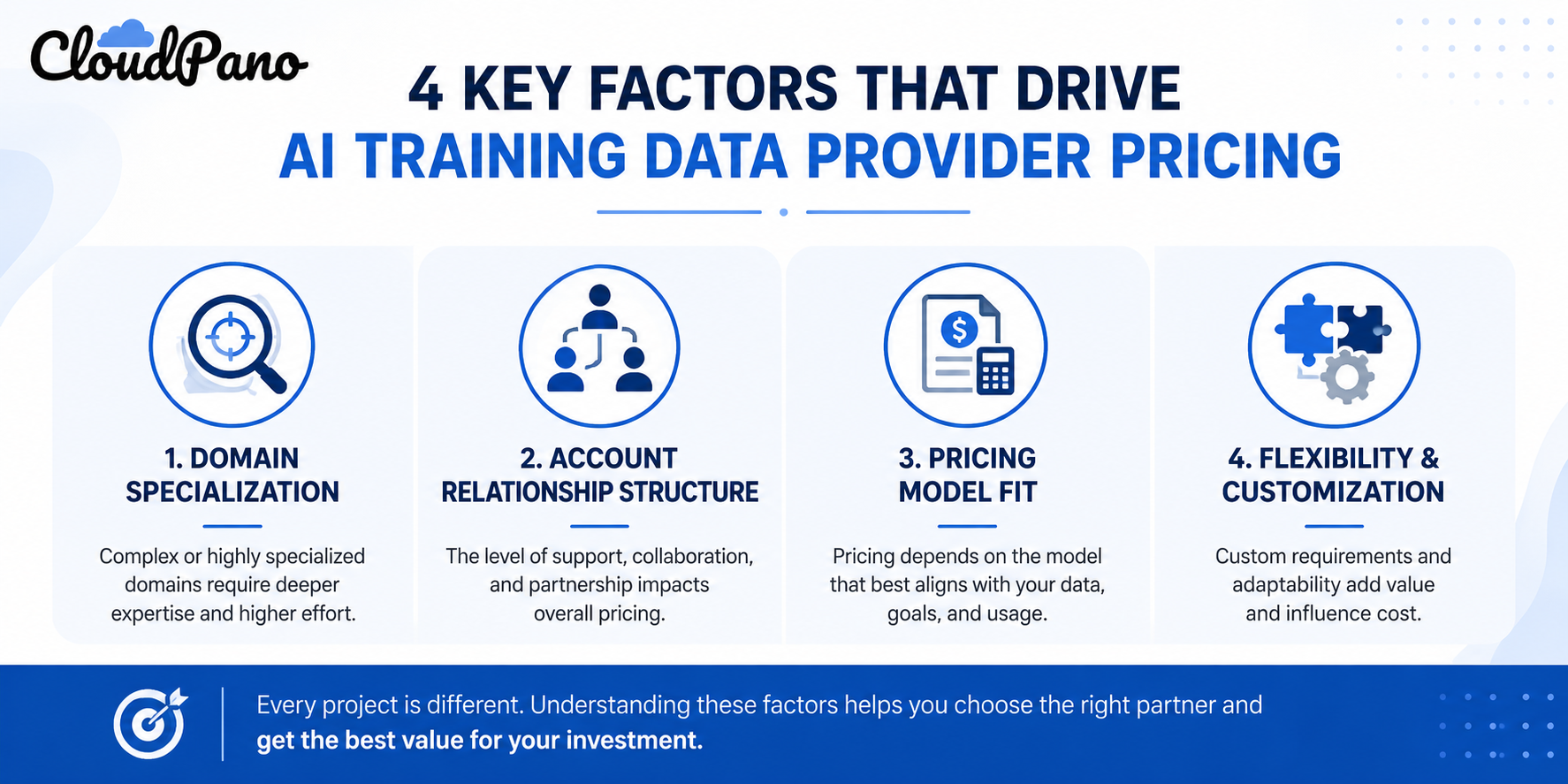
Domain specialization. Large-scale generalist providers serve many industries at once; a team with highly specialized data (clinical, technical, safety-critical) sometimes finds a narrower, domain-focused provider offers deeper annotator expertise for that specific use case.
Account relationship structure. Some teams want a more direct, senior-level account relationship than a large-scale provider's standard account structure offers, particularly for complex or evolving projects.
Pricing model fit. Provider pricing models are often built around a certain volume range; a project meaningfully smaller or larger than that range sometimes gets better-fit pricing from a provider built for that scale specifically.
Flexibility and customization. Smaller or more specialized providers can sometimes offer more tailored workflow, tooling, or QA customization than a highly standardized, large-scale process allows.
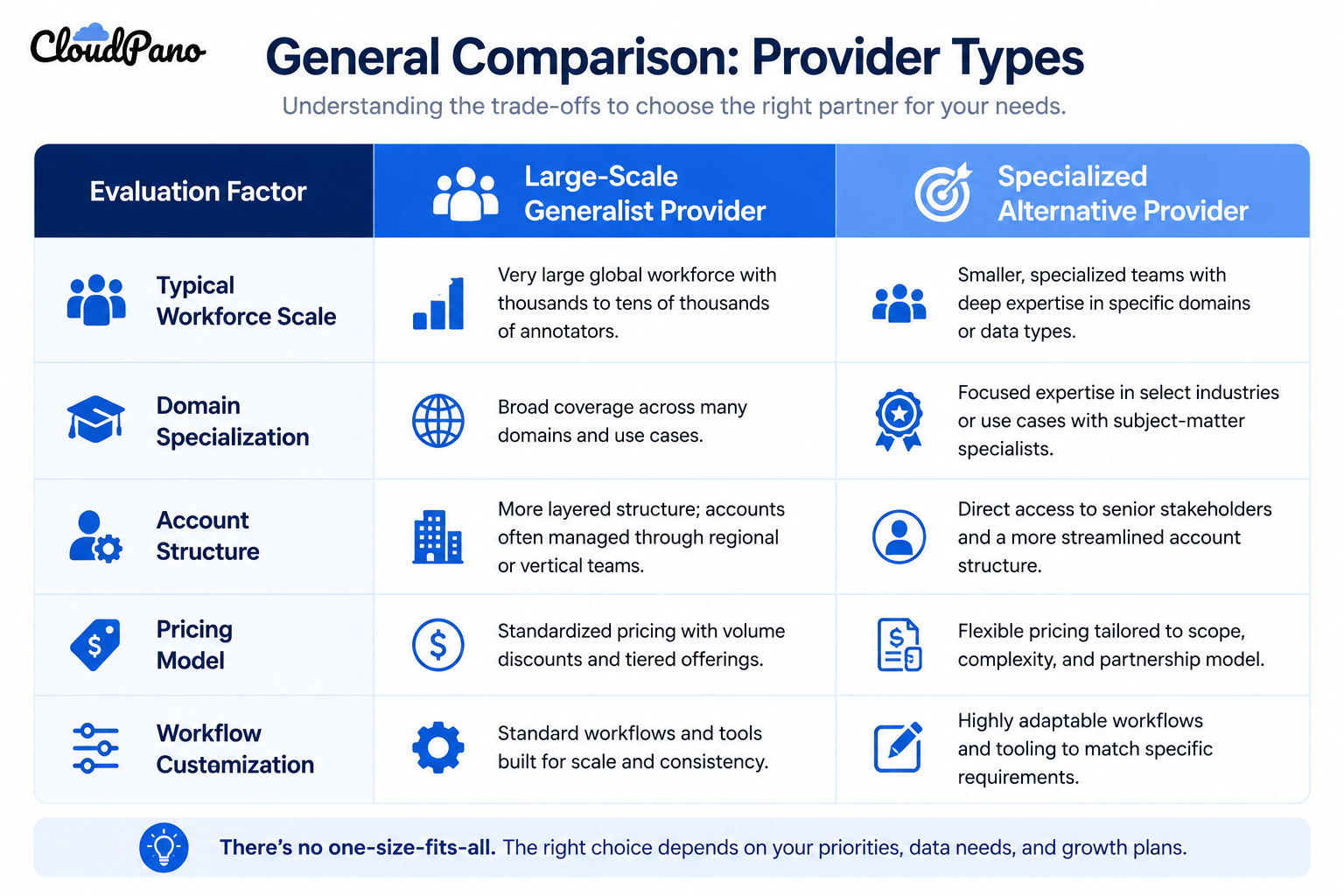
Understanding how these workflows operate at the provider level — not just their marketing positioning — is what actually determines fit, regardless of company size or name recognition.

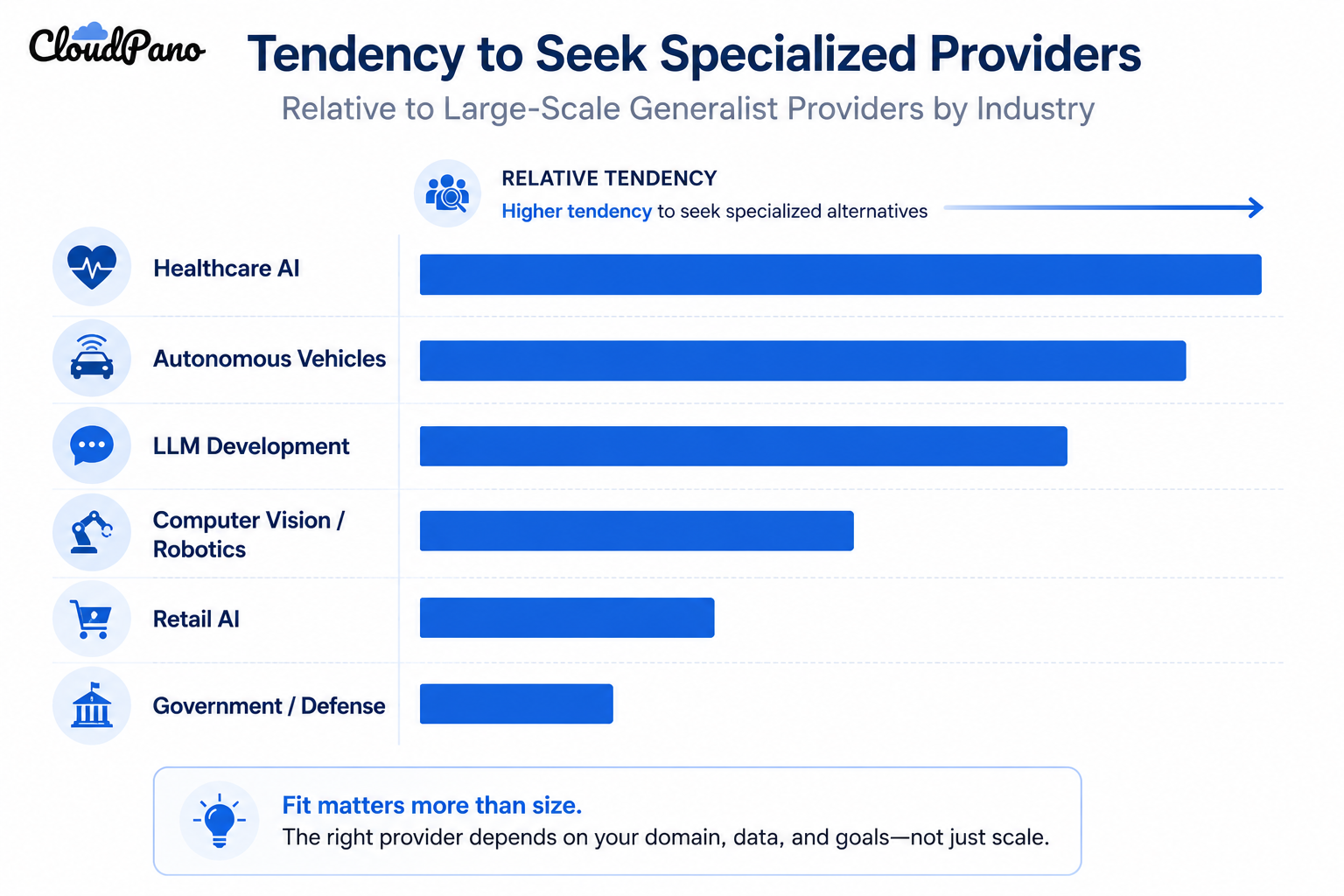
Most commonly for more specialized domain expertise, a more direct account relationship, pricing better matched to their specific volume, or more workflow customization than a large-scale, standardized process offers.
Not automatically. Provider size doesn't reliably predict domain expertise or flexibility — both need to be verified directly during evaluation.
Cost alone is rarely a sufficient reason. A cheaper alternative that doesn't address the specific gap driving the search for alternatives is likely to introduce a different mismatch rather than solve the original problem.
Use the same set of criteria — data capability, domain expertise, quality assurance methodology, security posture, scalability, and pricing transparency — for every candidate, including any incumbent provider you're comparing against.
Yes. A pilot on your actual data, benchmarked against your current provider's output, is the most reliable way to confirm an alternative actually performs better rather than just seeming like it will.
Managed data labeling services from large-scale providers typically offer broad workforce capacity and standardized processes, while more specialized providers often offer deeper domain expertise or more customizable workflows for a narrower range of use cases.
Trace the specific issue back to its source — if guidelines are ambiguous or requirements were never clearly defined, that's often a scoping issue that a different provider won't automatically fix.

Scale AI, Appen, Sama alternatives are worth exploring when a specific, identifiable gap exists — domain specialization, account structure, pricing fit, or workflow flexibility — not simply because a large-scale provider is large. Defining that gap clearly, evaluating candidates consistently against it, and piloting before committing is what actually determines whether a different provider solves the original problem or just introduces a new one.


Compact, ready to go anywhere
Interchangeable lens that’s upgradeable
Dual 1-inch sensors for improved clarity and low light performance
Dynamic range and 6K 360° capture
360° photo resolution at 21MP

8K 360° video recording for ultra-detailed visuals.
4K single-lens mode for traditional wide-angle shots.
Invisible selfie stick effect for drone-like perspectives.
2.5-inch touchscreen with Gorilla Glass protection.
Waterproof up to 33ft for underwater shooting.

360° photo resolution in 23MP
Slim design at 24 mm thick
Built-in image stabilization for smooth video capture.
Internal 19GB storage for photo and video storage.
Wireless connectivity for remote control and sharing.

60MP 360° still images for high-resolution photography.
5.7K 360° video recording at 30fps.
2.25-inch touchscreen for intuitive control.
USB Type-C port for fast charging and data transfer.
MicroSD card slot for expandable storage.
.png)

.png)

Try it free. No credit card required. Instant set-up.




.svg)


.svg)