


.png)


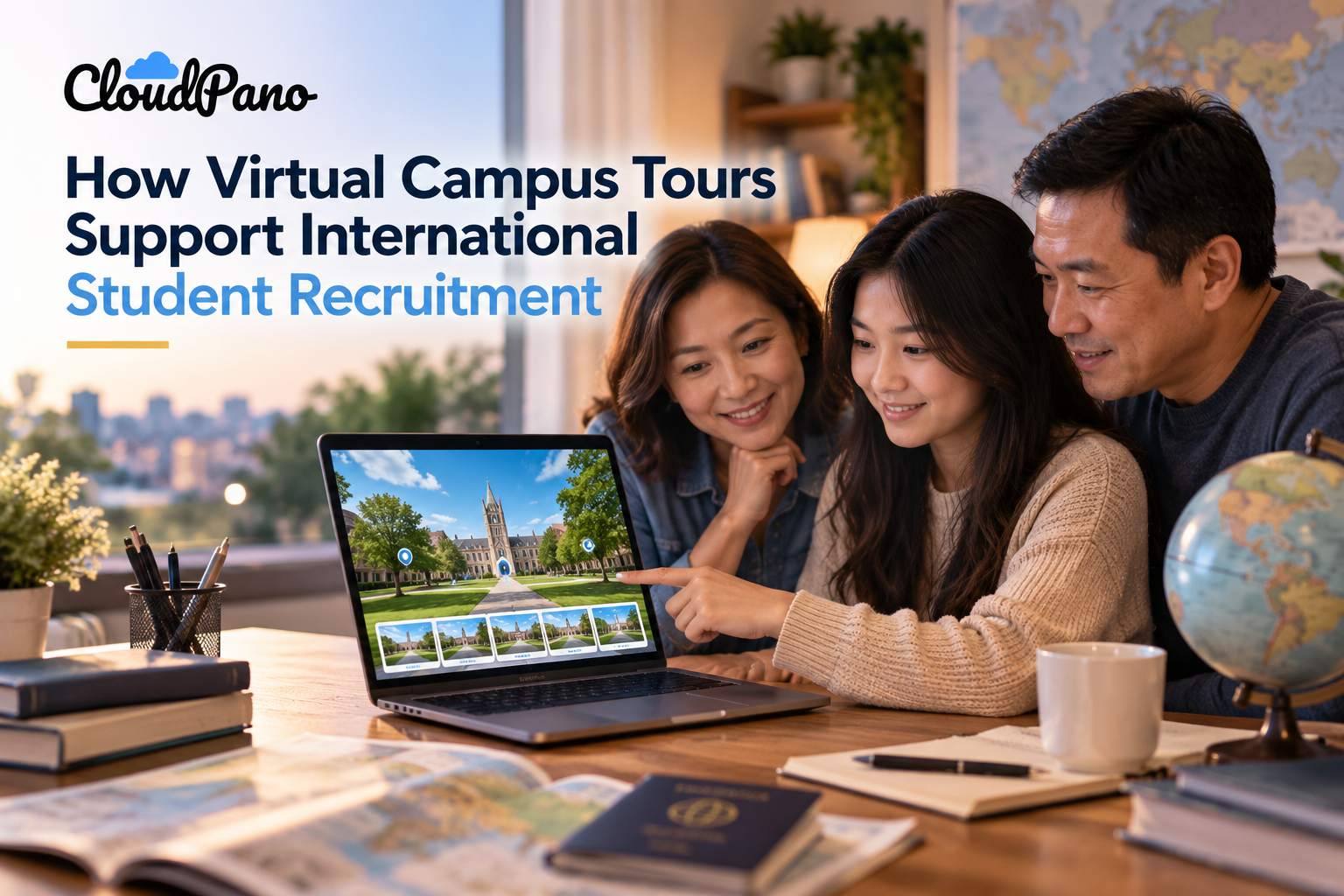
Virtual tour software built for higher-ed recruitment helps universities give international students and their families an accessible way to explore campus remotely. Through self-guided 360° tours, interactive campus content, live virtual experiences, and lead-generation opportunities, institutions can reduce geographic barriers and support international prospects throughout the research and admissions journey.
For international admissions teams, distance is one of the biggest obstacles standing between a promising applicant and an enrolled student. A prospective student in Lagos, Seoul, or São Paulo cannot easily make an afternoon campus visit, and the cost of international travel, combined with visa logistics and time away from school, can make an in-person visit impractical.
Yet prospective students and their families still want to understand what campus life actually looks and feels like before making such an important decision. This is where virtual campus tours can help bridge the gap. For institutions focused on growing their international pipeline, virtual tour software built for higher education can become a practical recruitment tool rather than simply a digital novelty.
This article looks specifically at how 360° virtual tours can address barriers unique to international recruitment: time zones, travel costs, family trust, and the challenge of converting remote interest into a real applicant pipeline.
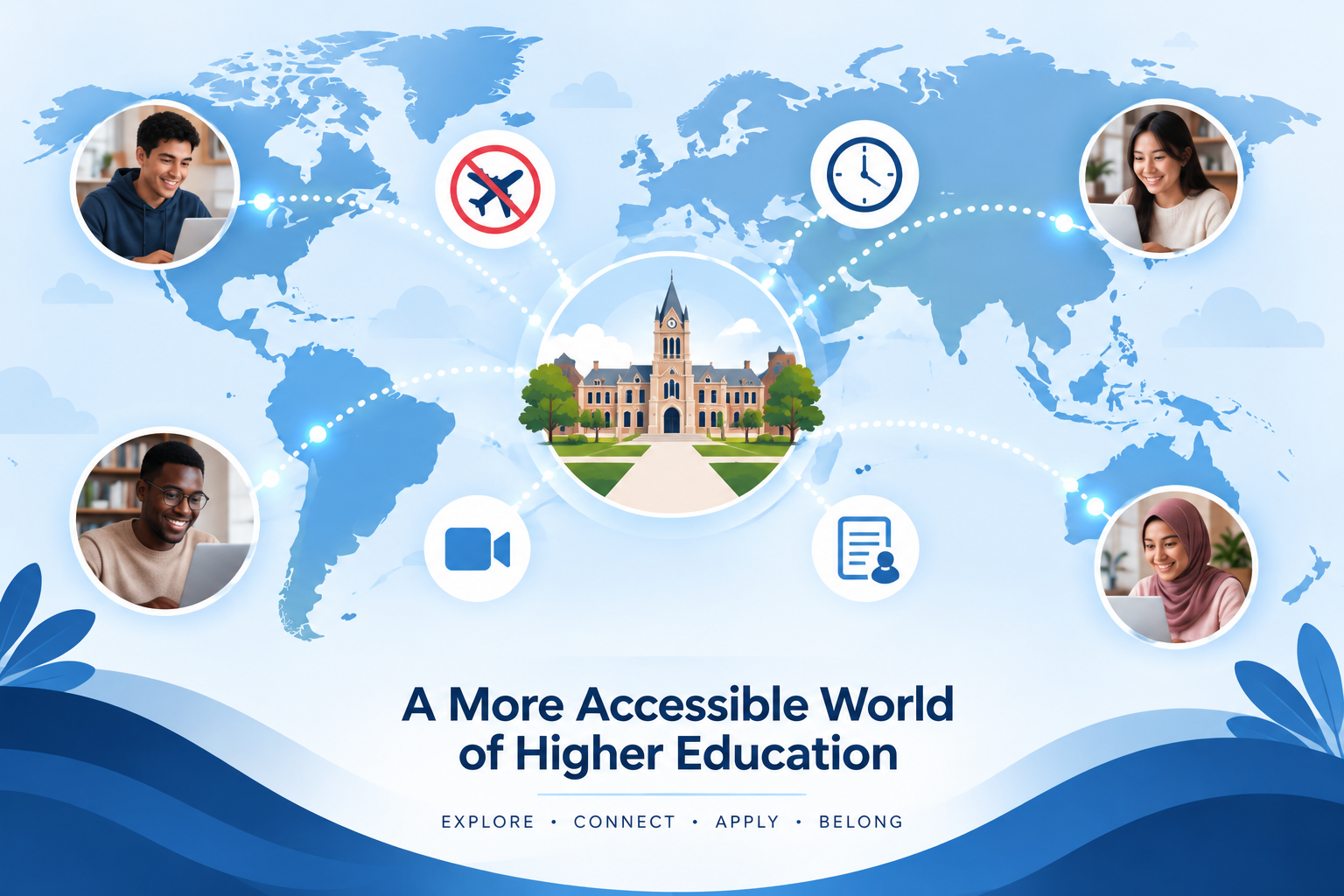
Domestic prospective students may have more opportunities to visit campus, sit in on a class, tour dining facilities, and explore the surrounding area before deciding where to apply. International students often don't have that option. Several realities shape the difference:
Travel cost and time. International flights, lodging, and the time needed to make a single visit worthwhile can add up quickly for families that may also be comparing multiple countries and institutions. For many, visiting several schools in person simply isn't practical.
Time zone misalignment. A counselor holding office hours from 9 a.m. to 5 p.m. Eastern may be unavailable during convenient hours for prospective students in parts of Asia and the Pacific. Live conversations often require deliberate scheduling on both sides, creating additional friction during the early stages of exploration.
Unfamiliarity with the physical layout of American or Western campuses. Families researching from abroad may have little frame of reference for what a "quad," "dining hall," or "residence hall" actually looks like. Static brochure photography can show individual spaces, but it may not communicate how those spaces connect or what navigating the campus feels like.
Trust and verification. Families considering significant tuition and relocation costs may understandably want greater reassurance about an institution they have never physically visited. They may rely on information from university websites, education agents, alumni networks, online communities, and other sources when evaluating their options.
None of these barriers are new, and higher education publications such as Inside Higher Ed have documented how international recruitment strategies continue to evolve alongside changing travel and demographic patterns. Virtual tours offer institutions another way to respond to those challenges.
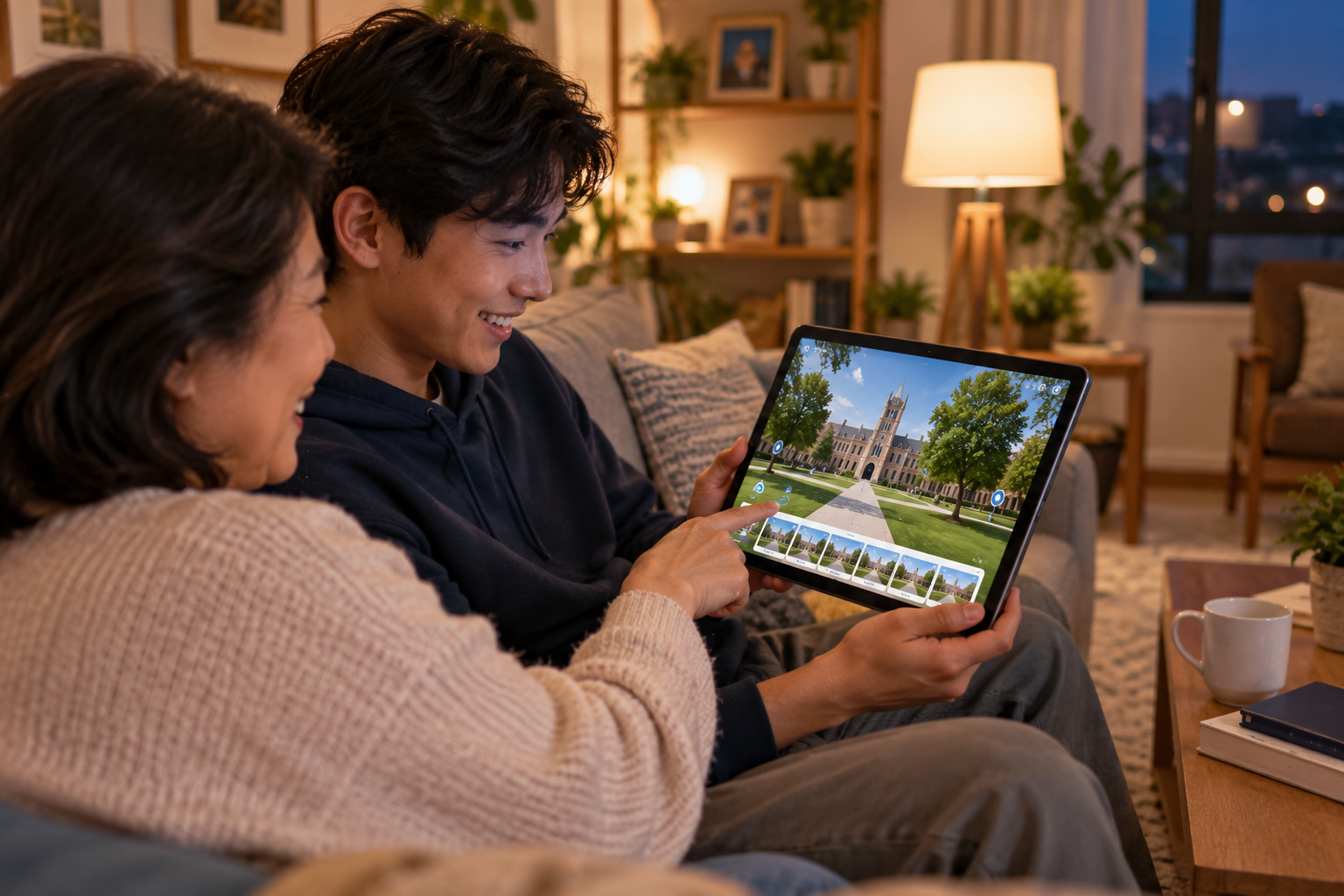
A 360° virtual tour transforms a scheduled campus experience into an always-available exploration tool. Instead of waiting for an admissions counselor to be online, a prospective student in another time zone can open the tour whenever it's convenient and move through campus using hotspot navigation — clicking from the main quad into a lecture hall, from the library into a residence hall room, or from the student center into an athletic facility.
Because the tour can live directly on the admissions website, students and families can explore it regardless of their local time.
This self-paced experience can be particularly useful for international families because several people may be involved in the decision-making process. Parents, family members, and education advisers can revisit and share the tour independently without coordinating a single live appointment.
3D dollhouse floor plans can provide another layer of orientation for viewers unfamiliar with a campus's physical layout. Rather than trying to build a mental map from individual photographs, families can better understand how spaces and buildings relate to one another.
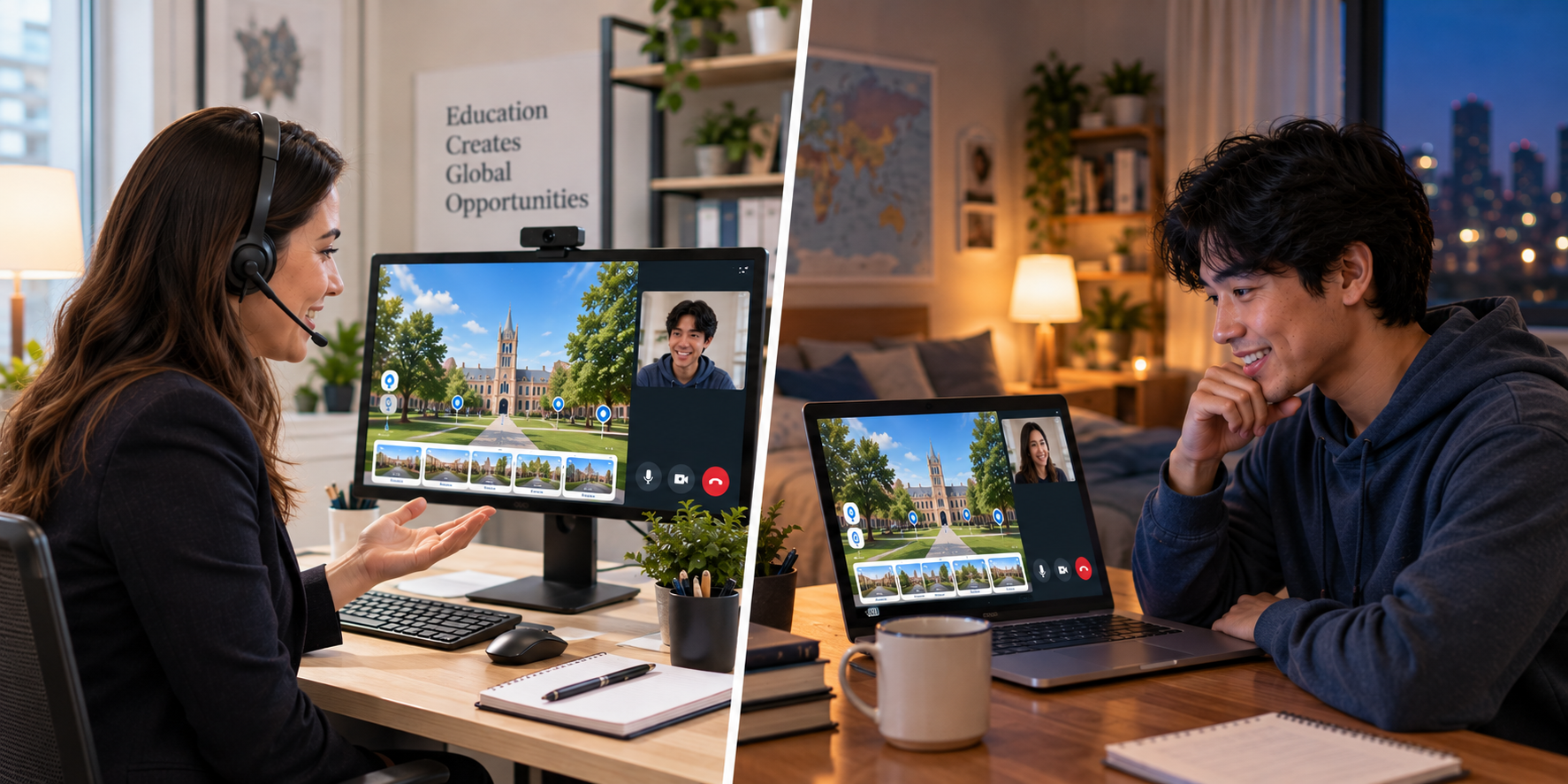
Self-guided exploration addresses part of the challenge, but international families may still want opportunities to ask questions directly.
This is where live 360° video chat functionality can complement an international recruitment strategy. Instead of relying solely on a traditional video call, a counselor can guide a prospective student through a 360° environment in real time, point out relevant details, answer questions about specific buildings or programs, and personalize the conversation based on what the family wants to explore.
The practical advantage is flexibility. Because the self-guided tour remains available asynchronously, live sessions can be reserved for higher-value interactions — such as monthly international information sessions or bookable evening appointments designed around specific regional time zones — rather than requiring individual live tours for every prospective student.
Admissions teams can also use recurring questions from these sessions to improve future walkthroughs and determine which campus spaces deserve additional explanation.
Enrollment research organizations such as Ruffalo Noel Levitz regularly examine the role of communication and engagement in enrollment strategy. Live virtual walkthroughs can provide international admissions teams with another way to communicate personally without requiring travel from either party.
Trust plays an important role in international recruitment. A family considering sending a student overseas — often at significant financial and emotional cost — understandably wants reassurance about the institution, its facilities, and the environment in which the student may live.
Photography and traditional video can help, but a 360° tour gives viewers greater control over what they explore. Instead of seeing only a sequence of predetermined shots, visitors can look around spaces themselves and navigate between different areas of campus.
Publishing appropriate campus imagery to Google Street View can provide another discovery channel. Families may already use Google Maps when researching the university's surrounding neighborhoods, transportation options, restaurants, and other amenities. Making campus imagery available within that broader environment can help prospective students understand both the institution and its surroundings.
Higher education publications such as The Chronicle of Higher Education have covered the ways institutions continue to adapt their recruitment and marketing strategies for students who may have limited opportunities to visit before applying or enrolling. Virtual tours can form one part of that broader digital recruitment strategy.
Exploration and trust matter, but international enrollment teams also need ways to convert interest into measurable recruitment activity.
This is where the practical features of virtual tour software become especially important. Tours can be embedded directly on admissions webpages, including pages designed specifically for international applicants. Institutions can then place lead-generation forms at appropriate points in the experience.
For example, after exploring a residence hall or dining facility, a prospective student could be invited to request more information, download a viewbook, or schedule a conversation with the international admissions office.
Depending on the virtual tour platform and analytics configuration, admissions teams may also be able to measure tour traffic and engagement alongside their existing website analytics. This information can help teams understand which pages and tour experiences are attracting attention from international audiences and which calls to action are generating inquiries.
Custom white-label domains, available through virtual tour software built for higher-ed recruitment, are also worth considering for institutions operating dedicated microsites for specific countries or regions. Keeping the tour visually consistent with the institution's branding can create a more seamless experience for prospective students and families.
Taken together, embedded tours, in-tour lead forms, branding, and analytics can make a virtual tour platform an integrated part of the international recruitment funnel rather than a standalone marketing asset.
No. Virtual tours are best understood as a complement or alternative for students who cannot realistically visit because of distance, cost, scheduling, or visa considerations.They can help prospective students explore the campus before applying and can also serve as a useful pre-visit or follow-up resource for international students who eventually visit in person.
A standard video call generally focuses on the counselor and prospective student or relies on screen sharing. A live 360° walkthrough can allow the counselor to guide the prospective student through a virtual campus environment while discussing specific spaces.This creates an opportunity to connect questions directly to the buildings, facilities, or campus areas the student is viewing.
Consider placing the tour directly on pages international prospects are already likely to visit — such as the international admissions landing page, country-specific microsites, housing pages, or academic program pages that attract significant overseas interest.Lead-capture forms or relevant calls to action can then be incorporated at natural points within the experience.
Yes. A self-guided tour can be reused across recruitment campaigns, webpages, email communications, and virtual events once it has been created.Smaller teams can focus on maintaining one comprehensive campus tour and supplementing it with a manageable number of scheduled live sessions rather than attempting to provide individual virtual walkthroughs to every prospective student.
Yes. Self-guided virtual tours are available without requiring the student and admissions staff to be online simultaneously, making them useful for international prospects across different time zones. Universities can then supplement the tour with scheduled virtual advising, information sessions, or counselor conversations when students need more personalized assistance.


Compact, ready to go anywhere
Interchangeable lens that’s upgradeable
Dual 1-inch sensors for improved clarity and low light performance
Dynamic range and 6K 360° capture
360° photo resolution at 21MP

8K 360° video recording for ultra-detailed visuals.
4K single-lens mode for traditional wide-angle shots.
Invisible selfie stick effect for drone-like perspectives.
2.5-inch touchscreen with Gorilla Glass protection.
Waterproof up to 33ft for underwater shooting.

360° photo resolution in 23MP
Slim design at 24 mm thick
Built-in image stabilization for smooth video capture.
Internal 19GB storage for photo and video storage.
Wireless connectivity for remote control and sharing.

60MP 360° still images for high-resolution photography.
5.7K 360° video recording at 30fps.
2.25-inch touchscreen for intuitive control.
USB Type-C port for fast charging and data transfer.
MicroSD card slot for expandable storage.
.png)

.png)

Try it free. No credit card required. Instant set-up.




.svg)


.svg)