Scalable Data Labeling: How Provider Networks Handle Enterprise Volume
Cloudpano
July 19, 2026
•
5 min read
Share this post
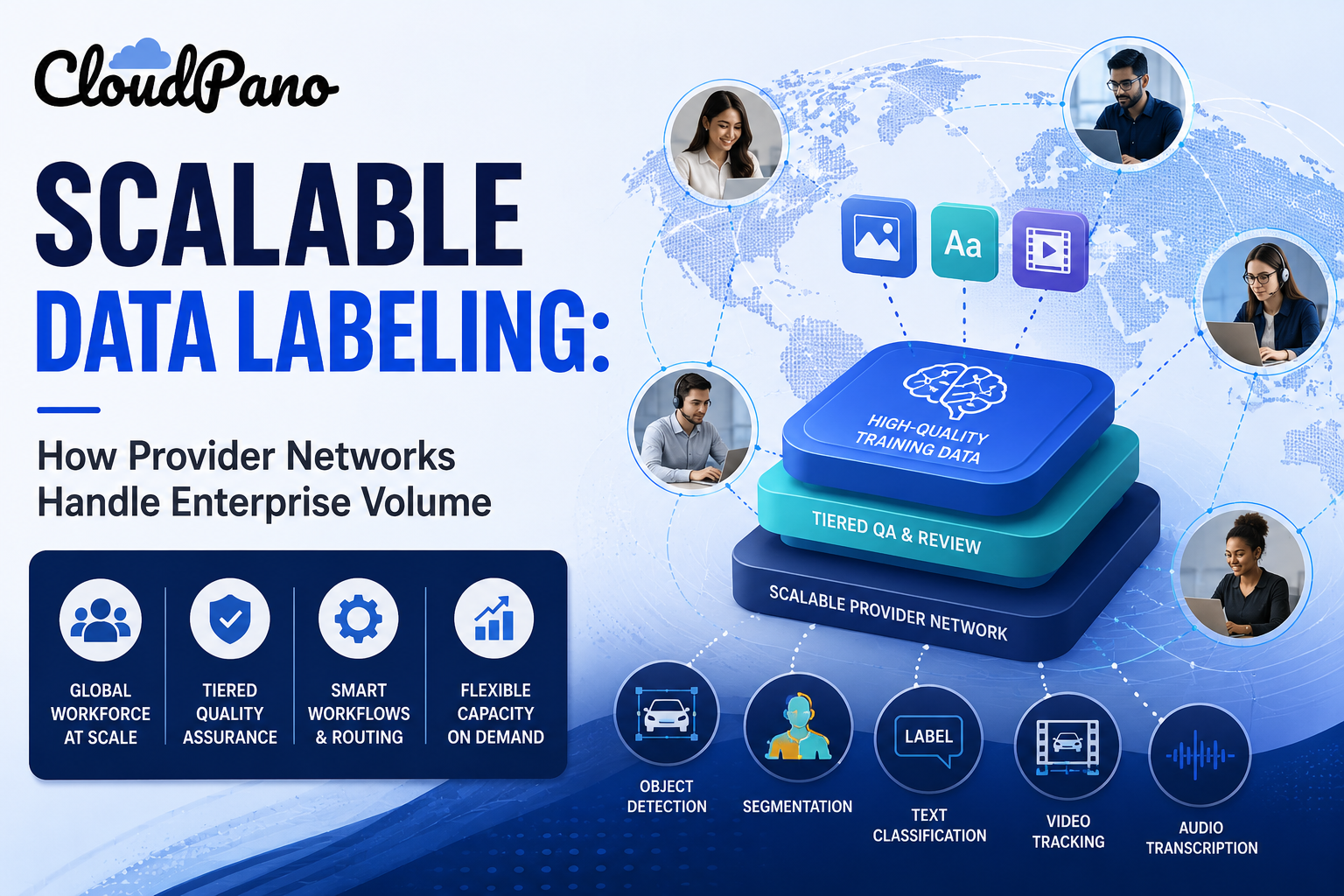
Scalable Data Labeling for Enterprise: How Provider Networks Handle High Volume
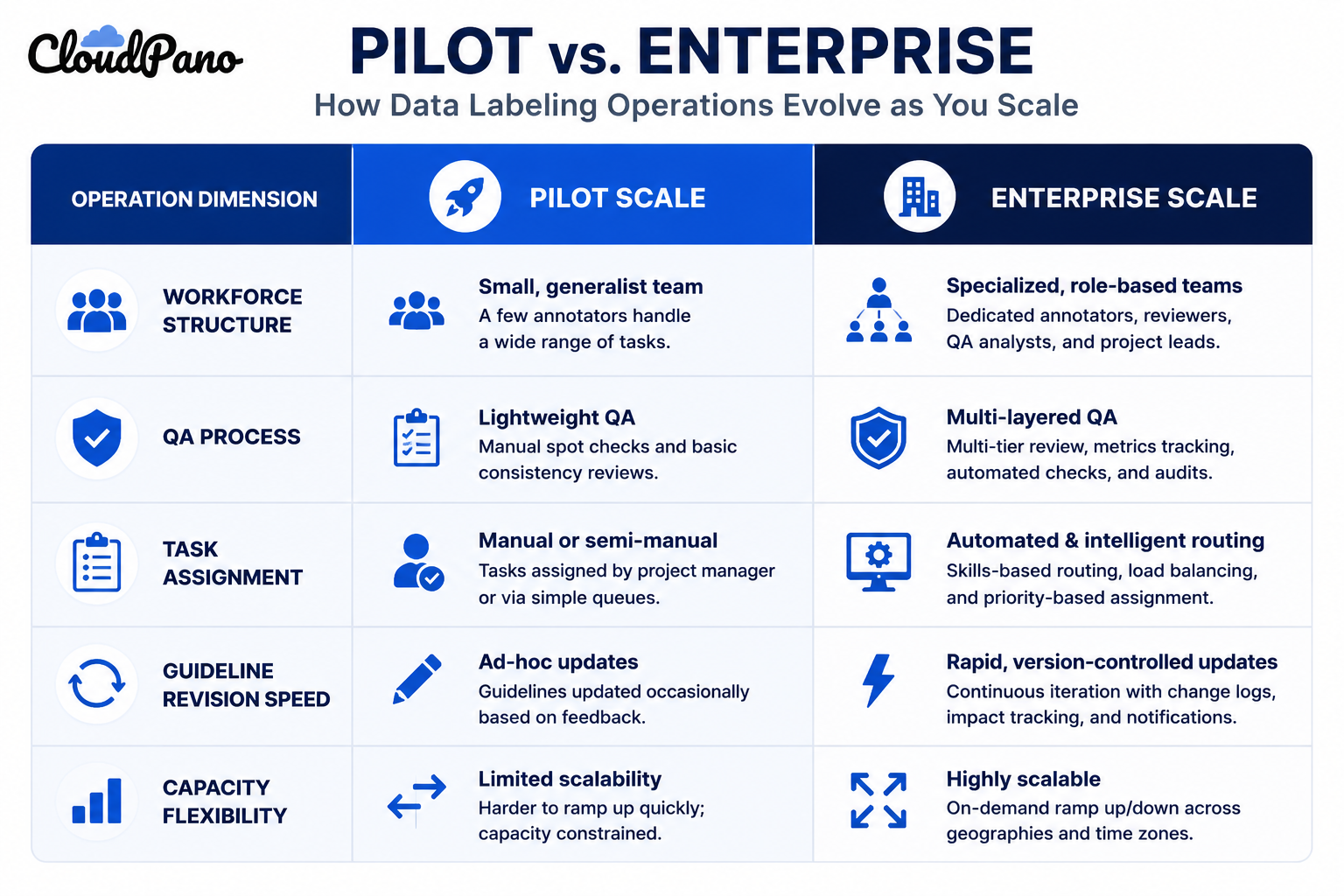
The process that worked well for a 5,000-item pilot rarely survives contact with a 5-million-item production dataset unchanged. Scalable data labeling for enterprise needs are different in kind, not just in size, from what most teams build for an initial proof of concept.
At small scale, a handful of annotators and a shared spreadsheet can work. At enterprise volume, the same informal process becomes the reason quality degrades exactly when a project needs it most — right as a model moves toward production.
Why It Matters
Scaling annotation without scaling the quality process behind it is one of the most common ways enterprise AI training data management goes wrong. Small, unaddressed quality gaps that were tolerable at pilot volume compound at scale — a pattern Google Research's "Data Cascades" study documented clearly, showing how data issues that seem minor early on become expensive, hard-to-trace production failures later (Sambasivan et al., Google Research).
NIST's AI Risk Management Framework treats data quality and provenance as foundational to trustworthy AI at any scale, which means scaling annotation volume without scaling oversight isn't just an operational risk — it's a governance one (NIST AI RMF).
The pressure to scale fast is real, too. Stanford HAI's AI Index has tracked how quickly organizations are moving models from research into production (Stanford HAI, AI Index Report), and enterprise teams often need annotation throughput to increase by an order of magnitude in a timeframe that doesn't leave much room to rebuild the process from scratch.
How It Works
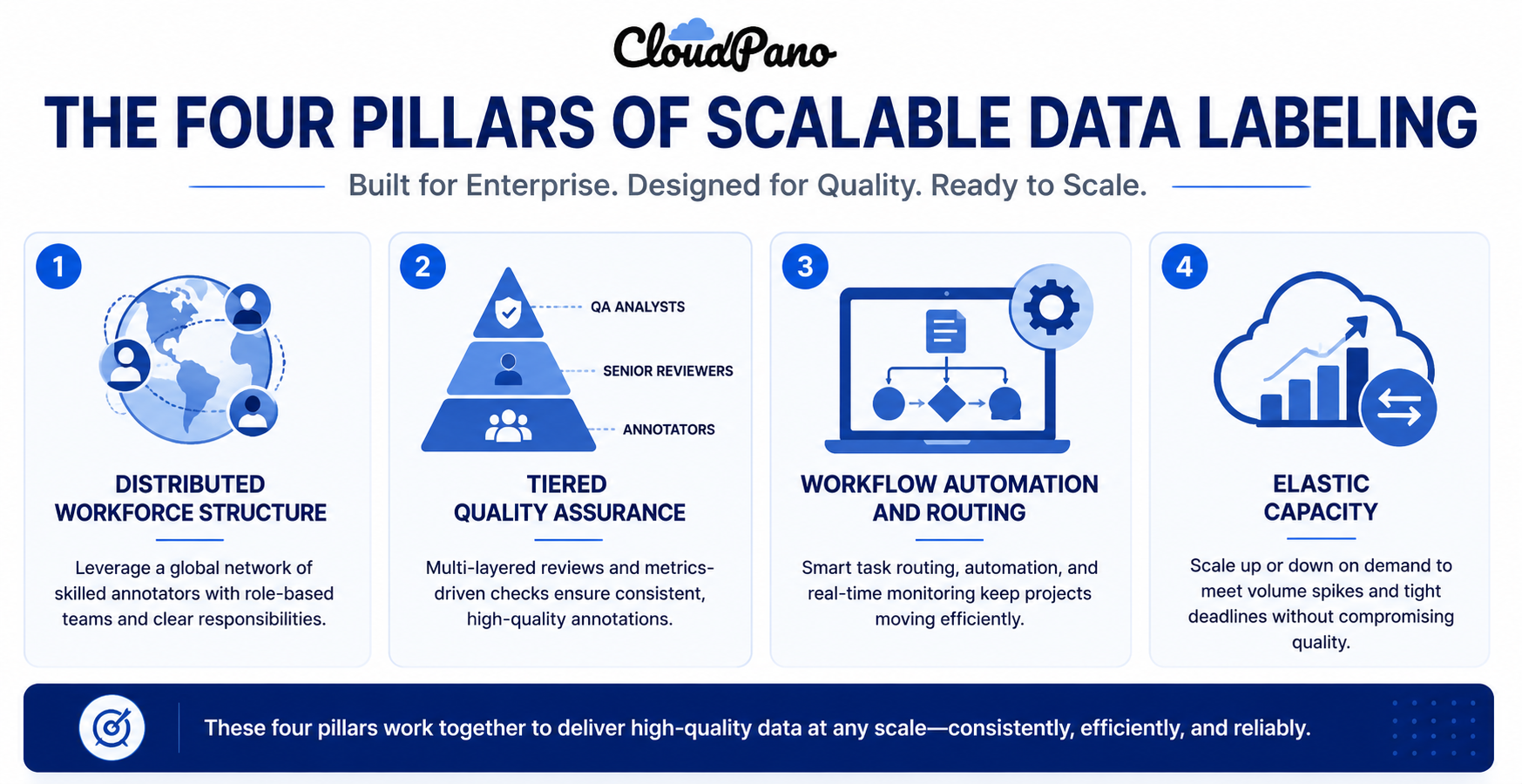
Provider networks built for high-volume data annotation solve the scaling problem through a few structural choices that differ meaningfully from a small internal team's setup. Understanding how these workflows operate at scale clarifies what to look for, whether you're evaluating a vendor or scaling an internal process.
Distributed workforce structure. Rather than a single team handling everything, scaled operations split work across parallel teams or pods, each responsible for a defined slice of the taxonomy or data type, which lets throughput increase without every annotator needing to master the entire project.
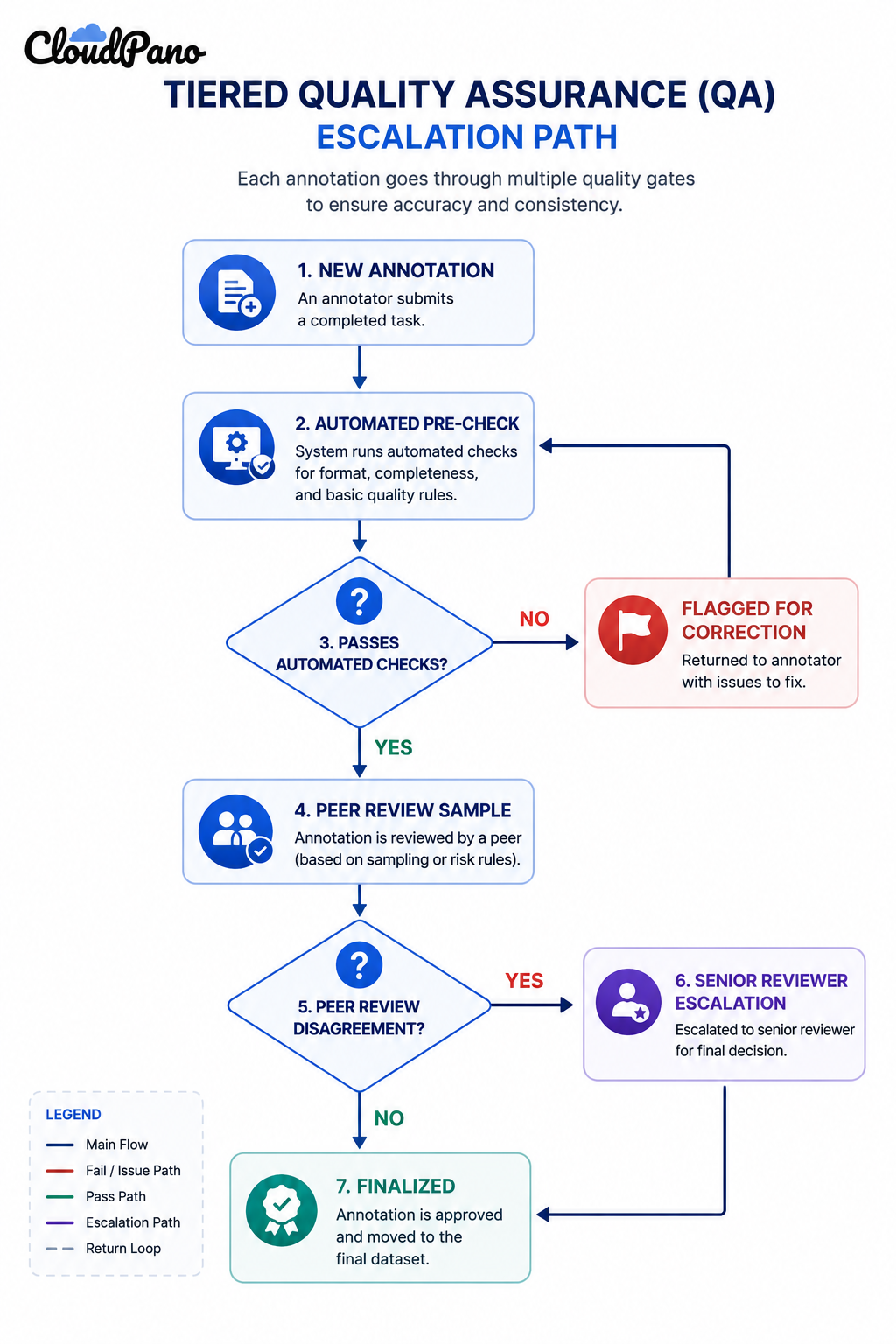
Tiered quality assurance. Instead of one QA pass, scaled processes layer tiers — automated pre-checks, peer review, senior reviewer escalation — so quality control itself scales in parallel with volume rather than becoming a single bottleneck.
Workflow automation and routing. Task assignment, progress tracking, and quality flagging get automated so that scaling headcount doesn't require scaling manual project management at the same rate.
Elastic capacity. Provider networks can add trained annotators to a project faster than most internal teams can hire, which is the core advantage they offer specifically at the volume-spike stage of a project.
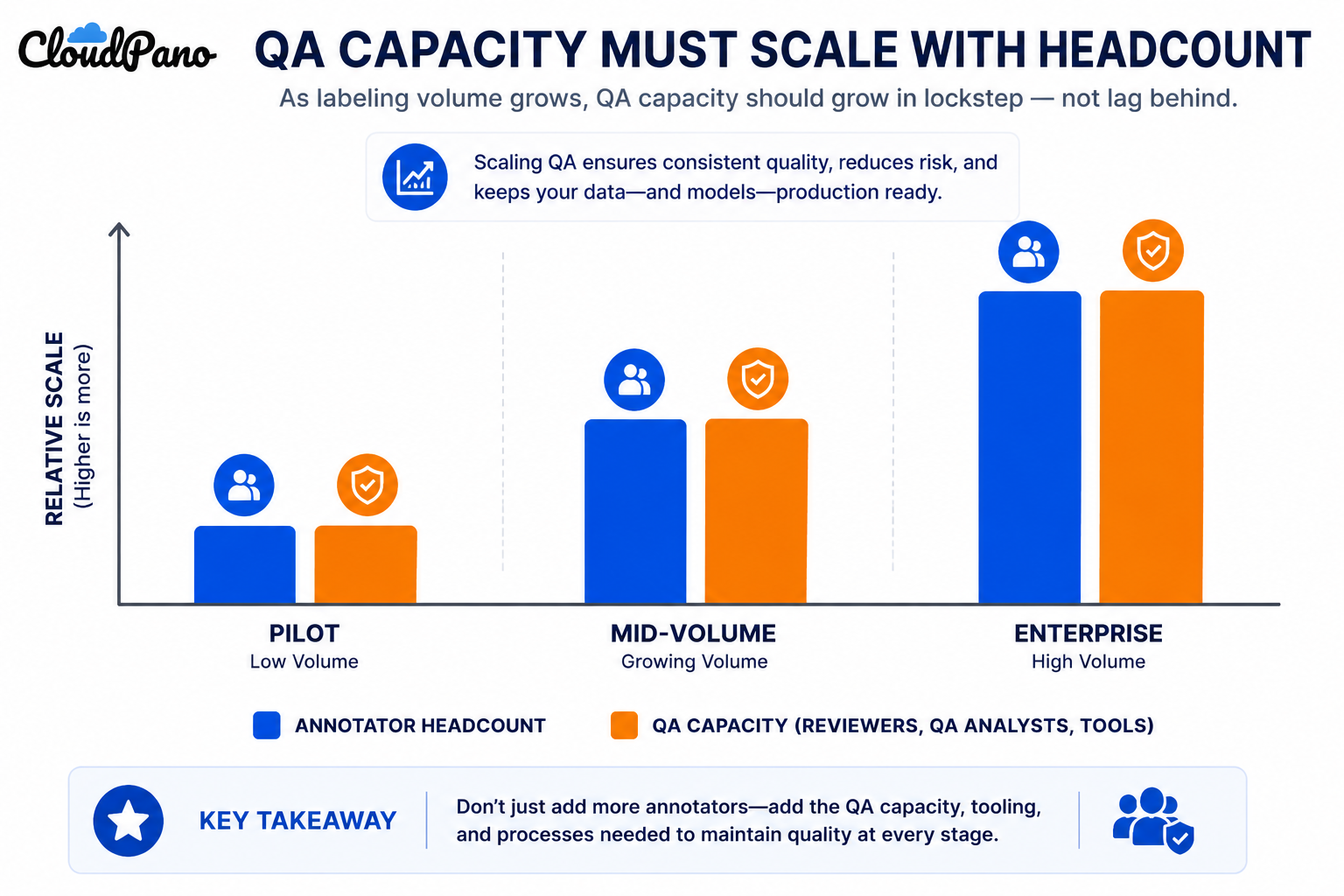
📊 Scaling the Annotation Engine
How workforce, QA, and automation grow from pilot to enterprise
Forecast volume and variability, not just total scale. A steady 100,000 items a month needs a different structure than a one-time spike to 2 million.
Segment the taxonomy for parallel workforce structure. Break the project into slices that different teams or pods can own independently without constant cross-team coordination.
Build tiered QA before scaling volume, not after. Automated pre-checks, peer review, and senior escalation should exist before throughput ramps, not get retrofitted once quality problems appear.
Automate task routing and progress tracking. Manual assignment and status tracking that worked at pilot scale won't hold at enterprise volume.
Ramp workforce in stages, validating quality at each stage. Scale from pilot to mid-volume to full volume with a quality check at each step, not a single jump.
Monitor inter-annotator agreement and audit results continuously. Set up dashboards or reporting that make quality visible in real time, not just at scheduled checkpoints.
Build a rapid guideline-revision process. At enterprise volume, an ambiguous guideline reaches far more annotators before anyone notices, so revision cycles need to be fast.
Plan for elastic capacity, not fixed headcount. Whether in-house or outsourced, structure the workforce so it can flex up or down as volume changes.
Industry Use Cases
Computer vision / robotics: High-volume bounding box and segmentation work across millions of images, typically requiring distributed workforce pods segmented by object category or environment type.
Autonomous vehicles: Massive video and sensor data volumes from fleet operations, requiring elastic capacity that can absorb sudden spikes tied to new vehicle deployments or route expansions.
Healthcare AI: Large-scale clinical data annotation where tiered QA with expert-level escalation is non-negotiable, even as volume scales.
Retail AI: High-volume, lower-ambiguity product categorization across large and frequently changing catalogs, where automation-heavy routing keeps management overhead manageable.
LLM developers: Enterprise-scale preference and safety labeling, where tiered QA and rapid guideline revision matter more than raw throughput alone.
Government & defense: Large classified or sensitive dataset annotation requiring elastic but tightly controlled workforce networks, often within strict security and clearance constraints.
Benefits
Throughput that matches enterprise demand. Distributed, elastic workforce structures scale far faster than a single internal team hiring and training from scratch.
Quality that holds up under volume. Tiered QA and continuous monitoring catch drift before it spreads across a large-scale dataset.
Lower management overhead per unit of volume. Workflow automation reduces the manual coordination burden that would otherwise grow linearly with headcount.
Faster response to guideline changes. A rapid revision process limits how far an ambiguous instruction propagates before it's corrected.
Flexibility to absorb volume spikes. Elastic capacity means a sudden increase in data volume doesn't require a scramble to hire or retrain.
Common Mistakes
Scaling headcount without scaling QA. Adding annotators faster than quality assurance capacity leads to a growing backlog of unverified or inconsistent labels.
Keeping manual task assignment as volume grows. Manual coordination that worked with ten annotators becomes a bottleneck with two hundred.
Underestimating how far guideline ambiguity travels at scale. An unclear instruction that affects five annotators in a pilot can affect hundreds at enterprise volume before it's caught.
Treating workforce capacity as fixed. Planning for a single throughput level instead of building in elasticity for demand spikes or dips.
Delaying quality monitoring until after a batch is complete. Auditing only at the end of a large batch means errors have already propagated across the full volume before anyone notices.
Assuming enterprise data labeling means less oversight, not more. Scale increases the need for structured QA and monitoring, not the opposite.
Best Practices
Build tiered quality assurance and workflow automation before scaling volume, not as a reaction to quality problems.
Segment your taxonomy so workforce pods can operate in parallel without constant cross-team dependency.
Monitor inter-annotator agreement and audit results continuously, with dashboards that make drift visible in real time.
Design for elastic capacity from the start, whether managing an internal team or working with a provider network.
Keep guideline revision cycles fast — at enterprise volume, ambiguity reaches more annotators before anyone notices it.
Treat scaling as an ongoing operational discipline rather than a one-time infrastructure build. McKinsey's research on generative AI adoption notes that data readiness — including the operational capacity to manage data work at scale — remains one of the most consistently underestimated factors in enterprise AI outcomes (McKinsey, "The economic potential of generative AI").
FAQ
What makes data labeling "scalable" for enterprise use?
A distributed workforce structure, tiered quality assurance, and automated task routing that let throughput increase without a proportional increase in management overhead or a drop in accuracy.
How do provider networks handle sudden volume spikes?
By maintaining elastic capacity — trained annotator pools that can be ramped up faster than most internal teams can hire — combined with workflow automation that absorbs the coordination load of a larger workforce.
Does scaling data labeling volume always mean lower quality?
Not if quality assurance scales alongside volume. Tiered QA, continuous agreement monitoring, and fast guideline revision are what keep accuracy steady as throughput increases.
What's the difference between enterprise data labeling and a small-scale pilot?
Enterprise data labeling requires distributed workforce structures, automated routing, and tiered QA built for parallel scale, while a pilot can often run informally with a small team and manual oversight.
How is quality assurance different at enterprise scale?
It's layered rather than single-pass — automated pre-checks, peer review, and senior escalation working together — so quality control itself scales in parallel with volume instead of becoming a bottleneck.
What tooling supports high-volume data annotation?
Platforms that automate task assignment, progress tracking, and quality flagging, since manual coordination that works at small scale becomes unmanageable as workforce size and data volume grow.
How do I know when my current labeling process needs to scale differently?
Signs include growing QA backlogs, slower guideline revision cycles, manual task assignment becoming a bottleneck, and inconsistent quality across different annotator teams — all indicators that the process built for pilot scale isn't built for current volume.
Conclusion
Scalable data labeling for enterprise isn't just about adding more annotators — it's about building workforce structure, quality assurance, and tooling that scale together. The teams that handle high-volume data annotation well are the ones that treat quality control as something to scale in parallel with throughput, not something to catch up on afterward.
Create an interactive virtual showroom and engage affluent digital buyers with live 360º video calls, all through the CloudPano mobile app for a complete automotive sales solution.
Create 2D and 3D floor plans with measurements in 4 minutes or less, all from your phone. Download the Floor Plan Scanner app and get your first scan free.
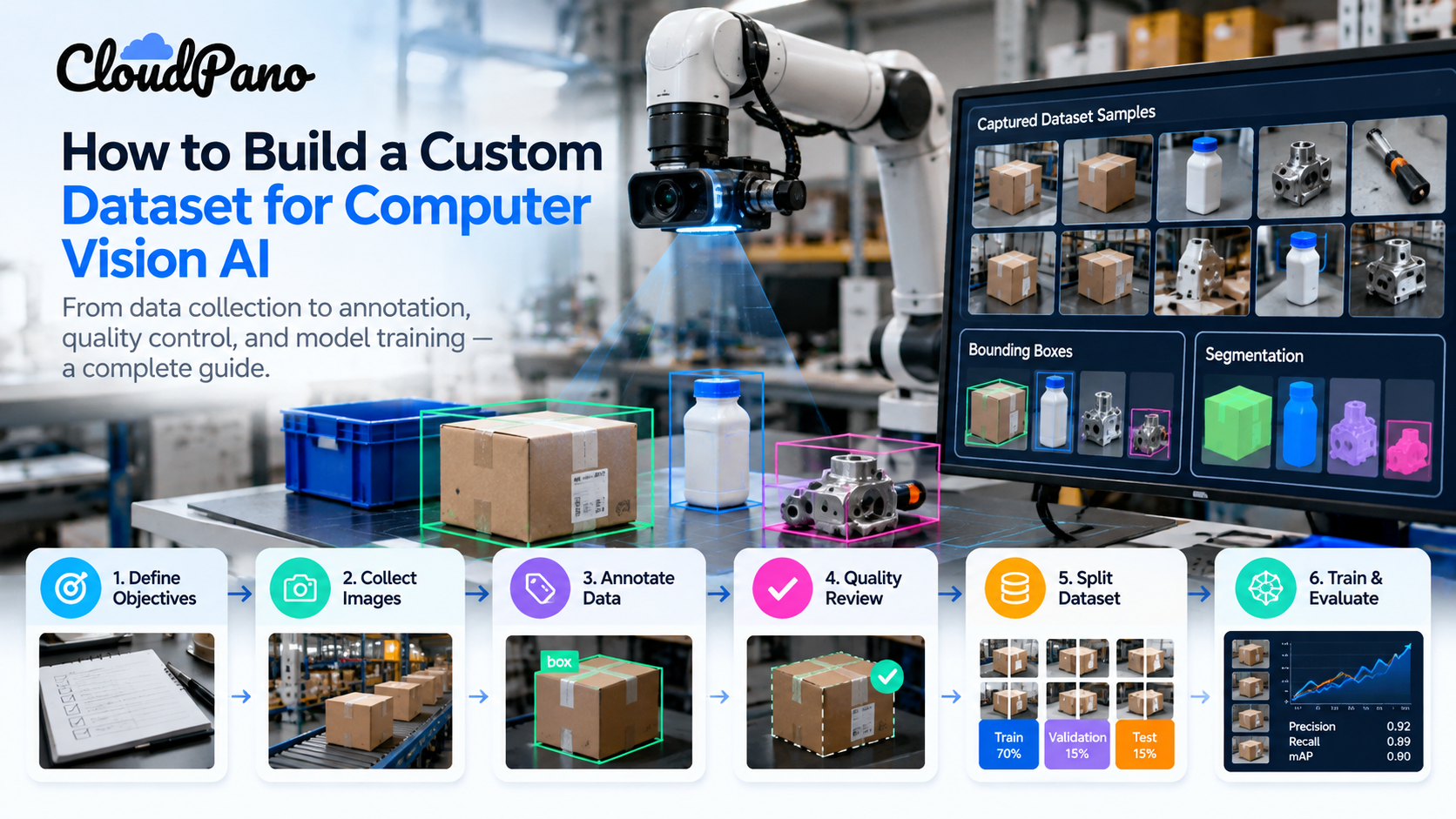
Building a custom computer vision dataset takes more than collecting images and adding labels. Learn how to define annotation requirements, gather representative visual data, maintain labeling quality, and prepare reliable datasets for AI model training.
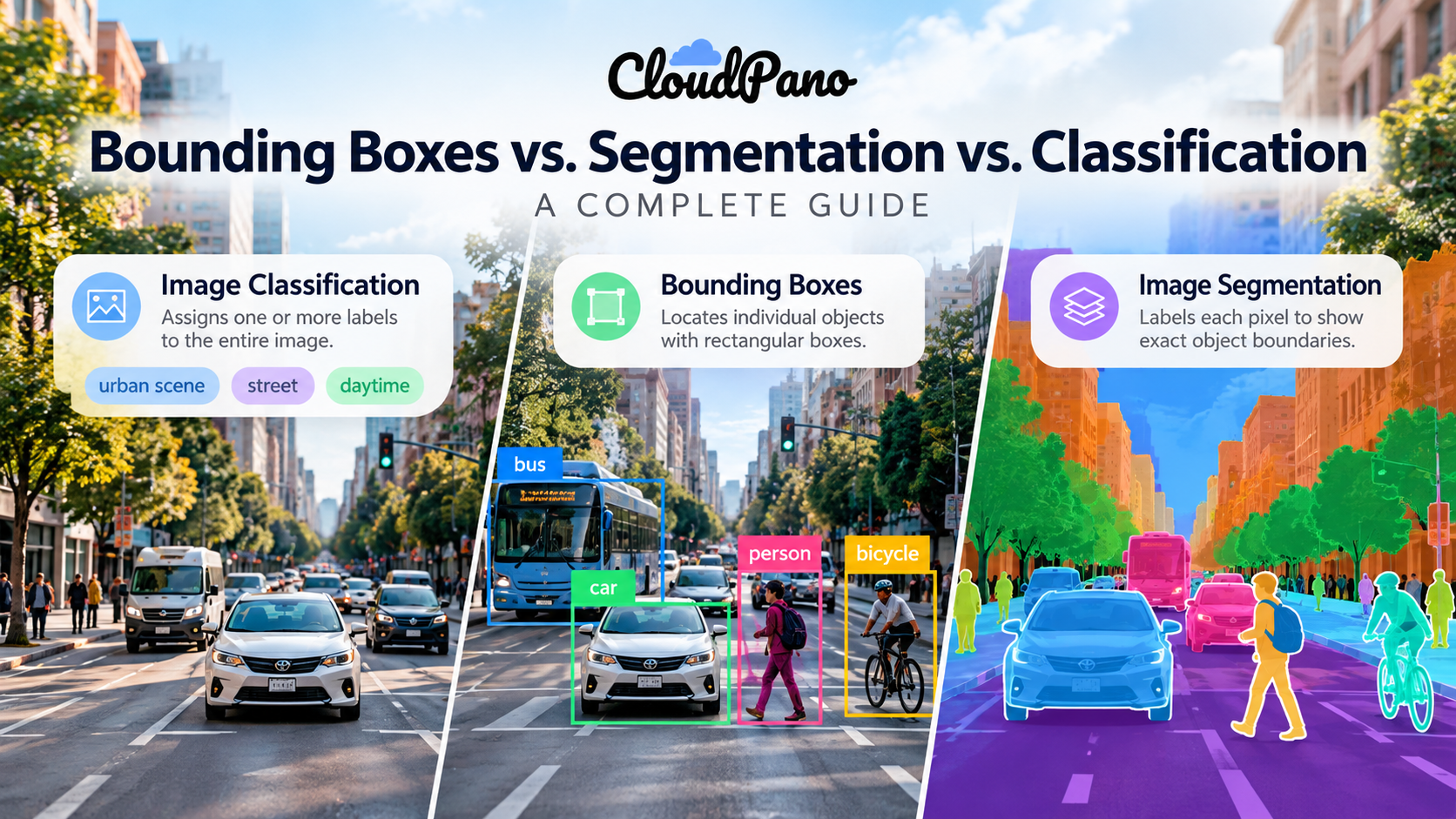
Bounding boxes, segmentation, and classification are three essential computer vision annotation methods, but they serve different purposes. Discover how each works, where it performs best, and how to choose the right annotation approach for accurate, scalable AI training data.
Home robots and vision models need video from real homes, yet the best-known indoor datasets cover a few dozen kitchens or a few hundred people. This guide explains why home footage is scarce, what public datasets offer, and how custom in-home collection works.


.png)




.png)

.png)






.svg)


.svg)