


.png)


Teams evaluating RLHF vs supervised fine-tuning often frame it as choosing the "better" technique, when the more useful question is which one actually matches what they're trying to improve. The two methods use fundamentally different kinds of training data and solve different problems.
Supervised fine-tuning for LLMs trains a model on example input-output pairs — here's a prompt, here's the correct or ideal response — teaching the model to imitate that pattern. RLHF instead trains on comparisons between multiple candidate outputs ranked by preference, teaching the model to optimize toward what people actually prefer rather than to copy a fixed example.
Choosing the wrong technique for your actual goal wastes both data collection effort and model development time, since the two methods require genuinely different kinds of annotation work. Google Research's "Data Cascades" study documented how mismatches introduced early in a data or model development process compound into larger, harder-to-diagnose problems, which is exactly the risk of collecting the wrong type of data for your actual tuning goal (Sambasivan et al., Google Research).
NIST's AI Risk Management Framework treats fitness for intended use as a core property of trustworthy AI systems, and matching your fine-tuning approach to your actual objective is a direct application of that principle rather than a purely technical preference (NIST AI RMF).
The stakes rise given how quickly LLM development moves. Stanford HAI's AI Index has tracked the rapid pace of large language model iteration and deployment (Stanford HAI, AI Index Report), leaving less room for a full redo if the wrong tuning approach was chosen and doesn't move the metric a team actually cared about.
Supervised fine-tuning for LLMs works by showing the model curated examples of ideal input-output behavior and adjusting the model's parameters to make those examples more likely outputs. It's conceptually similar to standard supervised learning: correct answers, provided directly, that the model learns to reproduce.
RLHF works differently: rather than a single correct answer per input, annotators compare multiple candidate outputs and rank them by preference. That comparison data trains a reward model, and the target model is then fine-tuned through reinforcement learning to produce outputs the reward model scores highly.
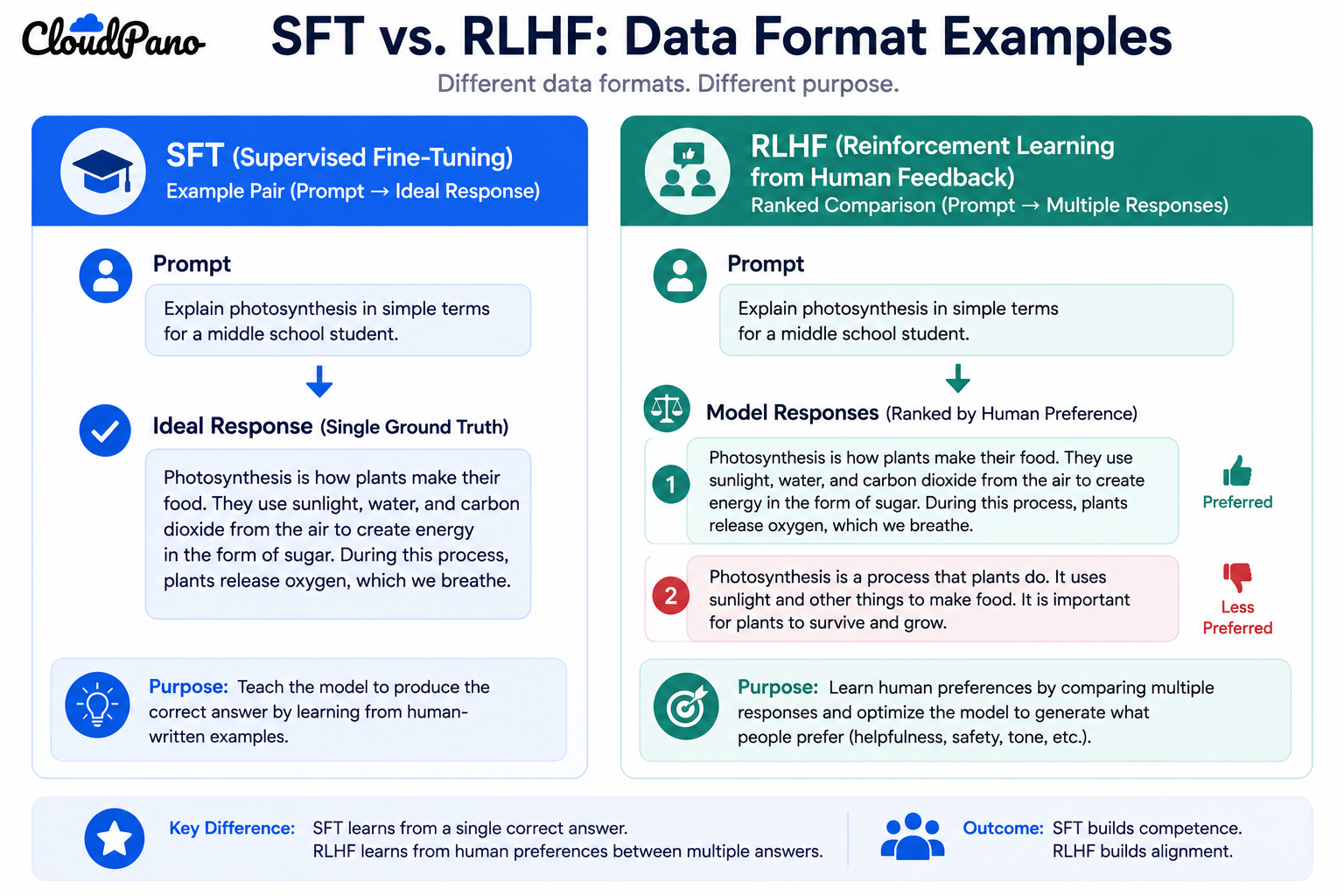
The practical difference in RLHF vs SFT shows up most clearly in what each is naturally good at. SFT excels at teaching a model specific formats, factual patterns, or task structures where there's a clear "correct" example to demonstrate. RLHF excels at teaching more subjective qualities — helpfulness, tone, safety — where "correct" is really "what people actually prefer" rather than a single fixed answer.
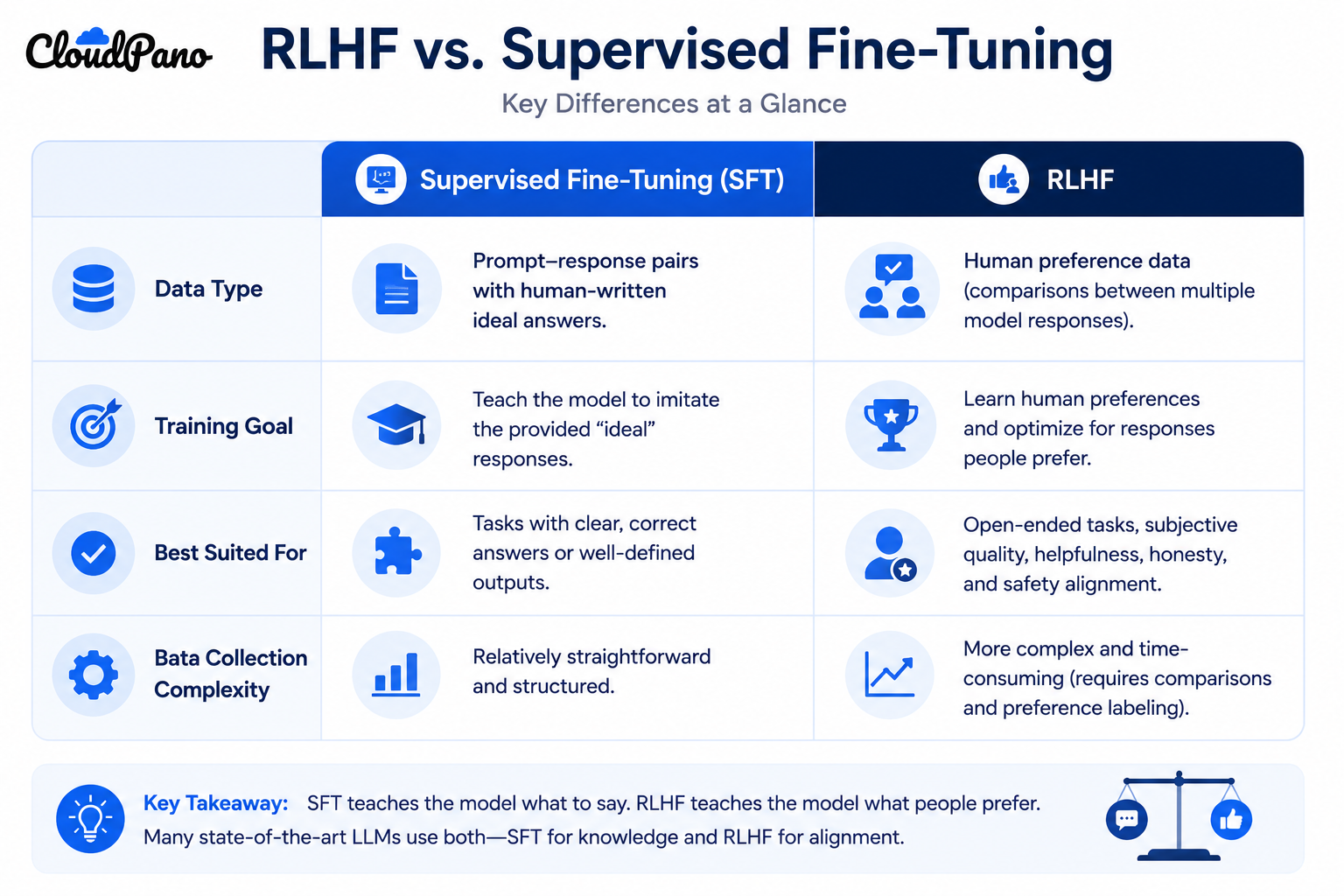
Understanding how these workflows operate — example-based imitation versus preference-based optimization — is what actually determines which one fits a given project, rather than treating them as competing options where one is generally superior.
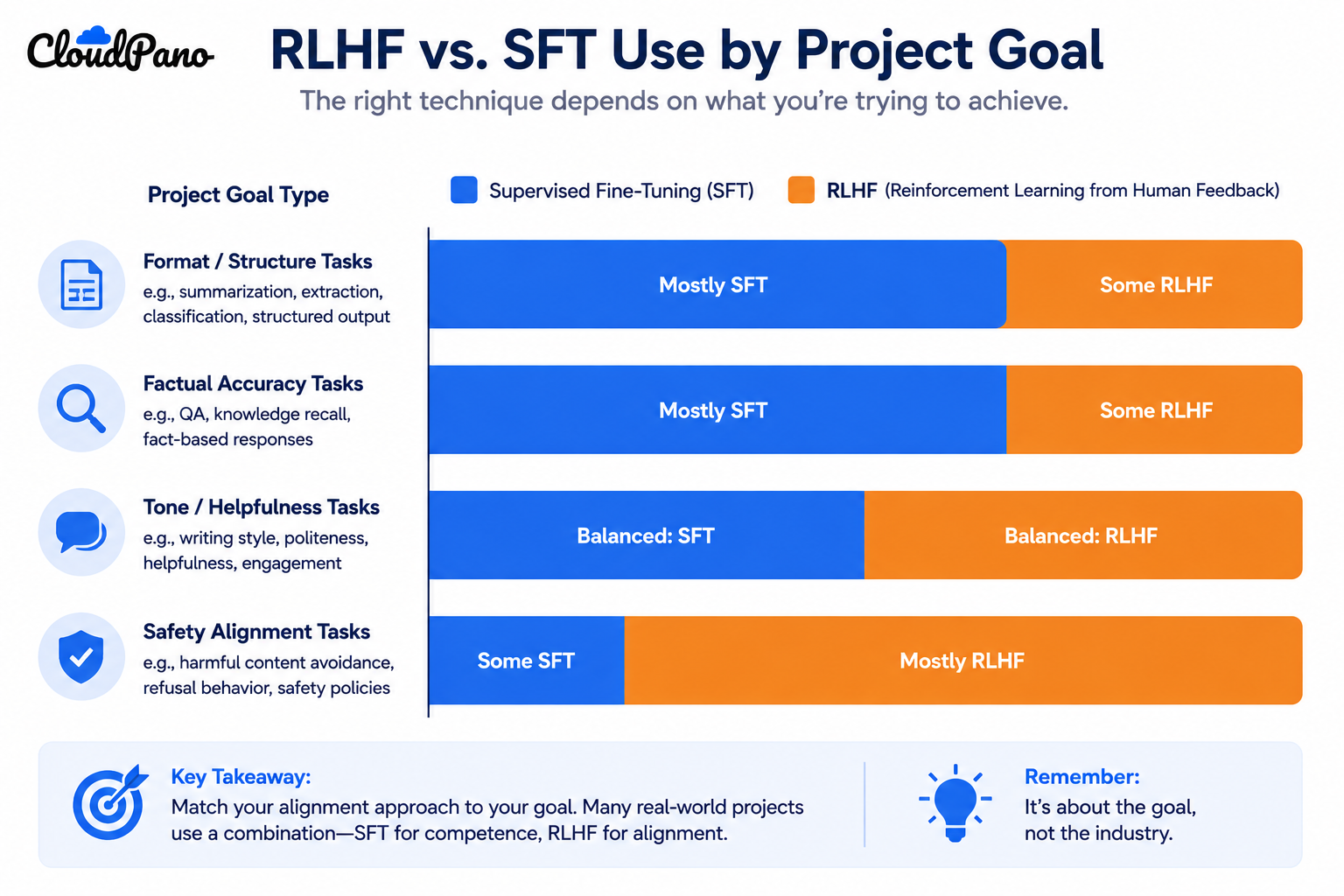
Supervised fine-tuning for LLMs offers:
RLHF offers:
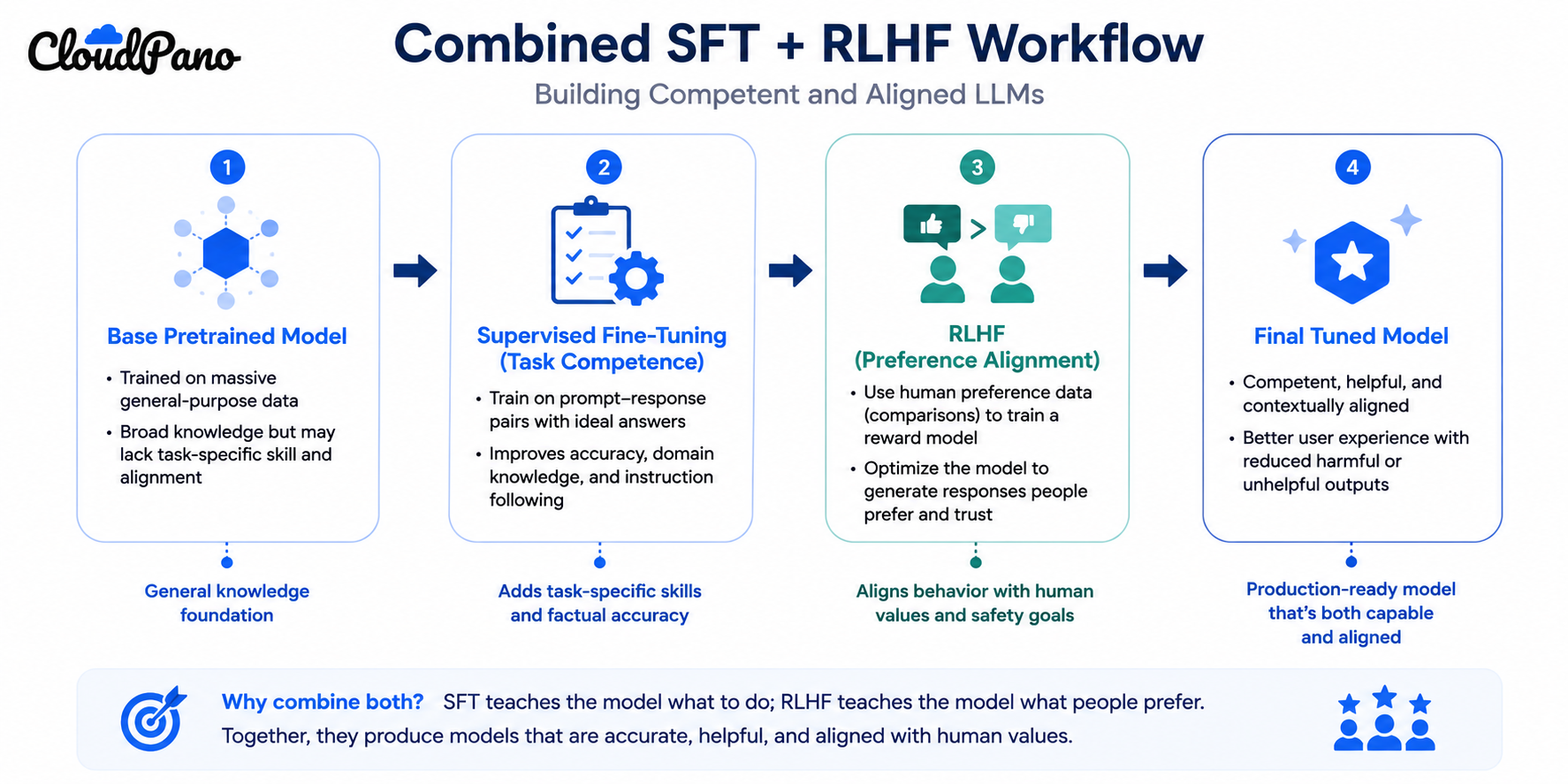
Combining both offers:
Supervised fine-tuning trains a model on example input-output pairs showing a correct response, while RLHF trains on comparisons between multiple outputs ranked by preference, optimizing for what people actually prefer rather than imitating a fixed example.
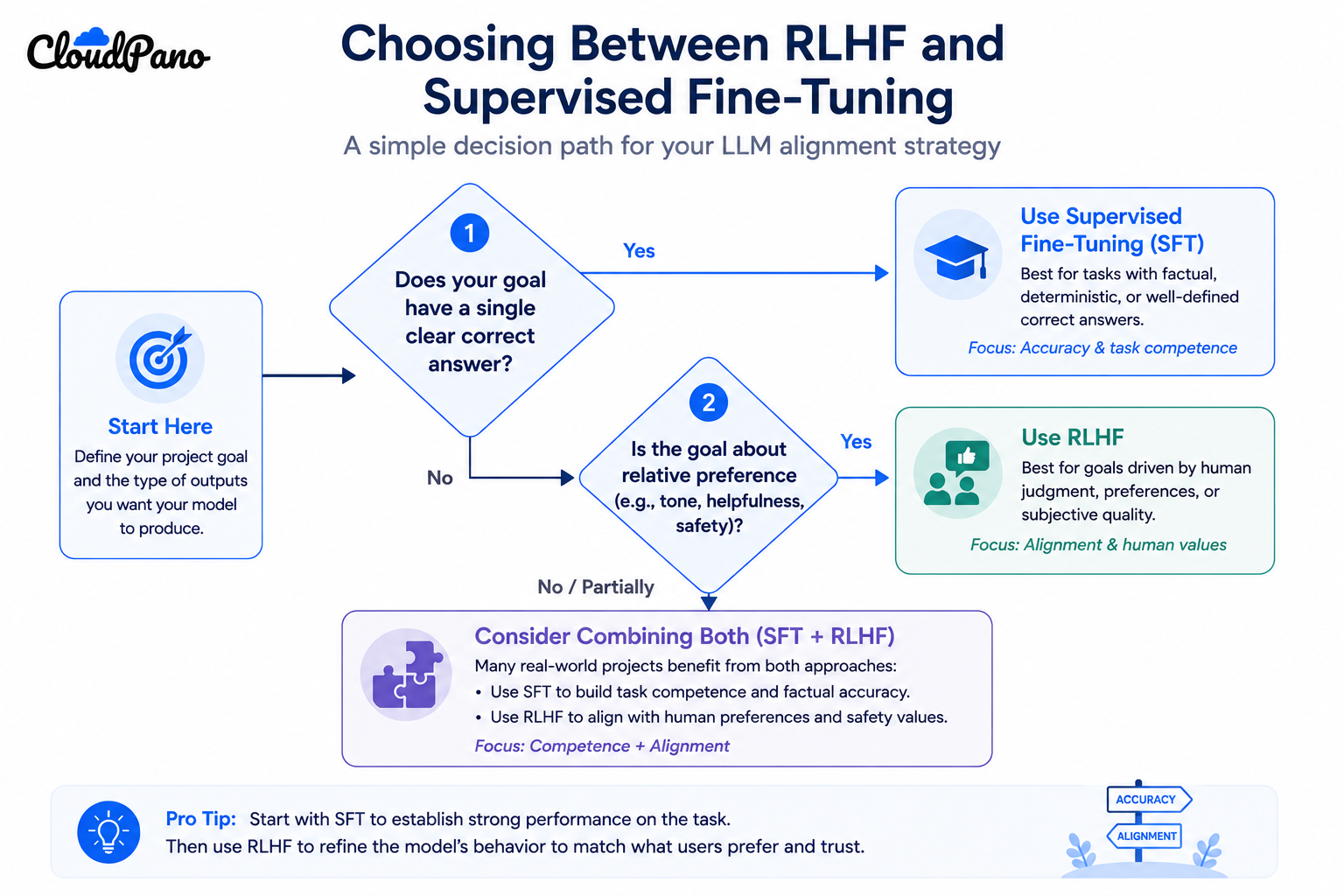
When your goal has a clear "correct" example to demonstrate — specific formats, factual patterns, or task structures — SFT's example-based approach is usually the simpler, more direct fit.
For goals centered on subjective qualities like tone, helpfulness, or safety, where there isn't one single correct answer but rather a relative preference between possible responses.
Yes, and this is common in practice: SFT is often used first to establish baseline task competence, with RLHF applied afterward to refine tone, helpfulness, and preference alignment on top of that foundation.
Data requirements vary by project, so it's best assessed against your specific scope rather than assumed as a fixed comparison; the annotation task itself differs in kind, not just volume.
No. They solve different problems — SFT for example-based imitation, RLHF for preference-based optimization — and the right choice depends on which one matches your specific improvement goal.
Ask whether your goal has one clear correct answer per input (SFT) or is fundamentally about which of several reasonable responses is preferred (RLHF).
RLHF vs supervised fine-tuning isn't a competition with one universal winner — each technique is built for a different kind of model improvement. Supervised fine-tuning teaches a model to imitate correct examples; RLHF teaches it to optimize toward human preference where there isn't a single fixed answer. Many effective LLM development projects use both, matched deliberately to what each stage of the model actually needs.


Compact, ready to go anywhere
Interchangeable lens that’s upgradeable
Dual 1-inch sensors for improved clarity and low light performance
Dynamic range and 6K 360° capture
360° photo resolution at 21MP

8K 360° video recording for ultra-detailed visuals.
4K single-lens mode for traditional wide-angle shots.
Invisible selfie stick effect for drone-like perspectives.
2.5-inch touchscreen with Gorilla Glass protection.
Waterproof up to 33ft for underwater shooting.

360° photo resolution in 23MP
Slim design at 24 mm thick
Built-in image stabilization for smooth video capture.
Internal 19GB storage for photo and video storage.
Wireless connectivity for remote control and sharing.

60MP 360° still images for high-resolution photography.
5.7K 360° video recording at 30fps.
2.25-inch touchscreen for intuitive control.
USB Type-C port for fast charging and data transfer.
MicroSD card slot for expandable storage.
.png)

.png)

Try it free. No credit card required. Instant set-up.







.svg)


.svg)