


.png)


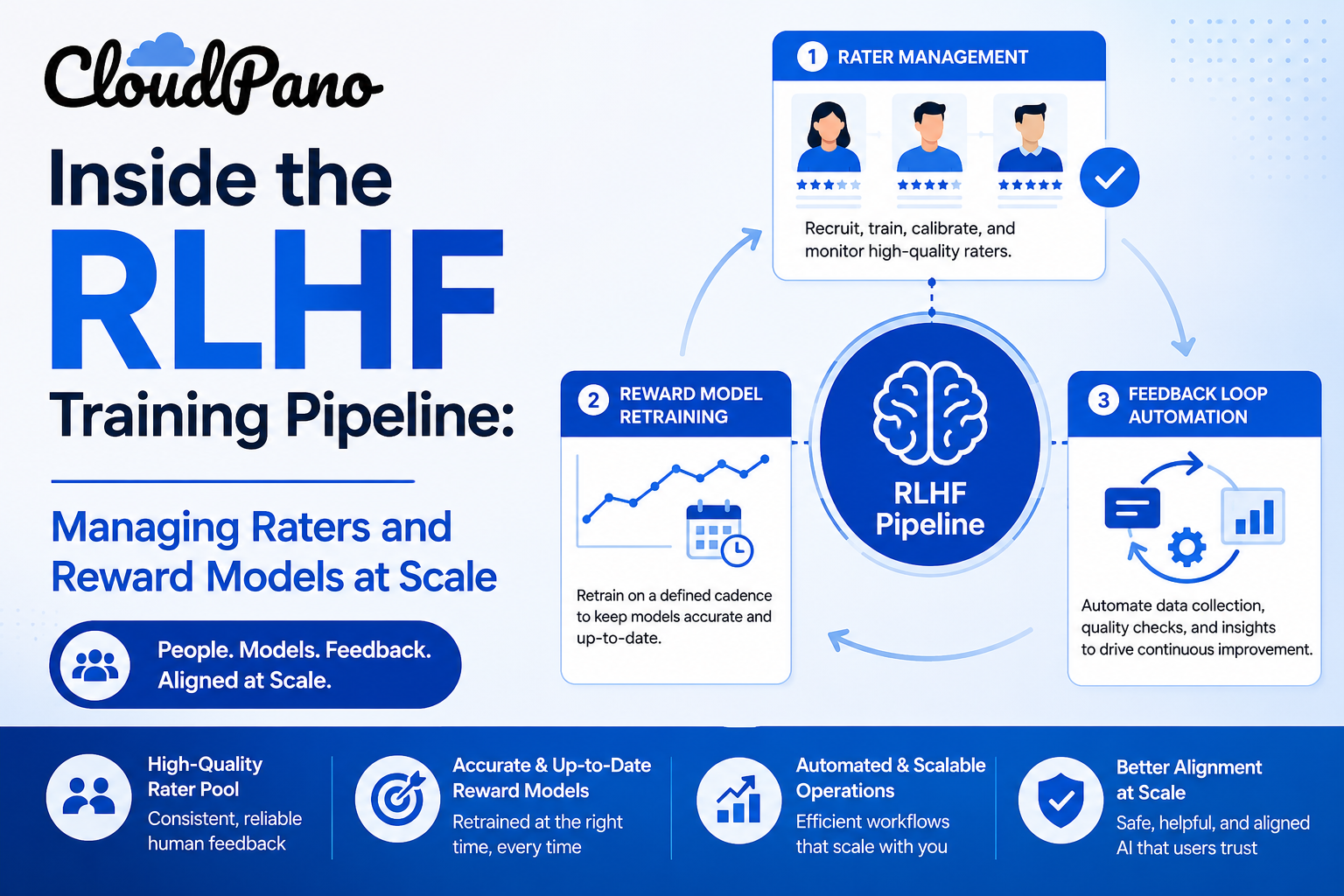
A pilot RLHF pipeline reward model with a handful of raters and a single training pass is a very different operation from one running at production volume. Rater consistency that held up with five people drifts with fifty. A reward model trained once goes stale as the target model changes. What worked manually now needs to run without someone checking every step.
This is the part of RLHF that gets less attention than the conceptual explanation — the operational discipline required to keep a reward model training process accurate and a rater pool consistent once the project moves past a small pilot.
A degraded rater pool or a stale reward model doesn't fail loudly — it produces a reward signal that's quietly less aligned with actual human preference, and a model fine-tuned against that degraded signal inherits the drift. Google Research's "Data Cascades" study documented exactly this pattern: small, unaddressed quality issues compound over time into problems that are much harder to trace back to their source once discovered (Sambasivan et al., Google Research).
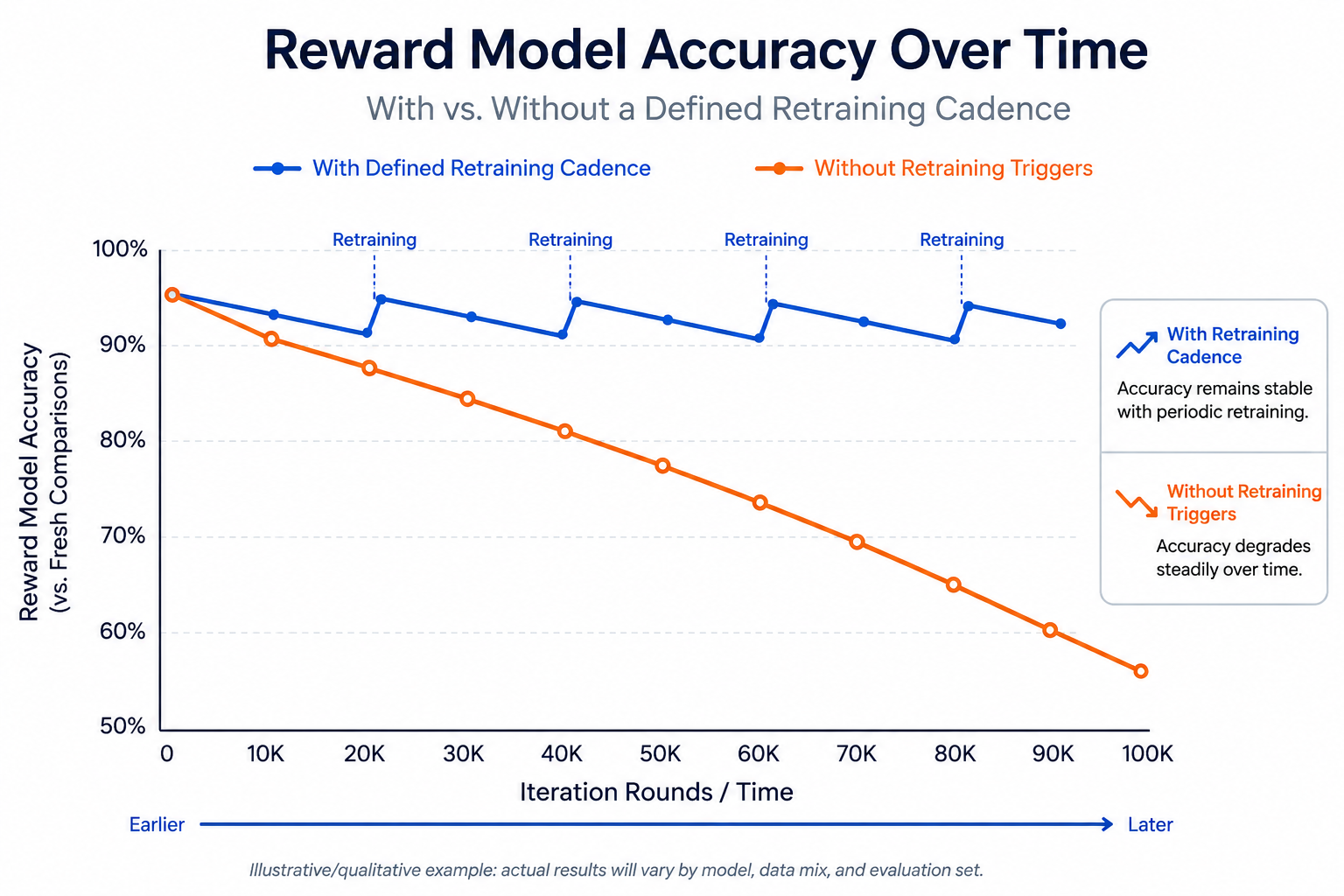
NIST's AI Risk Management Framework treats ongoing monitoring as a distinct, necessary function separate from initial validation, which applies directly to reward models — a reward model validated once at launch still needs ongoing checks as it's used across new comparison data over time (NIST AI RMF).
The operational stakes rise with how quickly language models are being iterated on. Stanford HAI's AI Index has tracked the accelerating pace of LLM development and deployment (Stanford HAI, AI Index Report), and a manual, unscaled RLHF pipeline becomes a bottleneck exactly when a team needs to iterate fastest.
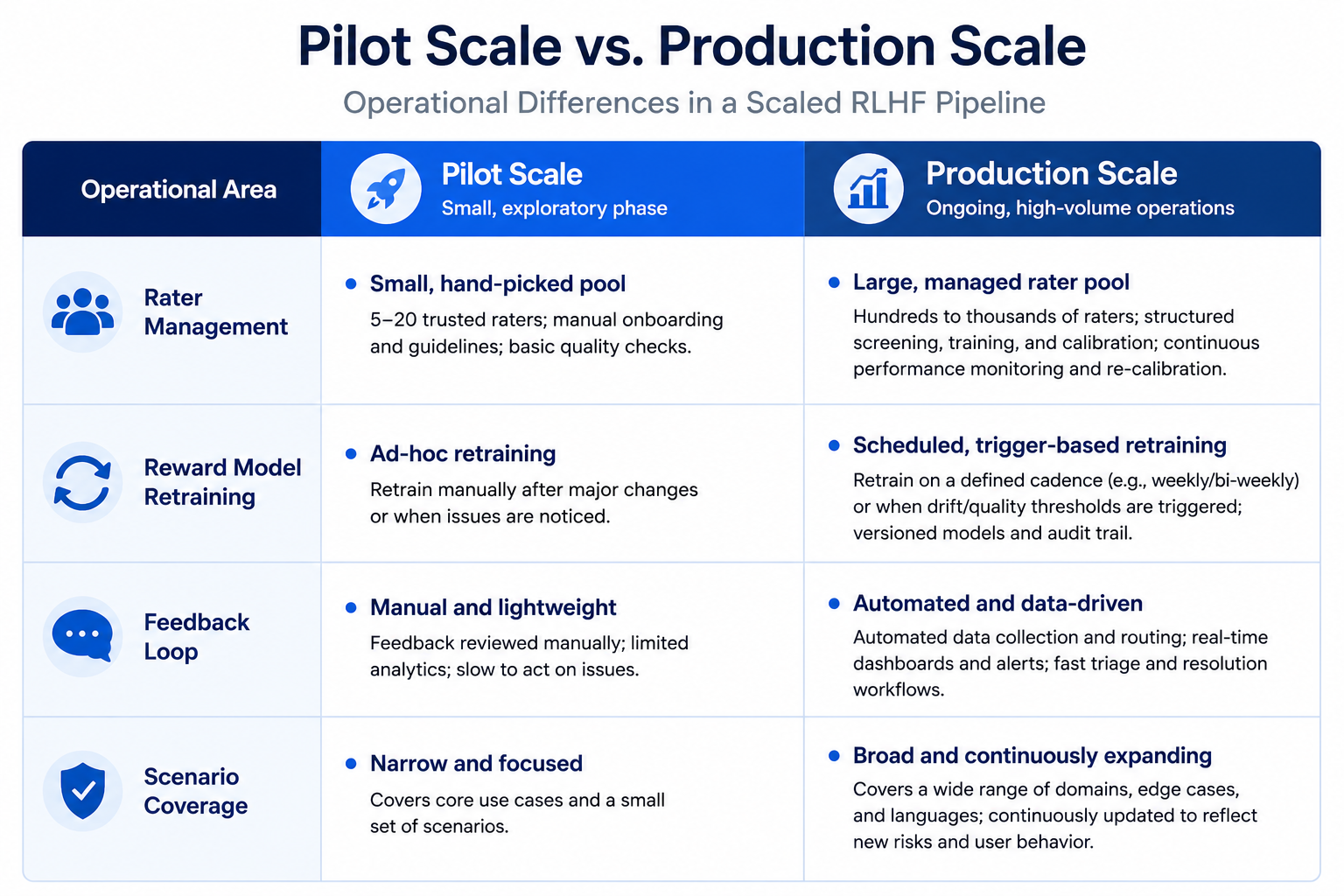
Running an RLHF training pipeline at scale requires managing three operational layers together, not just the conceptual three stages of comparison collection, reward model training, and fine-tuning.
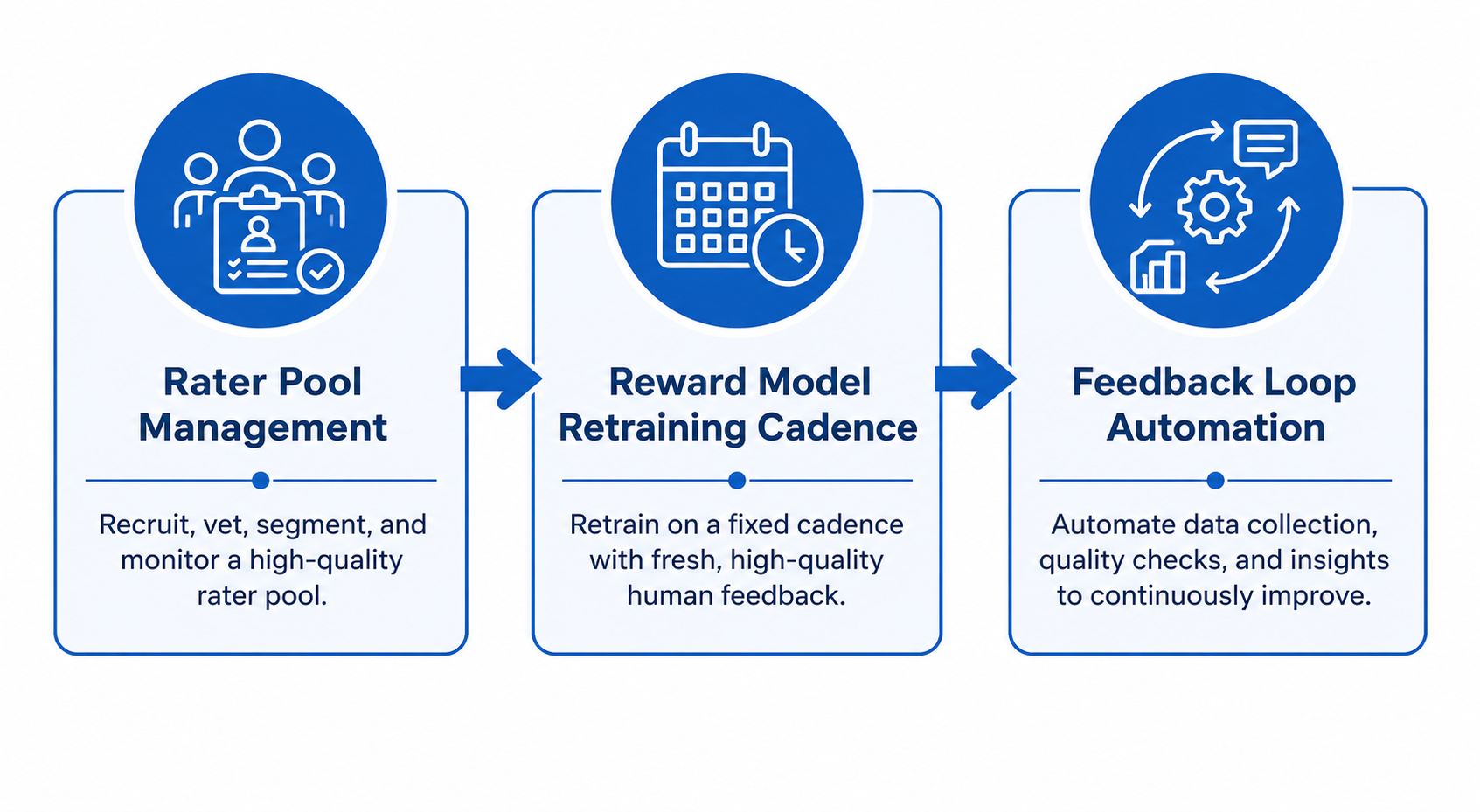
Rater pool management. As the pool of people providing comparisons grows, consistency requires ongoing calibration — periodic agreement checks against a gold-standard set of comparisons, and a defined process for correcting or removing raters whose judgments drift from the group.
Reward model retraining cadence. A reward model trained once on an initial comparison batch degrades in relevance as the target model's outputs evolve through fine-tuning rounds. A defined retraining schedule, tied to specific triggers, keeps the reward model current.
Feedback loop automation. At small scale, routing comparisons to raters and feeding results back into training can be managed manually. At volume, this needs to be automated — task routing, decision capture, and data formatting for retraining all need to run without manual intervention at every step.
Preference data collection itself also needs to scale deliberately: expanding coverage of prompt types and edge cases as the pipeline matures, not just increasing volume on the same narrow set of scenarios collected during the pilot.
Understanding how these workflows operate as an operational system with these three layers — not just a conceptual three-stage process — is what separates a pipeline that holds up at scale from one that quietly degrades.
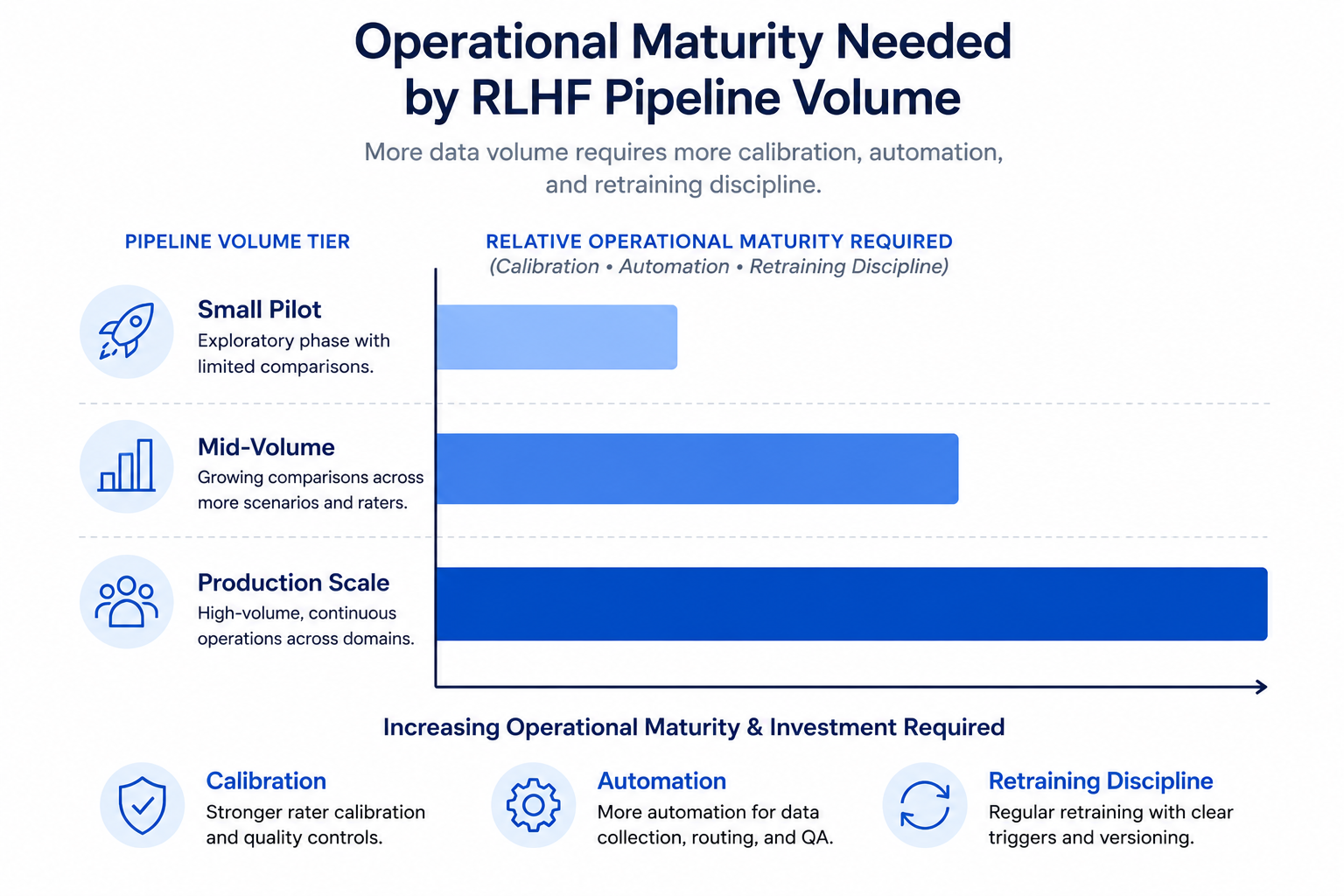

Ongoing rater pool calibration, a defined reward model retraining cadence tied to specific triggers, and automated task routing and data capture, rather than the manual processes that work at small pilot scale.
Based on specific triggers — comparison data volume thresholds, target model updates, or detected drift in reward model accuracy — rather than a single training pass or an arbitrary fixed schedule.
Through a gold-standard comparison set used for both onboarding new raters and running periodic calibration checks across the existing pool, catching drift before it affects production comparison data.
Task routing to raters, structured capture of their decisions, and formatting that data for retraining — the manual coordination that works at pilot scale becomes a bottleneck at production volume.
Coverage should expand deliberately to include new prompt types and edge cases as the pipeline matures, rather than continuing to collect on the same narrow scenario set used during the initial pilot.
By monitoring its scoring accuracy against fresh held-out human comparisons on an ongoing basis; a widening gap between reward model scores and actual rater judgment signals it's time to retrain.
It can work at small pilot scale with a handful of raters and infrequent retraining, but it typically becomes unsustainable as comparison volume, rater pool size, and iteration frequency all increase.
Running an RLHF pipeline reward model at scale is a genuinely different operational challenge than piloting the concept. Rater pool calibration, a defined retraining cadence, and automated feedback loops are what keep the reward signal accurate as volume grows — without them, the pipeline that worked at pilot scale quietly degrades as it's pushed to production volume.


Compact, ready to go anywhere
Interchangeable lens that’s upgradeable
Dual 1-inch sensors for improved clarity and low light performance
Dynamic range and 6K 360° capture
360° photo resolution at 21MP

8K 360° video recording for ultra-detailed visuals.
4K single-lens mode for traditional wide-angle shots.
Invisible selfie stick effect for drone-like perspectives.
2.5-inch touchscreen with Gorilla Glass protection.
Waterproof up to 33ft for underwater shooting.

360° photo resolution in 23MP
Slim design at 24 mm thick
Built-in image stabilization for smooth video capture.
Internal 19GB storage for photo and video storage.
Wireless connectivity for remote control and sharing.

60MP 360° still images for high-resolution photography.
5.7K 360° video recording at 30fps.
2.25-inch touchscreen for intuitive control.
USB Type-C port for fast charging and data transfer.
MicroSD card slot for expandable storage.
.png)

.png)

Try it free. No credit card required. Instant set-up.






.svg)


.svg)