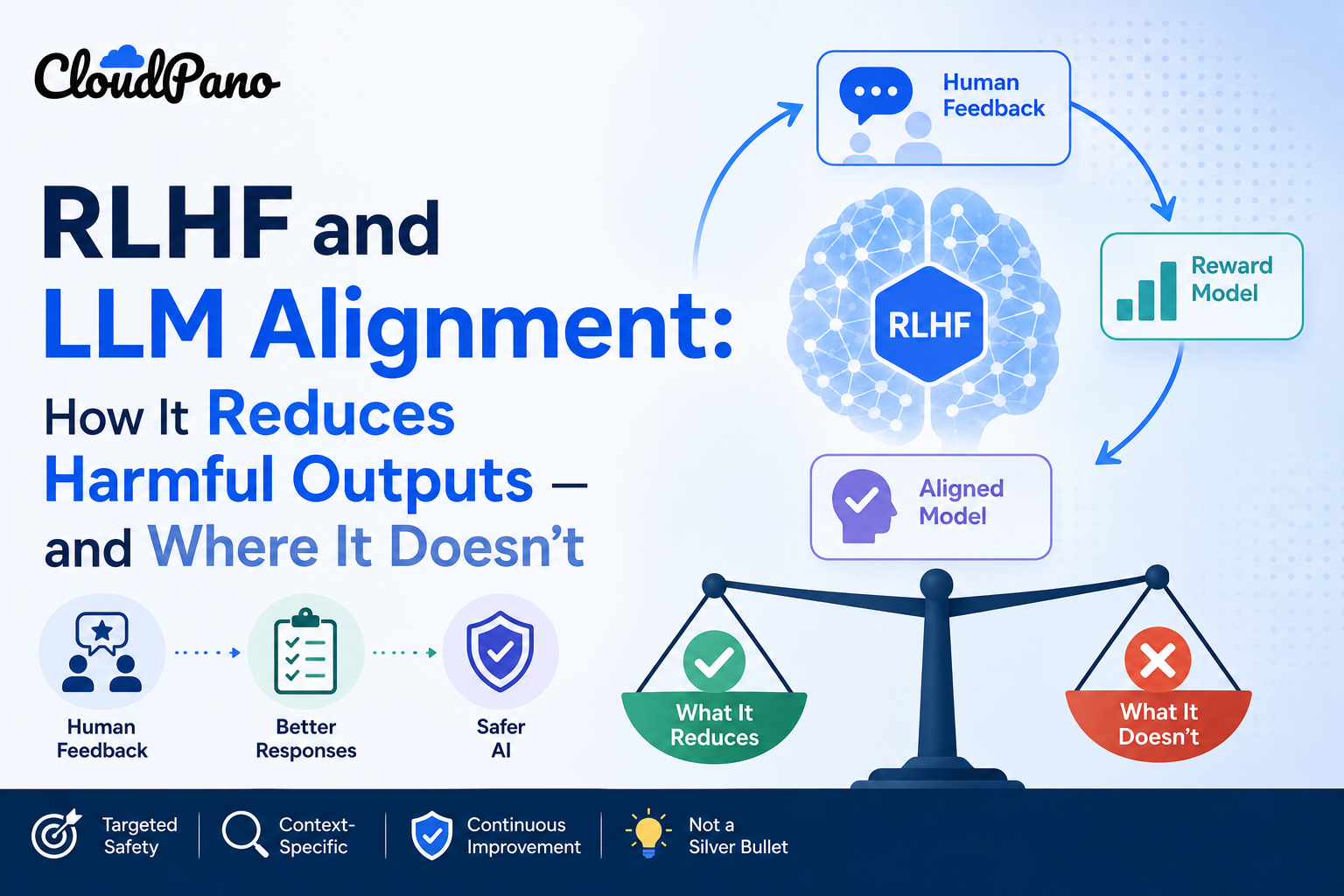
RLHF and LLM Alignment: How It Reduces Harmful Outputs — and Where It Doesn't

Cloudpano
July 25, 2026
5 min read
Share this post

RLHF and LLM Alignment: How It Reduces Harmful Outputs — and Where It Doesn't

RLHF LLM alignment is often treated as a solved problem once it's applied — as if adding human feedback to a model's training process automatically makes it safe. That's an overstatement of what the mechanism actually does, and understanding the specific way RLHF reduces harmful outputs also means understanding where its coverage runs out.

AI model alignment through RLHF works by teaching a model, through explicit human comparisons, that certain responses are preferred over others — including that safe, appropriate responses are strongly preferred over harmful or inappropriate ones. That's a real and meaningful safety mechanism, but it's bounded by the specific cases included in the feedback data used to train it.

Why It Matters

Overestimating what RLHF guarantees for safety is itself a risk, because teams that assume alignment is "handled" by RLHF alone may under-invest in other safety layers a deployed system actually needs. Google Research's "Data Cascades" study documented how gaps in a data pipeline — including gaps in what feedback data actually covers — tend to surface later as harder-to-diagnose problems, which applies directly to safety-relevant blind spots in RLHF training data (Sambasivan et al., Google Research).

Comparison table of what RLHF LLM alignment does and doesn't guarantee for safety

NIST's AI Risk Management Framework treats alignment and safety as ongoing, multi-layered concerns rather than something a single training technique resolves completely, which is the right frame for evaluating what reinforcement learning from human feedback actually contributes versus what still needs additional safeguards (NIST AI RMF).

The stakes rise with how widely these models are deployed. Stanford HAI's AI Index has tracked the rapid expansion of large language model use across consumer and enterprise applications (Stanford HAI, AI Index Report), which means the specific gaps in any given model's alignment coverage are increasingly likely to be encountered by real users in real conditions.

How It Works

RLHF reduces harmful outputs through a specific mechanism: safety becomes one of the explicit criteria annotators use when comparing candidate responses, alongside helpfulness and accuracy.
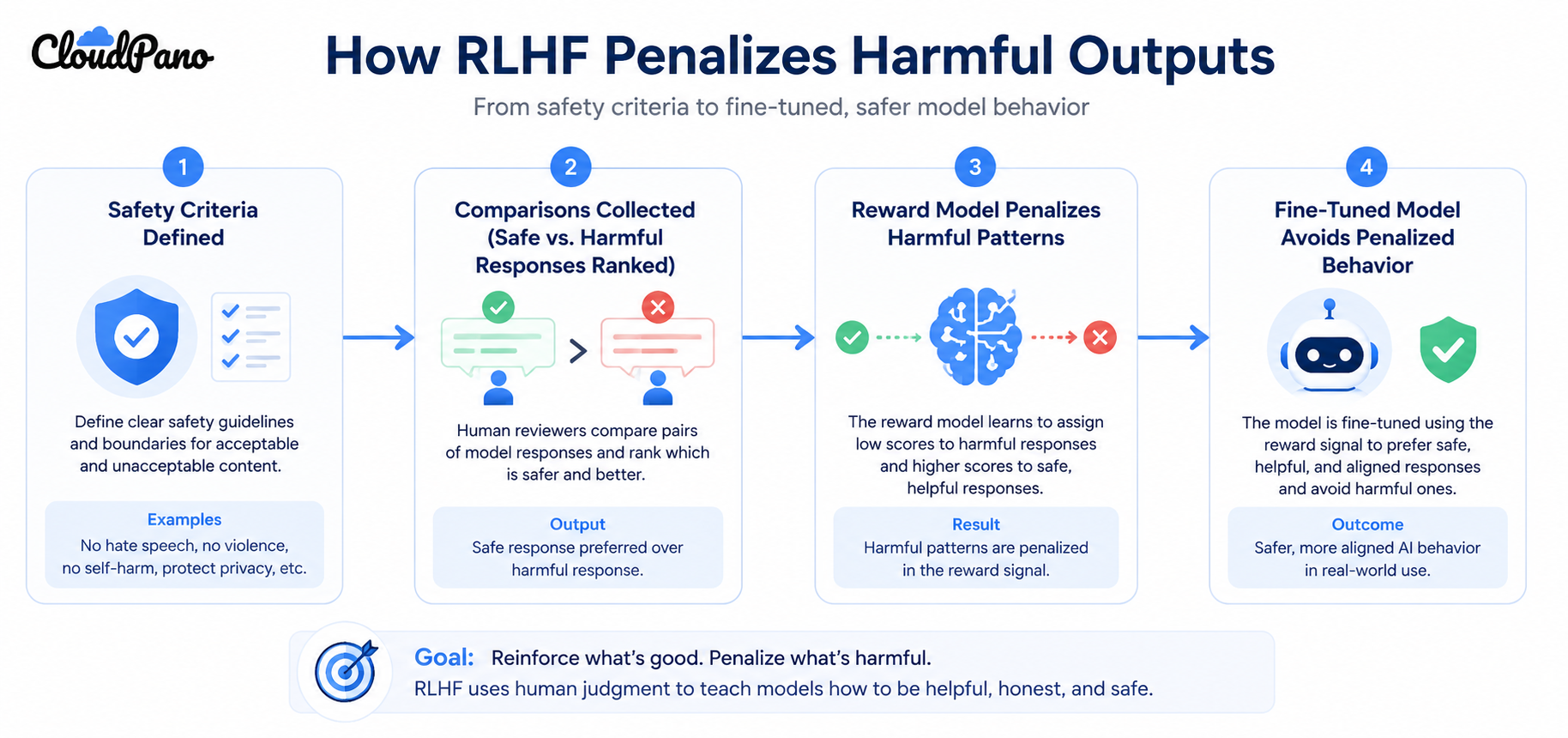
Safety-specific comparison criteria. Annotators are given explicit guidance for what counts as a harmful, inappropriate, or unsafe response for the given context, and asked to rank candidate responses accordingly — not just for general quality.

Reward model penalization. The reward model trained on these comparisons learns to score harmful responses lower, creating a training signal that discourages the fine-tuned model from producing them.

Coverage-dependent generalization. The model's improved safety behavior generalizes to cases similar to what was covered in the comparison data, but coverage gaps — categories of harmful content not well-represented in training comparisons — remain a real limitation.

This is the core nuance in human preference optimization for safety: the mechanism works by penalizing the specific patterns humans flagged during data collection, which means our training data services team consistently emphasizes deliberate, structured coverage of harm categories during comparison collection — not just general "does this seem safe" judgment calls.

Step-by-Step Workflow

  • Define specific harm categories relevant to your deployment context. General "avoid harmful content" guidance is too vague; specific categories (misinformation, unsafe instructions, harassment) need explicit definition.
Infographic checklist for defining harm categories in RLHF safety alignment
  • Write comparison criteria that make safety trade-offs explicit. Annotators need guidance on how to weigh safety against helpfulness when a fully safe and fully helpful response aren't both available.
  • Collect comparison data deliberately across defined harm categories. Ensure coverage isn't accidental — deliberately sample scenarios likely to surface each category.
  • Train the reward model and validate its safety-specific scoring. Check that the reward model correctly penalizes known harmful examples before using it for fine-tuning.
  • Fine-tune the model and test specifically against held-out harmful scenarios. Confirm reduced harmful output rates on cases similar to, but not identical to, the training comparisons.
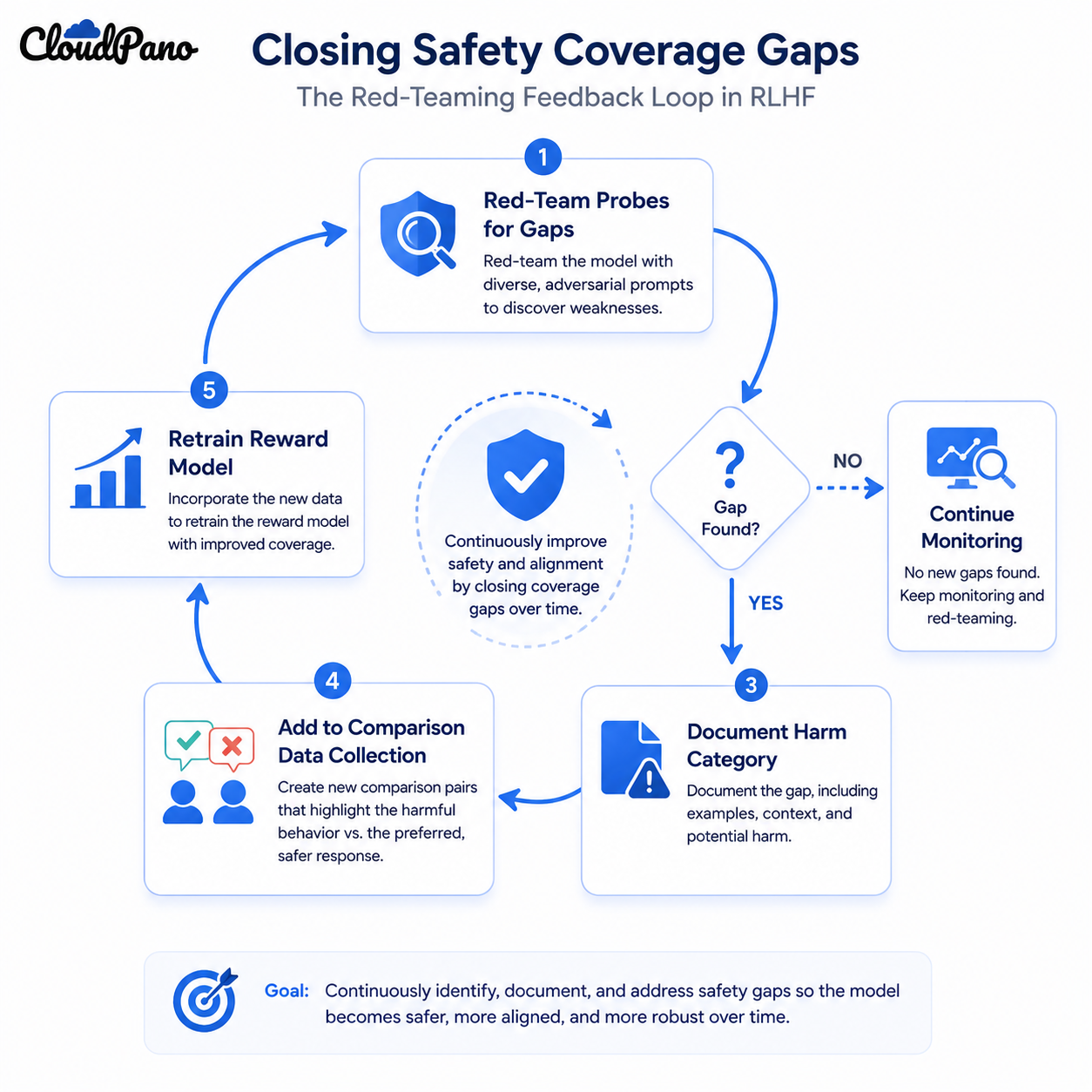
  • Red-team the fine-tuned model for coverage gaps. Actively probe for harm categories or edge cases the original comparison data didn't address well.
Flowchart of closing RLHF safety coverage gaps through red-teaming feedback
  • Feed red-teaming findings back into new comparison data. Treat discovered gaps as a signal to expand comparison coverage, not just a one-off patch.

Industry Use Cases

Bar chart showing relative emphasis on RLHF safety alignment across industries
  • LLM developers: RLHF-based safety alignment is central to reducing harmful outputs in conversational and generative models deployed to end users.
  • Healthcare AI: Alignment work needs to specifically cover medical misinformation and inappropriate clinical guidance, categories general safety training doesn't automatically address.
  • Retail AI: Customer-facing assistants need alignment coverage for inappropriate content and manipulative sales language, distinct from general harmful-content categories.
  • Government & defense: Safety alignment requirements often include policy-specific categories — classified information handling, appropriate tone for sensitive topics — beyond general harm categories.
  • Computer vision / robotics: Alignment concepts apply differently here, since the safety concerns are typically physical rather than conversational, though the general principle of coverage-dependent generalization still applies.
  • Autonomous vehicles: Safety alignment in this domain is largely handled through different mechanisms than RLHF, though the underlying lesson about coverage-dependent generalization applies broadly.

Benefits

  • Meaningfully reduces harmful output frequency. RLHF-based alignment measurably decreases the rate of unsafe responses on cases similar to what the training data covered.
  • Makes safety trade-offs explicit and trainable. Rather than relying on implicit model behavior, RLHF gives teams a direct mechanism for teaching specific safety preferences.
  • Scales safety judgment through the reward model. Once trained, the reward model applies safety criteria consistently at a scale manual review of every output couldn't match.
  • Provides a feedback mechanism for ongoing improvement. Red-teaming findings can be fed back into new comparison data, allowing alignment coverage to expand over time.

Common Mistakes

  • Assuming RLHF alone fully solves alignment. Treating the technique as a complete safety solution rather than one layer that needs to be paired with red-teaming, monitoring, and other safeguards.
  • Using vague safety criteria for comparisons. Asking annotators to judge general "safety" without specific harm category definitions produces inconsistent, incomplete coverage.
  • Not deliberately sampling for harm category coverage. Relying on whatever scenarios happen to surface naturally instead of actively ensuring known harm categories are represented in comparison data.
  • Skipping red-teaming after fine-tuning. Assuming reduced harmful outputs on the training distribution means the model is safe more broadly, without actively probing for gaps.
  • Treating alignment as a one-time project. Not building a process for feeding newly discovered gaps back into updated comparison data over time.

Best Practices

  • Define specific, explicit harm categories relevant to your deployment context rather than relying on general safety guidance.
  • Write comparison criteria that address safety-versus-helpfulness trade-offs explicitly, since these situations come up regularly in practice.
  • Deliberately sample comparison data to ensure coverage of known harm categories, not just naturally occurring scenarios.
  • Validate the reward model's safety-specific scoring against known harmful examples before using it for fine-tuning.
  • Red-team the fine-tuned model actively, specifically probing for gaps the original training data didn't address.
  • Treat safety alignment as an ongoing process, feeding red-teaming findings back into expanded comparison data over time.

FAQ

Does RLHF completely eliminate harmful outputs from a language model?

No. It meaningfully reduces harmful output frequency on cases similar to what the training comparison data covered, but coverage gaps for harm categories not well-represented in that data remain a real limitation.

How does RLHF LLM alignment actually reduce harmful content?

By having annotators explicitly rank candidate responses on safety criteria during comparison collection, training a reward model that penalizes harmful responses, and fine-tuning the model to produce outputs the reward model scores as safer.

What's the difference between general RLHF and safety-focused alignment work?

General RLHF often optimizes for helpfulness and quality broadly, while safety-focused alignment specifically defines harm categories and builds comparison criteria and data coverage around them deliberately.

Why isn't red-teaming redundant if RLHF already improves safety?

Because RLHF's safety improvements are bounded by what the training comparison data covered; red-teaming actively probes for gaps in that coverage that wouldn't otherwise be discovered until encountered in real use.

How does human preference optimization handle safety-versus-helpfulness trade-offs?

Through explicit comparison criteria that guide annotators on how to weigh safety against helpfulness in situations where a response can't fully satisfy both, rather than leaving that judgment implicit.

Should AI model alignment rely on RLHF alone?

No. RLHF is an important layer, but it works best paired with red-teaming, ongoing monitoring, and other safety mechanisms rather than as a single, complete solution.

How often should safety alignment coverage be updated?

Whenever red-teaming or real-world monitoring surfaces a harm category or edge case not well-represented in the original comparison data, treating each discovery as a signal to expand coverage.

Conclusion

RLHF LLM alignment genuinely reduces harmful output frequency by making safety an explicit, trainable preference criterion rather than an implicit hope. But the mechanism's coverage is only as good as the comparison data behind it, which is why red-teaming, deliberate harm-category sampling, and ongoing coverage expansion matter as much as the RLHF process itself. Treating alignment as a continuously maintained system, not a one-time fix, is what actually holds up as models see wider deployment.

🚀 Your All‑In‑One Virtual Experience Stack
🎬
PhotoAIVideo
Turn photos into scroll‑stopping AI videos.
Get Started →
🏡
Pictastic
Instantly stage listings with AI.
Try Staging →
🌀
CloudPano
Create stunning 360° tours in minutes.
Launch Tour →
💰
VirtualTourProfit
Build a profitable virtual tour business.
Learn More →
🤝
CloudPano Reseller
Resell AI visual software without building it.
Become a Reseller →
🚗
Auto CloudPano
Sell more vehicles with 360° experiences.
Explore Auto →
🏗️
AI Floor Plan Builder
Generate detailed floor plans with AI.
Build Now →
📐
3D Measure
Capture accurate floor plans & 3D measurements.
Measure Now →
🧠
AI Training Data
Custom AI training data services.
Learn More →
Share this post
Cloudpano

Choose The Right 360° Camera

Insta360 ONE RS 1-Inch 360 Edition

  • Compact, ready to go anywhere

  • Interchangeable lens that’s upgradeable

  • Dual 1-inch sensors for improved clarity and low light performance

  • Dynamic range and 6K 360° capture

  • 360° photo resolution at 21MP

Learn More

Insta360 X4

  • 8K 360° video recording for ultra-detailed visuals.

  • 4K single-lens mode for traditional wide-angle shots.

  • Invisible selfie stick effect for drone-like perspectives.

  • 2.5-inch touchscreen with Gorilla Glass protection.

  • Waterproof up to 33ft for underwater shooting.

Learn More

Ricoh Theta Z1

  • 360° photo resolution in 23MP

  • Slim design at 24 mm thick

  • Built-in image stabilization for smooth video capture.

  • Internal 19GB storage for photo and video storage.

  • Wireless connectivity for remote control and sharing.

Learn More

Ricoh Theta X

  • 60MP 360° still images for high-resolution photography.

  • 5.7K 360° video recording at 30fps.

  • 2.25-inch touchscreen for intuitive control.

  • USB Type-C port for fast charging and data transfer.

  • MicroSD card slot for expandable storage.

Learn More
Property Marketing
Allows potential buyers to explore properties in detail from anywhere, enhancing the real estate marketing process.
Automotive Spins
Create an interactive virtual showroom and engage affluent digital buyers with live 360º video calls, all through the CloudPano mobile app for a complete automotive sales solution.
Interactive Floor Plans
Create 2D and 3D floor plans with measurements in 4 minutes or less, all from your phone. Download the Floor Plan Scanner app and get your first scan free.

360 Virtual Tours With CloudPano.com. Get Started Today.

Try it free. No credit card required. Instant set-up.

Try it free
Latest posts

See our other posts

Interviews, tips, guides, industry best practices, and news.

RLHF and LLM Alignment: How It Reduces Harmful Outputs — and Where It Doesn't

RLHF LLM alignment reduces harmful outputs by training a reward model on human comparisons that explicitly penalize unsafe or inappropriate responses, then fine-tuning the model to avoid them. It meaningfully reduces harmful output frequency but doesn't eliminate the risk entirely, since it depends on the specific cases covered in the feedback data.
Read post

What Is RLHF? A Practical Guide to Reinforcement Learning From Human Feedback

RLHF stands for reinforcement learning from human feedback — a training method where people rank or compare a model's outputs, and that feedback trains a system to produce responses more aligned with human preference. It's a key reason modern language models can follow instructions and communicate in a natural, helpful way.
Read post

RLHF Services: How Human Feedback Data Actually Shapes Model Behavior

RLHF services provide the human feedback data — typically comparison rankings between model outputs — used to train a reward model that then guides a language model's behavior through reinforcement learning. This differs from standard annotation because it captures relative preference between outputs rather than a single correct label per item.
Read post