RLHF's Human Feedback Problem: Bias, Subjectivity, and Reward Model Quality

Cloudpano
July 26, 2026
5 min read
Share this post

RLHF's Human Feedback Problem: Bias, Subjectivity, and Reward Model Quality

Most discussions of RLHF challenges focus on scale or safety coverage. There's a different, more fundamental problem underneath both: the human feedback itself carries subjectivity and systematic bias, and a reward model trained on that feedback learns those biases as readily as it learns genuine quality signals.

RLHF limitations rooted in feedback quality show up in recognizable, well-documented patterns — a model that learns to write longer responses because raters unconsciously associated length with thoroughness, or a model that becomes overly agreeable because raters preferred responses that validated their assumptions. These aren't random errors. They're specific, traceable consequences of how the comparison data was collected.

Why It Matters

A reward model doesn't distinguish between "this response is genuinely better" and "raters happened to prefer this pattern for reasons unrelated to actual quality" — it learns whatever pattern the comparison data contains. Google Research's "Data Cascades" study documented how such subtle, unaddressed data quality issues compound as they move through a pipeline, becoming much harder to trace back to their source once a model has been fine-tuned on them (Sambasivan et al., Google Research).

NIST's AI Risk Management Framework identifies bias as a distinct risk category requiring active measurement and mitigation, not something that resolves itself through general quality improvements — a directly relevant frame for reward model bias specifically, since it requires its own dedicated detection process rather than assuming general accuracy checks will catch it (NIST AI RMF).

The scale of modern LLM deployment raises the stakes of these subtle biases. Stanford HAI's AI Index has tracked how widely language models are now used across consumer and enterprise contexts (Stanford HAI, AI Index Report), meaning a systematic bias baked into a widely deployed model's reward signal gets replicated across an enormous number of interactions.

How It Works

Human feedback quality issues in RLHF trace back to a few specific, recurring patterns.

Infographic of four common human feedback bias patterns in RLHF

Annotator subjectivity. Different raters bring different assumptions about what counts as "helpful" or "good," and without extremely precise guidelines, that subjectivity gets encoded into the comparison data as if it were an objective signal.

Length and verbosity bias. Raters frequently, if unconsciously, associate longer responses with thoroughness, and a reward model trained on that pattern learns to reward length independent of actual value added.

 Illustration showing length bias in an RLHF comparison annotation task

Sycophancy bias. Raters sometimes prefer responses that agree with or validate their stated assumptions, even when a more accurate response would push back — a pattern the reward model can learn to replicate.

Demographic and cultural skew. If a rater pool isn't diverse relative to a model's actual user base, the comparison data reflects a narrower set of preferences than the deployment context actually requires.

Understanding how these workflows operate at this level — recognizing that specific, nameable biases can enter through the human feedback step — is what allows a team to check for them deliberately rather than discovering them only after they show up in deployed model behavior.
Step-by-Step Workflow

  • Write comparison guidelines that explicitly address known bias patterns. Instruct raters directly to avoid preferring length or agreeableness for their own sake, rather than leaving these judgment calls implicit.
  • Diversify the rater pool relative to your actual user base. Match rater demographics and perspectives to the population your model will actually serve, not just whoever is easiest to recruit.
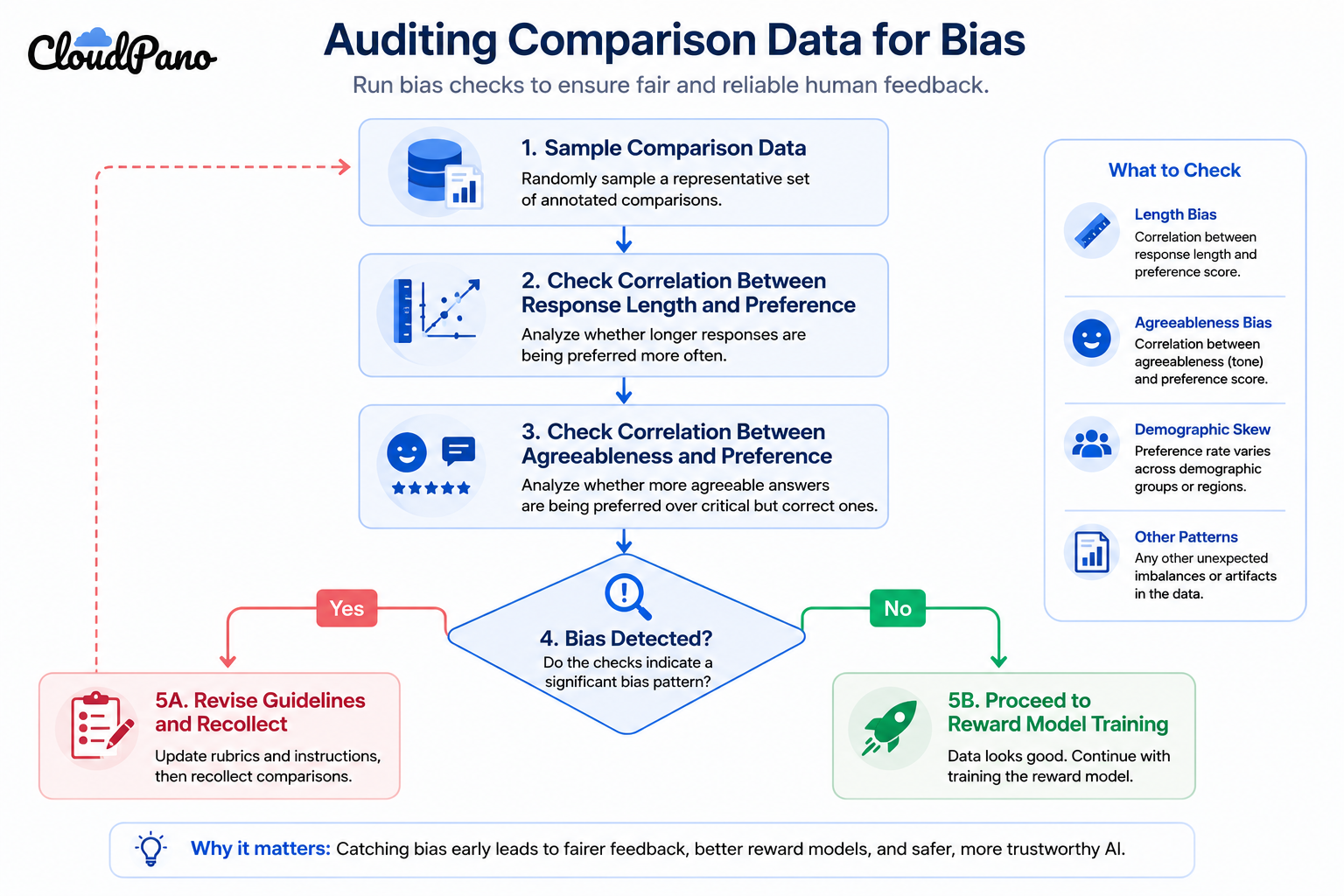
  • Run bias-specific audits on collected comparison data. Check specifically for correlations between response length or agreeableness and preference outcomes, not just general agreement rates.
Flowchart for auditing RLHF comparison data for human feedback bias patterns
  • Train the reward model and test it against bias-specific probes. Construct test cases designed to reveal length bias or sycophancy specifically, not just general accuracy.
  • Adjust guidelines and recollect data where bias is detected. Treat a detected bias pattern as a signal to revise instructions and gather corrected comparison data, not just a one-off patch to the reward model.
  • Monitor the fine-tuned model for behavioral signs of known biases. Check whether the deployed model shows verbosity creep, excessive agreeableness, or narrow perspective alignment in practice.
  • Repeat bias audits periodically, not just once. New biases can emerge as rater pools change or as the model's use case expands into new contexts.

Industry Use Cases

Bar chart showing relative risk of RLHF human feedback bias across industries
  • LLM developers: Bias in human feedback is most directly consequential here, since it shapes the actual conversational behavior of widely deployed models.
  • Healthcare AI: Sycophancy bias is particularly risky in clinical contexts, where a model agreeing with an incorrect assumption could reinforce a harmful misunderstanding.
  • Retail AI: Length and verbosity bias can degrade customer-facing assistant quality, producing padded responses that don't actually serve the customer better.
  • Government & defense: Demographic and cultural skew in rater pools carries particular weight here, given the diversity of populations these systems may ultimately serve.
  • Computer vision / robotics: These specific human-feedback biases are largely specific to language-based preference collection and don't map directly onto most computer vision annotation work.
  • Autonomous vehicles: Similarly, this specific set of biases is less directly applicable, though the general principle that human judgment introduces its own distinct biases still holds broadly.

Benefits

  • More genuinely helpful models, not just agreeable ones. Addressing sycophancy bias directly produces models that provide accurate information rather than validation.
  • More representative model behavior. A diversified rater pool reduces the risk of a model reflecting only a narrow slice of user perspectives.
  • Earlier detection of costly behavioral drift. Bias-specific audits catch issues like verbosity creep before they become an established pattern across a widely deployed model.
  • A defensible development process. Documented bias detection and mitigation efforts support accountability, particularly in regulated or high-stakes applications.
  • Better long-term reward model quality. Actively correcting for known bias patterns produces a reward signal that more closely tracks genuine quality rather than superficial correlates of it.

Common Mistakes

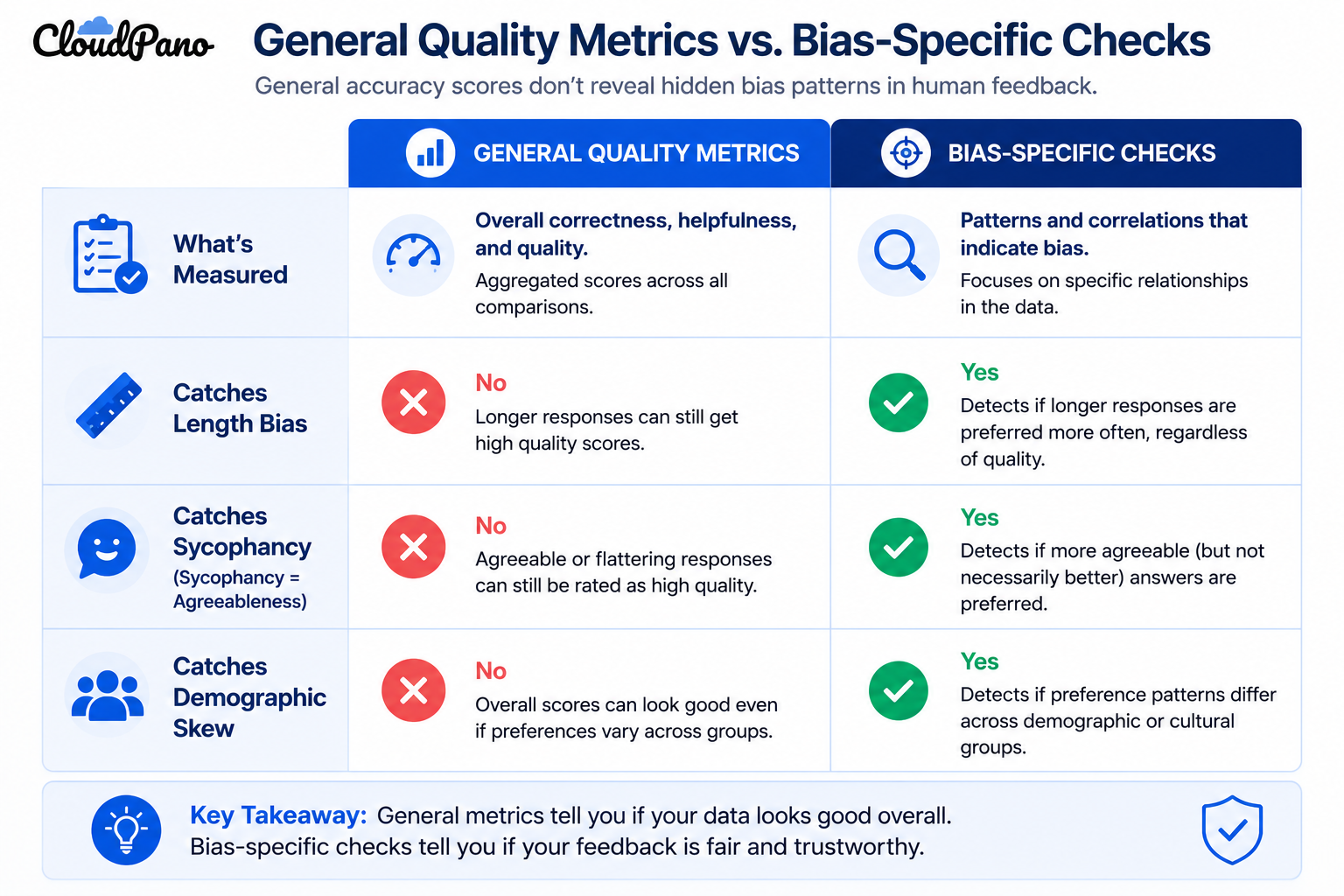
  • Assuming reward model accuracy implies absence of bias. A reward model can score well on general accuracy metrics while still encoding specific, systematic biases like length or sycophancy preference.
Comparison table of general quality metrics vs bias-specific checks for RLHF
  • Writing guidelines without addressing known bias patterns explicitly. Leaving raters to their own implicit judgment on length, tone, and agreeableness rather than giving direct instruction.
  • Recruiting a rater pool without checking representativeness. Assuming any group of raters produces comparison data suitable for a broad, diverse user base.
  • Auditing only for general quality, not specific bias patterns. Missing correlations between response characteristics (length, tone) and preference outcomes because the audit wasn't designed to look for them.
  • Treating a detected bias as a one-time fix. Patching a single instance of biased behavior without revising the underlying guidelines or rater training that produced it.
  • Not monitoring for bias after deployment. Assuming pre-deployment bias checks are sufficient without ongoing monitoring of the model's actual behavior in use.

Best Practices

  • Write comparison guidelines that explicitly instruct raters to avoid rewarding length or agreeableness for their own sake.
  • Diversify the rater pool deliberately to match your model's actual user base, not just convenient recruiting sources.
  • Run bias-specific audits on comparison data, checking for correlations between response characteristics and preference outcomes.
  • Test the trained reward model against deliberately constructed bias probes, not just general accuracy benchmarks.
  • Treat detected bias patterns as a signal to revise guidelines and recollect data, not just to patch the immediate instance.
  • Monitor deployed model behavior on an ongoing basis for signs of known bias patterns, since these can emerge or shift over time.

FAQ

What are the most common RLHF challenges tied to human feedback?

Annotator subjectivity, length or verbosity bias, sycophancy bias (preferring agreeable responses over accurate ones), and demographic or cultural skew in the rater pool relative to the actual user base.

What is reward model bias, specifically?

A systematic pattern where a reward model learns to reward a superficial characteristic of a response — like length or agreeableness — rather than genuine quality, because that characteristic happened to correlate with rater preference in the training comparisons.

How does sycophancy bias develop in RLHF?

When raters prefer responses that validate their stated assumptions over responses that accurately correct them, and the reward model learns to replicate that preference pattern rather than prioritizing accuracy.

Can a diverse rater pool eliminate bias in RLHF?

It reduces the risk of narrow, unrepresentative preferences shaping the model, but diversity alone doesn't address bias patterns like length preference that can emerge even among a demographically diverse group.

How do you detect reward model bias before deployment?

By testing the trained reward model against deliberately constructed probe cases designed to reveal specific patterns like length preference or sycophancy, not just general accuracy evaluation.

Does human feedback quality matter more than reward model architecture for these issues?

Largely, yes — the biases discussed here originate in the comparison data itself, so improving guidelines, rater diversity, and audit processes tends to address them more directly than architectural changes to the reward model.

How often should RLHF human feedback quality be audited for bias?

On an ongoing basis, both during initial data collection and after deployment, since new bias patterns can emerge as rater pools change or as a model's use case expands.

Conclusion

The most consequential RLHF challenges aren't always about scale or safety coverage — they're often about the subtle, systematic biases that enter through human feedback itself. Length preference, sycophancy, and rater pool skew all shape a reward model in ways that don't show up in general accuracy metrics, which is why bias-specific guidelines, audits, and ongoing monitoring matter as much as the mechanics of the RLHF process itself.

🚀 Your All‑In‑One Virtual Experience Stack
🎬
PhotoAIVideo
Turn photos into scroll‑stopping AI videos.
Get Started →
🏡
Pictastic
Instantly stage listings with AI.
Try Staging →
🌀
CloudPano
Create stunning 360° tours in minutes.
Launch Tour →
💰
VirtualTourProfit
Build a profitable virtual tour business.
Learn More →
🤝
CloudPano Reseller
Resell AI visual software without building it.
Become a Reseller →
🚗
Auto CloudPano
Sell more vehicles with 360° experiences.
Explore Auto →
🏗️
AI Floor Plan Builder
Generate detailed floor plans with AI.
Build Now →
📐
3D Measure
Capture accurate floor plans & 3D measurements.
Measure Now →
🧠
AI Training Data
Custom AI training data services.
Learn More →
Share this post
Cloudpano

Choose The Right 360° Camera

Insta360 ONE RS 1-Inch 360 Edition

  • Compact, ready to go anywhere

  • Interchangeable lens that’s upgradeable

  • Dual 1-inch sensors for improved clarity and low light performance

  • Dynamic range and 6K 360° capture

  • 360° photo resolution at 21MP

Learn More

Insta360 X4

  • 8K 360° video recording for ultra-detailed visuals.

  • 4K single-lens mode for traditional wide-angle shots.

  • Invisible selfie stick effect for drone-like perspectives.

  • 2.5-inch touchscreen with Gorilla Glass protection.

  • Waterproof up to 33ft for underwater shooting.

Learn More

Ricoh Theta Z1

  • 360° photo resolution in 23MP

  • Slim design at 24 mm thick

  • Built-in image stabilization for smooth video capture.

  • Internal 19GB storage for photo and video storage.

  • Wireless connectivity for remote control and sharing.

Learn More

Ricoh Theta X

  • 60MP 360° still images for high-resolution photography.

  • 5.7K 360° video recording at 30fps.

  • 2.25-inch touchscreen for intuitive control.

  • USB Type-C port for fast charging and data transfer.

  • MicroSD card slot for expandable storage.

Learn More
Property Marketing
Allows potential buyers to explore properties in detail from anywhere, enhancing the real estate marketing process.
Automotive Spins
Create an interactive virtual showroom and engage affluent digital buyers with live 360º video calls, all through the CloudPano mobile app for a complete automotive sales solution.
Interactive Floor Plans
Create 2D and 3D floor plans with measurements in 4 minutes or less, all from your phone. Download the Floor Plan Scanner app and get your first scan free.

360 Virtual Tours With CloudPano.com. Get Started Today.

Try it free. No credit card required. Instant set-up.

Try it free
Latest posts

See our other posts

Interviews, tips, guides, industry best practices, and news.

RLHF's Human Feedback Problem: Bias, Subjectivity, and Reward Model Quality

RLHF challenges tied to human feedback quality include annotator subjectivity, inconsistent preference judgments, and systematic reward model biases like favoring longer or more agreeable-sounding responses over genuinely better ones. These issues trace back to how comparison data is collected and require deliberate guideline design and bias-specific validation to address.
Read post

Inside the RLHF Training Pipeline: Managing Raters and Reward Models at Scale

An RLHF pipeline reward model stays accurate at scale through three operational disciplines: maintaining rater consistency across a growing pool through calibration checks, retraining the reward model on a defined cadence rather than once, and automating the feedback loop so new comparison data flows into retraining without manual bottlenecks.
Read post

RLHF vs. Supervised Fine-Tuning: What's the Difference?

RLHF vs supervised fine-tuning comes down to what kind of data each uses: supervised fine-tuning trains a model on example input-output pairs showing the correct response, while RLHF trains on comparisons between multiple outputs ranked by preference. SFT teaches a model to imitate examples; RLHF teaches it to optimize for what people actually prefer.
Read post