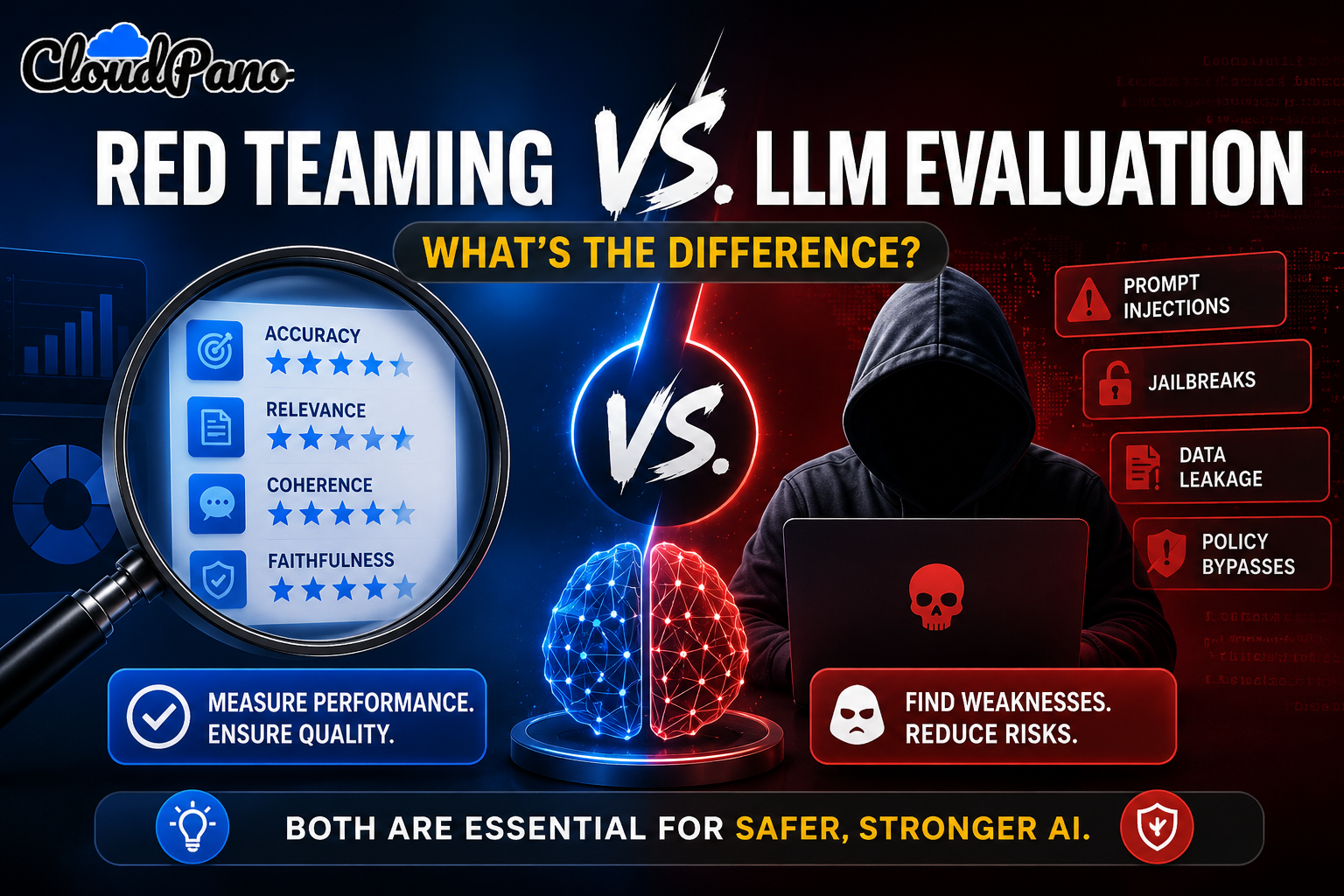
Red Teaming vs. LLM Evaluation: What's the Difference?

Cloudpano
July 30, 2026
5 min read
Share this post

Red Teaming vs. LLM Evaluation: What's the Difference?

Teams sometimes treat "we evaluated the model" and "we red-teamed it" as interchangeable statements of confidence, when red teaming vs LLM evaluation actually describes two different testing philosophies aimed at two different questions. Evaluation asks "how well does this model perform on the inputs it's likely to see?" Red teaming asks "what's the worst a determined adversary could get this model to do?"

AI red teaming deliberately searches for failure — adversarial prompts, edge cases, and manipulation attempts specifically designed to break a model's safety measures or produce harmful output. Standard evaluation, by contrast, typically tests against representative, expected use, which means it's not built to find the kind of deliberately crafted attacks red teaming specifically looks for.

Why It Matters

A model that performs well on standard evaluation can still have exploitable vulnerabilities that only surface under deliberately adversarial conditions, since evaluation and red teaming are built to find different things. Google Research's "Data Cascades" study documented how unaddressed gaps in a testing process tend to compound into larger problems once a system is deployed and encountered by real, sometimes adversarial, users (Sambasivan et al., Google Research).
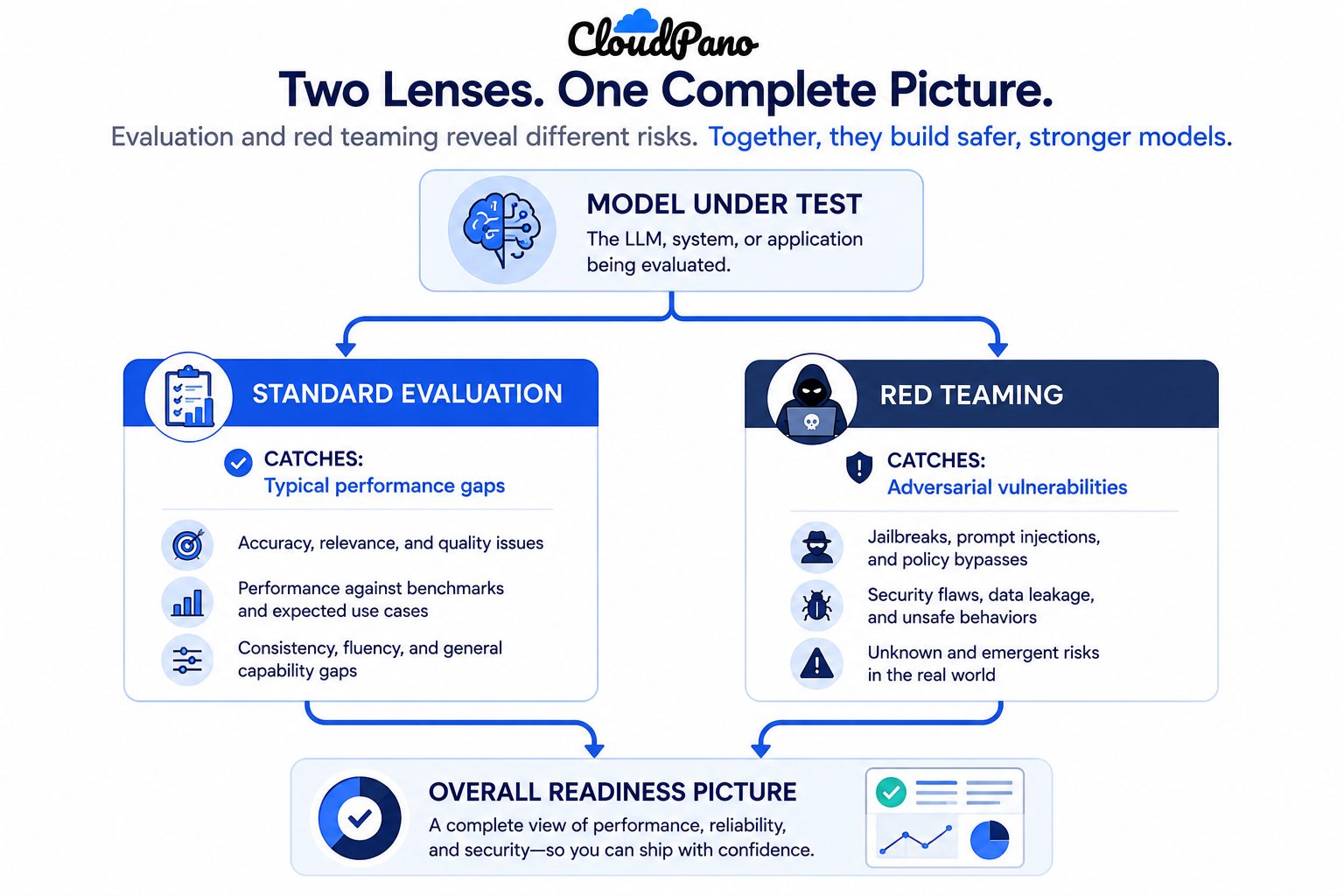
Diagram showing what LLM evaluation and red teaming each catch

NIST's AI Risk Management Framework explicitly identifies adversarial testing as a distinct risk-management activity, separate from general performance evaluation, reinforcing that LLM safety testing through red teaming isn't a more intensive version of evaluation — it's a fundamentally different activity aimed at a different kind of risk (NIST AI RMF).

The stakes of skipping this distinction grow with deployment scale. Stanford HAI's AI Index has tracked how widely language models are now deployed across consumer and enterprise contexts (Stanford HAI, AI Index Report), meaning a vulnerability that only red teaming would catch is increasingly likely to be discovered by a real adversarial user rather than a friendly tester.

How It Works

LLM evaluation tests a model against representative, expected inputs and measures performance across dimensions like accuracy, consistency, and typical safety behavior. It answers: does this model do its job well under normal, anticipated conditions?

Adversarial AI testing — red teaming — works differently. Testers deliberately craft inputs designed to bypass safety measures, extract harmful content, manipulate the model into unintended behavior, or exploit edge cases a standard evaluation set wouldn't include. The goal isn't measuring typical performance; it's actively hunting for exploitable weaknesses.

The two activities complement each other precisely because they're built to catch different things. Evaluation without red teaming can miss deliberately engineered failure modes. Red teaming without evaluation can find dramatic exploits while missing more mundane, everyday performance gaps that affect far more users.
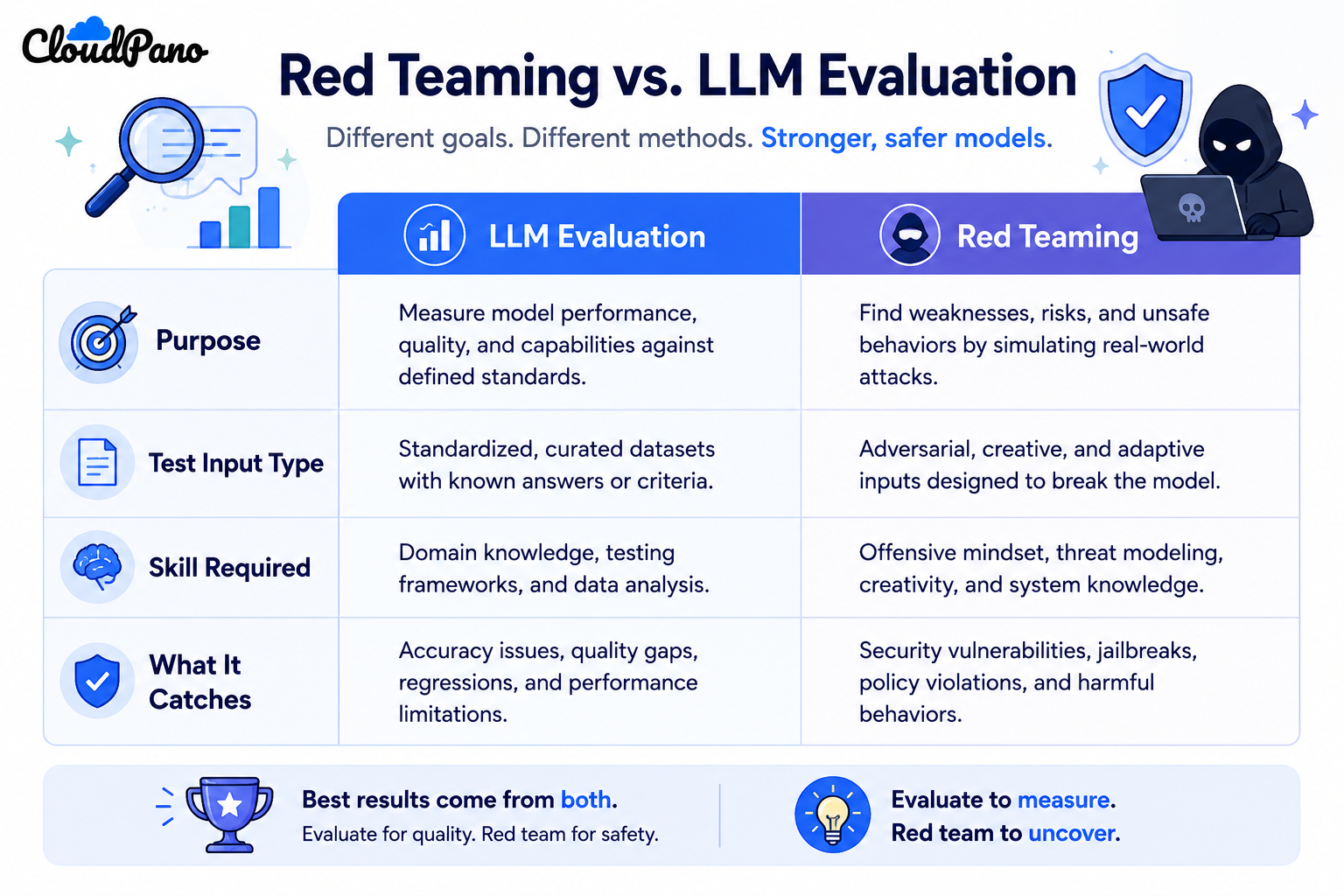
Comparison table of red teaming vs LLM evaluation for language models

Understanding how these workflows operate as complementary rather than redundant is what keeps a model from being under-tested in either direction — confident in typical performance but blind to adversarial risk, or hardened against attacks but underperforming on everyday use.
Step-by-Step Workflow

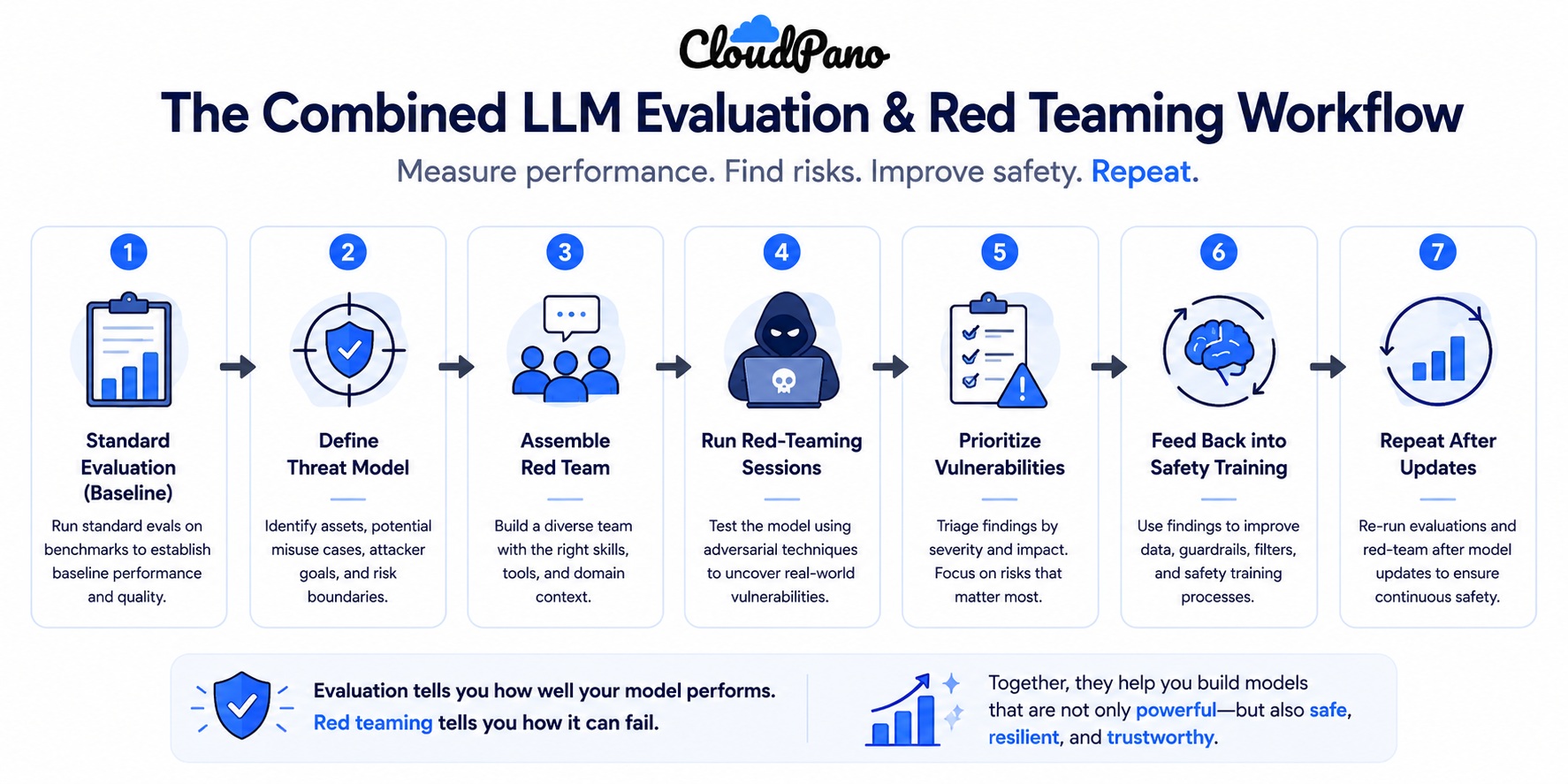
Diagram of a combined LLM evaluation and red teaming workflow
  • Run standard evaluation first to establish baseline performance. Confirm the model performs adequately on representative, expected use cases before adversarial testing begins.
  • Define the specific threat model for red teaming. Identify what kinds of adversarial behavior — harmful content extraction, safety bypass, manipulation — are most relevant to your deployment.
  • Assemble a red team with adversarial testing expertise. This role requires a different skill set than standard evaluators: creativity in finding exploits, not just applying a rubric.
  • Run structured red-teaming sessions against the defined threat model. Document specific successful exploits, not just a general sense of how the model held up.
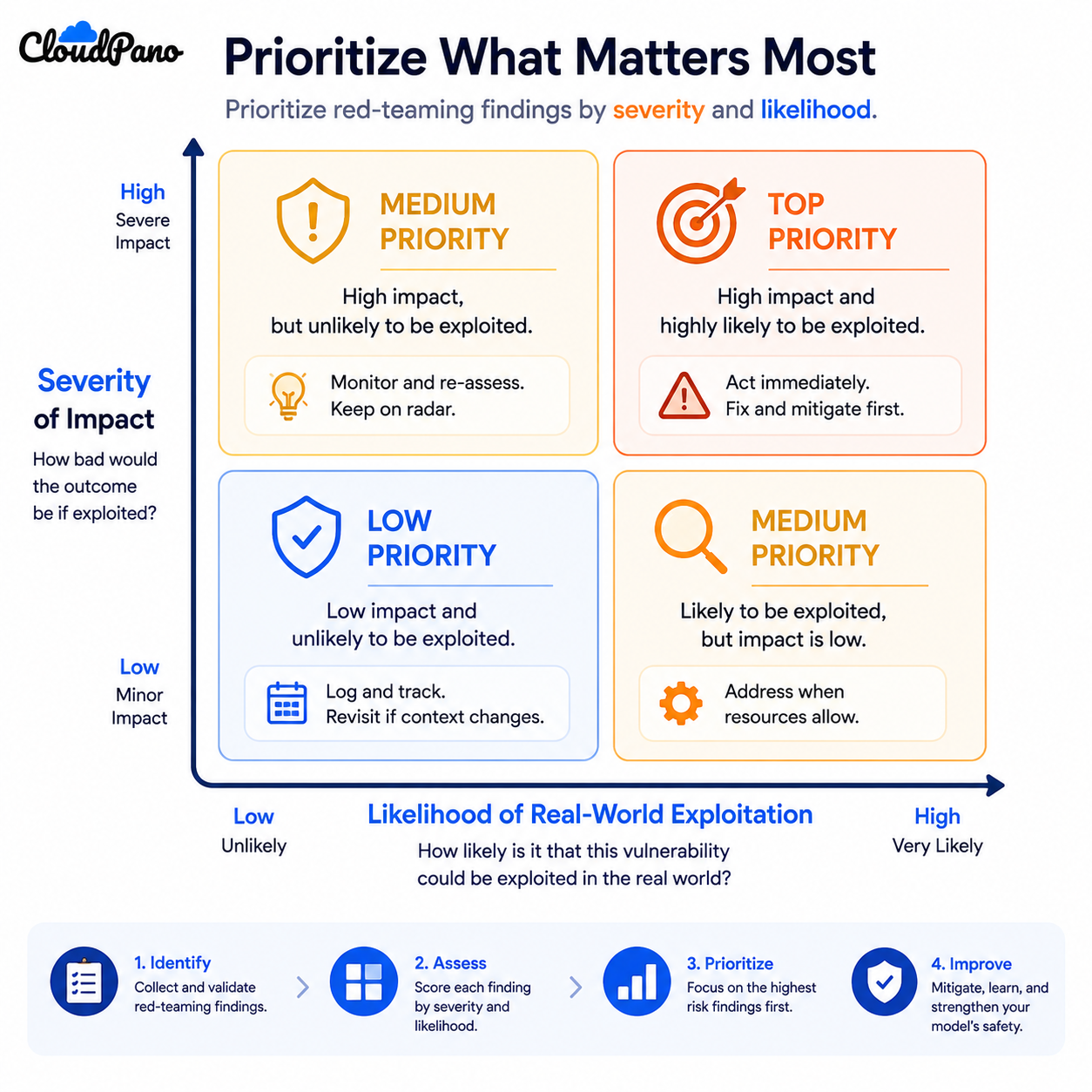
  • Categorize and prioritize discovered vulnerabilities. Rank findings by severity and likelihood of real-world exploitation, not just by how dramatic the exploit looked.
  • Feed red-teaming findings back into model safety training or guardrails. Treat discovered vulnerabilities as specific gaps to close, not just a report to file away.
  • Repeat both evaluation and red teaming after any model update. A change that fixes one issue can introduce new gaps in either standard performance or adversarial robustness.

Industry Use Cases

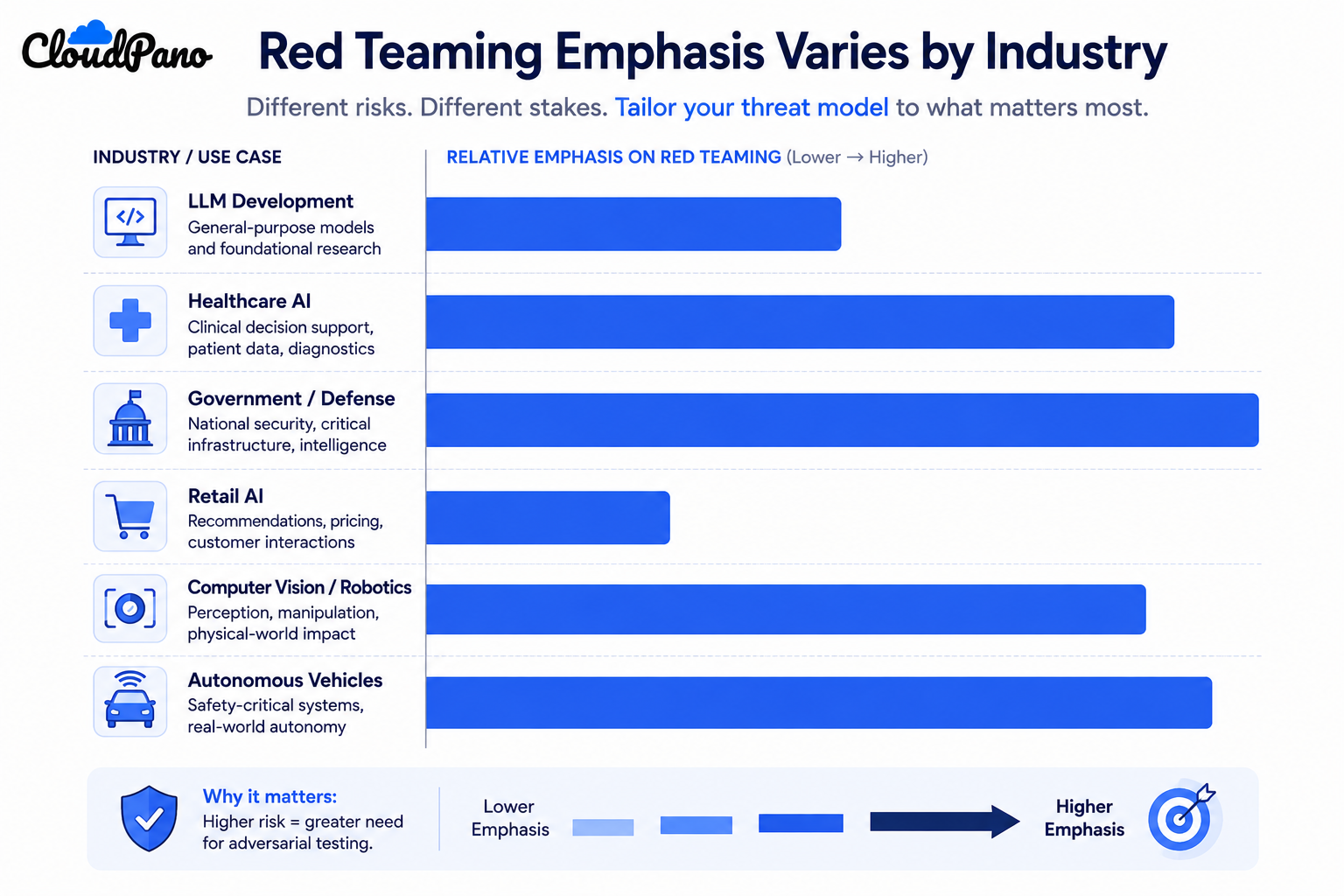
Bar chart showing relative emphasis on red teaming across AI industries
  • LLM developers: Both activities are core to responsible model development, with evaluation confirming typical performance and red teaming confirming adversarial robustness before wide deployment.
  • Healthcare AI: Red teaming needs to specifically probe for scenarios where a model could be manipulated into providing harmful medical misinformation.
  • Retail AI: Red teaming for customer-facing assistants often focuses on manipulation attempts to extract inappropriate discounts, policy violations, or off-brand content.
  • Government & defense: Red teaming requirements are often formally mandated for deployed conversational systems, given the security and policy stakes involved.
  • Computer vision / robotics: These specific LLM-focused red-teaming and evaluation methods don't map directly onto computer vision testing, though analogous adversarial testing concepts exist in that domain.
  • Autonomous vehicles: Similarly, this specific combination of methods is less directly applicable, though the underlying principle that typical-case testing and adversarial testing serve different purposes applies broadly.

Benefits

  • Confidence in both typical and adversarial conditions. Running both activities gives a fuller picture of model reliability than either alone.
  • Earlier discovery of exploitable vulnerabilities. Red teaming catches deliberately engineered failure modes before a real adversarial user does.
  • More efficient testing resource allocation. Understanding which activity catches which kind of issue prevents wasted effort applying the wrong method to the wrong risk.
  • Stronger safety training signal. Red-teaming findings, fed back into model training, directly close the specific gaps discovered rather than relying on general safety improvements.
  • A more defensible deployment decision. Documented evidence of both standard evaluation and adversarial testing supports accountability, particularly in regulated contexts.

Common Mistakes

  • Treating evaluation and red teaming as interchangeable. Assuming strong evaluation results mean a model is also adversarially robust, or vice versa.
  • Skipping red teaming because evaluation looked strong. Missing that evaluation specifically doesn't test for deliberately engineered adversarial behavior.
  • Running red teaming without a defined threat model. Testing without specific goals produces an unfocused exercise rather than a targeted search for the vulnerabilities that matter most for your deployment.
  • Not prioritizing discovered vulnerabilities by real-world risk. Treating every red-teaming finding with equal urgency rather than focusing on the most exploitable or damaging issues first.
  • Treating red teaming as a one-time pre-launch activity. Not repeating it after model updates, when new vulnerabilities can be introduced even while fixing previous ones.
  • Filing red-teaming findings without acting on them. Documenting vulnerabilities without feeding them back into safety training or guardrail updates.

Best Practices

  • Run standard evaluation and red teaming as complementary activities, not substitutes for each other.
  • Define a specific threat model before red teaming begins, focused on the risks most relevant to your deployment context.
  • Staff red teaming with people skilled in adversarial thinking, distinct from the skill set needed for standard evaluation.
  • Prioritize discovered vulnerabilities by real-world exploitability and impact, not just how dramatic they appear.
  • Feed red-teaming findings directly back into safety training or guardrail development, treating them as specific gaps to close.
  • Repeat both evaluation and red teaming after every significant model update, since either activity can surface new issues introduced by a change.

FAQ

What's the main difference between red teaming and LLM evaluation?

Evaluation measures how well a model performs on representative, expected inputs, while red teaming actively searches for adversarial inputs designed to make the model fail or produce harmful output.

Do I need both AI red teaming and standard evaluation?

Yes, for most responsible deployments. Evaluation and red teaming are built to catch different kinds of problems, and skipping either leaves a real gap in understanding how the model will actually behave.

What does LLM safety testing through red teaming actually involve?

Deliberately crafting inputs designed to bypass safety measures, extract harmful content, or manipulate the model into unintended behavior, then documenting and prioritizing the specific vulnerabilities discovered.

Who should conduct adversarial AI testing?

People with skill in adversarial thinking and creative exploit discovery, which is a distinct skill set from the more structured, rubric-based judgment used in standard evaluation.

How often should red teaming be repeated?

After every significant model update or retraining cycle, since changes intended to fix one issue can introduce new vulnerabilities elsewhere.

Can strong evaluation results substitute for red teaming?

No. Evaluation results reflect performance on typical, representative inputs and don't reliably indicate how a model will hold up against deliberately adversarial attempts to break it.

How should red-teaming findings be used after discovery?

They should be categorized and prioritized by real-world risk, then fed back into safety training or guardrail updates to specifically close the discovered gaps, rather than just documented and filed away.

Conclusion

Red teaming vs LLM evaluation isn't a choice between two versions of the same activity — they answer different questions about a model's readiness. Evaluation confirms typical performance; red teaming confirms adversarial robustness. Responsible deployment generally needs both, run as complementary activities and repeated across the model's lifecycle rather than treated as one-time, interchangeable checks.

🚀 Your All‑In‑One Virtual Experience Stack
🎬
PhotoAIVideo
Turn photos into scroll‑stopping AI videos.
Get Started →
🏡
Pictastic
Instantly stage listings with AI.
Try Staging →
🌀
CloudPano
Create stunning 360° tours in minutes.
Launch Tour →
💰
VirtualTourProfit
Build a profitable virtual tour business.
Learn More →
🤝
CloudPano Reseller
Resell AI visual software without building it.
Become a Reseller →
🚗
Auto CloudPano
Sell more vehicles with 360° experiences.
Explore Auto →
🏗️
AI Floor Plan Builder
Generate detailed floor plans with AI.
Build Now →
📐
3D Measure
Capture accurate floor plans & 3D measurements.
Measure Now →
🧠
AI Training Data
Custom AI training data services.
Learn More →
Share this post
Cloudpano

Choose The Right 360° Camera

Insta360 ONE RS 1-Inch 360 Edition

  • Compact, ready to go anywhere

  • Interchangeable lens that’s upgradeable

  • Dual 1-inch sensors for improved clarity and low light performance

  • Dynamic range and 6K 360° capture

  • 360° photo resolution at 21MP

Learn More

Insta360 X4

  • 8K 360° video recording for ultra-detailed visuals.

  • 4K single-lens mode for traditional wide-angle shots.

  • Invisible selfie stick effect for drone-like perspectives.

  • 2.5-inch touchscreen with Gorilla Glass protection.

  • Waterproof up to 33ft for underwater shooting.

Learn More

Ricoh Theta Z1

  • 360° photo resolution in 23MP

  • Slim design at 24 mm thick

  • Built-in image stabilization for smooth video capture.

  • Internal 19GB storage for photo and video storage.

  • Wireless connectivity for remote control and sharing.

Learn More

Ricoh Theta X

  • 60MP 360° still images for high-resolution photography.

  • 5.7K 360° video recording at 30fps.

  • 2.25-inch touchscreen for intuitive control.

  • USB Type-C port for fast charging and data transfer.

  • MicroSD card slot for expandable storage.

Learn More
Property Marketing
Allows potential buyers to explore properties in detail from anywhere, enhancing the real estate marketing process.
Automotive Spins
Create an interactive virtual showroom and engage affluent digital buyers with live 360º video calls, all through the CloudPano mobile app for a complete automotive sales solution.
Interactive Floor Plans
Create 2D and 3D floor plans with measurements in 4 minutes or less, all from your phone. Download the Floor Plan Scanner app and get your first scan free.

360 Virtual Tours With CloudPano.com. Get Started Today.

Try it free. No credit card required. Instant set-up.

Try it free
Latest posts

See our other posts

Interviews, tips, guides, industry best practices, and news.

How to Benchmark Large Language Models: Human vs. Automated Evaluation

LLM benchmarking compares models against each other using standardized test suites, either through automated scoring (including LLM-as-judge methods) or structured human evaluation. Automated benchmarking scales efficiently but is vulnerable to contamination and gaming; human evaluation catches nuance automated scoring misses but doesn't scale as easily across many model comparisons.
Read post

Red Teaming vs. LLM Evaluation: What's the Difference?

Red teaming vs LLM evaluation comes down to purpose: evaluation measures how a model performs on typical and representative inputs, while red teaming actively searches for adversarial inputs designed to make the model fail, produce harmful content, or bypass safety measures. Most responsible deployments need both, not one or the other.
Read post

How to Evaluate LLM Outputs: Metrics, Methods, and Human Review

How to evaluate LLM outputs depends on the task: automated metrics like BLEU, ROUGE, or perplexity work for narrow, reference-based tasks, while embedding similarity captures semantic closeness more flexibly. For subjective qualities like tone or helpfulness, structured human evaluation with clear rubrics and rating scales is usually necessary alongside automated methods.
Read post