


.png)


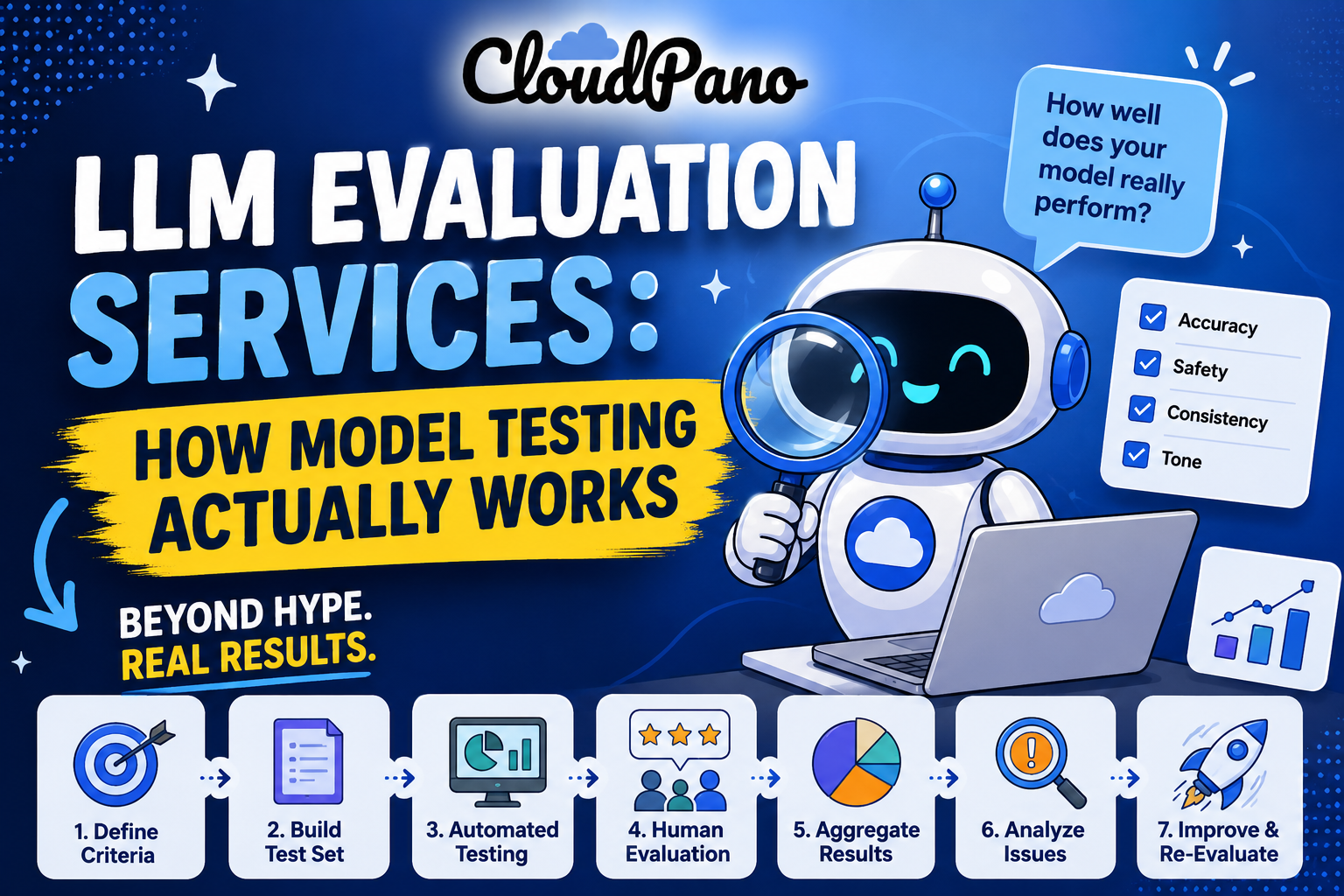
Training a model and knowing how well it actually performs are two different things, and the gap between them is where LLM evaluation services fit. Standard benchmark scores tell you something, but they rarely tell you whether a model performs well on your specific tasks, in your specific domain, against your specific risk profile.
Large language model evaluation, done properly, combines structured benchmarks with targeted human judgment — testing not just whether a model produces plausible-sounding text, but whether it's actually reliable, safe, and useful for the specific way it's going to be used.
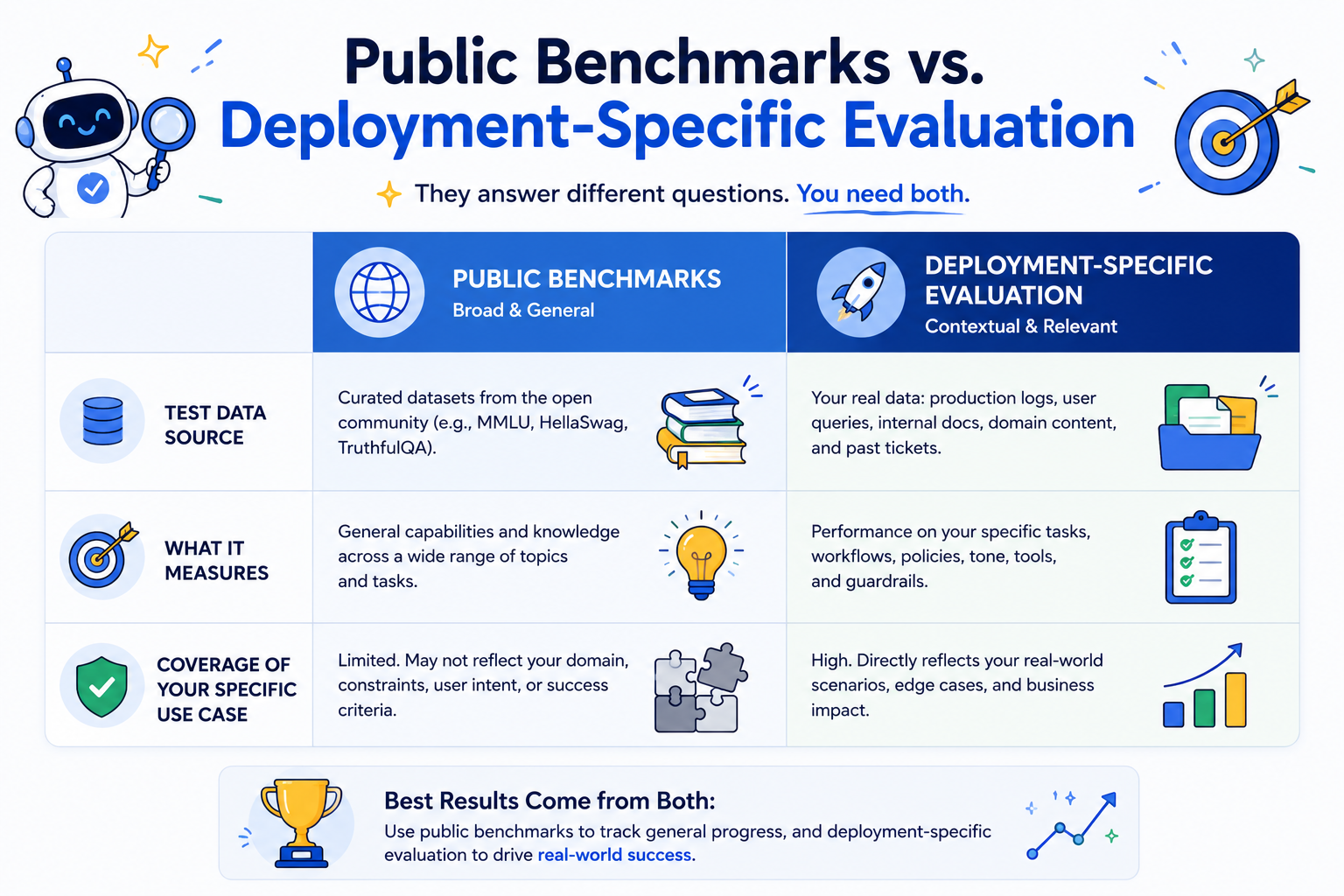
A model that scores well on general public benchmarks can still fail badly on the specific tasks a particular deployment actually needs, because public benchmarks test general capability, not your specific use case. Google Research's "Data Cascades" study documented how gaps that seem minor early in a pipeline — including gaps in what evaluation actually covers — tend to surface later as expensive, hard-to-diagnose problems once a model is already in production (Sambasivan et al., Google Research).
NIST's AI Risk Management Framework treats ongoing evaluation and monitoring as a distinct, necessary function of trustworthy AI, not a one-time checkbox before launch — a framing that applies directly to how AI model evaluation services should be scoped and repeated over a model's lifecycle (NIST AI RMF).
The pace of LLM deployment makes skipping rigorous evaluation riskier. Stanford HAI's AI Index has tracked how quickly organizations are deploying language models into production use (Stanford HAI, AI Index Report), and a model evaluated only against general public benchmarks may hit real users with untested failure modes specific to its actual deployment context.
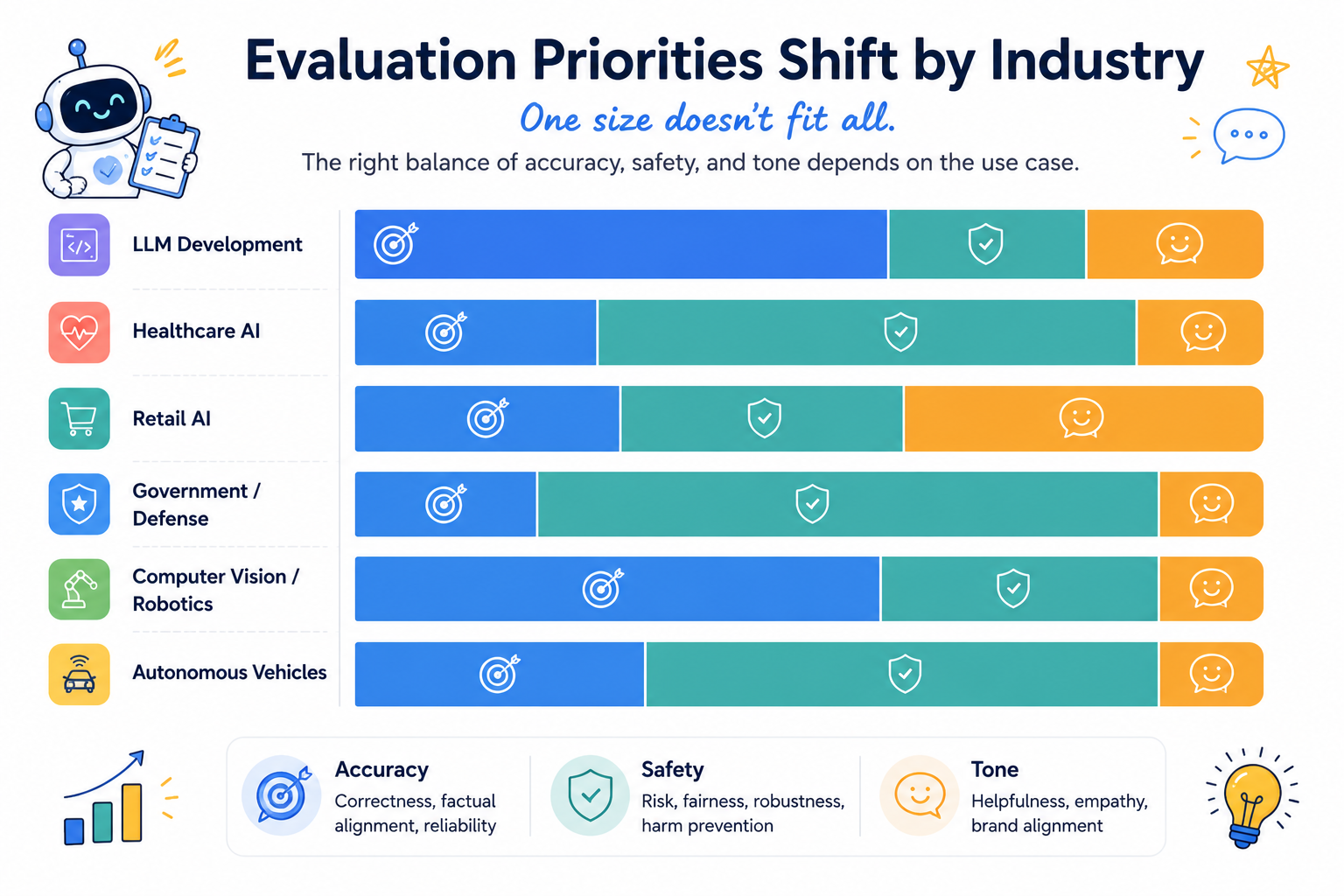
LLM benchmarking and testing typically covers several distinct evaluation dimensions, and a proper evaluation service tests each deliberately rather than relying on a single aggregate score.

Infographic of the four dimensions of LLM evaluation services
Task-specific accuracy. Testing the model against examples representative of the actual tasks it will handle in deployment, not just general knowledge or reasoning benchmarks.
Safety and harm evaluation. Testing for harmful, biased, or inappropriate outputs across defined risk categories relevant to the deployment context.
Consistency and robustness. Testing whether the model produces stable, reliable outputs across similar inputs, rather than varying unpredictably.
Human judgment on subjective quality. Testing dimensions like tone, helpfulness, and appropriateness that automated benchmarks can't fully capture, using structured human evaluation.
Understanding how these workflows operate as multiple distinct testing dimensions — not one score — is what separates a genuinely useful evaluation from a generic benchmark report that doesn't tell you much about your actual deployment risk.
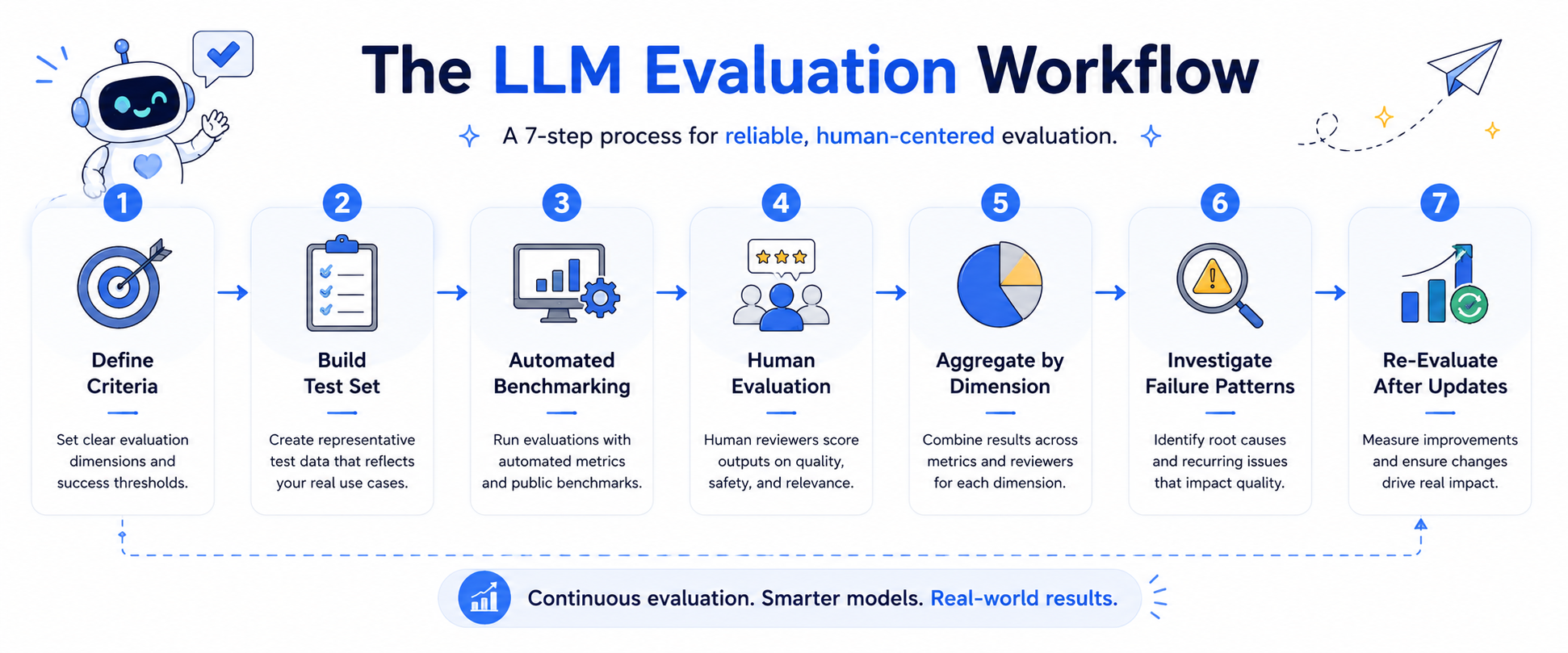

Task-specific accuracy testing, safety and harm evaluation, consistency and robustness checks, and structured human evaluation of subjective qualities like tone and helpfulness.
Standard benchmarks test general capability against public datasets, while a full evaluation service tests a model against criteria specific to its actual deployment context, often combining automated and human evaluation methods.
Because averaging performance into one score can obscure specific weaknesses — a model might score well overall while failing consistently on a particular safety category or task type.
Both are typically needed. Automated benchmarking handles quantifiable dimensions efficiently, while human evaluation is usually necessary for subjective qualities like tone and appropriateness that automated methods can't fully capture.
On a regular cadence tied to model updates or retraining, not just once before initial launch, since performance and behavior can shift with any change to the underlying model.
Evaluation measures how well a model currently performs against defined criteria, while RLHF is a training technique that uses human feedback to actively change model behavior; evaluation often informs where RLHF or other tuning is needed.
Use examples that reflect your actual deployment context — realistic user inputs, relevant edge cases, and domain-specific scenarios — rather than relying solely on generic public benchmark datasets.
LLM evaluation services exist because training a model and knowing how well it performs are genuinely different problems. Testing across distinct dimensions — accuracy, safety, consistency, and subjective quality — with a test set that reflects actual deployment context gives teams a defensible, detailed picture of readiness that a single benchmark score can't provide on its own.


Compact, ready to go anywhere
Interchangeable lens that’s upgradeable
Dual 1-inch sensors for improved clarity and low light performance
Dynamic range and 6K 360° capture
360° photo resolution at 21MP

8K 360° video recording for ultra-detailed visuals.
4K single-lens mode for traditional wide-angle shots.
Invisible selfie stick effect for drone-like perspectives.
2.5-inch touchscreen with Gorilla Glass protection.
Waterproof up to 33ft for underwater shooting.

360° photo resolution in 23MP
Slim design at 24 mm thick
Built-in image stabilization for smooth video capture.
Internal 19GB storage for photo and video storage.
Wireless connectivity for remote control and sharing.

60MP 360° still images for high-resolution photography.
5.7K 360° video recording at 30fps.
2.25-inch touchscreen for intuitive control.
USB Type-C port for fast charging and data transfer.
MicroSD card slot for expandable storage.
.png)

.png)

Try it free. No credit card required. Instant set-up.







.svg)


.svg)