


.png)


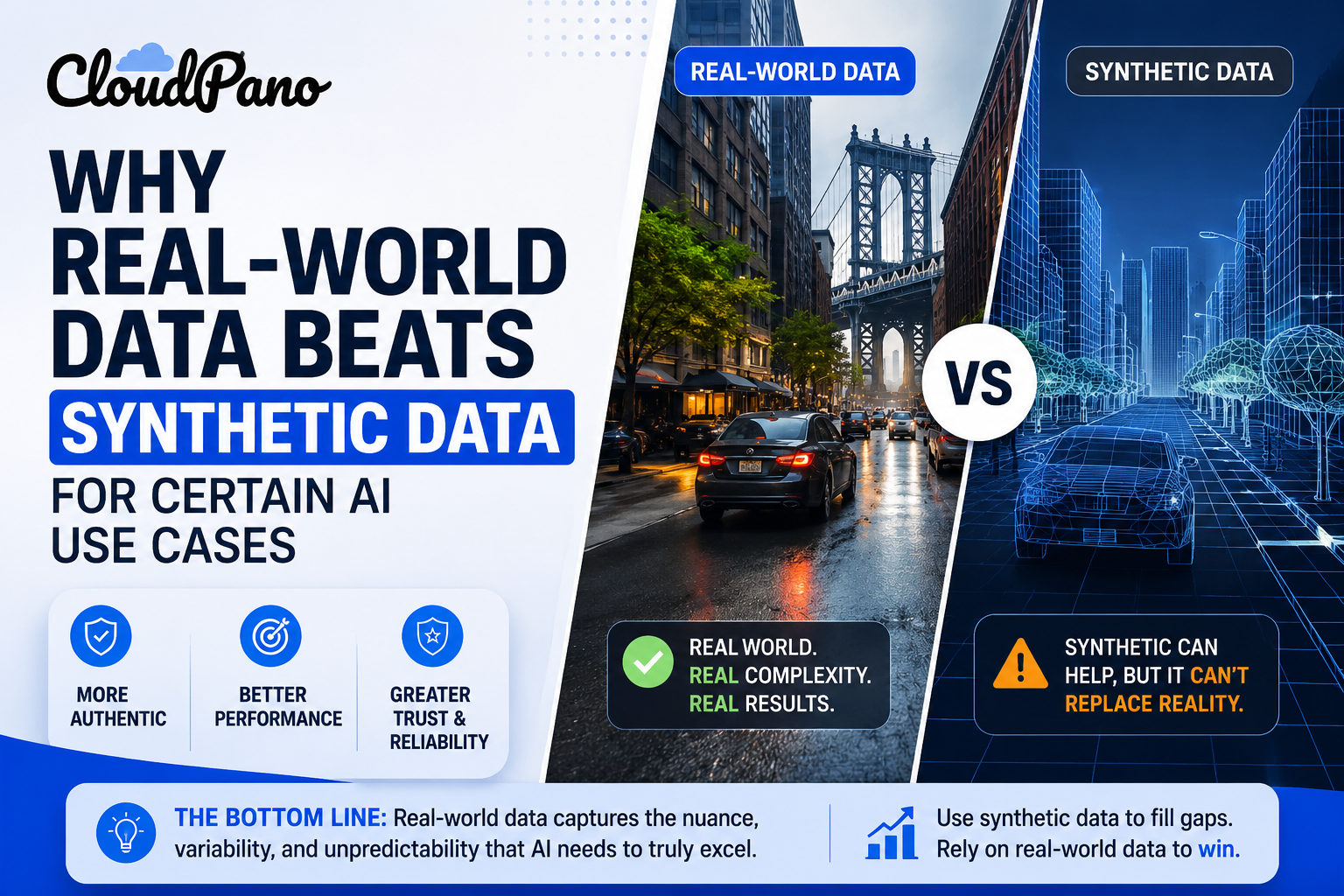
The real-world data vs synthetic data AI question gets pitched too often as synthetic data being a faster, cheaper substitute for the real thing. That framing undersells both options — each has a genuine advantage the other doesn't, and the right answer depends heavily on what your model actually needs to learn.
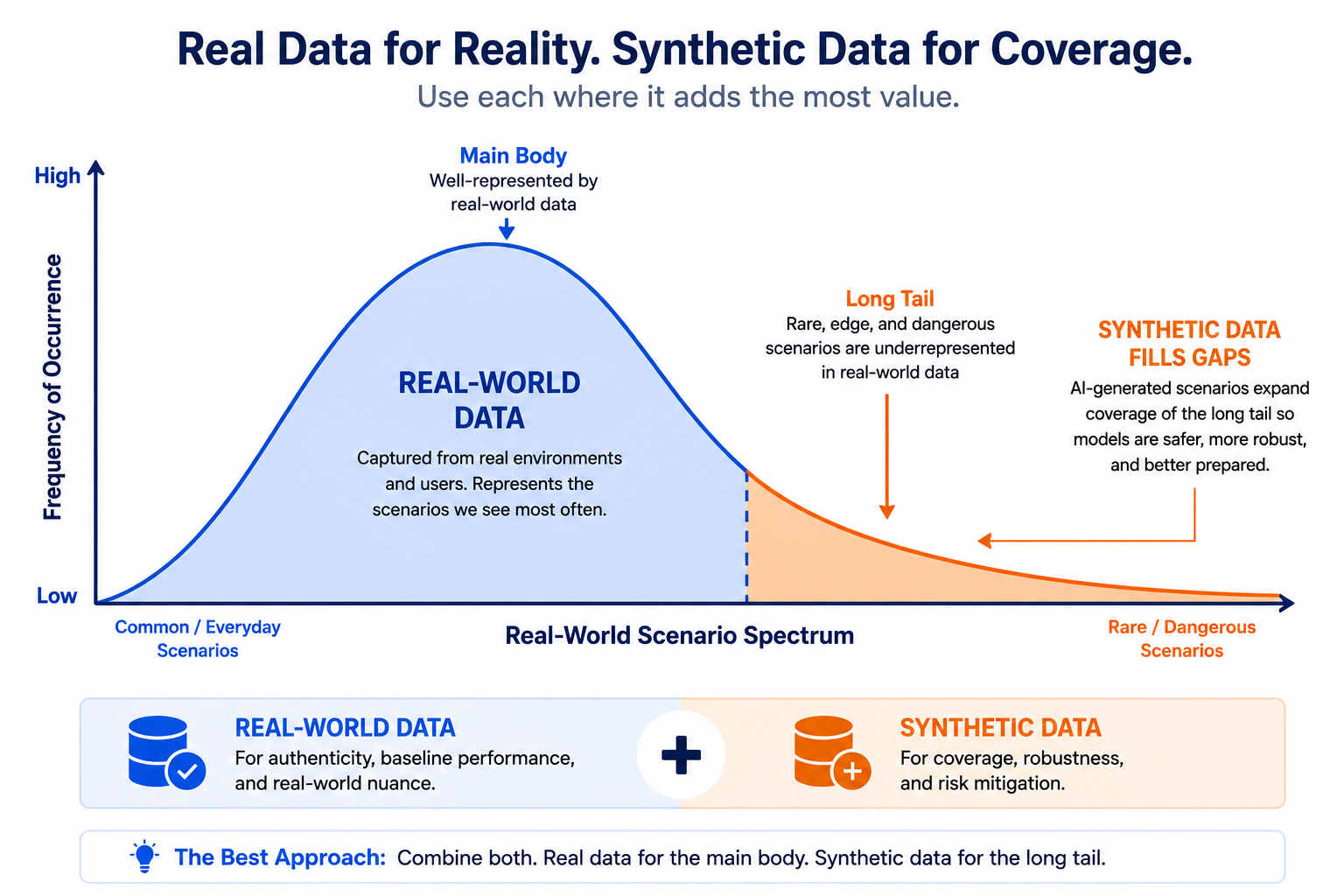
Real-world data captures the true, messy complexity of the environment a model will operate in. Synthetic data fills in exactly the gaps real-world collection struggles with — rare events, dangerous scenarios, and cases that would take years to naturally occur in sufficient volume.
Choosing the wrong mix of real-world and synthetic training data doesn't usually fail in testing — it fails quietly in production, on the specific cases the training data didn't represent well. Google Research's "Data Cascades" study documented how gaps introduced early in data preparation compound into problems that are difficult to trace back to their source later (Sambasivan et al., Google Research).
NIST's AI Risk Management Framework treats data representativeness as foundational to trustworthy AI, and a training dataset over-reliant on synthetic data without validation against real-world performance is exactly the kind of representativeness gap the framework flags as a risk (NIST AI RMF).
The stakes are higher given how quickly organizations are deploying models into production. Stanford HAI's AI Index has tracked this acceleration (Stanford HAI, AI Index Report), leaving less room to discover a synthetic-to-real performance gap after a model is already live.
Real-world data is collected directly from the environment a model will operate in — actual driving footage, actual patient scans, actual customer interactions. Its core strength is authenticity: it captures the true statistical distribution and unpredictable complexity of the real target environment, including correlations and noise that are genuinely difficult to fabricate.
Synthetic data is generated — through simulation, procedural generation, or generative models — to approximate real-world data without collecting it directly. Its core strength is coverage: it can produce rare, dangerous, or expensive-to-capture scenarios at a volume and cost real-world collection can't match.
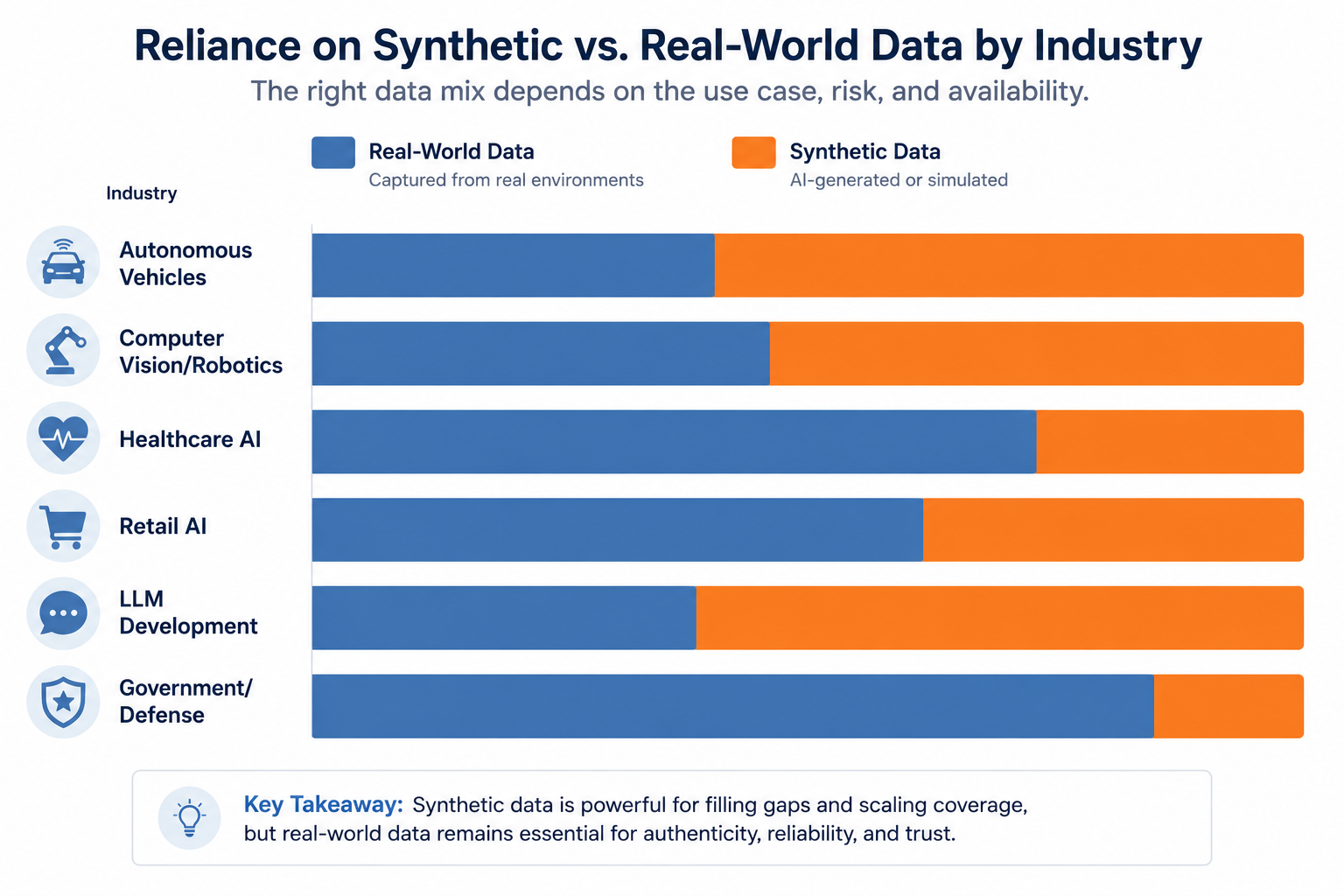
Hybrid AI training datasets combine both, typically using real-world data as the core distribution the model learns from and synthetic data to fill specific, identified gaps — rare edge cases, underrepresented conditions, or scenarios too risky to collect naturally.

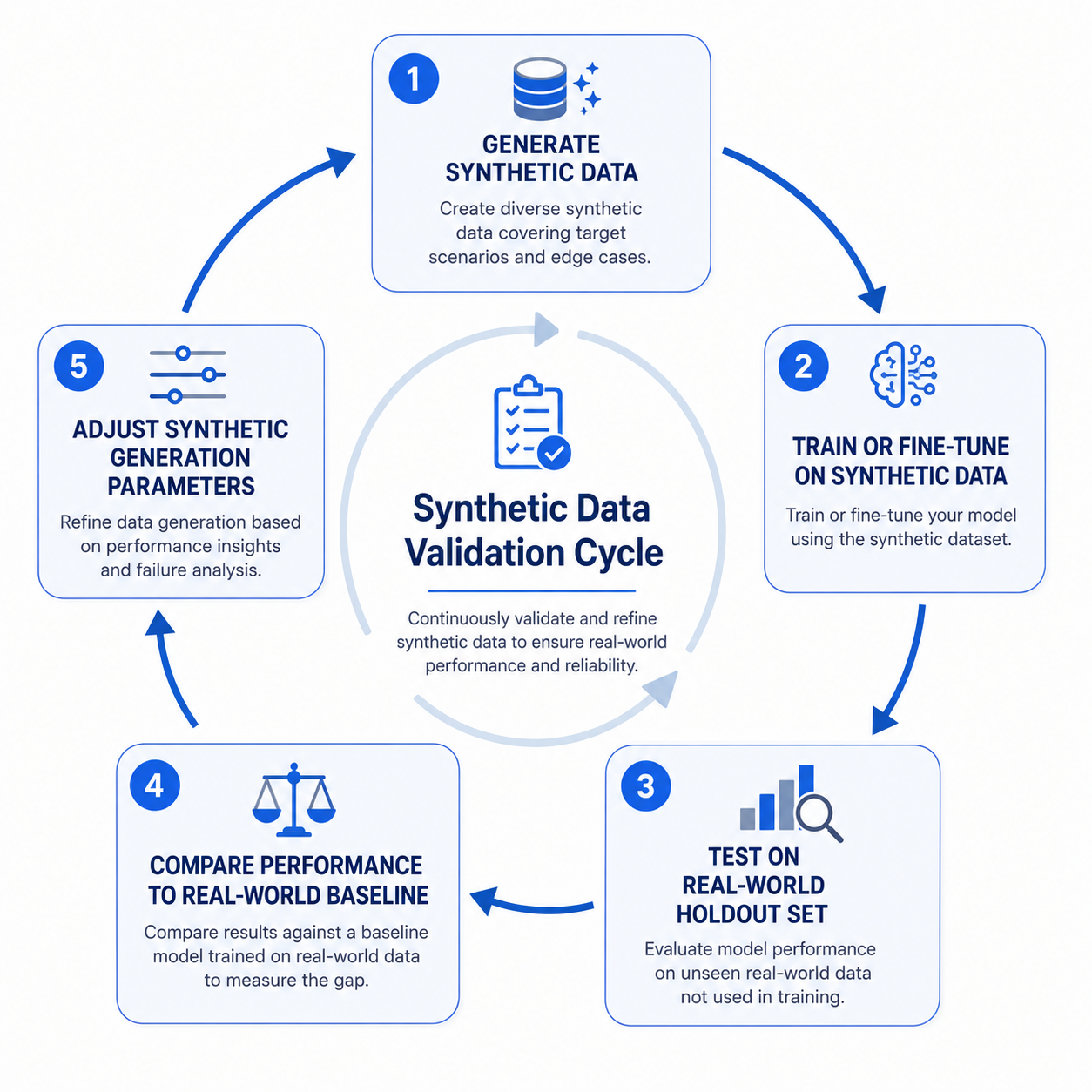
Understanding how these workflows operate — where synthetic data genuinely helps versus where it introduces a distribution mismatch — is the core decision most teams actually need to make, rather than treating the choice as strictly either/or.
Real-world data offers:
Synthetic data for AI training offers:
Hybrid AI training datasets offer:
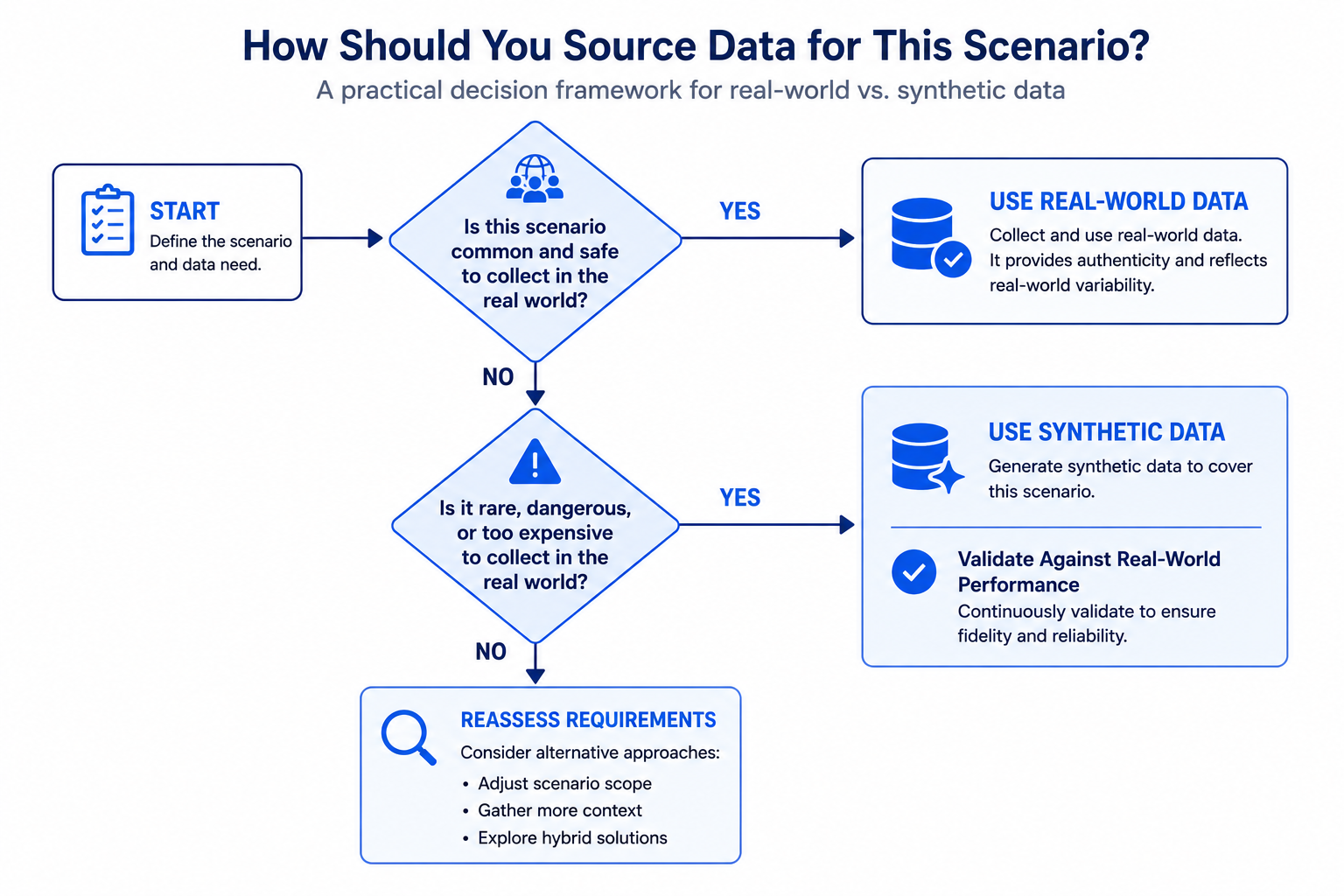
For common, frequent scenarios where authenticity and true statistical distribution matter most, and especially for regulated or safety-critical applications where a model's training data needs to be directly defensible.
For rare, dangerous, or expensive-to-collect scenarios where real-world data would take too long to accumulate naturally or would be impractical or unsafe to collect directly.
Training sets that combine real-world data as the core distribution with synthetic data used specifically to fill identified gaps, rather than relying entirely on either approach alone.
Test model performance separately on real-world and synthetic-heavy data segments; if performance on real-world cases doesn't improve alongside synthetic training, the synthetic data likely isn't transferring well.
Rarely, and not responsibly for regulated or safety-critical applications; even strong synthetic data generation is usually best used to supplement, not replace, a real-world data foundation.
This depends entirely on your specific gap analysis — which scenarios your real-world data underrepresents — rather than a fixed ratio.
No. Synthetic data still needs validation and quality checks, since it can encode its own generation artifacts or biases that require the same scrutiny as human-labeled real-world data.
Real-world data vs synthetic data AI isn't a competition with one universal winner — each has a genuine strength the other doesn't fully replicate. Real-world data anchors a model in the true complexity of its target environment; synthetic data fills the gaps real-world collection can't reasonably cover. Most production systems that get this right end up with a deliberately built hybrid, not an all-or-nothing choice.


Compact, ready to go anywhere
Interchangeable lens that’s upgradeable
Dual 1-inch sensors for improved clarity and low light performance
Dynamic range and 6K 360° capture
360° photo resolution at 21MP

8K 360° video recording for ultra-detailed visuals.
4K single-lens mode for traditional wide-angle shots.
Invisible selfie stick effect for drone-like perspectives.
2.5-inch touchscreen with Gorilla Glass protection.
Waterproof up to 33ft for underwater shooting.

360° photo resolution in 23MP
Slim design at 24 mm thick
Built-in image stabilization for smooth video capture.
Internal 19GB storage for photo and video storage.
Wireless connectivity for remote control and sharing.

60MP 360° still images for high-resolution photography.
5.7K 360° video recording at 30fps.
2.25-inch touchscreen for intuitive control.
USB Type-C port for fast charging and data transfer.
MicroSD card slot for expandable storage.
.png)

.png)

Try it free. No credit card required. Instant set-up.





.svg)


.svg)