


.png)


An agent in Tampa used a free video app for eight months before she noticed something during a listing presentation: every video she'd posted that year had a small, translucent watermark in the corner — not hers, the app's. She'd been unintentionally advertising someone else's brand on every single listing she'd marketed. Nobody had complained. But when she finally compared her videos next to a competing agent's clean, branded ones, the difference in perceived professionalism was obvious, and it wasn't in her favor.
This is the trade nobody spells out clearly when people search for best real estate video apps: free tools aren't actually free. They're subsidized by something — a watermark, a capped export quality, limited formats, or your own time spent working around limitations a paid tool wouldn't have. The real question isn't whether free tools work. It's what you're quietly giving up in exchange for not paying a subscription.
Free real estate video tools generally fall into one of three models: watermark-supported free tiers, limited-feature free versions meant to upsell you into a paid plan, or genuinely free tools built for a broader audience that just happen to work for real estate video, without any real estate-specific features at all.
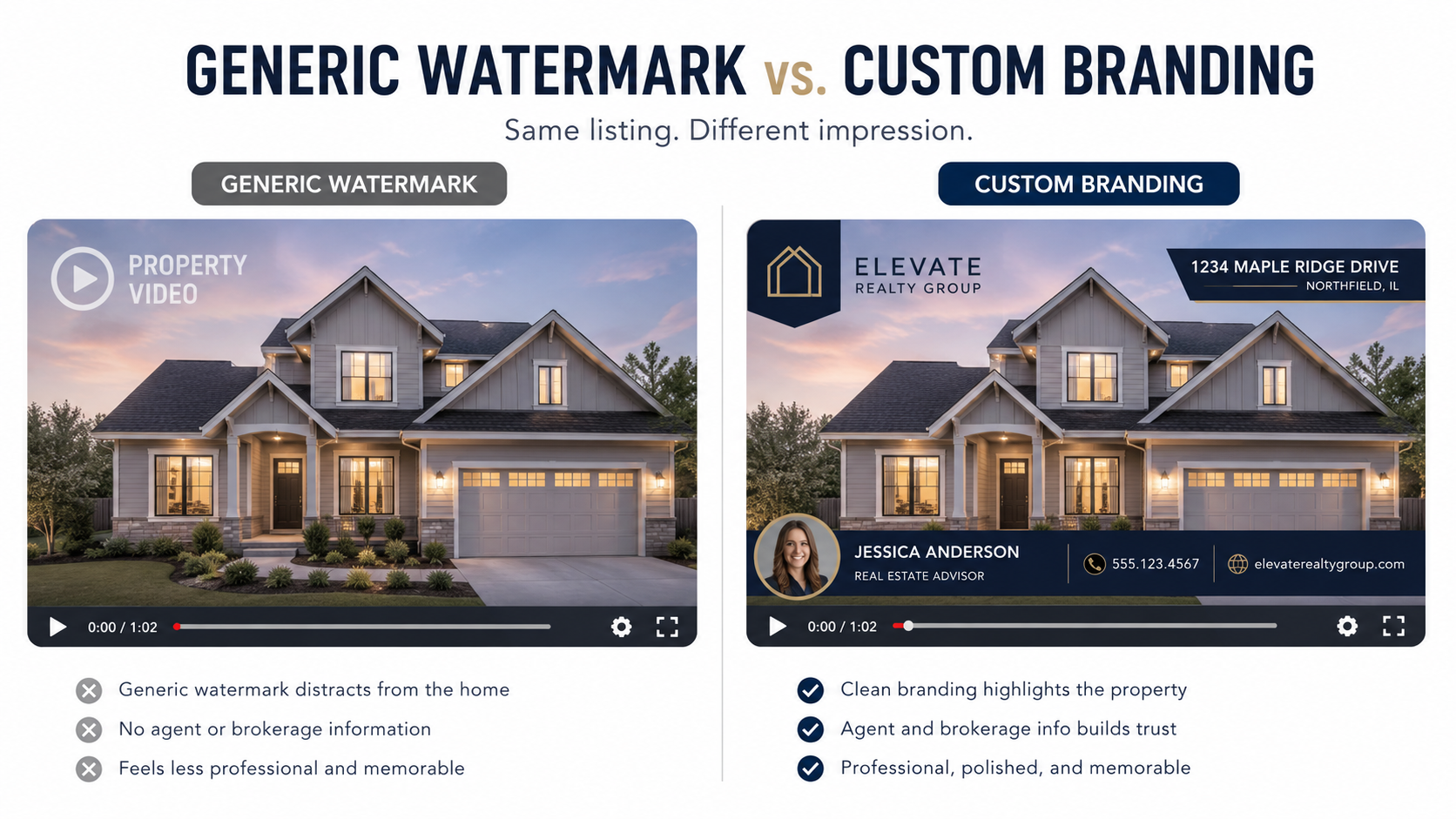
None of these are free in the sense of "costing nothing." The watermark model costs you brand perception. The limited-feature model costs you time, since you'll hit a wall eventually and have to either pay or work around it. The general-purpose free tool costs you relevance — you'll spend extra time manually adding contact info, adjusting formatting, or fixing MLS-unfriendly language the tool has no real estate context to avoid.
The obvious argument for free tools is budget, especially for newer agents or small operations. That's a legitimate constraint, and it shouldn't be dismissed. But the actual cost comparison isn't "$0 versus $30 a month" — it's "$0 plus hidden costs versus $30 with those costs removed." A watermark on every video is a small, constant signal to potential clients that you didn't invest in your own marketing, which matters more than people expect in a business built almost entirely on trust and perceived competence.
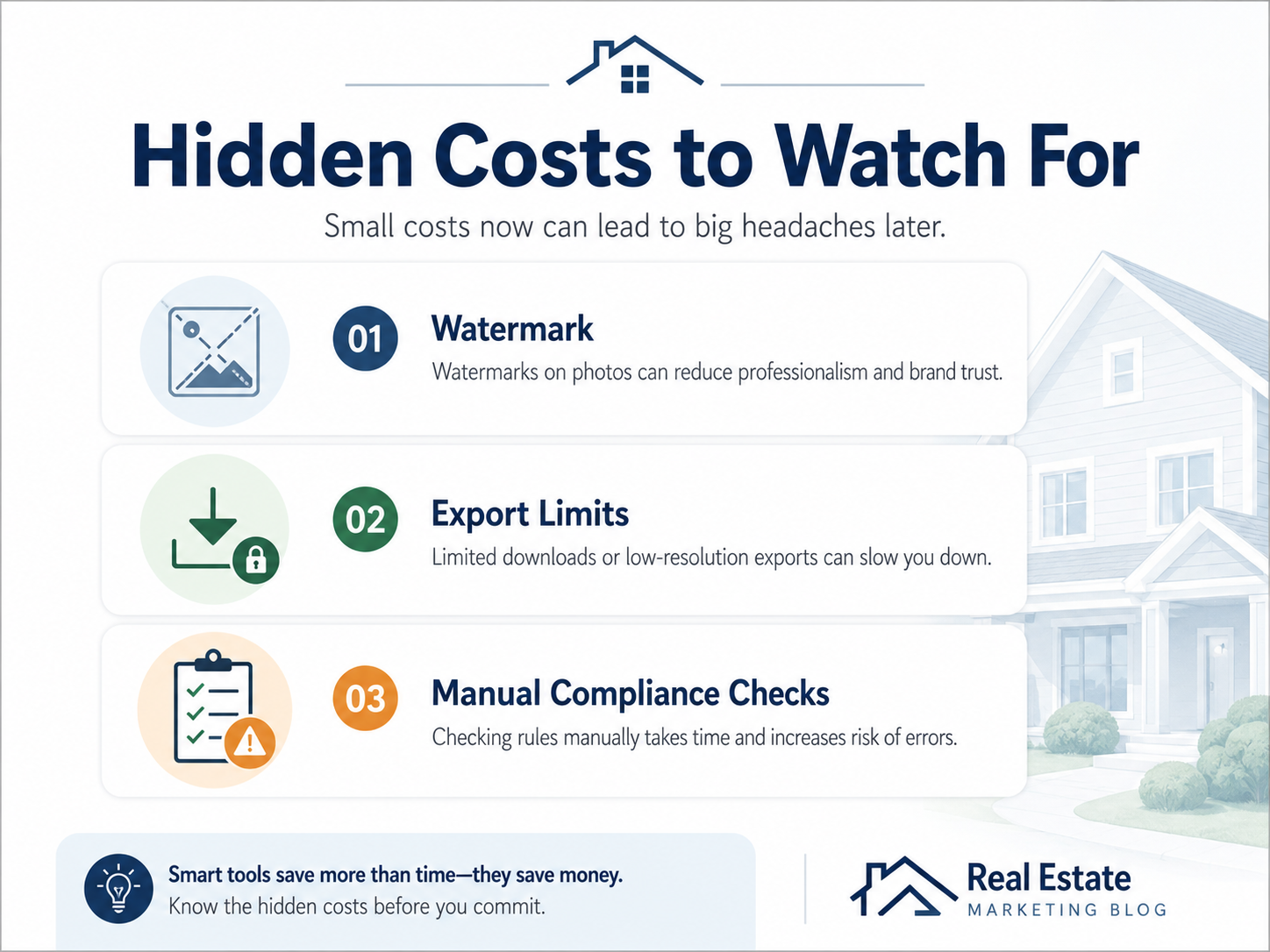
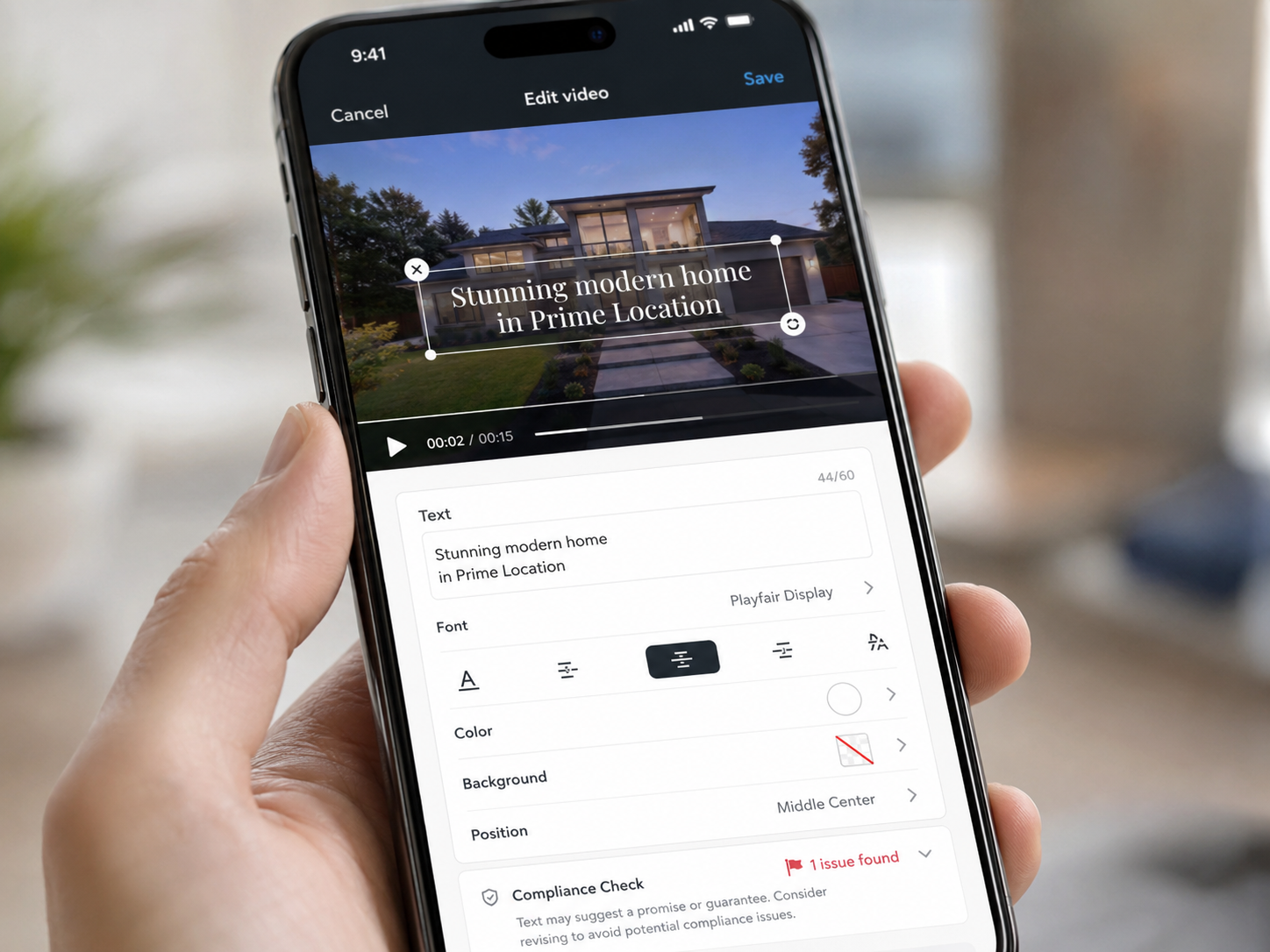
There's also a compliance angle that's easy to overlook. Real estate advertising has real rules — around fair housing language, accurate claims, and required disclosures — and NAR's guidance on advertising compliance is something agents are expected to know regardless of what tool they're using. Free, general-purpose video tools have no awareness of any of that. They'll happily generate whatever caption you type, with no guardrails, which shifts the entire compliance burden onto you catching every issue manually.
Here's the pattern that plays out repeatedly: an agent starts with a free tool because it's genuinely fine for the first few listings. Then volume increases, or a client notices the watermark, or an export limitation means the video looks worse on Instagram than it did in the app's preview. At that point, the agent faces a choice — upgrade to a paid tier they may not have budgeted for, or keep using a tool that's now visibly costing them professionalism on every listing.
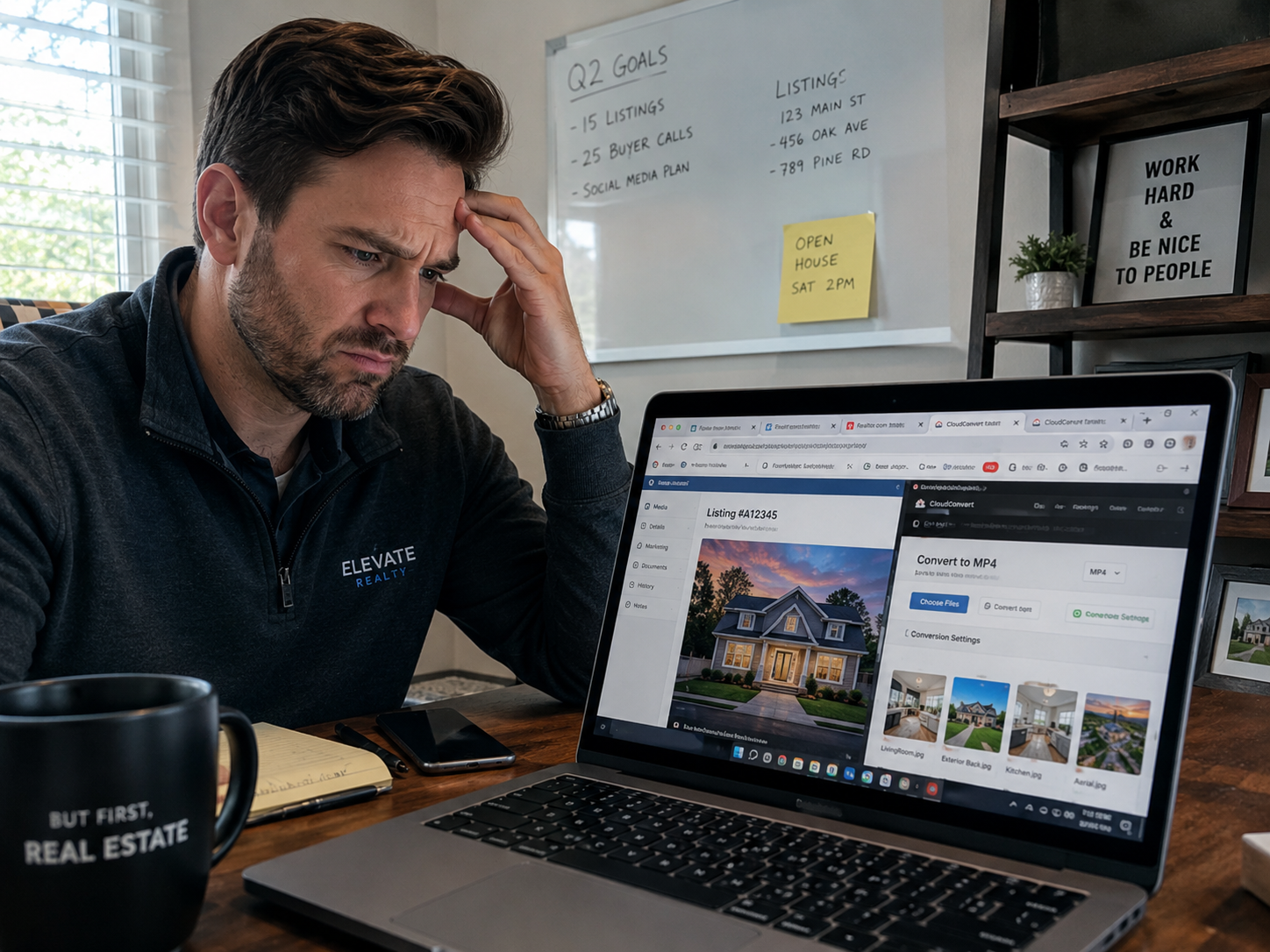
The frustrating part is that this usually happens at a bad time — right when business is picking up and there's the least spare time to research alternatives. This is often the moment someone searches for an AI real estate video software comparison specifically comparing paid options, having finally hit the ceiling of what free could offer.
PhotoAIVideo is built around the assumption that professional real estate marketing shouldn't come with someone else's watermark on it, or with export limitations that force a workaround. Every video carries your brand — your logo, your contact information, your colors — not a placeholder for an upgrade prompt. Multi-format exports are included from the start, so there's no moment where you discover a format you need is locked behind a higher tier mid-listing.
The more useful way to think about the decision isn't "free versus paid" in the abstract — it's whether the time and professionalism you're currently trading for a free tool is actually worth more than a modest subscription cost. For most agents doing more than a handful of listings a month, the math tends to favor paying for something built specifically for the job, rather than free software that's either capped or generic.
Step 4 is the one people underestimate most. A free tool with no real estate context doesn't know what it doesn't know, and that risk sits entirely with you, not the software.
If you're weighing an AI listing video software alternative against a free option you've been using, this is the honest version of that comparison — not features on a spec sheet, but what each option actually costs you once time and perception are counted.

A brand-new agent with almost no marketing budget. A free tool can genuinely make sense here short-term, as long as the watermark tradeoff is a conscious decision rather than an unnoticed one.
An agent doing 15–20 listings a year who's outgrown free limitations. This is usually the point where the time cost of workarounds exceeds a modest subscription price, even on a tight budget.
A photographer offering video as an add-on service to clients. A watermarked or generic-looking video reflects on the photographer's business, not just the agent's — professional branding here isn't optional if video is being sold as a paid upsell.
A brokerage considering free tools to cut costs across many agents. The math changes dramatically at scale — a small per-agent inefficiency multiplied across a whole office adds up to real lost time and inconsistent branding.
An agent who occasionally needs video for a higher-end listing. Free tools' limitations tend to show up most obviously on listings where perceived quality matters most — exactly the wrong place to have a watermark or capped export.
Not noticing your own tool's watermark or limitations until a client points it out. Review your own recent videos with fresh eyes occasionally, the way a prospective client would see them for the first time.
Assuming free tools save money just because there's no subscription bill. Time spent on workarounds and manual compliance checks has a real cost, even if it doesn't show up on a statement.
Sticking with a free tool purely out of inertia once volume increases. The tool that made sense at five listings a year may be actively costing you more than it saves at thirty.
Ignoring compliance risk because a free tool "just generates text." Auto-generated captions with no real estate context can occasionally use language that creates advertising compliance risk — that risk is yours, not the app's.
Switching to a paid tool without checking what free features you'll actually miss. Not every paid upgrade is worth it — confirm the paid tier actually solves your specific limitation before committing.
Are free real estate video apps actually free?
Not in practice — most include a watermark, limited export options, or force extra manual work, all of which carry a real cost even without a subscription fee.
When does it make sense to use a free real estate video tool?
At very low listing volume, or when just starting out with limited budget — the tradeoffs matter less when you're only producing a handful of videos a year.
What's the biggest risk with free, general-purpose video tools for real estate?
Lack of compliance awareness — these tools have no real estate advertising context, so any risky language in auto-generated captions is entirely on you to catch.
How do I know if I've outgrown a free video tool?
If you're spending noticeable time working around export limits, manually fixing branding, or checking captions for compliance issues, the time cost has likely exceeded what a modest paid subscription would cost.
Do clients actually notice watermarks on real estate videos?
Often yes, even if they don't say so directly — a watermark reads as a signal of an unfinished or budget-constrained marketing effort, which isn't the impression most agents want to give.
Is it worth paying for real estate video automation software instead of using a free general tool?
For most agents doing regular listings, yes — the combination of built-in branding, real estate-aware defaults, and time saved on workarounds tends to outweigh a modest subscription cost.
What should I compare beyond price when weighing free versus paid real estate video apps?
Branding control, export flexibility, and compliance awareness — these three factors usually account for more real-world cost difference than the subscription price itself.


Compact, ready to go anywhere
Interchangeable lens that’s upgradeable
Dual 1-inch sensors for improved clarity and low light performance
Dynamic range and 6K 360° capture
360° photo resolution at 21MP

8K 360° video recording for ultra-detailed visuals.
4K single-lens mode for traditional wide-angle shots.
Invisible selfie stick effect for drone-like perspectives.
2.5-inch touchscreen with Gorilla Glass protection.
Waterproof up to 33ft for underwater shooting.

360° photo resolution in 23MP
Slim design at 24 mm thick
Built-in image stabilization for smooth video capture.
Internal 19GB storage for photo and video storage.
Wireless connectivity for remote control and sharing.

60MP 360° still images for high-resolution photography.
5.7K 360° video recording at 30fps.
2.25-inch touchscreen for intuitive control.
USB Type-C port for fast charging and data transfer.
MicroSD card slot for expandable storage.
.png)

.png)

Try it free. No credit card required. Instant set-up.






.svg)


.svg)