Multi-Sensor Egocentric Capture: Syncing Camera, IMU, and Eye Tracking

Cloudpano
August 2, 2026
5 min read
Share this post

Multi-Sensor Egocentric Capture: Syncing Camera, IMU, and Eye Tracking

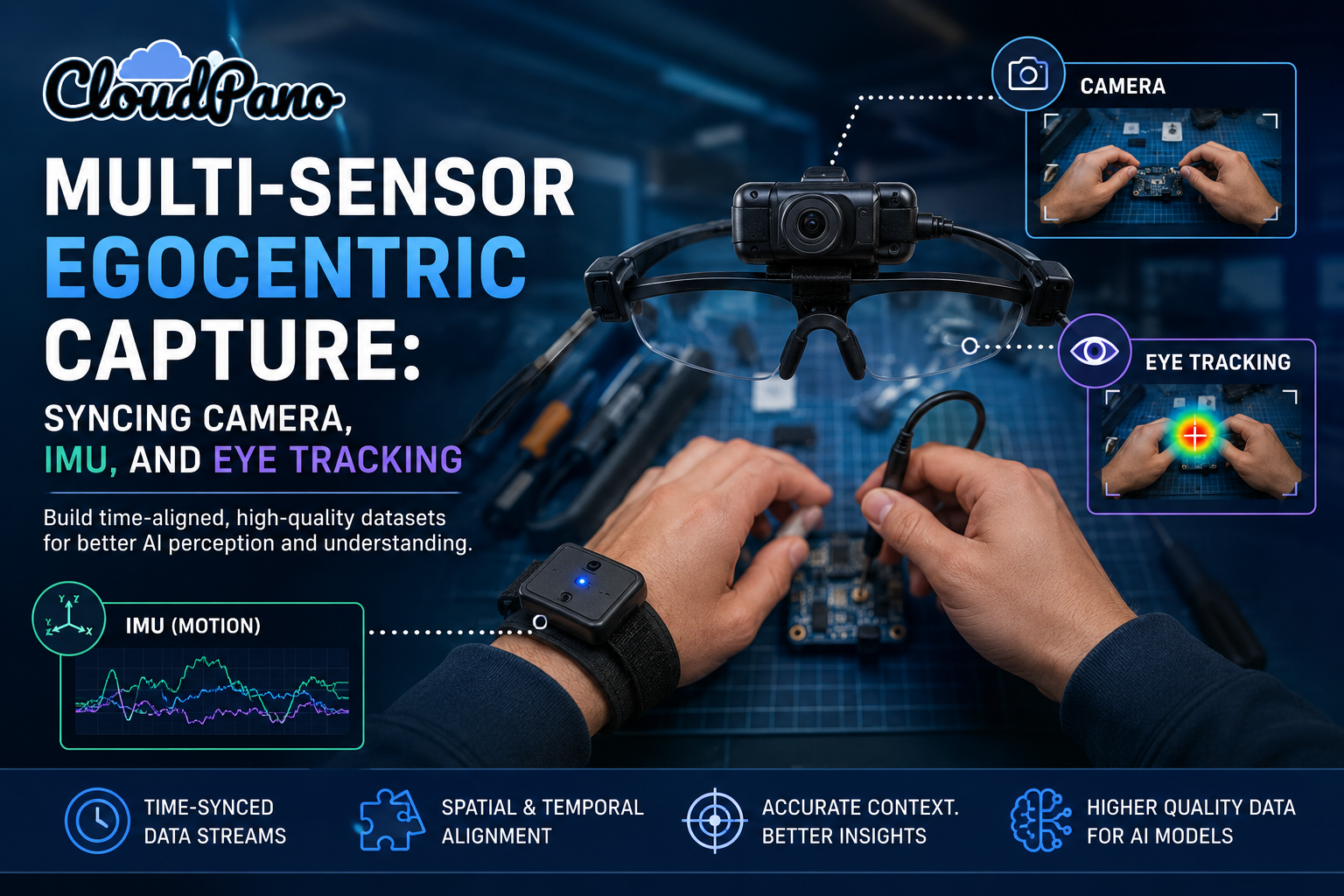
A camera alone tells you what was visible. It doesn't tell you where the wearer was actually looking within that frame, or how their head and body were moving at that exact moment. Multi-sensor egocentric capture adds IMU motion data and eye tracking specifically to fill those gaps, but combining multiple sensor streams introduces a genuinely different challenge than collecting video alone.

Wearable Sensor Fusion isn't primarily a data collection problem — each individual sensor is usually straightforward to capture on its own. The real challenge is synchronization and integration: making sure camera frames, IMU readings, and gaze data actually correspond to the same instant and can be meaningfully combined into one usable dataset.
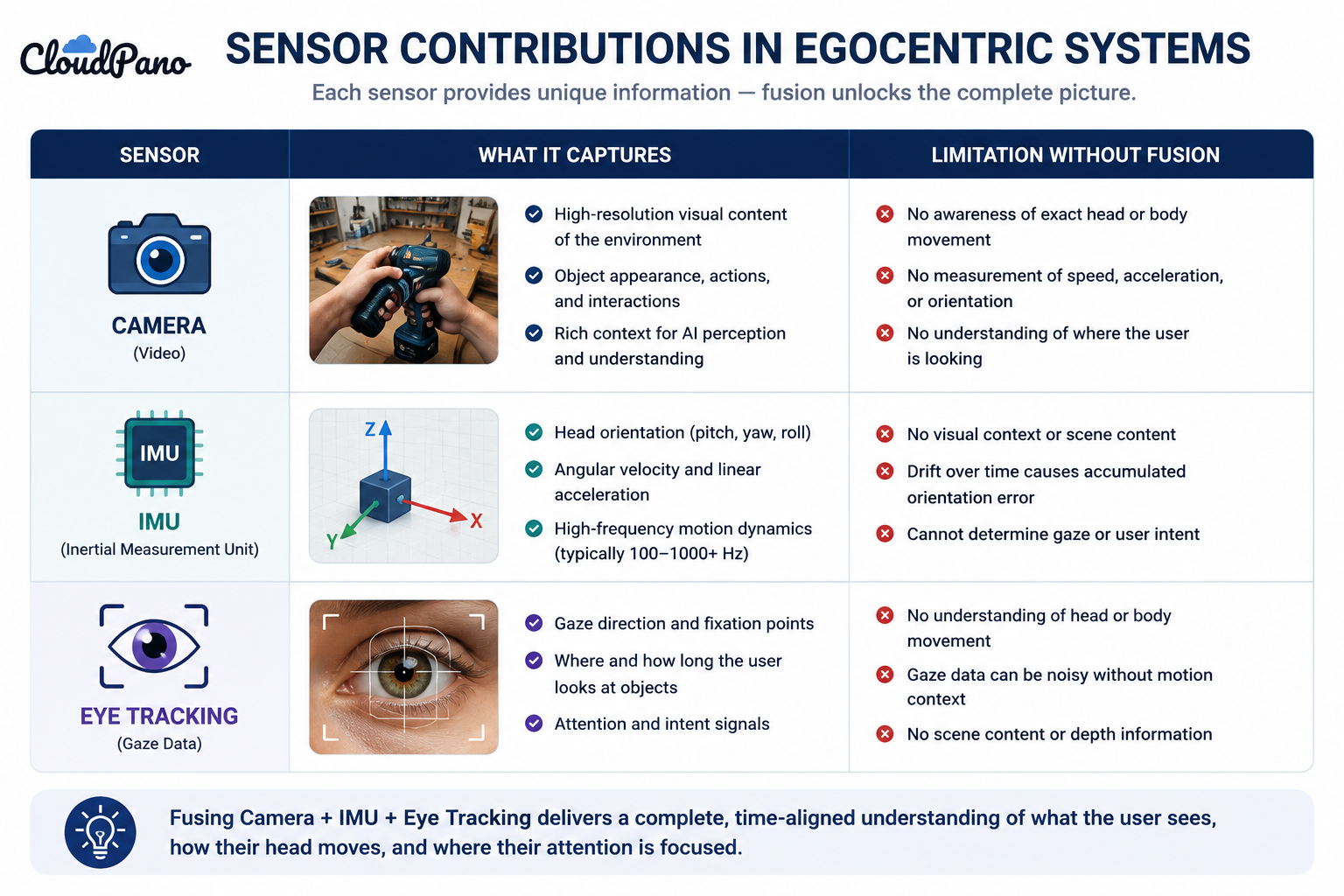
Comparison table of what camera, IMU, and eye tracking sensors add to egocentric capture

Why It Matters

Sensor streams that are each individually accurate but not properly synchronized with each other produce a dataset that looks complete while actually misrepresenting the relationship between what was seen, where attention was directed, and how the body was moving. Google Research's "Data Cascades" study documented how such subtle misalignment compounds into larger, harder-to-diagnose problems once a model has been trained on inconsistent multi-stream data (Sambasivan et al., Google Research).

NIST's AI Risk Management Framework treats data fitness for the intended task as foundational to trustworthy AI, directly relevant to First-Person Eye Tracking Data needing accurate temporal alignment with camera frames, since gaze information disconnected from the correct visual context provides limited or even misleading signal (NIST AI RMF).

The stakes rise as research increasingly relies on multimodal egocentric data. Stanford HAI's AI Index has tracked growing interest in multimodal AI systems that combine visual, motion, and attention signals (Stanford HAI, AI Index Report), and synchronization errors at that scale can quietly undermine the added value multiple sensors were meant to provide.

How It Works

IMU Camera Synchronization and broader multi-sensor egocentric capture generally address a few specific technical challenges.

Diagram of camera, IMU, and eye tracking streams aligning into a fused egocentric dataset

Establishing a common timing reference. Camera, IMU, and eye tracking hardware typically run on independent internal clocks, requiring a shared timing reference so data from each stream can be aligned to the same instant.

Matching sample rates across sensors. Cameras, IMUs, and eye trackers often capture data at different native frequencies, requiring a deliberate approach to align or resample streams that don't naturally match up frame-for-frame.

Spatial alignment between sensor coordinate frames. Beyond timing, each sensor may have its own spatial reference, requiring calibration so gaze direction, motion data, and camera frame content can be meaningfully related to each other.

Validating fused data for genuine coherence. Confirming that the combined dataset actually represents accurate correspondence between streams, not just that each stream individually looks reasonable in isolation.

Understanding how these workflows operate as a synchronization and fusion problem — not simply "collect more sensor types" — is what actually determines whether multi-sensor data delivers the added value it's meant to provide.
Step-by-Step Workflow

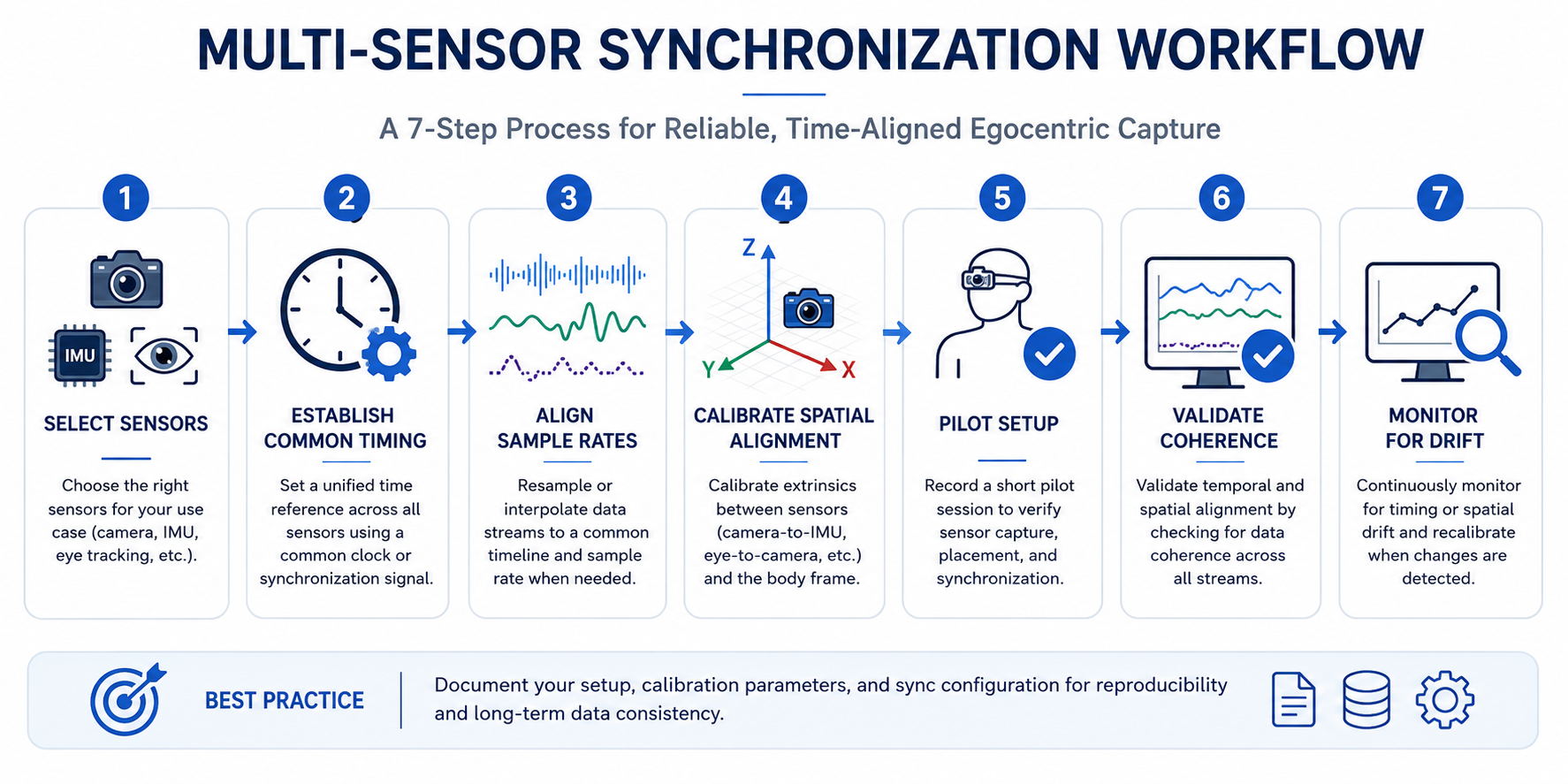
Flowchart of the multi-sensor egocentric capture synchronization and validation workflow
  1. Select sensors matched to the specific information gaps video alone leaves. Add IMU data if motion detail is missing, eye tracking if gaze information is needed, based on actual task requirements.
  2. Establish a common timing reference across all sensor hardware. Confirm each device's data can be aligned to a shared clock before collection begins.
  3. Determine how to handle differing native sample rates. Decide on an alignment or resampling approach for sensors that capture data at different frequencies.
  4. Calibrate spatial alignment between sensor coordinate frames. Establish how gaze direction and motion data relate spatially to what the camera captures.
  5. Pilot the full multi-sensor setup before scaling collection. Confirm synchronization and fusion actually work in practice on a small sample first.
  6. Validate fused data for genuine cross-stream coherence. Check that combined data represents accurate correspondence, not just individually plausible streams.
  7. Monitor synchronization throughout extended collection sessions. Confirm alignment holds over time, since drift in one sensor stream can desynchronize the fused dataset.

Industry Use Cases

  • Computer vision / robotics: Eye tracking combined with hand-object interaction video supports understanding not just what a demonstrator did, but where their attention was directed during the task.
  • Healthcare AI: Multi-sensor capture supports detailed clinical or rehabilitation analysis where motion data and gaze information both add clinically relevant detail beyond video alone.
  • Manufacturing AI: IMU data combined with video supports understanding of precise body movement during assembly or inspection tasks, useful for ergonomic and process analysis.
  • Government & defense: Multi-sensor systems in this sector often combine standard fusion challenges with additional security and access considerations for the resulting data.
  • Retail AI: Limited direct application here, since most retail egocentric use cases don't require the precision multi-sensor fusion is built to support.
  • Autonomous vehicles: This specific wearable multi-sensor context has limited direct application, since vehicle sensor fusion follows a different set of synchronization considerations.

Benefits

  • Richer, more informative training data. Combining video, motion, and gaze data captures information no single sensor provides on its own.
  • Better support for attention-aware or motion-precise tasks. Tasks that depend on understanding where someone looked, or exactly how they moved, genuinely benefit from properly fused multi-sensor data.
  • More accurate downstream modeling. Correctly synchronized data gives a model a genuinely coherent signal to learn from, rather than streams that only appear related.
  • Reduced risk of subtle, hard-to-diagnose training issues. Validating cross-stream coherence catches synchronization problems before they're baked into a trained model's behavior.
  • A stronger foundation for multimodal research and applications. Well-fused multi-sensor egocentric data supports more sophisticated modeling approaches than video alone can.

Common Mistakes

  • Adding sensors without a synchronization plan. Collecting multiple data streams independently without establishing how they'll actually be aligned in time.
  • Assuming sensors with different native sample rates align automatically. Missing that cameras, IMUs, and eye trackers often need deliberate resampling or alignment rather than naive frame-for-frame matching.
  • Skipping spatial calibration between sensor coordinate frames. Treating gaze or motion data as automatically compatible with camera frame content without establishing the actual spatial relationship.
  • Not validating fused data for cross-stream coherence. Assuming individually reasonable-looking streams mean the combined dataset is actually accurate.
  • Ignoring synchronization drift over extended sessions. Assuming initial alignment holds throughout a long recording without monitoring for drift between sensors.
  • Treating multi-sensor capture as simply "more data." Missing that the actual value depends on accurate fusion, not just the presence of additional sensor streams.

Best Practices

  • Select additional sensors based on specific information gaps your task actually needs filled, not simply because more sensors seem better.
  • Establish a common timing reference across all hardware before collection begins.
  • Plan explicitly for how differing native sample rates will be aligned or resampled.
  • Calibrate spatial alignment between sensor coordinate frames as a distinct step from timing synchronization.
  • Validate fused data for genuine cross-stream coherence, not just individual stream plausibility.
  • Monitor for synchronization drift throughout extended recording sessions, not just at initial setup.

FAQ

What does multi-sensor egocentric capture actually combine?

Typically video from a wearable camera along with additional streams like IMU motion data and eye tracking gaze data, each adding information a camera alone can't provide.

Why is synchronization the main challenge in wearable sensor fusion?

Because each sensor is usually straightforward to capture individually; the difficulty is establishing a common timing reference and spatial alignment so the different streams actually correspond to the same moment and context.

How does IMU camera synchronization typically work?

By establishing a shared timing reference across both devices and addressing differences in their native sample rates, so motion data and video frames can be reliably aligned to the same instants.

Why does first-person eye tracking data need to be aligned with camera frames?

Because gaze direction only provides useful signal when it's correctly matched to the specific visual content the wearer was looking at in that same instant; misaligned data can misrepresent what attention was actually directed toward.

Can sensors with different sample rates be combined accurately?

Yes, but it requires a deliberate resampling or alignment approach rather than assuming the different-frequency streams naturally correspond frame-for-frame.

How do you validate that multi-sensor data is properly fused?

By checking for genuine cross-stream coherence — confirming the combined dataset accurately represents the relationship between streams — rather than assuming each individually reasonable-looking stream means the fusion is correct.

Does adding more sensors always improve an egocentric dataset?

Only if the additional streams are properly synchronized and fused; poorly integrated sensor data can add complexity without adding genuine value, or worse, introduce subtle inaccuracies.

Conclusion

Multi-sensor egocentric capture delivers real value when camera, IMU, and eye tracking data are properly synchronized and fused, not simply collected in parallel. The core challenge is establishing common timing references, handling differing sample rates, calibrating spatial alignment, and validating that the combined dataset genuinely coheres across streams. Getting this right is what turns multiple sensors into a richer, more informative dataset rather than a set of individually accurate but disconnected recordings.

🚀 Your All‑In‑One Virtual Experience Stack
🎬
PhotoAIVideo
Turn photos into scroll‑stopping AI videos.
Get Started →
🏡
Pictastic
Instantly stage listings with AI.
Try Staging →
🌀
CloudPano
Create stunning 360° tours in minutes.
Launch Tour →
💰
VirtualTourProfit
Build a profitable virtual tour business.
Learn More →
🤝
CloudPano Reseller
Resell AI visual software without building it.
Become a Reseller →
🚗
Auto CloudPano
Sell more vehicles with 360° experiences.
Explore Auto →
🏗️
AI Floor Plan Builder
Generate detailed floor plans with AI.
Build Now →
📐
3D Measure
Capture accurate floor plans & 3D measurements.
Measure Now →
🧠
AI Training Data
Custom AI training data services.
Learn More →
Share this post
Cloudpano

Choose The Right 360° Camera

Insta360 ONE RS 1-Inch 360 Edition

  • Compact, ready to go anywhere

  • Interchangeable lens that’s upgradeable

  • Dual 1-inch sensors for improved clarity and low light performance

  • Dynamic range and 6K 360° capture

  • 360° photo resolution at 21MP

Learn More

Insta360 X4

  • 8K 360° video recording for ultra-detailed visuals.

  • 4K single-lens mode for traditional wide-angle shots.

  • Invisible selfie stick effect for drone-like perspectives.

  • 2.5-inch touchscreen with Gorilla Glass protection.

  • Waterproof up to 33ft for underwater shooting.

Learn More

Ricoh Theta Z1

  • 360° photo resolution in 23MP

  • Slim design at 24 mm thick

  • Built-in image stabilization for smooth video capture.

  • Internal 19GB storage for photo and video storage.

  • Wireless connectivity for remote control and sharing.

Learn More

Ricoh Theta X

  • 60MP 360° still images for high-resolution photography.

  • 5.7K 360° video recording at 30fps.

  • 2.25-inch touchscreen for intuitive control.

  • USB Type-C port for fast charging and data transfer.

  • MicroSD card slot for expandable storage.

Learn More
Property Marketing
Allows potential buyers to explore properties in detail from anywhere, enhancing the real estate marketing process.
Automotive Spins
Create an interactive virtual showroom and engage affluent digital buyers with live 360º video calls, all through the CloudPano mobile app for a complete automotive sales solution.
Interactive Floor Plans
Create 2D and 3D floor plans with measurements in 4 minutes or less, all from your phone. Download the Floor Plan Scanner app and get your first scan free.

360 Virtual Tours With CloudPano.com. Get Started Today.

Try it free. No credit card required. Instant set-up.

Try it free
Latest posts

See our other posts

Interviews, tips, guides, industry best practices, and news.

Egocentric Video Capture for Surgical and Clinical Training Data

Egocentric video for healthcare AI requires addressing sterile field compatibility, patient consent obligations distinct from general bystander privacy, and procedural framing that captures clinically relevant detail without compromising the sterile environment. These clinical-specific constraints go beyond general egocentric capture practices and require dedicated planning for surgical or clinical settings.
Read post

Consent and Bystander Privacy in Egocentric Video Collection

Egocentric video privacy requires addressing not just the wearer's consent but the reality that a body-worn camera will likely capture bystanders who never agreed to be recorded. Responsible collection requires explicit planning for bystander notice, footage handling, and de-identification, built into the study design rather than addressed only if a concern arises later.
Read post

Multi-Sensor Egocentric Capture: Syncing Camera, IMU, and Eye Tracking

Multi-sensor egocentric capture combines video with additional data streams like IMU motion data and eye tracking, each adding information a single camera can't provide on its own. The core challenge isn't collecting each stream — it's synchronizing and fusing them accurately enough that a model can use them together as one coherent dataset.
Read post