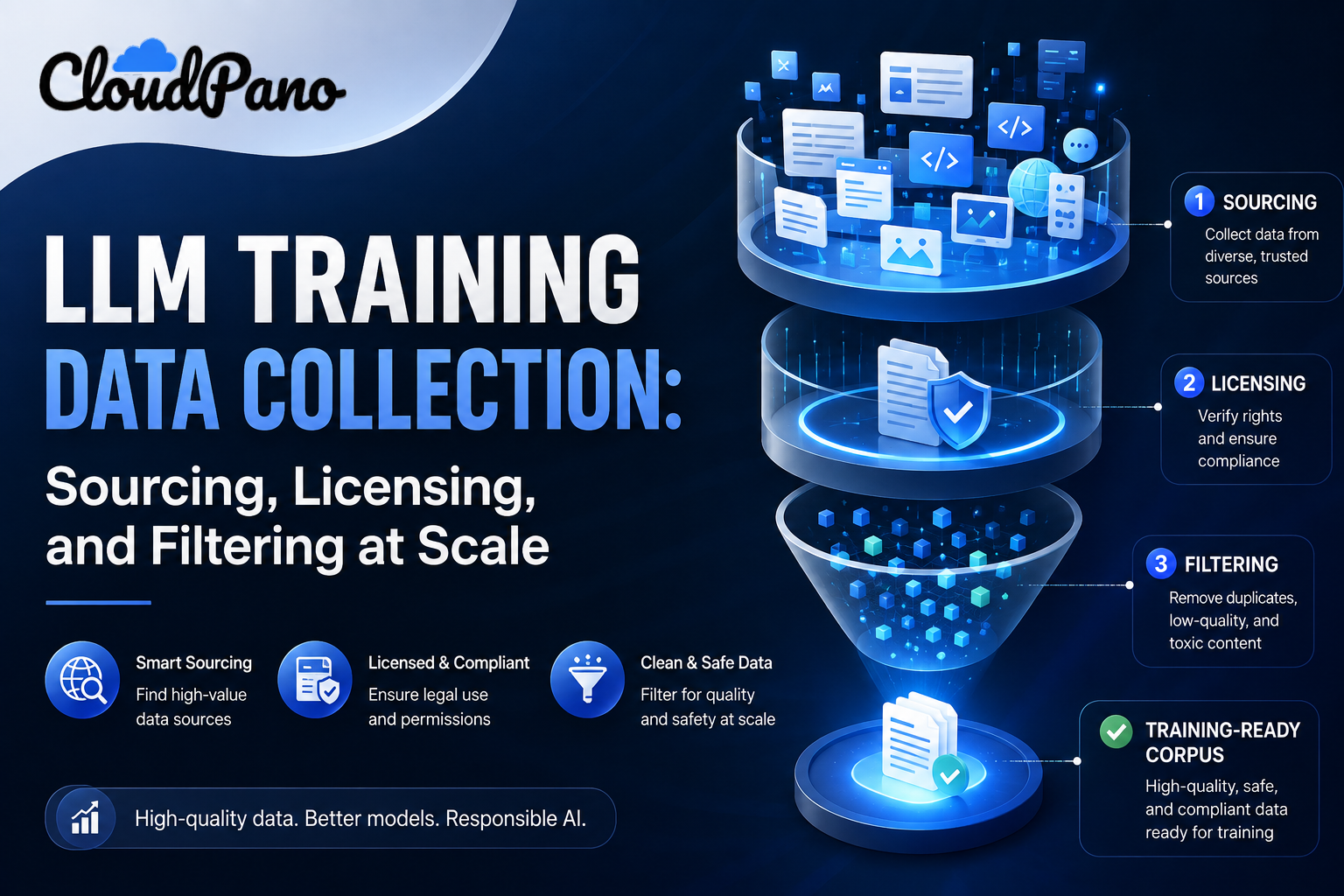
LLM Training Data Collection: Sourcing, Licensing, and Filtering at Scale

Cloudpano
August 1, 2026
5 min read
Share this post

LLM Training Data Collection: Sourcing, Licensing, and Filtering at Scale

Assembling a text corpus for language model pretraining looks, from a distance, like a bulk collection problem — get enough text, point a training run at it. LLM training data collection at any serious scale is a lot more than that: sourcing decisions carry real legal exposure, raw web text is full of near-duplicate content that wastes training compute, and unfiltered text carries quality and safety problems a model will otherwise learn to replicate.

Text Corpus Collection for a production-grade model typically moves through several distinct stages, each addressing a specific risk that simply gathering more text doesn't resolve on its own.

Why It Matters

Corpus quality issues introduced during collection don't stay contained to that stage — they surface later as licensing disputes, wasted training runs on redundant content, or a model that's learned patterns from low-quality or harmful source material. Google Research's "Data Cascades" study documented how data problems that seem minor at the collection stage compound into much larger, harder-to-diagnose issues as they propagate through a training pipeline (Sambasivan et al., Google Research).

NIST's AI Risk Management Framework treats data provenance — knowing where training data came from and under what rights — as foundational to trustworthy AI, directly relevant to AI Text Data Sourcing decisions that determine what legal exposure a model's training data actually carries (NIST AI RMF).

The stakes rise given how central large-scale pretraining has become to modern AI development. Stanford HAI's AI Index has tracked the growing scale and resource intensity of large language model training (Stanford HAI, AI Index Report), and a corpus quality issue discovered after a large, expensive training run is far more costly to correct than one caught during collection.

How It Works

LLM training data collection at scale generally moves through four distinct stages.

Diagram of the four-stage LLM training data collection pipeline

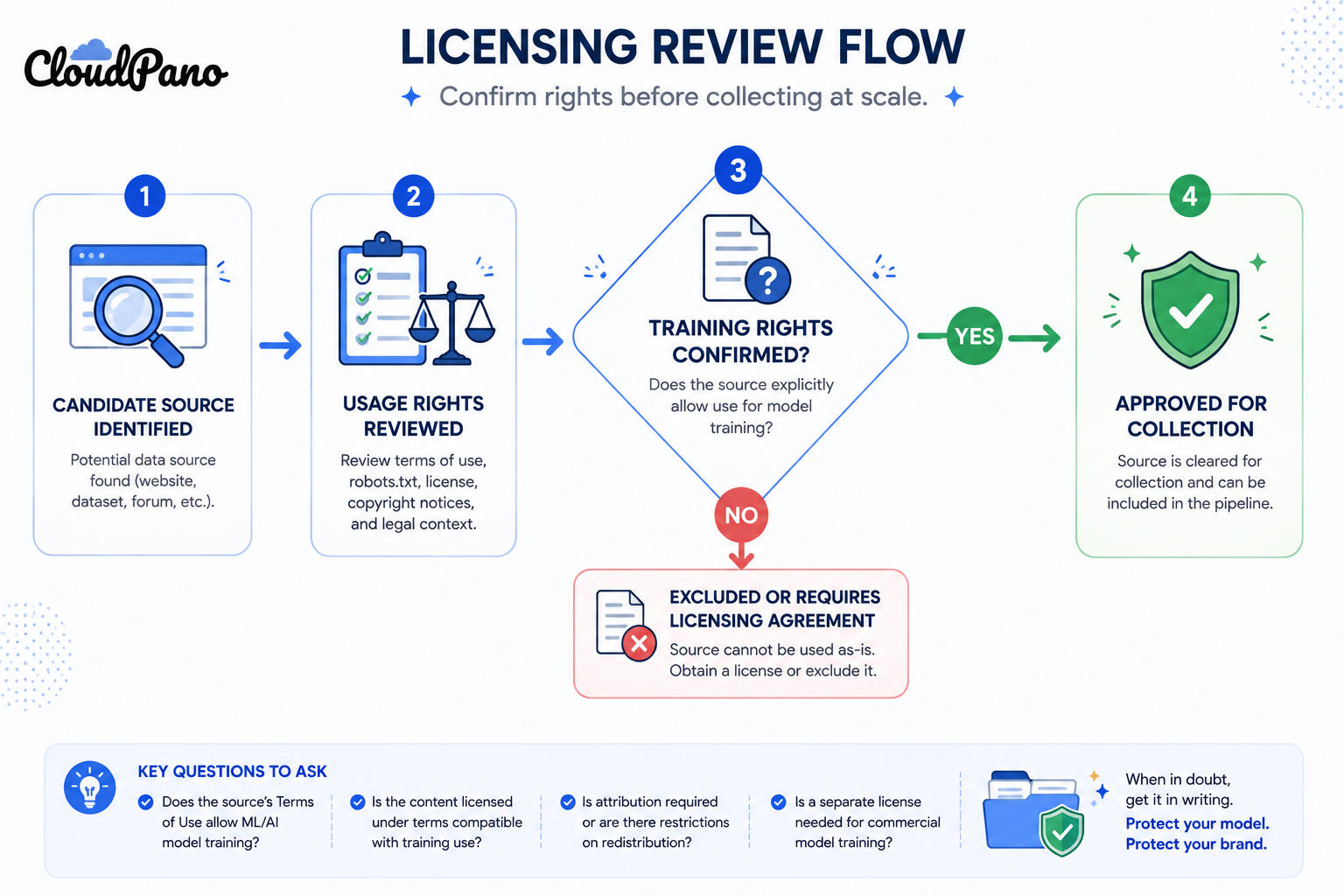
Sourcing and licensing. Identifying text sources — web content, licensed datasets, publisher partnerships — and confirming the specific usage rights each source actually grants for training purposes, since not all publicly available text carries clear training rights.

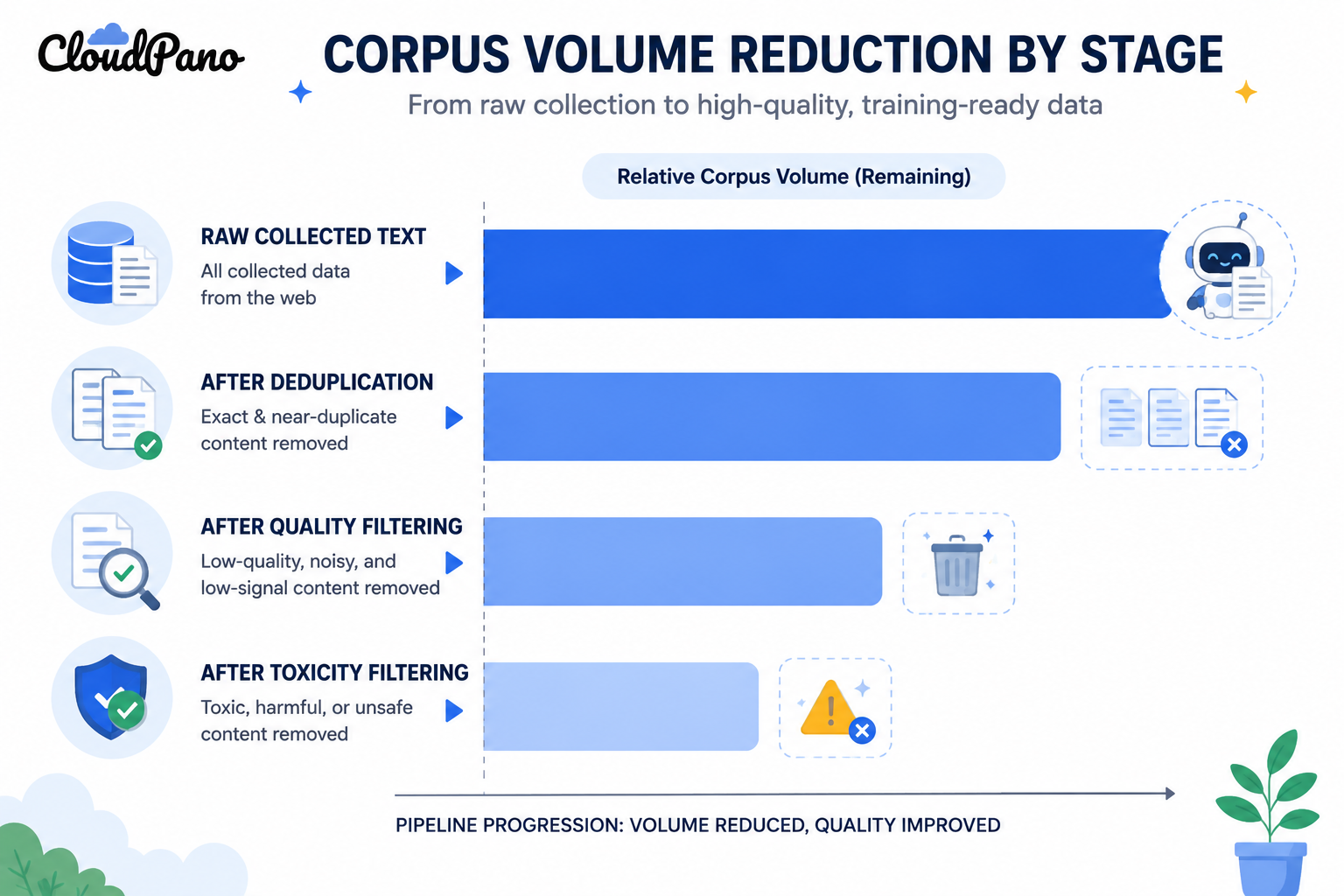
Deduplication. Web-scale text collection produces enormous amounts of duplicate and near-duplicate content; deduplication removes this redundancy, since training on the same content repeatedly wastes compute without adding useful signal.

Quality filtering. Removing low-quality content — spam, boilerplate, poorly formatted text — that doesn't contribute useful patterns for a model to learn from.

Toxicity and harmful content filtering. Screening out content that would teach a model harmful patterns, a distinct filtering pass from general quality filtering, since low-quality and harmful aren't the same category.
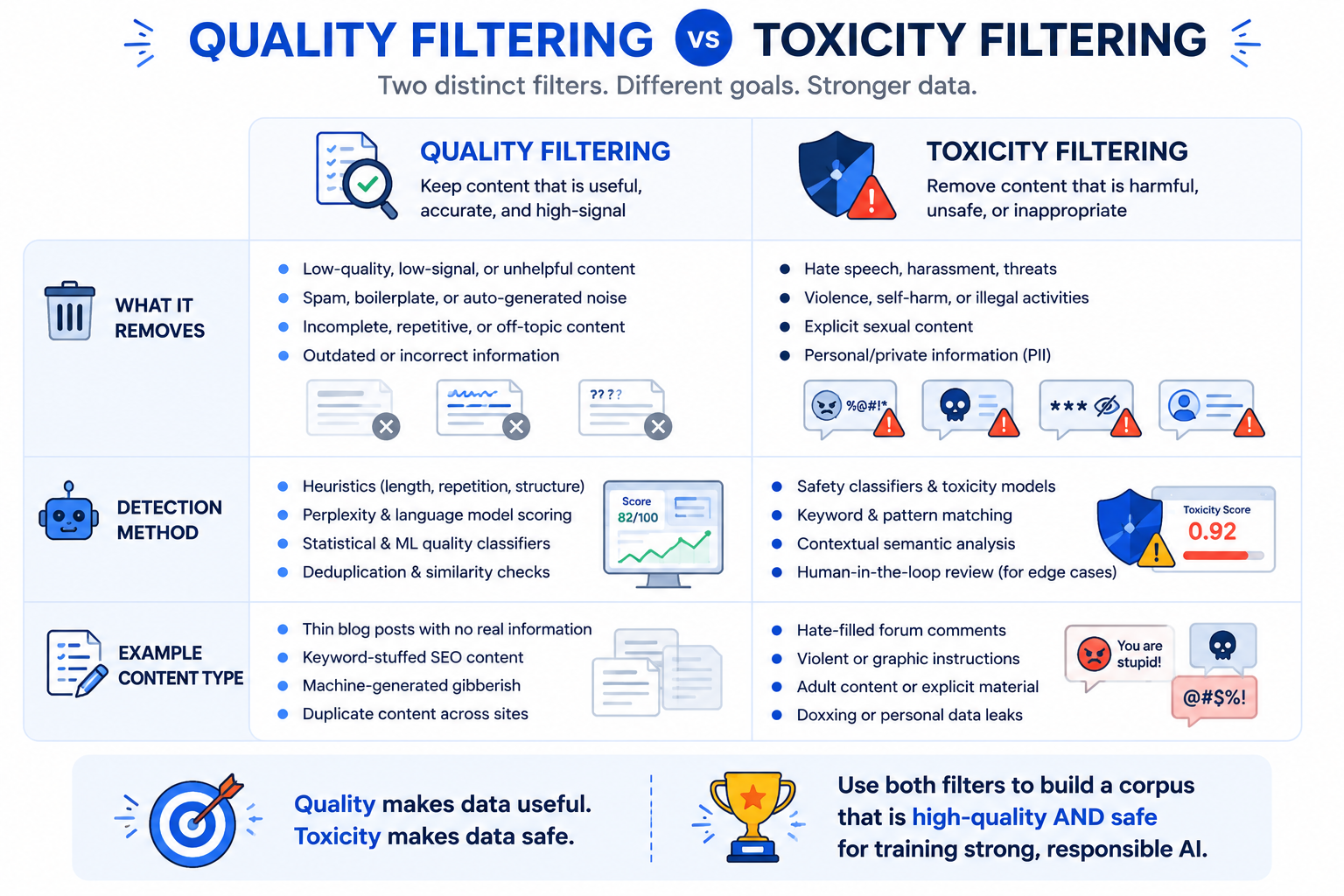
Comparison table of quality filtering vs toxicity filtering in LLM data collection

Understanding how these workflows operate as four genuinely distinct stages — not one undifferentiated "data collection" step — is what separates a properly scoped corpus-building project from one that treats licensing, deduplication, and filtering as an afterthought.
Step-by-Step Workflow

  • Define your sourcing strategy and licensing requirements upfront. Identify which sources you'll use and confirm training-rights clarity before large-scale collection begins.
Flowchart for licensing review before large-scale LLM training data collection
  • Collect text at scale from your defined sources. Web scraping, licensed dataset acquisition, or direct publisher partnerships, depending on your sourcing strategy.
  • Run deduplication across the full collected corpus. Identify and remove exact and near-duplicate content to avoid wasting training compute on redundant text.
  • Apply quality filtering to remove low-value content. Screen out spam, boilerplate, and poorly formatted text that doesn't contribute useful training signal.
  • Apply toxicity and harmful content filtering as a distinct pass. Screen specifically for harmful patterns, separate from general quality filtering criteria.
  • Document provenance and licensing status for the final corpus. Maintain a clear record of where each portion of the corpus came from and under what rights.
  • Validate the final corpus against your training objectives. Confirm the filtered, deduplicated corpus still provides sufficient volume and diversity for your specific pretraining goals.

Industry Use Cases

  • LLM developers: Corpus collection at this scale is foundational to pretraining any general-purpose or domain-specific language model.
  • Healthcare AI: Domain-specific corpus collection for clinical language models requires particular attention to licensing for medical literature and patient data privacy considerations.
  • Retail AI: Building a domain-specific corpus for retail or e-commerce language applications often relies more heavily on licensed or first-party data than general web scraping.
  • Government & defense: Corpus collection in this sector often requires strict provenance documentation and security handling well beyond standard licensing considerations.
  • Computer vision / robotics: Text corpus collection is generally less directly relevant here, though some multimodal projects require paired text data collected under similar sourcing and licensing discipline.
  • Autonomous vehicles: Similarly, large-scale text corpus collection has limited direct application in this industry compared to its central role in LLM development.

Benefits

Bar chart showing relative corpus volume reduction across LLM data collection stages
  • Reduced legal exposure. Clear sourcing and licensing documentation reduces the risk of disputes over how training data was obtained and used.
  • More efficient use of training compute. Deduplication prevents wasted training cycles on redundant content, improving the effective value of a fixed compute budget.
  • Better model behavior from cleaner input. Quality and toxicity filtering reduce the chance a model learns from low-value or harmful source material.
  • A defensible development record. Documented provenance and filtering criteria support accountability if a model's training data composition is later questioned.
  • More predictable corpus quality across projects. A structured, repeatable collection process produces more consistent results than an ad hoc, one-off scraping effort.

Common Mistakes

  • Treating corpus collection as a single undifferentiated step. Missing that sourcing, deduplication, and filtering each address a distinct risk requiring its own attention.
  • Skipping licensing review before large-scale collection. Assuming publicly accessible text automatically carries clear rights for training use.
  • Underestimating deduplication needs at web scale. Assuming raw collected text is sufficiently diverse without checking for redundant or near-duplicate content.
  • Applying only general quality filtering, without a distinct toxicity pass. Missing that harmful content and low-quality content require different filtering criteria and detection methods.
  • Not documenting provenance during collection. Losing track of where specific portions of a corpus came from, making later governance or legal review far more difficult.
  • Not validating the final corpus against training objectives. Assuming filtering and deduplication automatically leave a corpus well-suited to the specific pretraining goal, without checking volume and diversity.

Best Practices

  • Define sourcing strategy and licensing requirements before large-scale collection begins, not after.
  • Treat deduplication as a necessary, substantial stage for any web-scale text collection, not an optional cleanup step.
  • Apply quality filtering and toxicity filtering as distinct passes with their own specific criteria.
  • Document provenance and licensing status throughout collection, not as an afterthought once the corpus is assembled.
  • Validate the final corpus against your specific training objectives before committing to a full pretraining run.
  • Revisit sourcing and filtering criteria periodically as legal, quality, and safety standards evolve.

FAQ

What does LLM training data collection actually involve?

Sourcing text from web content, licensed datasets, or partnerships; confirming usage rights; deduplicating redundant content; and filtering for quality and harmful material before the corpus is used for pretraining.

Why does deduplication matter for large-scale text corpus collection?

Because web-scale collection produces enormous amounts of duplicate and near-duplicate content, and training on redundant text wastes compute without adding useful learning signal.

What's the difference between quality filtering and toxicity filtering?

Quality filtering removes low-value content like spam or boilerplate text, while toxicity filtering specifically screens for harmful content patterns; the two require different detection criteria and shouldn't be treated as the same pass.

Do all publicly available text sources carry clear rights for AI training use?

No. Public accessibility doesn't automatically imply training rights, which is why licensing review is a necessary step in AI text data sourcing before large-scale collection.

How is corpus collection for pretraining different from fine-tuning data collection?

Pretraining corpus collection typically involves much larger volumes of general text with an emphasis on sourcing, deduplication, and broad filtering, while fine-tuning data collection is usually smaller-scale and more narrowly targeted to a specific task or behavior.

How much of a collected text corpus typically gets removed during filtering?

This varies significantly by source quality and filtering criteria, so it's best assessed on a project-specific basis rather than assumed as a fixed proportion.

Why does provenance documentation matter for a training corpus?

Because it supports legal and governance accountability, making it possible to explain where training data came from and under what rights if a model's training composition is ever questioned.

Conclusion

LLM training data collection at scale is a substantial body of work in its own right — sourcing and licensing, deduplication, and distinct quality and toxicity filtering passes each address a specific risk that simply gathering more text doesn't resolve. Scoping a corpus-building project with these four stages in mind, rather than treating collection as a single bulk step, is what produces a corpus a team can actually train on with confidence.

🚀 Your All‑In‑One Virtual Experience Stack
🎬
PhotoAIVideo
Turn photos into scroll‑stopping AI videos.
Get Started →
🏡
Pictastic
Instantly stage listings with AI.
Try Staging →
🌀
CloudPano
Create stunning 360° tours in minutes.
Launch Tour →
💰
VirtualTourProfit
Build a profitable virtual tour business.
Learn More →
🤝
CloudPano Reseller
Resell AI visual software without building it.
Become a Reseller →
🚗
Auto CloudPano
Sell more vehicles with 360° experiences.
Explore Auto →
🏗️
AI Floor Plan Builder
Generate detailed floor plans with AI.
Build Now →
📐
3D Measure
Capture accurate floor plans & 3D measurements.
Measure Now →
🧠
AI Training Data
Custom AI training data services.
Learn More →
Share this post
Cloudpano

Choose The Right 360° Camera

Insta360 ONE RS 1-Inch 360 Edition

  • Compact, ready to go anywhere

  • Interchangeable lens that’s upgradeable

  • Dual 1-inch sensors for improved clarity and low light performance

  • Dynamic range and 6K 360° capture

  • 360° photo resolution at 21MP

Learn More

Insta360 X4

  • 8K 360° video recording for ultra-detailed visuals.

  • 4K single-lens mode for traditional wide-angle shots.

  • Invisible selfie stick effect for drone-like perspectives.

  • 2.5-inch touchscreen with Gorilla Glass protection.

  • Waterproof up to 33ft for underwater shooting.

Learn More

Ricoh Theta Z1

  • 360° photo resolution in 23MP

  • Slim design at 24 mm thick

  • Built-in image stabilization for smooth video capture.

  • Internal 19GB storage for photo and video storage.

  • Wireless connectivity for remote control and sharing.

Learn More

Ricoh Theta X

  • 60MP 360° still images for high-resolution photography.

  • 5.7K 360° video recording at 30fps.

  • 2.25-inch touchscreen for intuitive control.

  • USB Type-C port for fast charging and data transfer.

  • MicroSD card slot for expandable storage.

Learn More
Property Marketing
Allows potential buyers to explore properties in detail from anywhere, enhancing the real estate marketing process.
Automotive Spins
Create an interactive virtual showroom and engage affluent digital buyers with live 360º video calls, all through the CloudPano mobile app for a complete automotive sales solution.
Interactive Floor Plans
Create 2D and 3D floor plans with measurements in 4 minutes or less, all from your phone. Download the Floor Plan Scanner app and get your first scan free.

360 Virtual Tours With CloudPano.com. Get Started Today.

Try it free. No credit card required. Instant set-up.

Try it free
Latest posts

See our other posts

Interviews, tips, guides, industry best practices, and news.

Video Annotation Services: Tracking, Temporal Events, and Frame Sampling

Video annotation services apply labels across sequences of frames, not just individual images — tracking a consistent object identity over time, marking temporal event boundaries, and recognizing actions across a sequence. This requires different tooling and quality assurance than static image annotation, since consistency across frames is the core added challenge.
Read post

LLM Training Data Collection: Sourcing, Licensing, and Filtering at Scale

LLM training data collection involves sourcing large volumes of text, confirming usage rights, removing duplicate or near-duplicate content, and filtering for quality and harmful material before the data is usable for pretraining. Each stage addresses a specific risk — legal exposure, wasted training compute, or degraded model behavior — that raw text collection alone doesn't solve.
Read post

How to Ensure Annotation Consistency Across Large CV Datasets

Annotation consistency computer vision teams achieve at scale relies on measurable methods — IoU-based overlap scoring to compare annotator boundaries, gold-standard test sets for calibration, and ongoing agreement tracking across the full annotator pool. Consistency isn't a matter of trusting good annotators; it's a matter of measuring and correcting drift continuously.
Read post