


.png)


Most people picture computer vision annotation services as drawing boxes around objects in photos. That's one technique among several, and it's often not the right one for what a specific model actually needs to learn — the real scoping question is which spatial technique matches your model's task, not whether annotation happens at all.
Image annotation services cover a range of techniques with real differences in cost, time, and what they teach a model. Getting this distinction right before a project starts avoids the common mismatch of paying for more annotation detail than a task requires, or discovering mid-project that a simpler technique won't support what the model actually needs to do.
Choosing the wrong annotation technique for a computer vision task doesn't fail obviously — it produces a dataset that trains a model to detect the wrong level of detail, discovered only once the model underperforms on its actual deployment task. Google Research's "Data Cascades" study documented how mismatches introduced early in a data pipeline compound into larger, harder-to-diagnose problems as a project progresses (Sambasivan et al., Google Research).
NIST's AI Risk Management Framework treats data fitness for the intended task as foundational to trustworthy AI, which applies directly to matching annotation technique to a computer vision model's actual requirement rather than defaulting to whatever technique a project happened to start with (NIST AI RMF).
The stakes rise with how widely computer vision models are now deployed. Stanford HAI's AI Index has tracked the growing footprint of computer vision applications across industrial, retail, and safety-critical contexts (Stanford HAI, AI Index Report), and a mismatched annotation technique discovered after deployment is significantly more expensive to correct than one caught during initial scoping.
Computer vision data labeling spans several distinct techniques, each suited to a different kind of task.
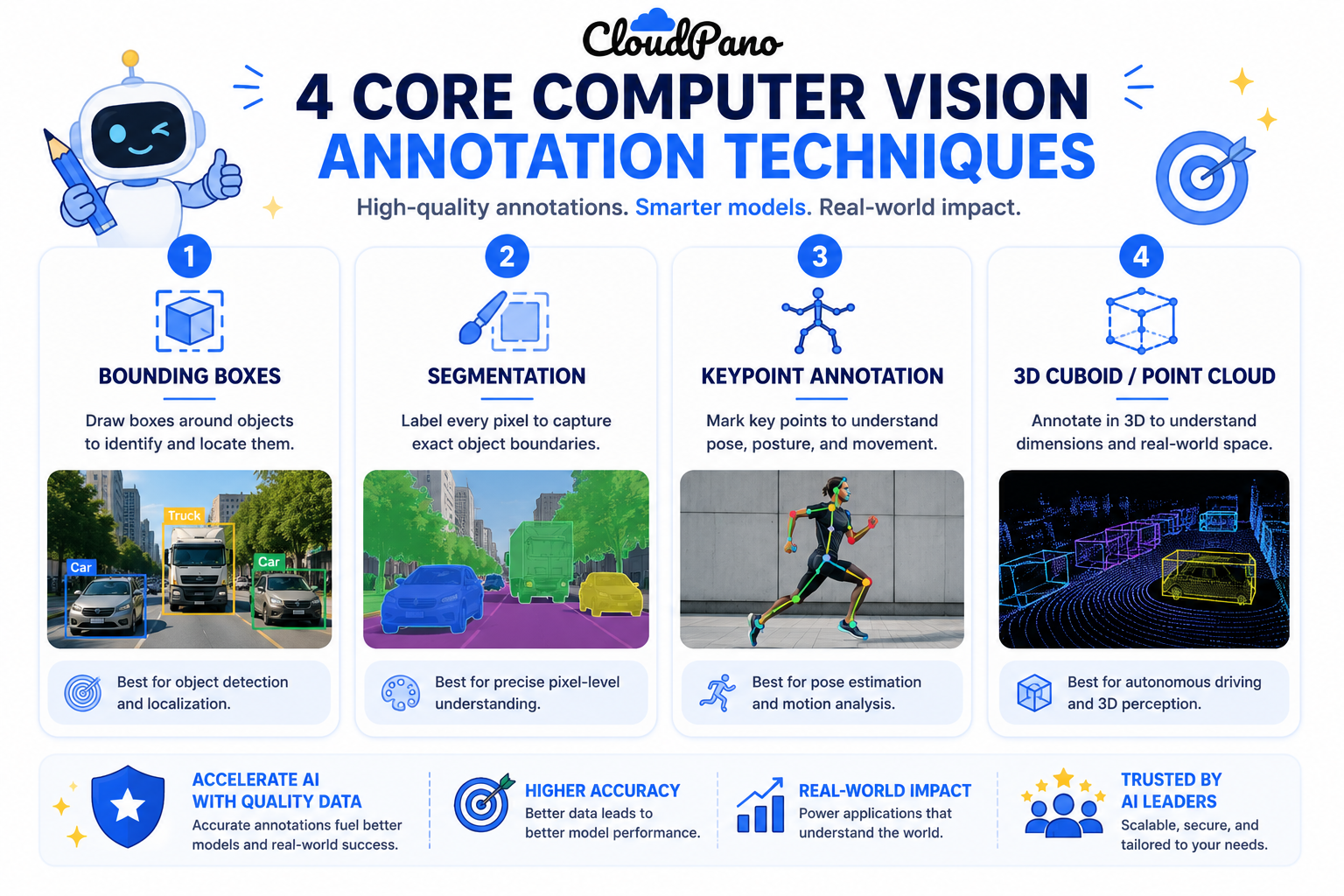
Bounding boxes. Rectangular boxes marking an object's location — the fastest and most common technique, well suited to tasks needing to know an object is present and roughly where.
Semantic and instance segmentation. Pixel-level masks marking exact object boundaries, needed when a model requires precise shape information, not just approximate location.
Keypoint annotation. Marking specific points on an object — joints for pose estimation, facial landmarks — used when a model needs to understand structure or orientation, not just presence.
3D cuboid and point cloud annotation. Marking objects in three-dimensional space, common in autonomous vehicle and robotics applications working with LiDAR or depth-sensor data.

Object detection annotation specifically usually refers to bounding-box-based labeling for identifying and localizing objects, distinct from the pixel-precise detail of segmentation or the structural detail of keypoints.
Understanding how these workflows operate at the technique level — not just "image annotation" as a single undifferentiated service — is what lets a team scope a project accurately and communicate requirements clearly to a provider.
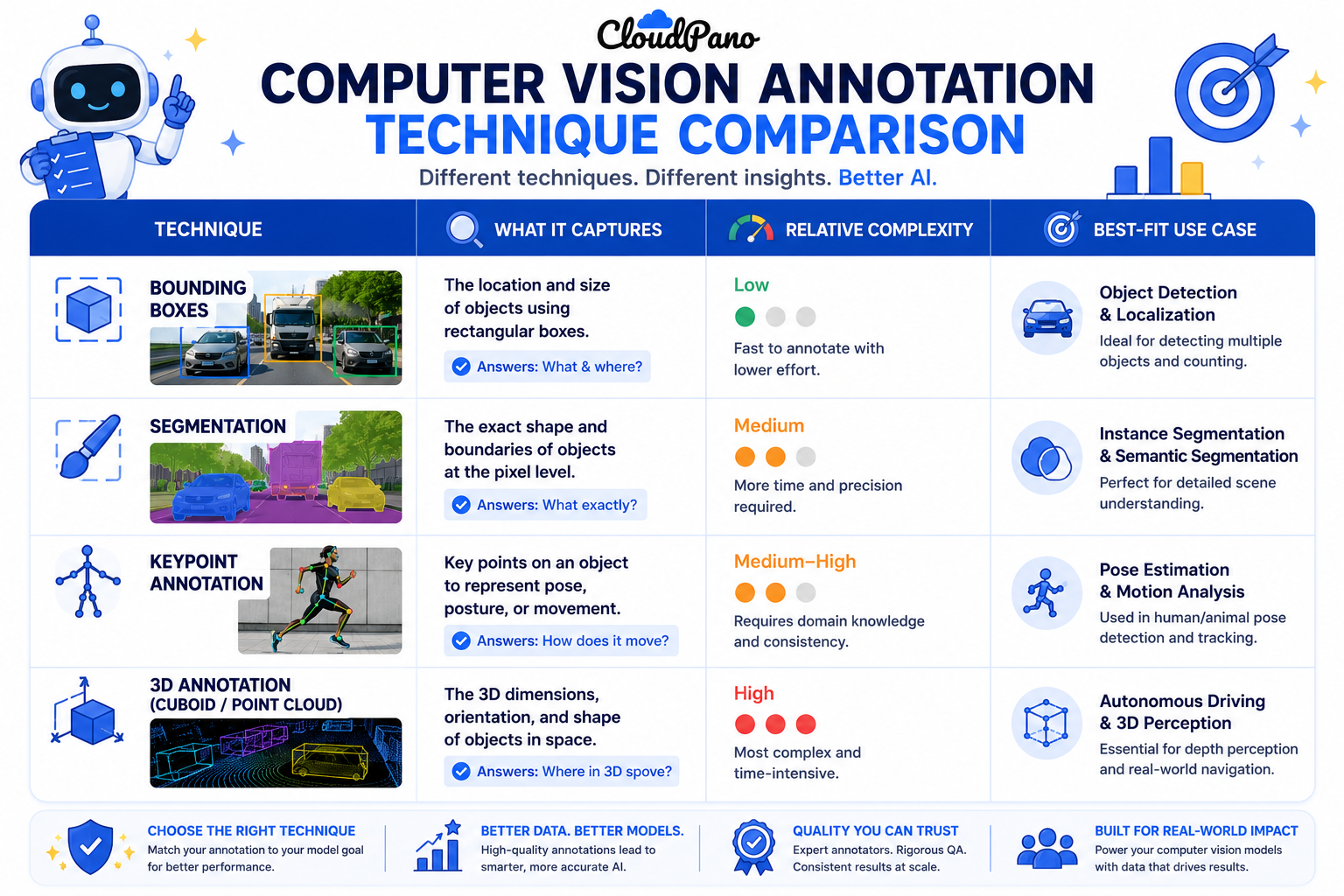

Bounding box annotation, semantic and instance segmentation, keypoint annotation, and 3D cuboid or point cloud annotation, each suited to different model requirements around location, shape, structure, or spatial position.
Object detection annotation typically uses bounding boxes to mark an object's approximate location, while segmentation provides pixel-precise boundaries, needed when a model requires exact shape information rather than approximate position.
When a model needs to understand structure or orientation — pose estimation, facial landmark detection — rather than simply detecting that an object is present and roughly where it is.
3D cuboid and point cloud annotation marks objects in three-dimensional space, typically using LiDAR or depth-sensor data, common in autonomous vehicle and robotics applications rather than standard 2D camera imagery.
Start by defining exactly what your model needs to detect or understand — presence, precise shape, structural points, or 3D position — and match the technique to that specific requirement.
Not necessarily. Using a more detailed technique than the task requires adds unnecessary cost and time without improving the model, since the extra detail isn't relevant to what the model actually needs to learn.
Cost varies significantly by technique, with segmentation, keypoint annotation, and 3D annotation typically costing more per item than bounding boxes.
Computer vision annotation services cover a genuinely broad range of techniques, and the right one for a given project depends on what a model actually needs to detect or understand — not on defaulting to the most common or most detailed option. Matching technique to task, scoping projects with the specific technique in mind, and applying technique-appropriate quality assurance is what turns a computer vision annotation project into training data that actually supports the model it's meant to serve.


Compact, ready to go anywhere
Interchangeable lens that’s upgradeable
Dual 1-inch sensors for improved clarity and low light performance
Dynamic range and 6K 360° capture
360° photo resolution at 21MP

8K 360° video recording for ultra-detailed visuals.
4K single-lens mode for traditional wide-angle shots.
Invisible selfie stick effect for drone-like perspectives.
2.5-inch touchscreen with Gorilla Glass protection.
Waterproof up to 33ft for underwater shooting.

360° photo resolution in 23MP
Slim design at 24 mm thick
Built-in image stabilization for smooth video capture.
Internal 19GB storage for photo and video storage.
Wireless connectivity for remote control and sharing.

60MP 360° still images for high-resolution photography.
5.7K 360° video recording at 30fps.
2.25-inch touchscreen for intuitive control.
USB Type-C port for fast charging and data transfer.
MicroSD card slot for expandable storage.
.png)

.png)

Try it free. No credit card required. Instant set-up.







.svg)


.svg)