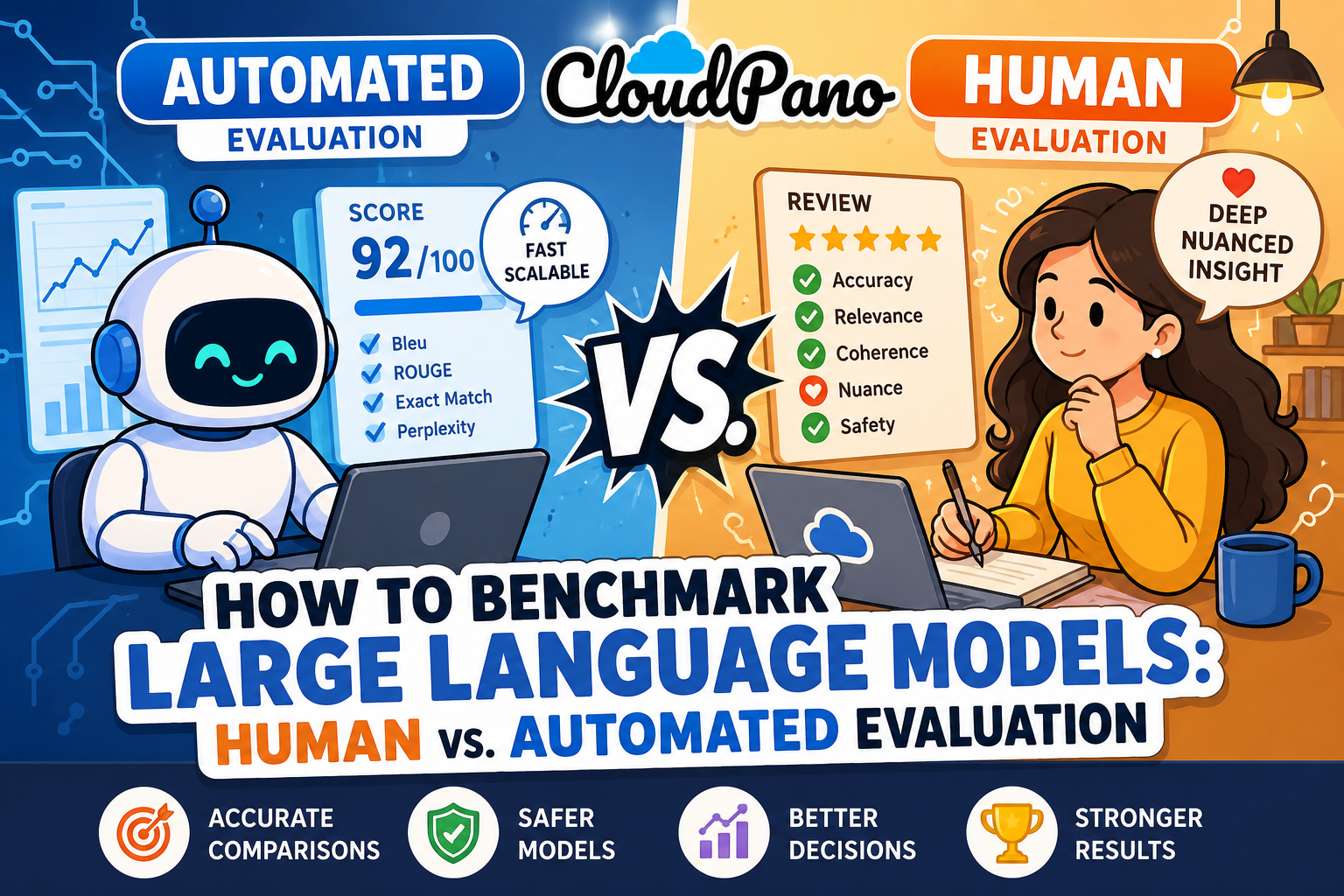
How to Benchmark Large Language Models: Human vs. Automated Evaluation

Cloudpano
July 30, 2026
5 min read
Share this post

How to Benchmark Large Language Models: Human vs. Automated Evaluation

Public leaderboards make LLM benchmarking look simple: run the standard test suite, get a score, compare rankings. In practice, how that score gets produced — automated scoring, an LLM acting as judge, or structured human comparison — shapes how much the ranking actually tells you, and public rankings don't always transfer cleanly to your specific use case.

Automated LLM evaluation and human evaluation approach the same comparison question differently, and understanding which one produced a given benchmark result is what separates a meaningful comparison from a leaderboard number that doesn't actually predict how a model will perform for you.

Why It Matters

A benchmark score that looks precise can still mislead if the underlying test set has been seen during training, or if the scoring method itself has known blind spots. Google Research's "Data Cascades" study documented how subtle, unaddressed measurement problems compound into larger issues once decisions get made based on flawed data — directly applicable to relying on a benchmark score without understanding its limitations (Sambasivan et al., Google Research).

NIST's AI Risk Management Framework emphasizes that performance claims need to be validated against the specific context of use, not treated as universally applicable — a direct challenge to relying purely on public leaderboard position when comparing models for your own deployment (NIST AI RMF).

The stakes rise given how quickly new models are released and compared. Stanford HAI's AI Index has tracked the rapid pace of language model development and public benchmarking activity (Stanford HAI, AI Index Report), and a benchmark methodology that doesn't account for contamination or gaming becomes less reliable exactly as the pace of comparison accelerates.

How It Works

LLM benchmark metrics get produced through a few distinct methods, each with real trade-offs.

Standardized automated test suites. Public benchmarks test models against large sets of fixed questions with known correct answers, scoring automatically. Fast and scalable, but vulnerable to contamination if test data leaked into a model's training set, artificially inflating scores.

LLM-as-judge scoring. Rather than fixed correct answers, one language model evaluates another's outputs against defined criteria. This scales better than human evaluation for open-ended tasks, but inherits the judging model's own biases and blind spots.

Structured human evaluation. People directly compare model outputs against defined criteria, catching nuance neither automated scoring method reliably captures, but at a cost and speed that doesn't scale to comparing many models across many test cases as easily.

Comparison table of automated, LLM-as-judge, and human LLM benchmarking methods

Human vs automated AI evaluation in benchmarking isn't a matter of one being generally superior — it's a matter of matching the method to what's actually being measured, and understanding a public score's limitations before treating it as a direct predictor of performance on your specific task.

Understanding how these workflows operate — what a given benchmark score actually measured and how — is what keeps teams from over-trusting a leaderboard position that may not transfer to their real deployment context.

Step-by-Step Workflow

Flowchart for choosing the right LLM benchmarking method
  1. Identify what specific capability you're actually trying to compare. Reasoning, factual accuracy, coding ability, and conversational quality each call for different benchmark approaches.
  2. Check whether relevant public benchmarks exist for that capability. Standard test suites can provide a useful starting comparison point if they're well-matched to your actual question.
  3. Assess contamination risk for any public benchmark you rely on. Check whether the benchmark data has been publicly available long enough to plausibly appear in training sets.
  4. Decide whether automated scoring, LLM-as-judge, or human evaluation fits your comparison question. Fixed-answer tasks fit automated scoring; open-ended, nuanced comparisons often need LLM-as-judge or human evaluation.
  5. Build a custom test set reflecting your actual use case. Public benchmark performance doesn't guarantee performance on your specific domain or task type.
  6. Run the comparison using the matched method, documenting the specific methodology used. Note whether scoring was automated, judge-based, or human, since this affects how the results should be interpreted.
  7. Validate surprising results with a secondary method. If a model's ranking seems inconsistent with your own experience, cross-check with a different evaluation approach before trusting the score.

Industry Use Cases

Bar chart showing reliance on different LLM benchmarking methods by industry
  • LLM developers: Benchmarking multiple models or model versions against each other is a routine part of development, requiring careful attention to contamination and methodology.
  • Healthcare AI: Public general-purpose benchmarks rarely capture clinical reasoning accuracy well, making custom, domain-specific comparison sets particularly important here.
  • Retail AI: Conversational quality benchmarking for customer-facing assistants often benefits from LLM-as-judge scoring at scale, supplemented by targeted human evaluation on brand-specific criteria.
  • Government & defense: Formal documentation of benchmarking methodology is often required, given the accountability and procurement stakes involved in model selection.
  • Computer vision / robotics: These LLM-specific benchmarking methods don't map directly onto computer vision model comparison, though analogous benchmark contamination concerns exist in that domain too.
  • Autonomous vehicles: Similarly, this specific benchmarking approach has limited direct application to core perception or control model comparison in this industry.

Benefits

  • More accurate model selection. Understanding benchmark methodology prevents choosing a model based on a leaderboard position that doesn't reflect your actual use case.
  • Efficient comparison at scale. Automated and LLM-as-judge scoring allow comparing many models quickly, reserving human evaluation for the comparisons that need it most.
  • Reduced risk of contamination-inflated conclusions. Checking benchmark data exposure prevents overestimating a model's genuine capability based on a score that partly reflects memorization.
  • Better-matched vendor and model decisions. Custom benchmarking against your actual use case produces comparisons that transfer meaningfully to real deployment performance.
  • A defensible basis for model choice. Documented benchmarking methodology supports internal and external accountability when explaining why a particular model was selected.

Common Mistakes

  • Treating public leaderboard position as a direct predictor of your use case performance. Assuming general benchmark strength transfers cleanly to a specific, narrower application.
  • Ignoring contamination risk in public benchmarks. Not checking whether widely available benchmark data may have leaked into a model's training set.
  • Relying solely on LLM-as-judge scoring without understanding its biases. Missing that a judge model can share systematic blind spots with the models it's evaluating.
  • Comparing models using different methodologies without noting the difference. Treating an automated score and a human-evaluated score as directly comparable numbers.
  • Skipping a custom, use-case-specific test set entirely. Relying only on general public benchmarks that may not represent your actual deployment conditions.
  • Not validating surprising benchmark results with a secondary method. Accepting an unexpected ranking at face value without cross-checking with a different evaluation approach.

Best Practices

  • Match your benchmarking method — automated, LLM-as-judge, or human — to the specific capability you're actually trying to compare.
  • Check contamination risk for any public benchmark before treating its scores as a reliable measure of genuine capability.
  • Build a custom test set that reflects your actual deployment context rather than relying solely on general public benchmarks.
  • Document which methodology produced each benchmark result, since automated, judge-based, and human-evaluated scores aren't directly comparable without that context.
  • Validate surprising or inconsistent results using a secondary evaluation method before trusting them.
  • Revisit your benchmarking approach as new models and methodologies emerge, since public benchmark reliability shifts as contamination risk accumulates over time.

FAQ

What is LLM benchmarking?

The process of comparing language models against each other using standardized test suites or comparison methods, scored through automated methods, an LLM acting as judge, or structured human evaluation.

What is benchmark contamination?

A situation where test data from a public benchmark has been included in a model's training data, inflating its score in a way that doesn't reflect genuine capability improvement.

What is LLM-as-judge scoring in automated LLM evaluation?

A method where one language model evaluates another's outputs against defined criteria, scaling better than human evaluation for open-ended tasks but inheriting the judging model's own biases.

Is human vs automated AI evaluation a matter of one being generally better?

No. Each method suits different comparison questions — automated scoring works well for fixed-answer tasks, while human evaluation captures nuance that automated methods, including LLM-as-judge scoring, can miss.

Should I trust public leaderboard rankings when choosing a model?

Use them as a starting point, but validate against your specific use case with a custom test set, since general leaderboard position doesn't guarantee performance on a narrower, specific application.

How do I check if a benchmark might be affected by contamination?

Consider how long the benchmark data has been publicly available and whether it's the kind of widely circulated dataset likely to appear in large training corpora.

What LLM benchmark metrics should I actually pay attention to?

The ones matched to the specific capability relevant to your use case — general leaderboard scores are a starting signal, but metrics from a custom, domain-specific comparison matter more for predicting your actual deployment performance.

Conclusion

LLM benchmarking looks straightforward from a public leaderboard, but the methodology behind a score — automated, LLM-as-judge, or human evaluation — shapes how much that number actually predicts about real-world performance. Understanding contamination risk, matching evaluation method to the specific capability being compared, and building a custom test set for your actual use case is what turns benchmarking from a leaderboard-chasing exercise into a genuinely useful comparison.

🚀 Your All‑In‑One Virtual Experience Stack
🎬
PhotoAIVideo
Turn photos into scroll‑stopping AI videos.
Get Started →
🏡
Pictastic
Instantly stage listings with AI.
Try Staging →
🌀
CloudPano
Create stunning 360° tours in minutes.
Launch Tour →
💰
VirtualTourProfit
Build a profitable virtual tour business.
Learn More →
🤝
CloudPano Reseller
Resell AI visual software without building it.
Become a Reseller →
🚗
Auto CloudPano
Sell more vehicles with 360° experiences.
Explore Auto →
🏗️
AI Floor Plan Builder
Generate detailed floor plans with AI.
Build Now →
📐
3D Measure
Capture accurate floor plans & 3D measurements.
Measure Now →
🧠
AI Training Data
Custom AI training data services.
Learn More →
Share this post
Cloudpano

Choose The Right 360° Camera

Insta360 ONE RS 1-Inch 360 Edition

  • Compact, ready to go anywhere

  • Interchangeable lens that’s upgradeable

  • Dual 1-inch sensors for improved clarity and low light performance

  • Dynamic range and 6K 360° capture

  • 360° photo resolution at 21MP

Learn More

Insta360 X4

  • 8K 360° video recording for ultra-detailed visuals.

  • 4K single-lens mode for traditional wide-angle shots.

  • Invisible selfie stick effect for drone-like perspectives.

  • 2.5-inch touchscreen with Gorilla Glass protection.

  • Waterproof up to 33ft for underwater shooting.

Learn More

Ricoh Theta Z1

  • 360° photo resolution in 23MP

  • Slim design at 24 mm thick

  • Built-in image stabilization for smooth video capture.

  • Internal 19GB storage for photo and video storage.

  • Wireless connectivity for remote control and sharing.

Learn More

Ricoh Theta X

  • 60MP 360° still images for high-resolution photography.

  • 5.7K 360° video recording at 30fps.

  • 2.25-inch touchscreen for intuitive control.

  • USB Type-C port for fast charging and data transfer.

  • MicroSD card slot for expandable storage.

Learn More
Property Marketing
Allows potential buyers to explore properties in detail from anywhere, enhancing the real estate marketing process.
Automotive Spins
Create an interactive virtual showroom and engage affluent digital buyers with live 360º video calls, all through the CloudPano mobile app for a complete automotive sales solution.
Interactive Floor Plans
Create 2D and 3D floor plans with measurements in 4 minutes or less, all from your phone. Download the Floor Plan Scanner app and get your first scan free.

360 Virtual Tours With CloudPano.com. Get Started Today.

Try it free. No credit card required. Instant set-up.

Try it free
Latest posts

See our other posts

Interviews, tips, guides, industry best practices, and news.

How to Benchmark Large Language Models: Human vs. Automated Evaluation

LLM benchmarking compares models against each other using standardized test suites, either through automated scoring (including LLM-as-judge methods) or structured human evaluation. Automated benchmarking scales efficiently but is vulnerable to contamination and gaming; human evaluation catches nuance automated scoring misses but doesn't scale as easily across many model comparisons.
Read post

Red Teaming vs. LLM Evaluation: What's the Difference?

Red teaming vs LLM evaluation comes down to purpose: evaluation measures how a model performs on typical and representative inputs, while red teaming actively searches for adversarial inputs designed to make the model fail, produce harmful content, or bypass safety measures. Most responsible deployments need both, not one or the other.
Read post

How to Evaluate LLM Outputs: Metrics, Methods, and Human Review

How to evaluate LLM outputs depends on the task: automated metrics like BLEU, ROUGE, or perplexity work for narrow, reference-based tasks, while embedding similarity captures semantic closeness more flexibly. For subjective qualities like tone or helpfulness, structured human evaluation with clear rubrics and rating scales is usually necessary alongside automated methods.
Read post