


.png)



Video has become an increasingly important part of real estate marketing, and that shift is why so many agents are looking for a straightforward answer about AI real estate video before adding another expense to their marketing budget.
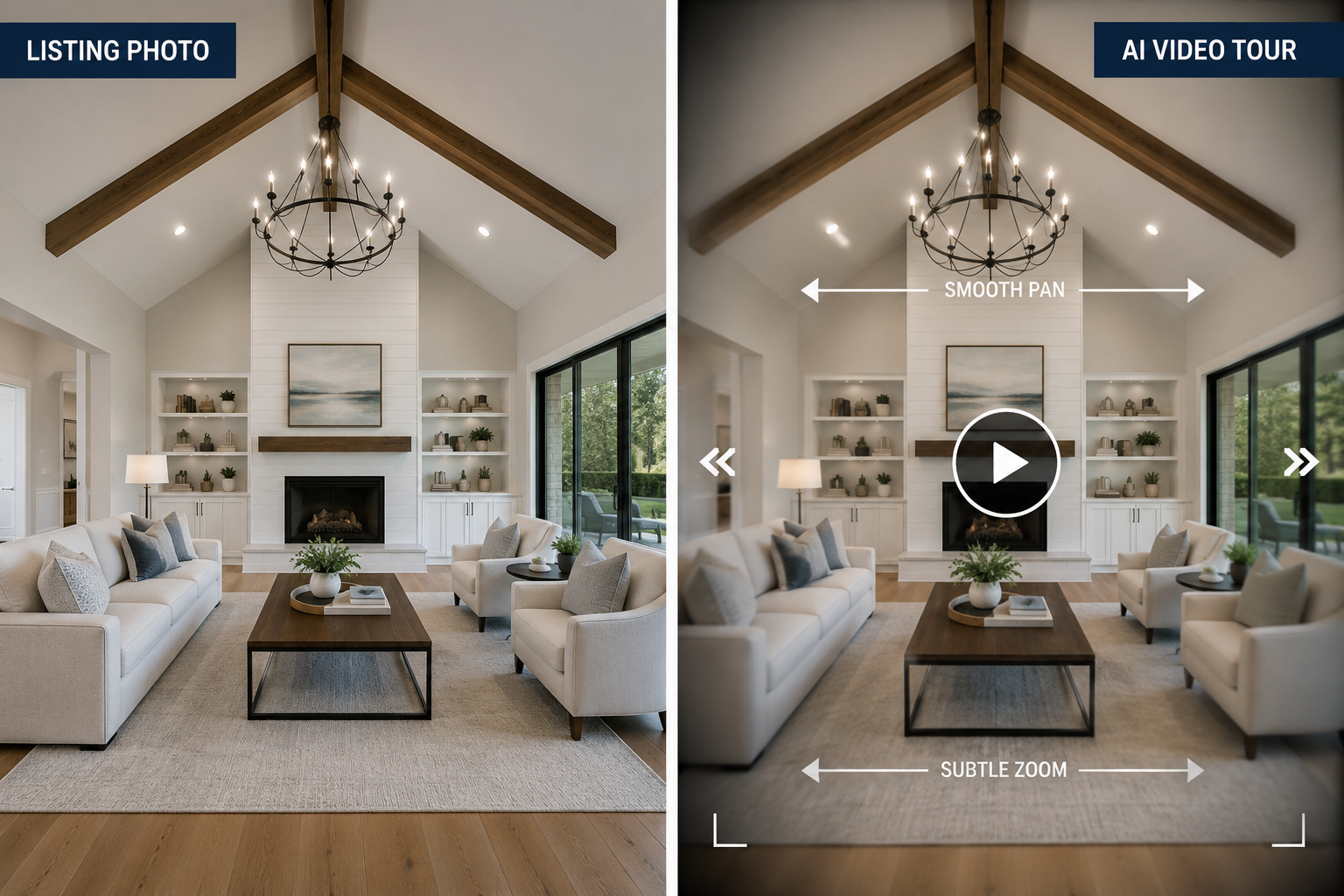
The pitch is simple: upload the listing photos you already have and turn them into a polished property video without a camera crew or traditional video-editing software. But fast turnaround doesn't automatically mean a good return.
This article lays out a practical way to think about the actual math — subscription costs compared with what you're currently paying for video, the value of the time you get back, and the potential marketing benefit of making video available for more listings rather than reserving it for flagship properties.
None of this requires guessing at industry-wide statistics. It requires knowing your own numbers: how many listings you handle, what you currently spend on marketing, and how often video gets skipped because of cost or inconvenience.
Once you have those inputs, the ROI question becomes much less abstract.
Return on investment for any marketing tool is essentially a comparison between what you spend and what you get back.
With video, however, the potential return isn't limited to direct cost savings. It can also include time saved and additional marketing opportunities that weren't previously practical.
A useful ROI framework for AI real estate video should therefore account for all three rather than focusing solely on the subscription fee versus a videographer's invoice.
Most agents naturally start with that direct comparison, and it's a reasonable place to begin. But it doesn't capture the full picture for agents who currently skip video on many listings or spend significant time coordinating outside shoots.
Start with a baseline you can calculate easily: what does traditional videography cost you per listing, and how does that compare with the subscription cost of the AI video platform you're considering?
A subscription model behaves differently from a per-shoot invoice. With traditional per-listing production, your total cost generally increases as you produce more videos. With a subscription, the effective cost per video may decrease as you create more videos within the limits of your plan.
That's one reason listing volume matters so much when evaluating ROI.
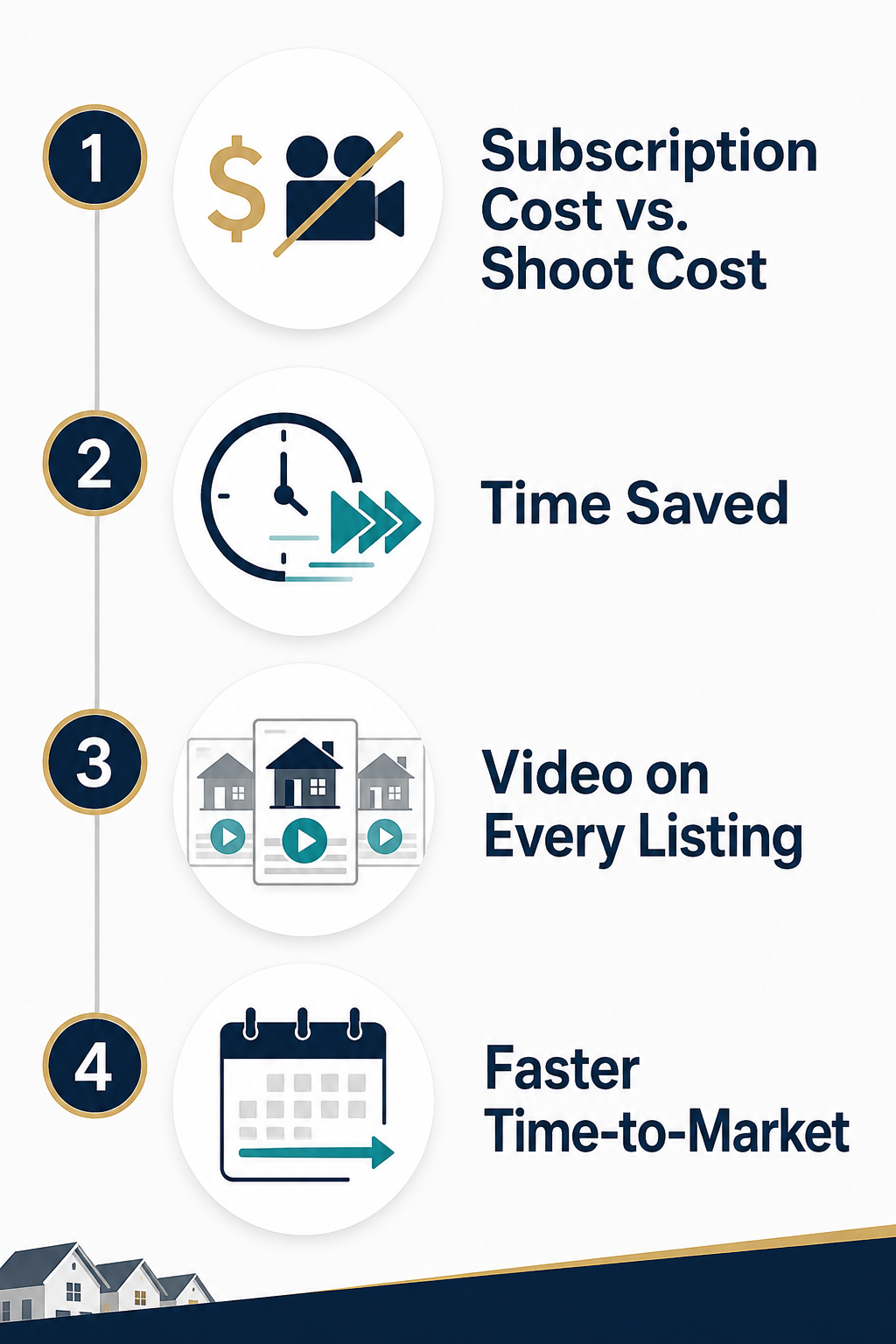
Rather than trying to arrive at one universal ROI number, break the calculation into four components.
Each can be estimated using information from your own business rather than relying entirely on industry benchmarks.
This is the most direct comparison.
Take what you currently pay per listing for professional videography, multiply it by the number of listings for which you would normally purchase video, and compare that total with the subscription cost of an AI video platform over the same period.
For an agent who currently books a videographer for most listings, this comparison may account for a significant portion of the potential savings.
For an agent who only occasionally hires a videographer for premium listings, the calculation is different because there are fewer existing video expenses to replace.
Coordinating traditional video production involves more than paying an invoice.
There may be scheduling between the agent, seller, photographer or videographer, along with considerations such as property readiness, weather, and lighting. After the shoot, there's also the production and revision process.
Generating video from photographs that have already been captured can reduce much of that coordination.
The value of that saved time depends on what you would otherwise be doing with it — showing another property, prospecting for clients, following up with leads, or handling other revenue-generating work.
Assign a reasonable hourly value to your time and estimate how many hours your current video-production process requires. That gives you a second ROI input separate from the direct cost comparison.
This is harder to quantify, but it's still worth considering.
When professional video requires an additional production budget and scheduling process, agents may reserve it for higher-value properties while marketing other listings primarily with photography.
Lowering the cost and production effort required to create video can make it practical to use video across a larger share of your listings.
Research from sources such as HubSpot, Think with Google, and Zillow Research provides broader context on the importance of video, visual content, and digital media in consumer marketing and the home-shopping journey.
That doesn't mean adding video guarantees more leads, faster sales, or higher conversion rates for an individual property. But it does give agents another visual asset they can use across listing pages, websites, social media, email campaigns, and other marketing channels.
There's another potential benefit: how quickly you can assemble a listing's complete marketing package.
Traditional video may require a separate appointment and post-production process. When video can instead be generated from listing photographs that have already been captured, it may be possible to add the video component without coordinating another property visit.
For agents working on tight listing-launch schedules, reducing those additional production steps can help streamline the overall marketing workflow.

The framework above can produce very different results depending on your individual business.
Three variables are particularly important.
Listing volume has a significant effect on the calculation.
If you're using a subscription plan, producing more videos within that plan can reduce your effective cost per video. An agent or team handling several listings each month may therefore see a different value proposition than an agent who handles only a few listings per year.
High-volume agents and teams may benefit particularly from workflows designed for repeat production. PhotoAIVideo's real estate agent solution provides more information about the features available for listing marketing.
If you're already paying for professional videography on most listings, the ROI calculation is relatively straightforward: compare what you're currently spending with the cost of the AI video platform, then account for differences in time, quality, capabilities, and workflow.
If you're currently spending very little on video, the question changes.
Instead of asking, "How much money will this replace?" you're asking whether adding video creates enough additional marketing value to justify a new expense.
Both are legitimate starting points, but they produce very different breakeven calculations.
This is another important distinction.
If you're not producing video today because traditional production hasn't felt worthwhile for most of your listings, the comparison isn't really AI subscription versus videographer.
It's AI subscription versus your current photo-only workflow.
In that case, there may be little or no direct video expense to eliminate. The potential return instead comes from gaining an additional marketing asset at a cost and level of effort you consider worthwhile.
Looking at before-and-after examples can help you judge the output using the type of listing photography you already produce rather than trying to evaluate the benefit purely in theory.
You don't need an industry-wide benchmark to run a basic calculation. Start with four numbers from your own business:
From there, you can create a simple comparison:
Current monthly video cost = number of video listings × average traditional video cost
Then add an estimate for the value of the time spent coordinating that production.
Compare the result with the cost of the AI video platform and the time required to produce the same number of videos using that workflow.
If you're currently skipping video entirely, don't manufacture a "savings" figure that doesn't exist. Instead, evaluate whether the new expense is justified by the additional marketing content and flexibility it provides.
PhotoAIVideo's walkthrough can help you evaluate the actual workflow and output before choosing a plan.
If your selected plan supports multiple aspect ratios or export formats, you may also be able to repurpose the same property video for different channels rather than producing entirely separate assets for each one.
That can add value when your marketing strategy includes websites, listing pages, YouTube, Instagram, TikTok, and other platforms.
Is AI real estate video actually worth it compared with hiring a videographer?
It depends heavily on your listing volume, current video spending, and the type of content you need. Agents already paying for traditional video on multiple listings have a relatively straightforward cost comparison. Agents who currently use little or no video need to evaluate whether gaining an additional marketing asset justifies the new expense.
What if I only have a few listings a year — is it still worth subscribing?
Possibly, but the calculation changes at lower volume. Your effective cost per video may be higher, so compare the platform's current pricing and usage limits with how many videos you realistically expect to produce.
Do AI voiceover and branding add meaningful value, or are they just extras?
That depends on your marketing strategy. If you already invest in consistent branding across listing materials, carrying your logo, colors, contact information, and messaging into video can help maintain that consistency. If branding isn't a major priority, the quality and usefulness of the core video may matter more to your ROI.
How do I know if my time savings outweigh the subscription cost?
Estimate how much time you currently spend scheduling video shoots, coordinating with vendors, waiting for production, reviewing deliverables, and handling revisions. Assign a reasonable value to those hours and include that amount in your comparison.
Don't count every hour between scheduling and final delivery as "time saved," though — only count the time that actually requires your involvement.
There's no universal answer to whether AI real estate video is worth the investment.
The answer depends primarily on your listing volume, current video-production costs, the amount of time involved in your existing workflow, and whether you're producing video at all today.
The goal of an ROI framework isn't to promise a guaranteed return. It's to give you a practical way to evaluate the numbers using your own business.
For agents already paying for video regularly, much of the comparison comes down to cost, workflow, and output quality.
For agents currently skipping video, the question is different: does making video easier and more affordable give you a marketing asset that's valuable enough to justify the expense?


Compact, ready to go anywhere
Interchangeable lens that’s upgradeable
Dual 1-inch sensors for improved clarity and low light performance
Dynamic range and 6K 360° capture
360° photo resolution at 21MP

8K 360° video recording for ultra-detailed visuals.
4K single-lens mode for traditional wide-angle shots.
Invisible selfie stick effect for drone-like perspectives.
2.5-inch touchscreen with Gorilla Glass protection.
Waterproof up to 33ft for underwater shooting.

360° photo resolution in 23MP
Slim design at 24 mm thick
Built-in image stabilization for smooth video capture.
Internal 19GB storage for photo and video storage.
Wireless connectivity for remote control and sharing.

60MP 360° still images for high-resolution photography.
5.7K 360° video recording at 30fps.
2.25-inch touchscreen for intuitive control.
USB Type-C port for fast charging and data transfer.
MicroSD card slot for expandable storage.
.png)

.png)

Try it free. No credit card required. Instant set-up.





.svg)


.svg)