


.png)



Video has quietly become an expected part of listing marketing, as buyers increasingly look beyond static photo carousels for more engaging ways to experience a property online. That shift is exactly why AI real estate video has moved from a novelty to a practical tool for agents looking to market their listings more effectively.
In simple terms, AI real estate video refers to software that automatically turns a set of listing photos into a polished, cinematic property video — no camera crew, filming day, or advanced video editing skills required. For agents who already have a folder of listing photos on their phone, computer, or MLS account, it means a walkthrough-style video can be created in minutes instead of days.
This article breaks down what AI real estate video actually is, how the underlying process works at a conceptual level, how it differs from hiring a videographer or using a generic template editor, and why agents, teams, and photographers are increasingly incorporating it into their everyday workflows.
At its core, AI real estate video refers to tools that use automated, photo-based processing to generate real estate marketing videos without requiring a live video shoot.
Instead of a videographer walking through a property with a camera or gimbal, the software starts with still images — the same listing photos an agent may have already uploaded to the MLS or used in a flyer — and builds a moving video around them.
The "AI" component refers to the automation involved in determining how each photo should be framed, how the virtual camera should appear to move across it, how long each shot should remain on screen, and how one image should transition into the next — all without requiring someone to manually create every movement and transition in a traditional video editor.
This is different from simply displaying still photos on screen for a few seconds each, which is what basic slideshow tools have done for years. AI real estate video platforms can simulate cinematic movements — such as panning, zooming, and gliding — and apply them across a set of listing photos so the finished video feels more dynamic than a traditional photo slideshow.
Platforms like PhotoAIVideo are built around this idea: take the listing photos an agent already has and turn them into a finished property video in just a few minutes.
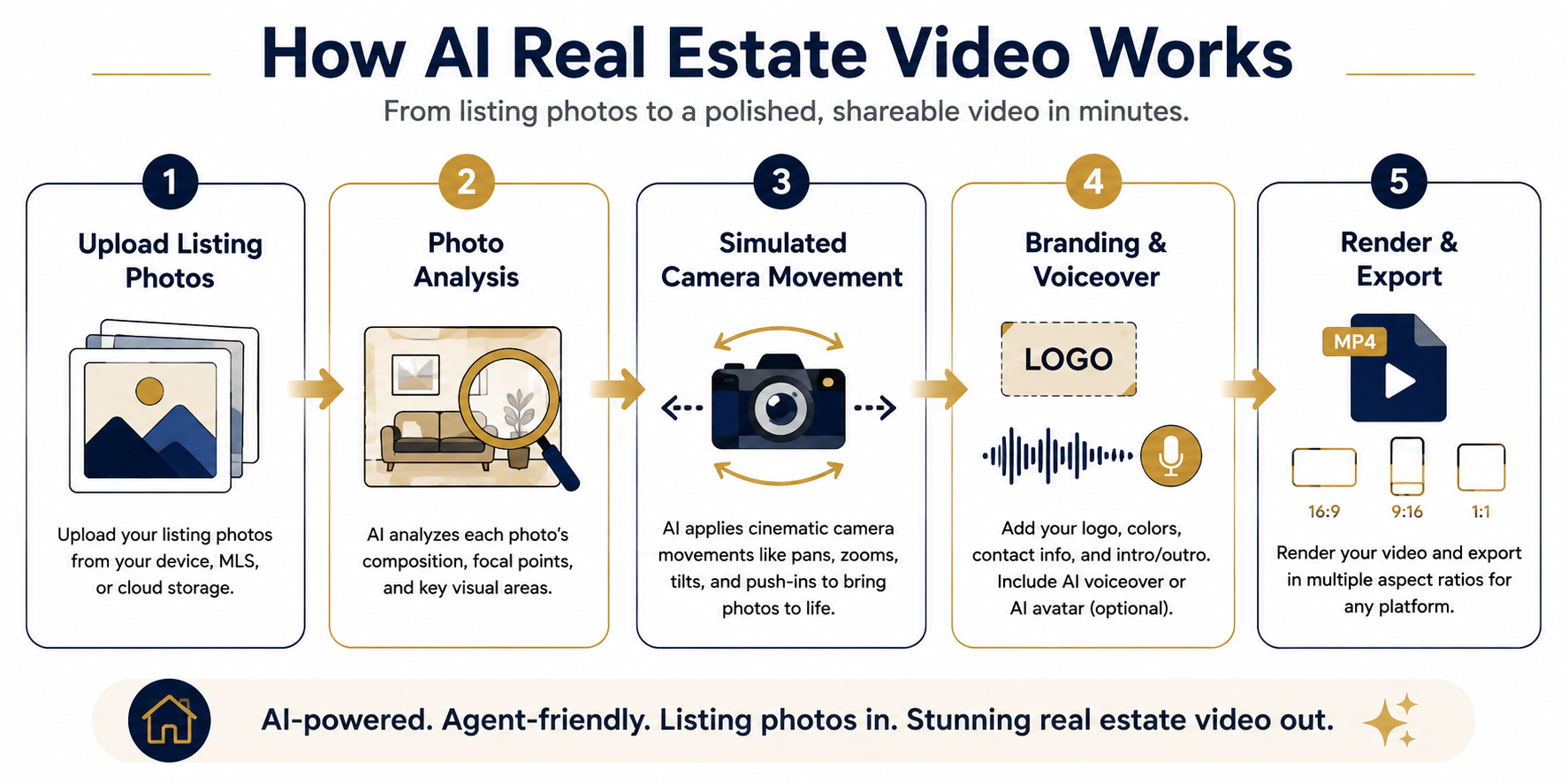
Although no two platforms are built exactly alike, many AI real estate video tools follow a similar conceptual workflow. Understanding these steps helps demystify what's happening behind the scenes — rather than being magic, it's a structured process applied to a set of listing photos.
The process begins with the software analyzing each uploaded photo. Depending on the platform, this may involve evaluating the image's composition and identifying important visual areas that can guide how movement is applied.
For example, a wide living room, kitchen island, fireplace, or pool may influence how the software frames and animates the image.
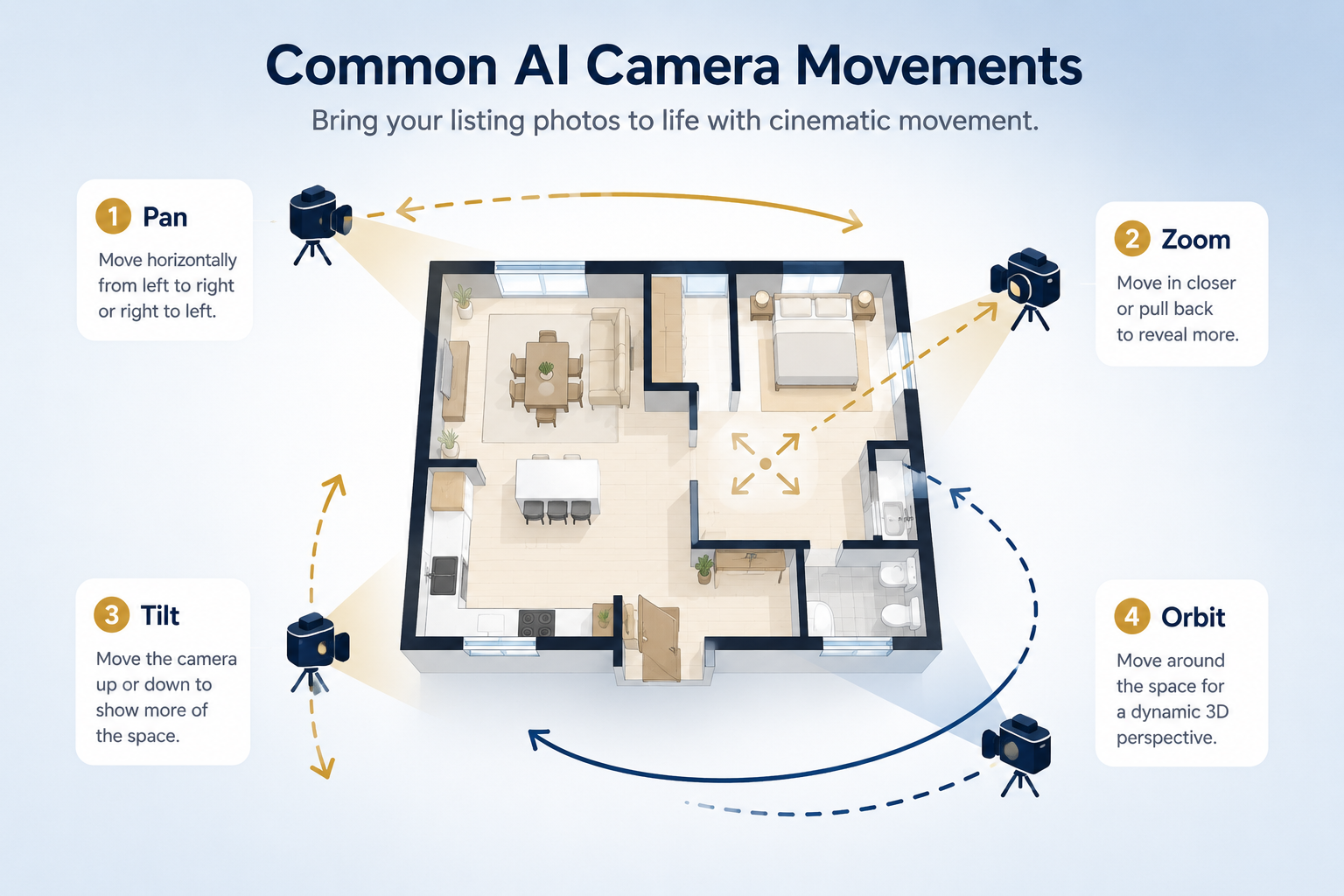
Rather than displaying a completely static photo, the software animates it to create the impression of camera movement through or across the space.
AI real estate video tools may draw from a library of camera movements — including pans, zooms, tilts, dolly-style push-ins, and orbit effects — and apply different movements across a listing's photo set.
PhotoAIVideo, for example, offers more than 12 camera movement styles. A wide living room image might receive a slow pan, while a detailed kitchen shot could use a gentle push-in.
The goal is to create a more cinematic presentation from still photography without requiring an actual video shoot.
Once movement has been applied to the individual photos, the software combines them into a sequence and adds transitions between scenes.
Pacing can help the finished video feel more natural, allowing important spaces to remain on screen longer while moving more quickly through secondary images.
AI real estate video platforms may also allow users to add branding elements such as an agent's logo, brand colors, contact information, and custom intros and outros.
Some platforms extend these capabilities further with features such as AI-generated voiceovers or AI avatars, allowing agents to incorporate narration or presenter-style elements without recording every listing video manually.
Finally, the completed sequence is rendered into a shareable video.
Because listing videos are used across multiple marketing channels, many tools support different aspect ratios — such as widescreen 16:9 for websites and YouTube, vertical 9:16 for Reels, TikTok, and Stories, and square 1:1 for social media feeds — allowing the same project to be adapted for different platforms.
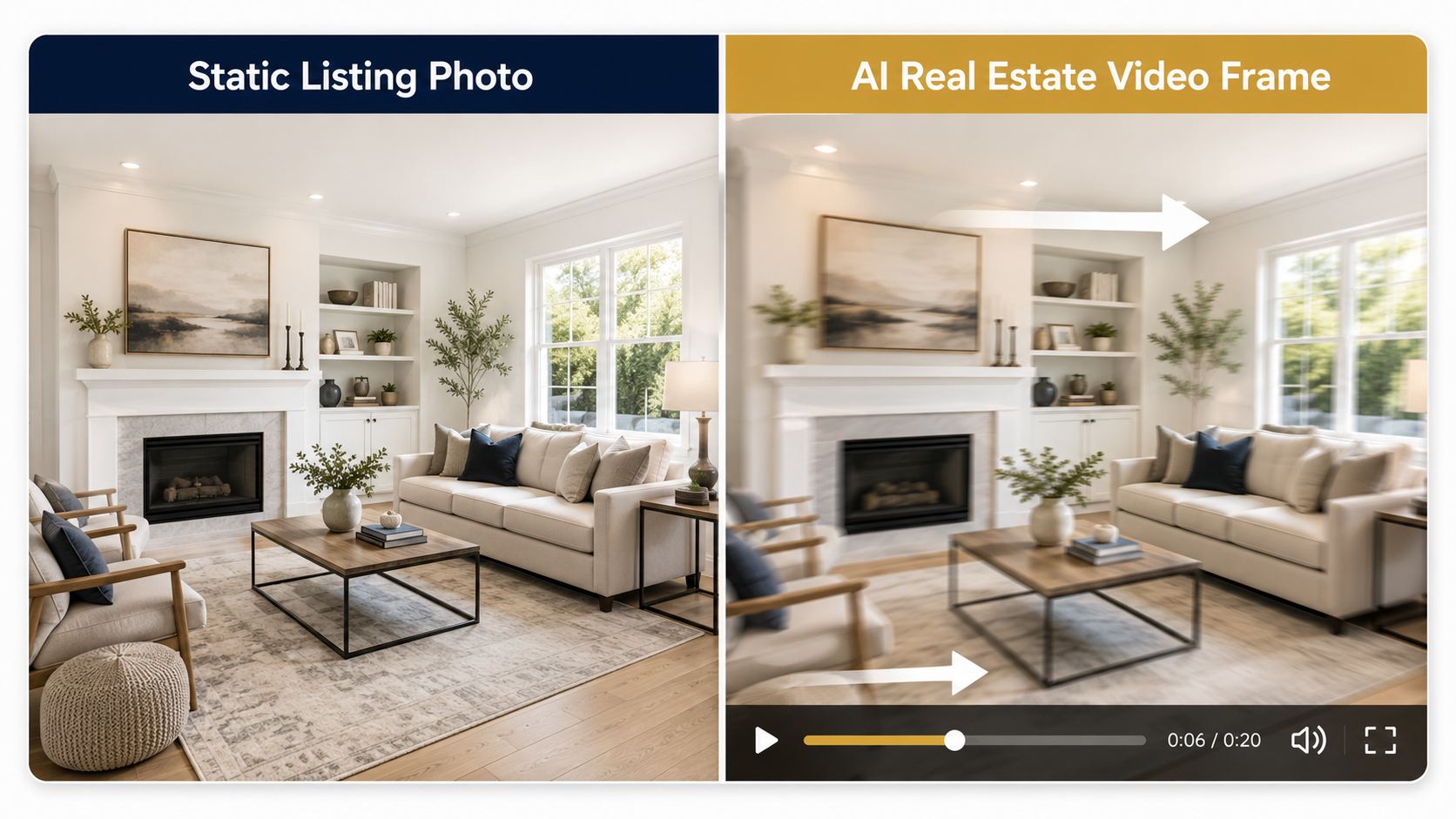
Traditional real estate videography typically involves hiring a videographer, coordinating a shoot around the property's availability, capturing footage on-site, and then waiting for the footage to be edited.
The major advantage is obvious: traditional videography captures genuine moving footage of the property. This can provide perspectives and movement that cannot be fully replicated from still photography alone.
However, it also requires scheduling, on-site production, editing time, and a larger budget.
AI real estate video takes a different approach. Because it works from photos an agent already has, there's no additional video shoot to schedule and potentially less production time.
A listing video can often be created soon after the listing photos are available.
That doesn't mean AI-generated video replaces professional videography in every situation. For luxury listings, architectural showcases, agent-led property tours, or projects requiring genuine continuous movement through a space, professional videography can still be the better choice.
For everyday listing marketing, however, AI real estate video offers a faster and more scalable way to turn existing photography into video content.
It's also worth separating AI real estate video tools from generic slideshow or template-based video editors that allow users to drop photos into predefined sequences.
The primary distinction is automation and how movement is applied.
A basic template editor may apply similar effects across multiple images regardless of what's actually in each frame. An AI-focused real estate video platform can analyze individual images and apply different simulated movements based on the content and composition of each photo.
This variation can make the finished result feel more like a cinematic property presentation and less like a traditional photo slideshow with music.
PhotoAIVideo's before-and-after video examples provide examples of how static listing photos can be transformed into moving, branded property videos.
Solo and independent agents.
For an individual agent juggling multiple parts of their business, AI real estate video provides a way to add polished video content to listing marketing without necessarily hiring outside help or learning complex editing software.
Teams and brokerages.
Larger teams and brokerages may need consistent branding across videos produced by multiple agents, along with the ability to create content at scale. Plans designed for teams or enterprise users can help standardize how listing videos look across the organization.
Agents comparing options can review PhotoAIVideo's pricing to see how its available plans and features differ.
Real estate photographers.
Photographers who already capture listing photos are also a natural fit for AI real estate video. They can potentially offer video as an additional service using photography they've already produced, without requiring a separate video shoot.
Some platforms also provide white-label or branding options that allow photographers to deliver finished content under their own business identity.
Beyond self-service tools, some providers may offer Done-For-You services for agents, teams, or photographers who would rather submit their photos and receive a completed video without creating it themselves.
Video continues to play an important role in digital marketing, including real estate. Research from the National Association of Realtors tracks how buyers use online tools and media throughout the home-search process.
More broadly, resources such as the Wyzowl State of Video Marketing report and HubSpot's video marketing statistics illustrate the continued importance of video as a format for communicating information and capturing attention online.
For real estate agents, one of the traditional barriers to using video on every listing has been production time and cost.
AI real estate video lowers that barrier by making it possible to repurpose photography that's already part of the listing workflow. Instead of reserving video only for certain properties, agents can potentially create video content for a much larger share of their listings.
That's where the technology becomes particularly useful: it turns existing listing photography into another marketing asset without necessarily requiring an additional on-site production day.
Does AI real estate video require filming on-site?
No. Photo-based AI real estate video tools generate videos from existing listing photos, so an additional camera crew or on-site video shoot isn't required.
Is AI real estate video the same as a photo slideshow?
Not exactly. A basic slideshow typically displays photos sequentially with simple transitions. AI real estate video can apply simulated camera movements — such as pans, zooms, tilts, and other effects — to make still images feel more dynamic.
Can I add my own branding to an AI-generated real estate video?
Many AI real estate video platforms support custom branding, which may include logos, brand colors, contact information, and customized intros and outros. Available branding options vary by platform and plan.
What video formats does AI real estate video export in?
Export options vary by platform, but common aspect ratios include widescreen 16:9 for websites and YouTube, vertical 9:16 for Reels, TikTok, and Stories, and square 1:1 for social media feed posts.
AI real estate video has changed what's practical for everyday listing marketing. What traditionally required a separate video shoot and editing workflow can now, in some cases, be created from photos an agent already has.
It isn't a replacement for professional videography in every situation, but it gives agents, teams, and photographers another way to turn existing listing photography into engaging video content quickly and at scale.
For agents still relying primarily on static photos, trying an AI real estate video tool on a listing can be a simple way to see how the format fits into their marketing workflow.


Compact, ready to go anywhere
Interchangeable lens that’s upgradeable
Dual 1-inch sensors for improved clarity and low light performance
Dynamic range and 6K 360° capture
360° photo resolution at 21MP

8K 360° video recording for ultra-detailed visuals.
4K single-lens mode for traditional wide-angle shots.
Invisible selfie stick effect for drone-like perspectives.
2.5-inch touchscreen with Gorilla Glass protection.
Waterproof up to 33ft for underwater shooting.

360° photo resolution in 23MP
Slim design at 24 mm thick
Built-in image stabilization for smooth video capture.
Internal 19GB storage for photo and video storage.
Wireless connectivity for remote control and sharing.

60MP 360° still images for high-resolution photography.
5.7K 360° video recording at 30fps.
2.25-inch touchscreen for intuitive control.
USB Type-C port for fast charging and data transfer.
MicroSD card slot for expandable storage.
.png)

.png)

Try it free. No credit card required. Instant set-up.







.svg)


.svg)