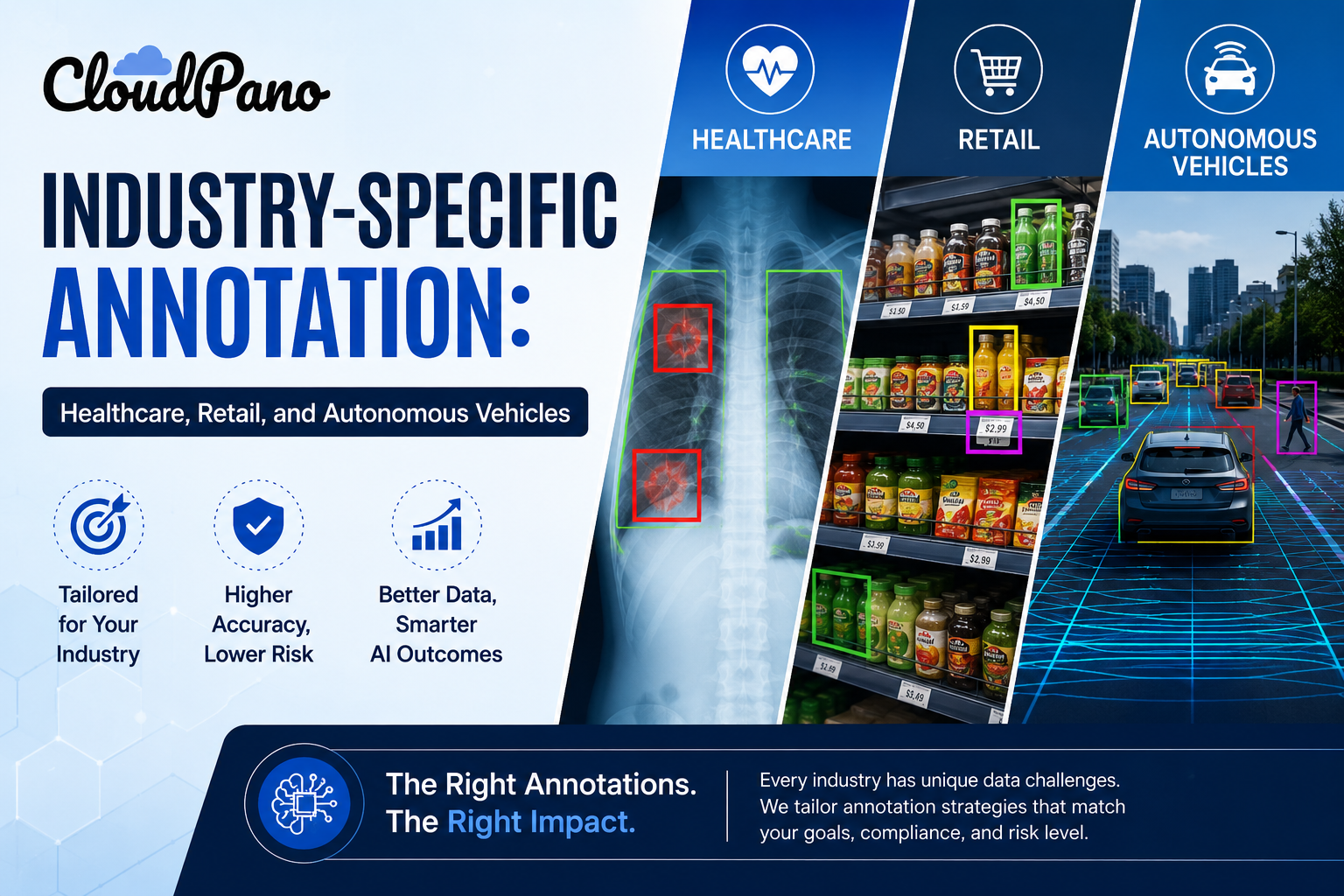
Industry-Specific Annotation: Healthcare, Retail, and Autonomous Vehicles
Cloudpano
July 18, 2026
•
5 min read
Share this post
Industry-Specific Data Annotation: How Requirements Differ by Sector
Treating annotation as one uniform discipline is how healthcare AI teams end up with generalist annotators on clinical imaging, or how autonomous vehicle programs discover mid-project that their labeling vendor has never handled 3D point cloud data. Industry specific data annotation exists because the requirements genuinely diverge — not just in data format, but in expertise, compliance burden, and acceptable error tolerance.
This guide walks through how annotation needs shift across healthcare, retail, autonomous vehicles, robotics, LLM development, manufacturing, and government/defense, so you can calibrate your approach to your actual sector rather than a generic template.
Why It Matters
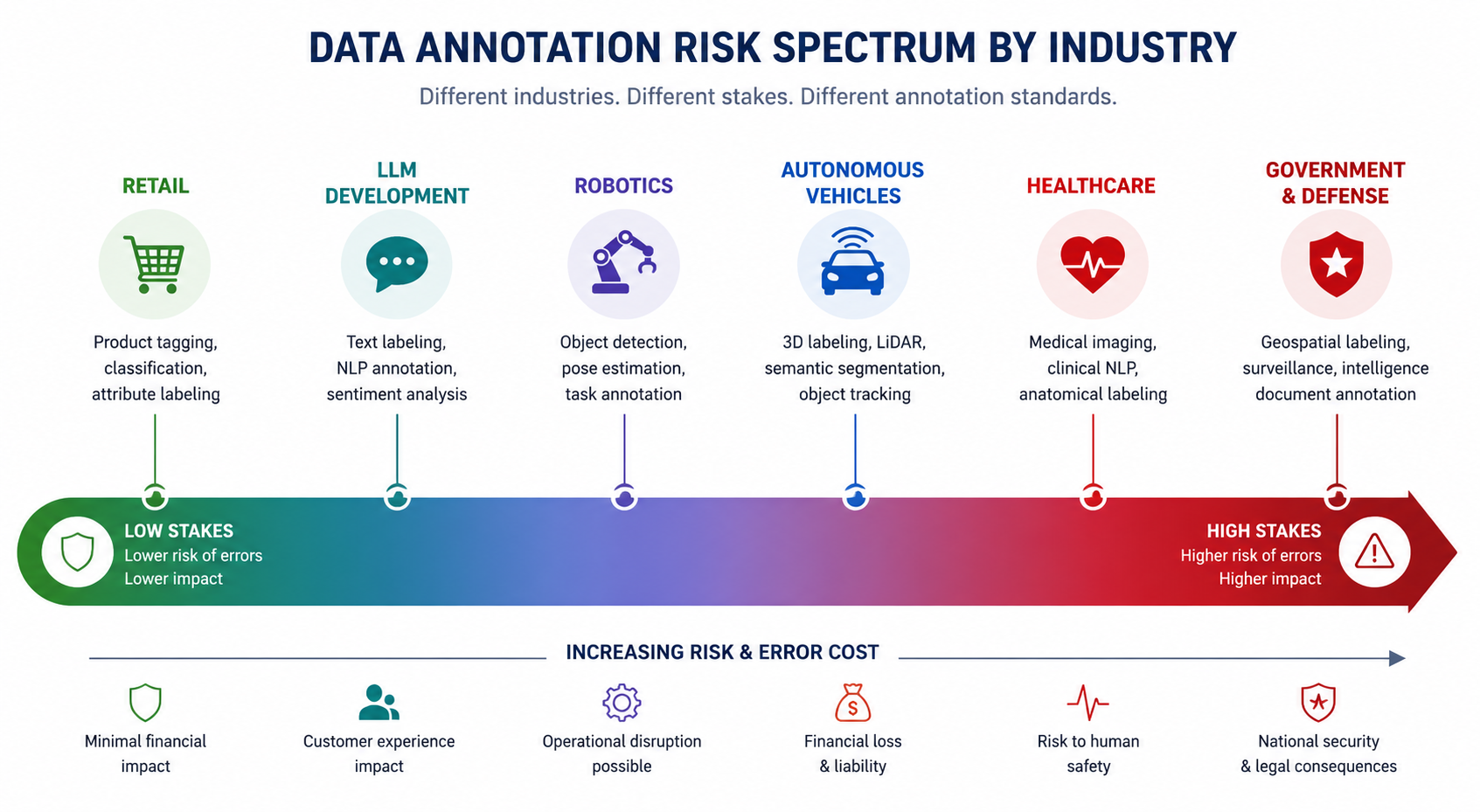
A labeling error in a retail product classification dataset costs a few misplaced recommendations. A labeling error in a diagnostic imaging dataset can teach a model a clinically significant blind spot. Industry-specific data labeling exists precisely because these error costs aren't remotely comparable, and neither is the annotation rigor each situation demands.
McKinsey's research on AI deployment across sectors has consistently found that domain-specific data preparation — not generic model architecture — is often the deciding factor in whether an AI system performs reliably in its actual production environment. Domain-specific data annotation is where that preparation either succeeds or quietly fails.
The differences that matter most across sectors include:
Required annotator expertise — a retail classification task needs general training; a radiology segmentation task needs clinical background
Compliance and audit burden — government/defense and healthcare data often need documented chain-of-custody; retail data typically doesn't
Acceptable error tolerance — an autonomous vehicle edge case has real safety stakes; a retail miscategorization does not
How It Works
AI training data services by industry generally adjust along four dimensions, and getting even one of them wrong undermines the value of the others:
Annotator background — matching annotator qualifications to the domain (clinical, legal, technical, multilingual) rather than defaulting to general-purpose labelers
Annotation type mix — some industries lean heavily on one annotation type (segmentation for healthcare imaging), while others need a broader mix (bounding boxes, classification, and NER for retail)
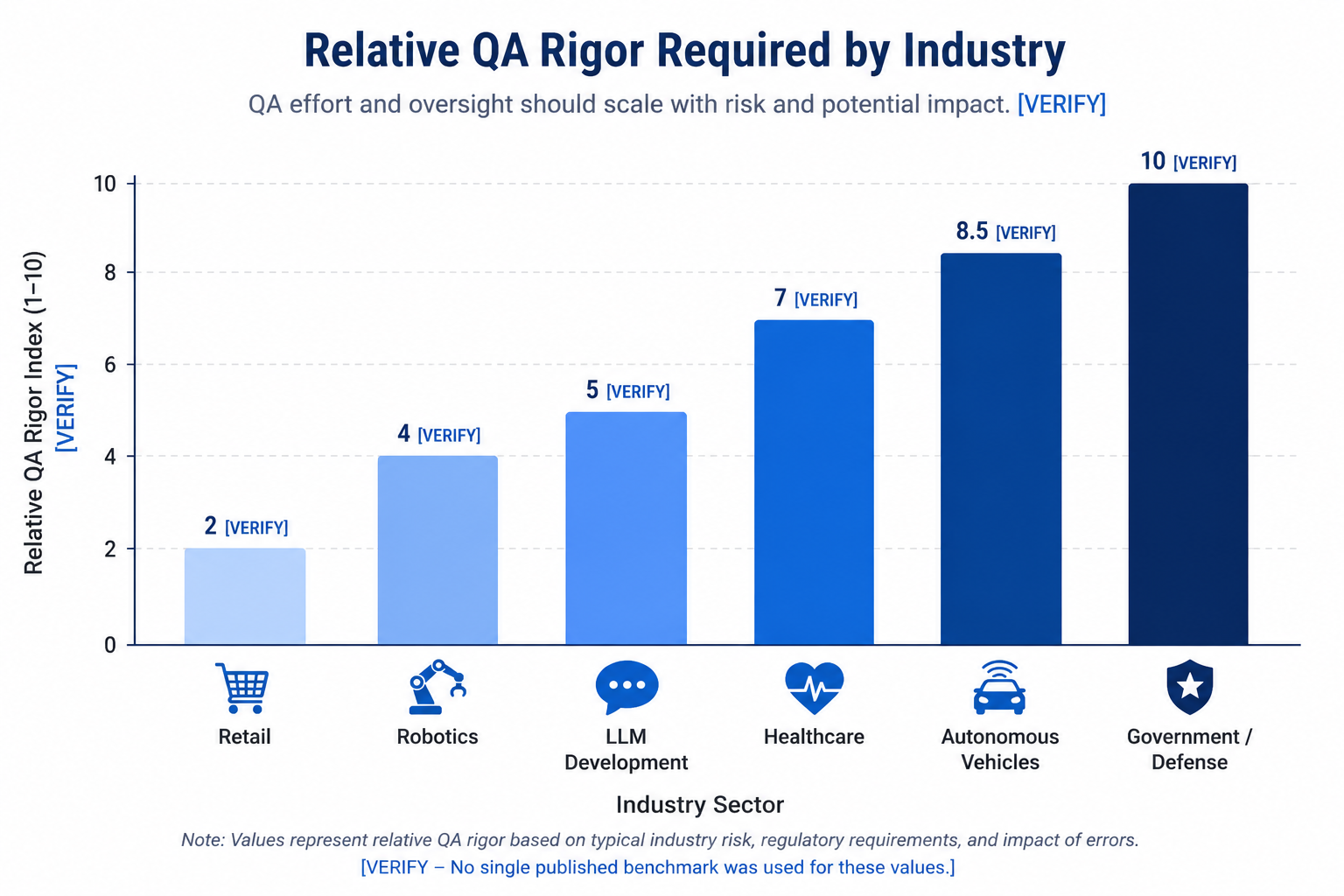
QA rigor — high-stakes sectors typically require tiered review and gold-standard testing, while lower-stakes sectors may rely more on confidence-based routing and lighter spot-checks
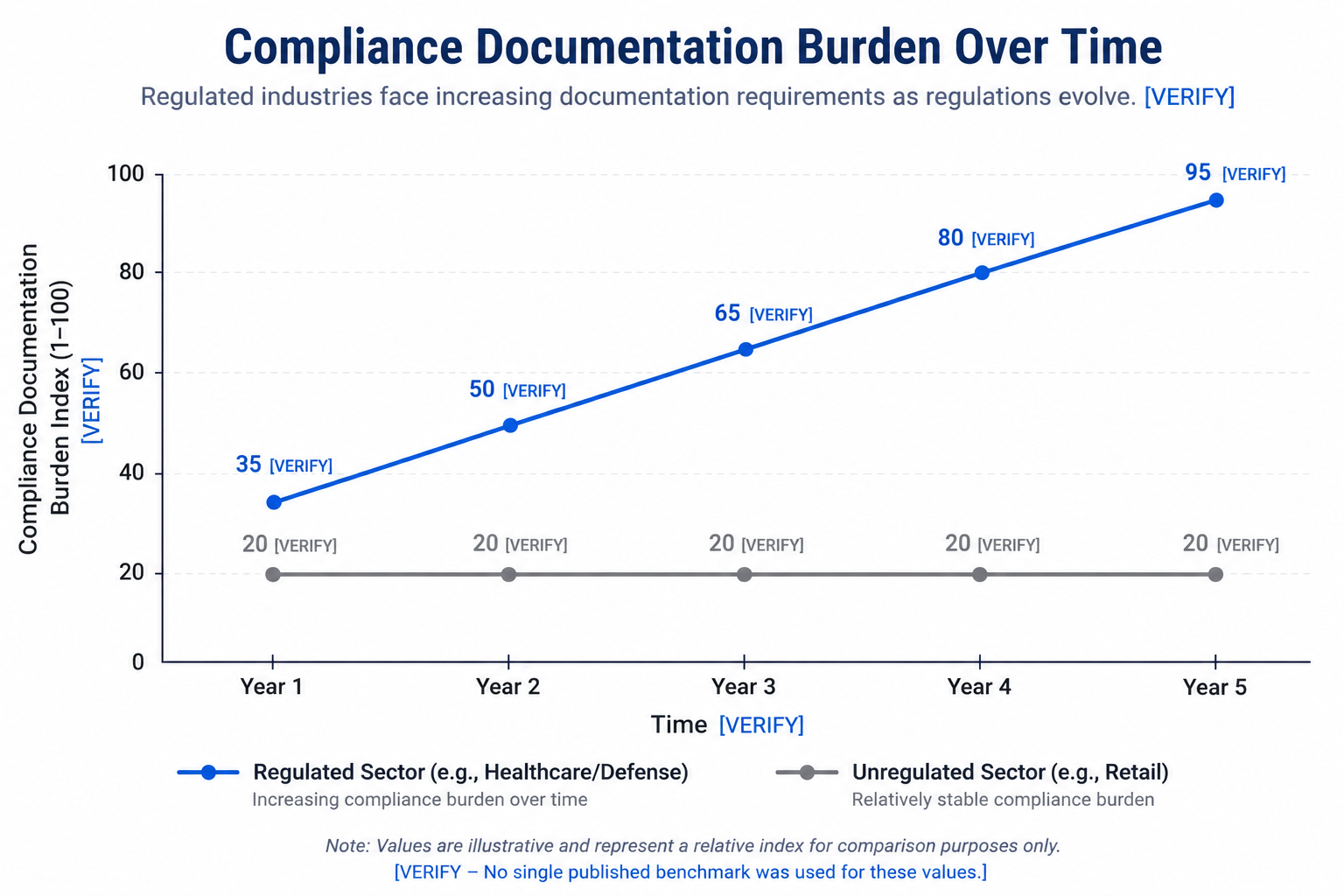
Compliance documentation — regulated sectors need auditable records of who labeled what and under what qualifications, which unregulated sectors generally don't need to track
🏢 How Requirements Shift by Sector
Reference
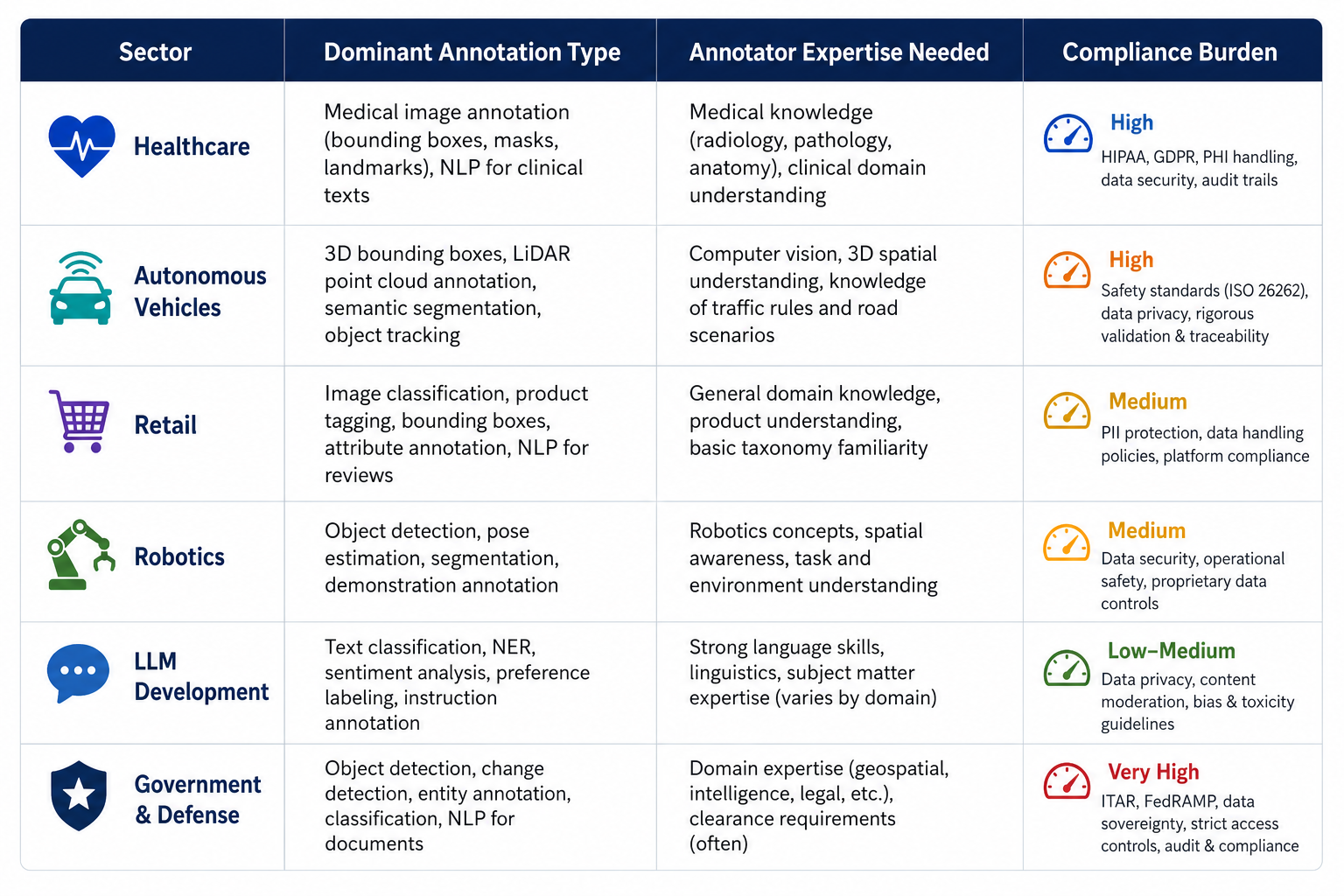
Annotation type, expertise needs, and compliance burden across six key industries.
Sector
Dominant Annotation Type
Annotator Expertise Needed
🛡️ Compliance Burden
🏥 Healthcare AI
Semantic segmentation, classification
Clinical training
🔴 High
🚗 Autonomous vehicles
3D point cloud, bounding box
Technical / domain training
🔴 High (safety‑critical)
🛍️ Retail AI
Classification, bounding box
General
🟢 Low
🤖 Robotics
Keypoint, 3D annotation
Technical training
🟡 Moderate
🧠 LLM development
NER, preference / comparison labeling
Linguistic / subject judgment
🟡 Moderate
🏛️ Government & defense
Geospatial, classification
Cleared personnel
🔴 Very high
Step-by-Step Workflow
Adapting an annotation approach to a specific industry generally follows this sequence:
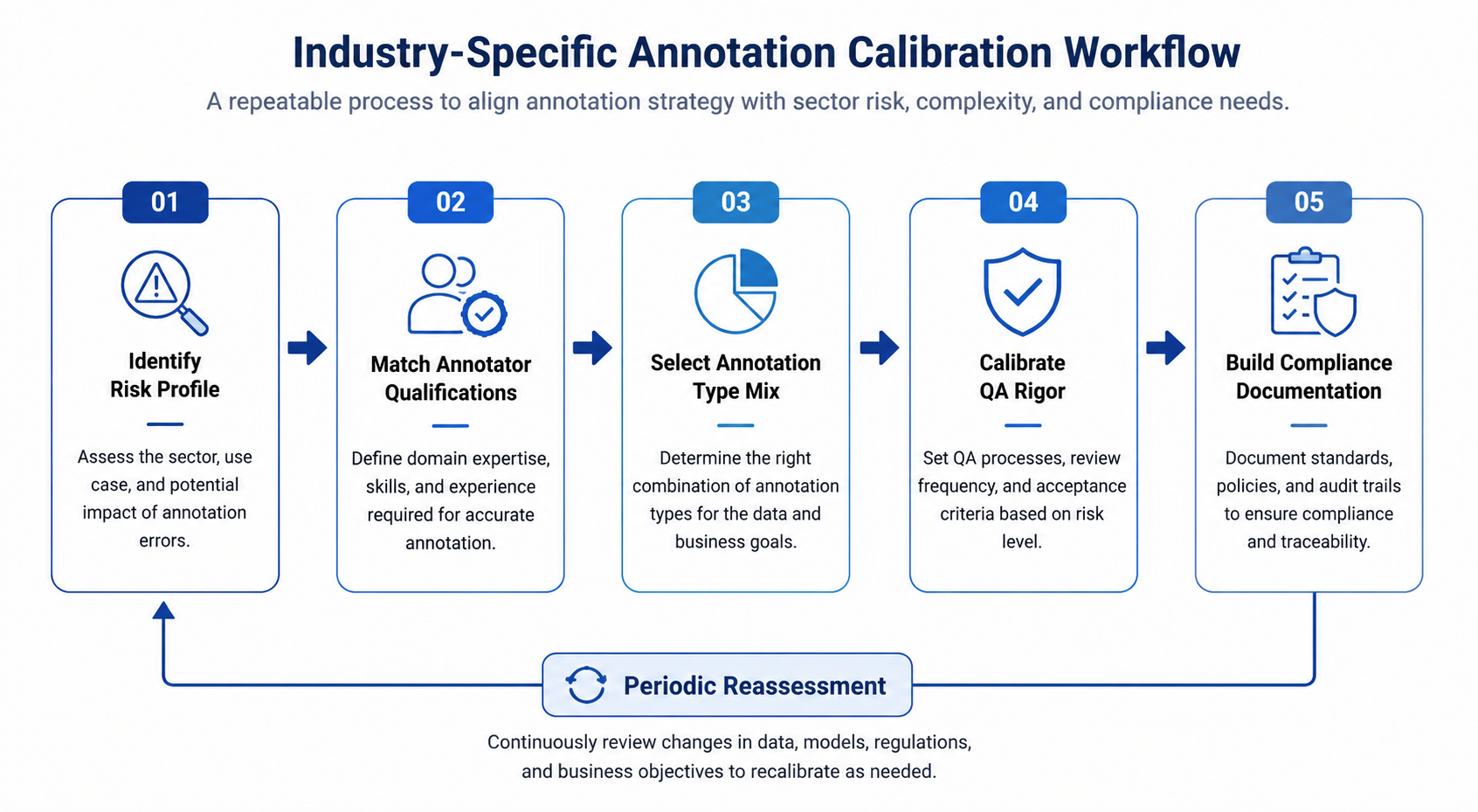
Identify sector-specific risk profile. Determine whether labeling errors carry safety, clinical, legal, or purely commercial consequences — this shapes every downstream decision.
Match annotator qualifications to the domain. Recruit or vet annotators with relevant background before annotation begins, rather than training generalists after the fact.
Select the dominant annotation type mix. Confirm which annotation types actually dominate your sector's data, and prioritize tooling and workflow design around those.
Calibrate QA rigor to risk tolerance. Apply tiered review and gold-standard testing where error cost is high, and confidence-based routing where volume and speed matter more.
Build compliance documentation into the workflow, not after it. For regulated sectors, capture annotator qualifications, review chains, and data handling records as part of the process itself.
Revisit sector requirements as regulations evolve. Compliance standards in healthcare, defense, and other regulated sectors shift over time — this type of data annotation work needs periodic review, not a one-time setup.
Industry Use Cases
Healthcare AI: Domain-specific data annotation here typically means clinically trained annotators labeling diagnostic imaging, with QA processes validated against known clinical ground truth rather than general annotator agreement alone.
Autonomous vehicles: Annotation work centers on 3D point cloud and sensor fusion labeling for lane detection, obstacle recognition, and rare-event scenarios, with tiered review reserved for edge cases a single annotator might miss.
Retail AI: High-volume classification and bounding-box work dominate, with lighter compliance overhead and QA weighted more toward confidence-based routing than toward audit documentation.
Robotics: Annotation needs shift as a robotics program matures — early-stage projects often need more human judgment on novel manipulation tasks, while mature programs can lean more on automated labeling for established motion patterns.
LLM development: Preference labeling and NER dominate, and annotator qualifications lean toward linguistic and subject-matter judgment rather than technical or clinical training.
Government & defense: Geospatial and classification annotation often require cleared personnel and audit-ready documentation, making compliance burden the primary constraint on vendor or team selection.
Bar chart comparing QA rigor required across industries for data annotation
Grand View Research has tracked the growing specialization within the data annotation and labeling market, noting that vendors increasingly differentiate by sector expertise rather than general labeling capacity — a trend that reflects how genuinely divergent these requirements have become.
Benefits
Calibrating annotation to sector-specific requirements pays off in ways generic approaches miss:
Lower error rates on the errors that actually matter, since annotator expertise is matched to the risk profile rather than applied uniformly
Reduced compliance risk, since documentation is built into the workflow for sectors that need it, rather than reconstructed after the fact
More efficient resource allocation, since low-risk sectors avoid unnecessary QA overhead while high-risk sectors get the rigor they require
Faster vendor or team evaluation, since sector-specific requirements narrow the field to providers with relevant experience
Common Mistakes
Applying a single QA standard across all data types. Using the same review rigor for a retail classification task and a clinical imaging task either overspends on the former or underprotects the latter.
Assuming general annotators can handle domain-specific data. Clinical, legal, and technical data often require background knowledge that general annotator training doesn't provide, regardless of instructions given.
Building compliance documentation retroactively. Trying to reconstruct chain-of-custody or annotator qualification records after a regulated project is underway is far harder than capturing them as part of the initial workflow.
Underestimating how sector requirements evolve. Regulatory and safety standards in healthcare, defense, and automotive sectors shift over time, and a workflow calibrated once at project start can become outdated.
Ignoring sector-specific edge cases during vendor evaluation. A vendor's general annotation experience doesn't guarantee experience with your sector's specific edge cases — this needs to be verified directly, not assumed.
Best Practices
Start every project by identifying the sector's actual risk profile, not just its data format
Recruit or vet annotators against sector-specific qualifications before annotation begins, rather than relying on general training alone
Calibrate QA rigor to error cost — heavier for healthcare, defense, and autonomous vehicle edge cases, lighter for high-volume commercial classification
Build compliance documentation into the workflow from the start for regulated sectors, rather than treating it as a final step
Reassess sector-specific requirements periodically, since regulatory standards and safety expectations shift over time
When evaluating vendors, ask specifically about experience with your sector's edge cases, not just general annotation capacity
Gartner's guidance on AI data operations has emphasized that sector-specific data preparation requirements are often underweighted in vendor selection relative to price and turnaround time — a pattern consistent with how many industry-specific annotation projects run into avoidable quality gaps.
FAQ
Why can't the same annotation process work across every industry?
Error cost, required annotator expertise, and compliance burden differ too much between sectors. A process calibrated for high-volume retail classification will either under-protect a healthcare imaging project or overspend on QA for a low-stakes commercial dataset.
What makes healthcare data annotation different from other domain-specific data annotation work?
Healthcare annotation typically requires clinically trained annotators and QA validated against known clinical ground truth, along with compliance documentation that most other sectors don't need to maintain.
Does industry-specific data labeling cost more than general annotation?
It often does, primarily due to the annotator expertise premium and additional QA or compliance overhead required in regulated or high-stakes sectors, though the cost is typically justified by the higher cost of errors in those contexts.
How do AI training data services by industry differ for autonomous vehicles versus retail?
Autonomous vehicle annotation centers on 3D point cloud and edge-case labeling with heavy QA for rare scenarios, while retail annotation is typically high-volume classification and bounding-box work with lighter compliance overhead.
Can a single annotation vendor handle multiple industries well?
Some vendors maintain distinct specialized teams for different sectors, but it's worth verifying a vendor's specific experience in your sector rather than assuming general annotation capacity transfers across industries.
How often should sector-specific annotation requirements be reassessed?
There's no universal cadence, but requirements should be revisited whenever relevant regulations change, or periodically even without a specific trigger, since standards in regulated sectors evolve over time.
Is compliance documentation only necessary for healthcare and government data?
Those sectors tend to have the strictest requirements, but any regulated or high-stakes domain — including certain financial or legal applications — may require similar documentation depending on jurisdiction and use case.
Conclusion
Industry specific data annotation isn't a marketing distinction — it reflects genuine differences in risk, expertise, and compliance burden across sectors. Calibrating annotator qualifications, QA rigor, and documentation to your actual industry, rather than applying a generic annotation template, is what determines whether a dataset holds up under your sector's specific stakes.
Create an interactive virtual showroom and engage affluent digital buyers with live 360º video calls, all through the CloudPano mobile app for a complete automotive sales solution.
Create 2D and 3D floor plans with measurements in 4 minutes or less, all from your phone. Download the Floor Plan Scanner app and get your first scan free.
Industry specific data annotation adjusts labeling methodology, annotator expertise, and QA rigor to match a sector's data type and risk profile. Healthcare requires clinically trained annotators and strict compliance documentation, autonomous vehicles require 3D and edge-case labeling for safety-critical scenarios, and retail prioritizes high-volume classification with lighter compliance overhead.
Data annotation quality assurance is the process of verifying label accuracy before it reaches a training pipeline, typically through consensus scoring, gold-standard test sets, and tiered review. Strong annotation quality control catches errors at the point of labeling rather than after model training, using human-in-the-loop quality assurance to flag inconsistent or low-confidence labels for review.
To choose a data annotation company, evaluate domain expertise, quality assurance methodology, data security certifications, tooling flexibility, and scalability under your expected volume. The best data annotation company for one project may not fit another — the right partner matches your specific annotation type, industry compliance needs, and growth timeline, not just price per label.