Data Annotation Quality Assurance: How Leading Providers Verify Accuracy
Cloudpano
September 25, 2026
•
5 min read
Share this post
How do data annotation providers verify the accuracy and quality of labeled training data?
Data annotation providers verify accuracy by combining multiple quality-control methods, such as multi-annotator review, annotation consolidation, validated reference labels, senior review, confidence scoring, and continuous quality monitoring. Rather than relying on a single accuracy check, strong data annotation quality assurance processes use several verification layers to identify disagreements, labeling errors, ambiguous guidelines, and difficult edge cases before data reaches model training.
Key Takeaways
Strong QA uses multiple verification layers. No single method catches every labeling error, so mature workflows combine independent review, reference data, escalation, and ongoing monitoring.
Multiple annotators can improve label reliability. Assigning the same item to more than one worker allows annotations to be compared and consolidated when appropriate. AWS documents annotation consolidation specifically as a method for combining multiple workers' annotations into a final label.
Ground-truth or validated reference data provides a quality baseline. Comparing labels against trusted examples gives teams a measurable way to evaluate accuracy rather than relying only on self-reported quality.
Confidence scores help prioritize review. Confidence information can help identify relatively uncertain labels for additional inspection, although confidence values should be interpreted within the context of the specific labeling workflow rather than as universal accuracy scores.
QA should continue throughout the annotation project. Recurring disagreements and errors can reveal problems with labeling instructions, taxonomy definitions, training, or the data itself. Quality findings should feed back into guidelines and review procedures instead of being treated only as end-of-project checks.
Data Annotation Quality Assurance: How Leading Providers Verify Accuracy
"We have a QA process" is one of the least verifiable claims in the annotation industry, mostly because almost no one explains what that process actually does. Understanding data annotation quality assurance at a mechanical level — not just as a marketing line — is what separates a labeling error caught in review from one that quietly ships into a training set.
This guide breaks down the specific methods rigorous providers use to verify label accuracy, where those methods commonly fall short, and how human-in-the-loop quality assurance fits into a modern annotation pipeline.
Why It Matters
A labeling error that reaches a training pipeline doesn't just cost one bad example — it can teach a model a systematic pattern that's expensive to unwind later, especially once a model has already been deployed on that pattern. Annotation quality control exists specifically to catch that error before it compounds.
NIST's AI Risk Management Framework explicitly identifies data quality and provenance as a documented risk category, not an implementation detail left to individual teams. That framing matters because it treats QA as something an organization should be able to describe and audit, not just something a vendor claims to do internally.
The stakes for weak QA vary sharply by context:
Healthcare AI, where an unflagged segmentation error in a training scan can propagate into diagnostic model blind spots
Autonomous vehicles, where inconsistent labeling of edge-case scenarios undermines exactly the data meant to handle rare events
Government & defense, where labeling decisions may need to be defensible under formal audit, not just statistically sound
How It Works
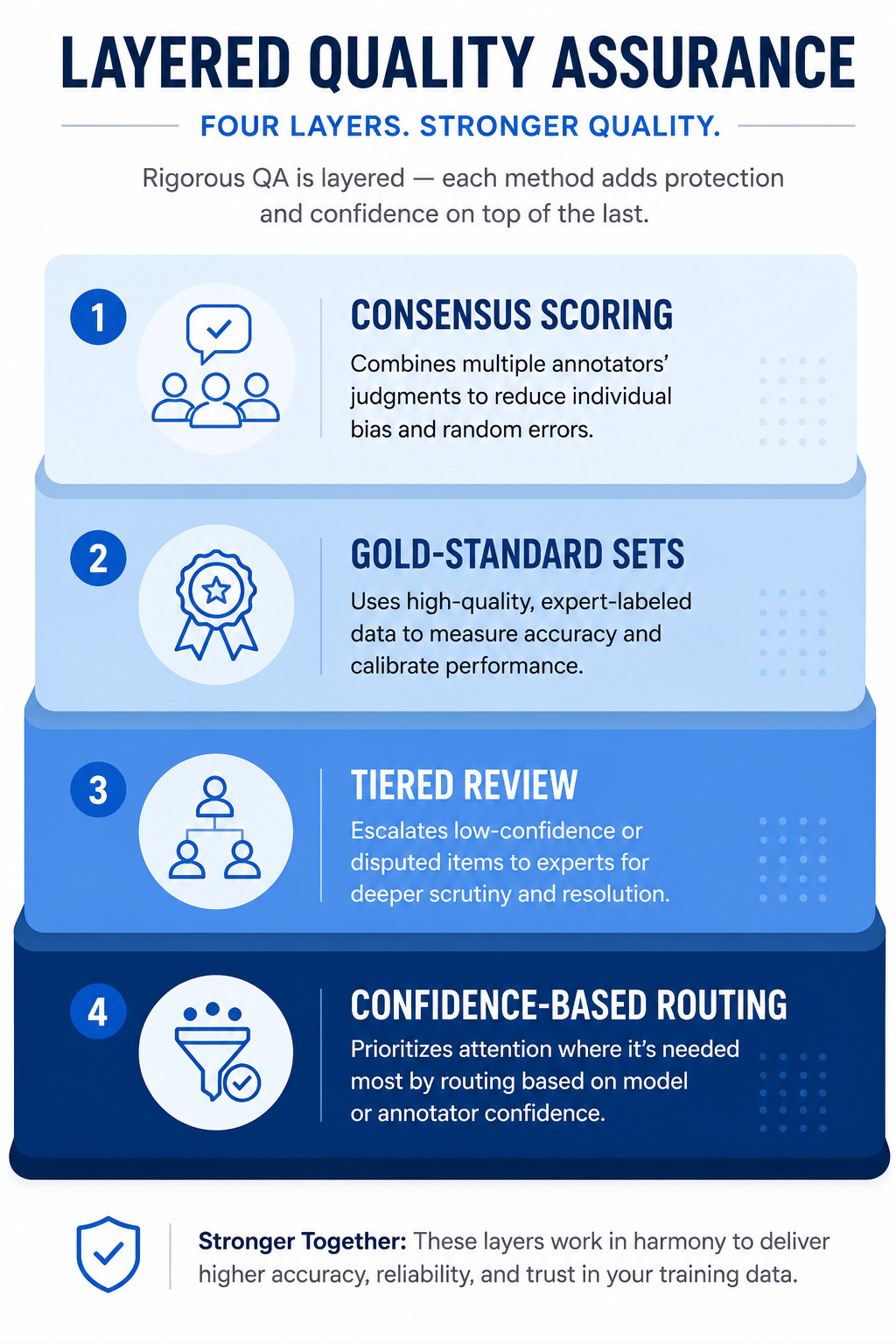
Rigorous data labeling quality assurance generally layers several verification methods rather than relying on a single check:
Consensus scoring — multiple annotators label the same item independently, and disagreement flags it for review rather than accepting a single annotator's judgment
Gold-standard test sets — a pre-validated set of correctly labeled examples is mixed into an annotator's workload, and their accuracy against this known-correct set is tracked continuously
Tiered review — junior annotator output is reviewed by senior annotators or subject-matter experts, with escalation paths for ambiguous cases
Confidence-based routing — in human-in-the-loop pipelines, model-predicted confidence scores determine which labels get mandatory human review versus a lighter spot-check
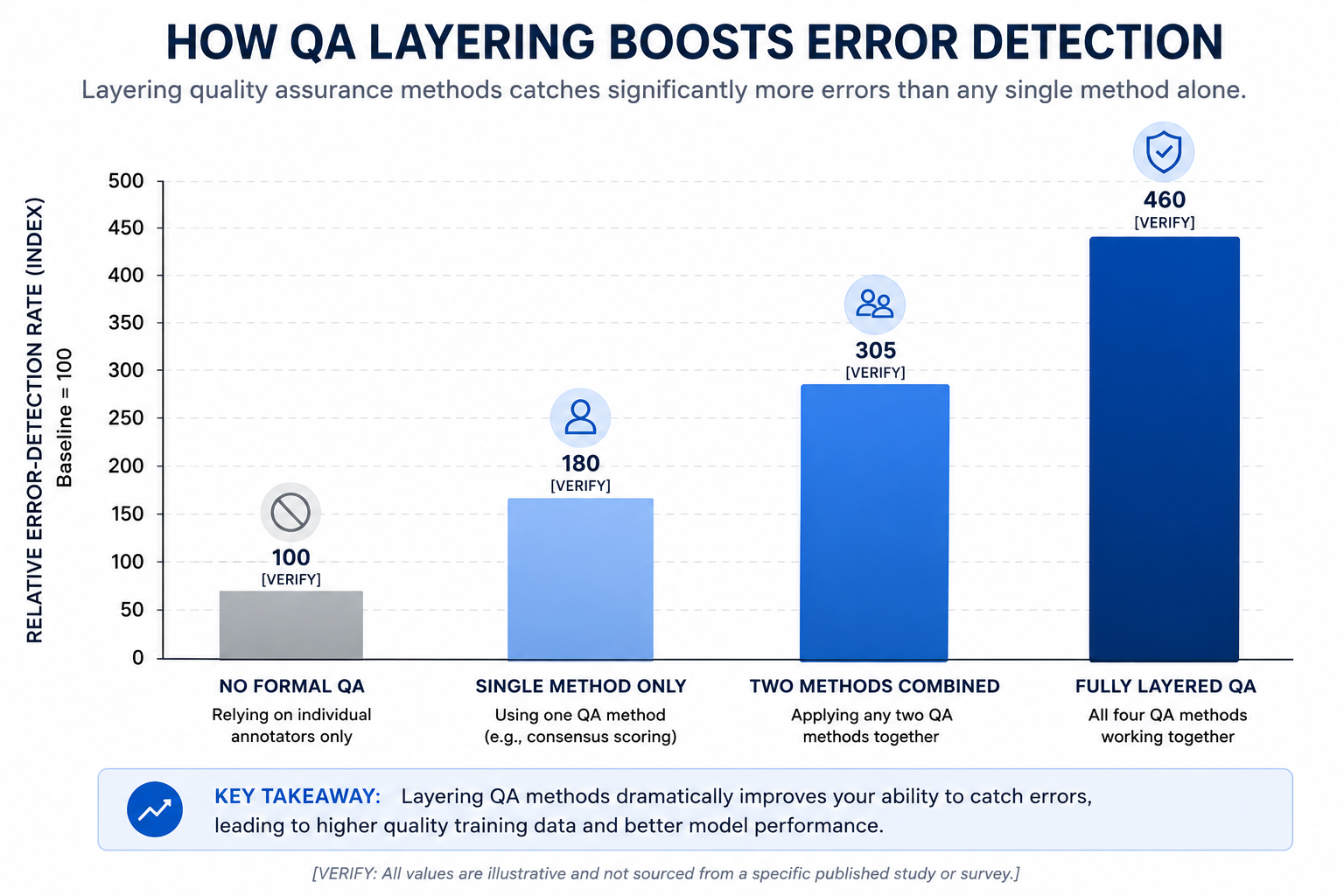
None of these methods is sufficient alone. Consensus scoring catches inconsistency between annotators but not a shared blind spot; gold-standard sets catch drift from known-correct answers but can't cover every edge case a live dataset will contain. This is how these workflows operate in combination in a mature QA process — layered, not singular.
🔍 QA Methods at a Glance
Reference
Four common quality assurance approaches — what they catch and what they miss.
Method
What It Catches
❌ What It Misses
📊 Consensus scoring
✅ Annotator‑to‑annotator inconsistency
⚠️ Shared blind spots across all annotators
🥇 Gold‑standard test sets
✅ Drift from known‑correct answers
⚠️ Novel edge cases not represented in the test set
📋 Tiered review
✅ Errors junior annotators miss
⚠️ Bottlenecks if senior review capacity is limited
🎯 Confidence‑based routing
✅ Low‑confidence automated labels
⚠️ Overconfident but incorrect model predictions
Step-by-Step Workflow
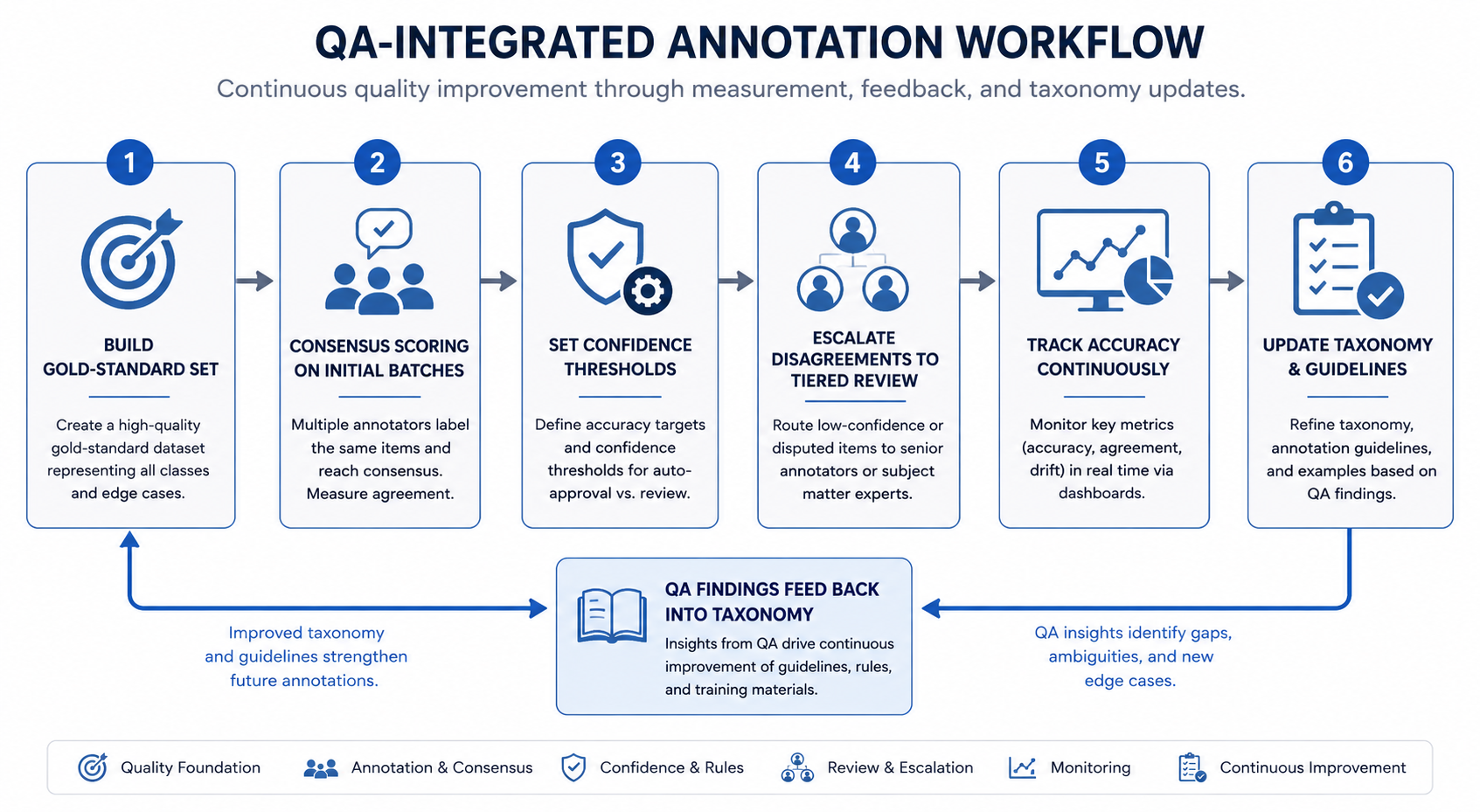
A typical QA-integrated annotation workflow moves through these stages:
Build a gold-standard test set. Validate a representative sample of labels internally before annotation begins at scale, and mix these into the ongoing workload undetected by annotators.
Route initial batches through consensus scoring. Assign a subset of early data to multiple annotators to establish a baseline agreement rate before scaling to single-annotator throughput.
Set confidence thresholds for automated pre-labeling. If a model pre-labels data, define which confidence range requires mandatory human review versus spot-check only.
Escalate disagreements to tiered review. Route flagged items — whether from consensus disagreement or low model confidence — to senior annotators or subject-matter experts.
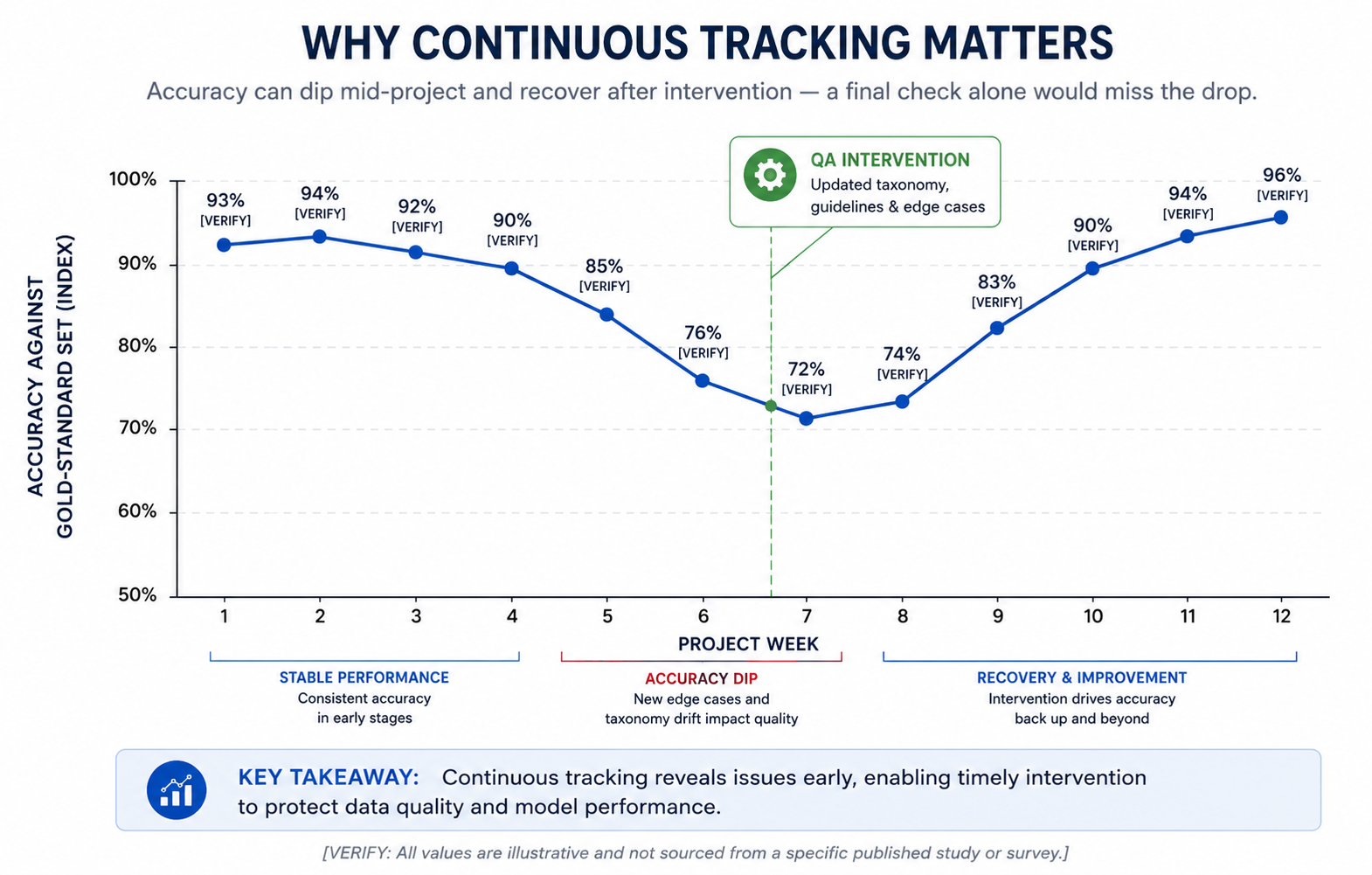
Track accuracy against the gold-standard set continuously. Monitor individual and team-level accuracy trends, not just a single project-end score.
Feed QA findings back into the taxonomy. Recurring disagreement patterns often signal an ambiguous label definition, not just annotator error — update guidelines accordingly.
Industry Use Cases
Autonomous vehicles: Tiered review and consensus scoring are typically applied to rare-event and edge-case labeling, where a single annotator's miss could mean an unrepresented safety scenario.
Healthcare AI: Gold-standard test sets validated by clinically trained reviewers are common, since general consensus scoring alone may not catch a clinically significant but subtle labeling error.
Retail AI: Confidence-based routing is used heavily for high-volume classification, reserving human review mainly for new product categories or ambiguous imagery.
Robotics: QA processes often need to adapt quickly as taxonomies evolve, making the feedback loop from QA findings back into labeling guidelines especially important.
LLM development: Consensus scoring is central to preference and comparison labeling, where annotator judgment naturally varies and disagreement itself is often meaningful signal, not just error.
Government & defense: Tiered review with cleared, audit-ready documentation is often mandatory, regardless of what lighter QA methods might otherwise suffice.
Google Research has published work on data quality practices in ML pipelines emphasizing that systematic label verification — not just spot-checking — meaningfully improves downstream model reliability, particularly on tasks with high annotator disagreement potential.
Benefits
A layered QA process pays off in ways that are easy to underestimate until a project scales:
Fewer retraining cycles, since errors are caught before they reach the training pipeline rather than after model evaluation reveals a problem
Defensible documentation, useful for regulated industries where labeling decisions may need to be audited
Faster identification of taxonomy problems, since recurring disagreement patterns surface ambiguous label definitions early
More efficient human review over time, since confidence-based routing focuses reviewer attention where it's actually needed rather than uniformly
Common Mistakes
Relying on a single QA method. Consensus scoring alone, or gold-standard testing alone, each misses error categories the other would catch — layering methods is what closes those gaps.
Treating disagreement as pure annotator error. Recurring disagreement often indicates an ambiguous taxonomy, not a training problem with the annotators.
Setting confidence thresholds once and never revisiting them. As a pre-labeling model improves or data distribution shifts, static thresholds either over- or under-route items to human review.
Under-resourcing tiered review. If senior reviewers or subject-matter experts are stretched too thin, tiered review becomes a bottleneck rather than a genuine quality gate.
Measuring QA success only at project completion. Waiting until the end of a project to check accuracy trends misses the chance to correct course while it's still cheap to do so.
Best Practices
Layer multiple QA methods rather than relying on any single check — consensus scoring, gold-standard sets, and tiered review each catch different error types
Build gold-standard test sets that represent genuine edge cases, not just average-case data, so accuracy tracking reflects real-world performance
Revisit confidence thresholds on a regular cadence, especially after retraining a pre-labeling model
Feed recurring disagreement patterns back into taxonomy updates, treating QA findings as a signal for process improvement, not just an error log
Track accuracy continuously throughout a project, not only at delivery, so issues surface while correction is still inexpensive
IBM Research has highlighted human-in-the-loop verification as a key mechanism for maintaining data quality in production ML systems, particularly where fully automated verification struggles to catch context-dependent labeling errors — consistent with how mature annotation QA processes are typically structured in practice.
Conclusion
Data annotation quality assurance is a mechanical process with specific, describable methods — not a marketing claim that should be taken on faith. Consensus scoring, gold-standard test sets, tiered review, and confidence-based routing each catch different error categories, and mature QA processes layer them rather than relying on any single check.
What's the difference between annotation quality control and data annotation quality assurance?
The terms are largely used interchangeably. Some practitioners use "quality control" for the specific checks applied during labeling (consensus scoring, spot-checks) and "quality assurance" for the broader process design around those checks, but there's no strict industry-wide distinction.
How does human-in-the-loop quality assurance differ from traditional manual review?
Human-in-the-loop quality assurance typically uses model confidence scores to route only uncertain or high-risk labels to human reviewers, rather than reviewing every item manually. This focuses reviewer time where it adds the most value.
What is a gold-standard test set, and why does it matter?
It's a set of pre-validated, known-correct labels mixed into an annotator's regular workload without their knowledge, used to measure ongoing accuracy against a trusted baseline rather than relying on annotators to self-report quality.
How much disagreement between annotators is normal?
This varies significantly by task ambiguity and isn't governed by a single universal benchmark — what matters more is tracking disagreement trends over time and investigating recurring patterns rather than fixating on a single agreement percentage.
What happens when consensus scoring reveals persistent disagreement?
Persistent disagreement usually signals that the taxonomy or labeling guidelines need clarification, rather than indicating annotator error — the QA process should route these cases back into taxonomy review, not just resolve them and move on.
Create an interactive virtual showroom and engage affluent digital buyers with live 360º video calls, all through the CloudPano mobile app for a complete automotive sales solution.
Create 2D and 3D floor plans with measurements in 4 minutes or less, all from your phone. Download the Floor Plan Scanner app and get your first scan free.
Home robots and vision models need video from real homes, yet the best-known indoor datasets cover a few dozen kitchens or a few hundred people. This guide explains why home footage is scarce, what public datasets offer, and how custom in-home collection works.
Learn how Reinforcement Learning from Human Feedback (RLHF) helps improve AI models through human preferences, response rankings, reward modeling, and evaluation. Explore how RLHF services support better instruction following, helpfulness, safety, and overall LLM performance.
Explore 47 open egocentric and robotics datasets for AI, computer vision, embodied AI, and robot learning. This guide compares each dataset’s primary focus and license or access terms to help researchers identify suitable training data and understand what to verify before commercial use.


.png)




.png)

.png)








.svg)


.svg)