


.png)


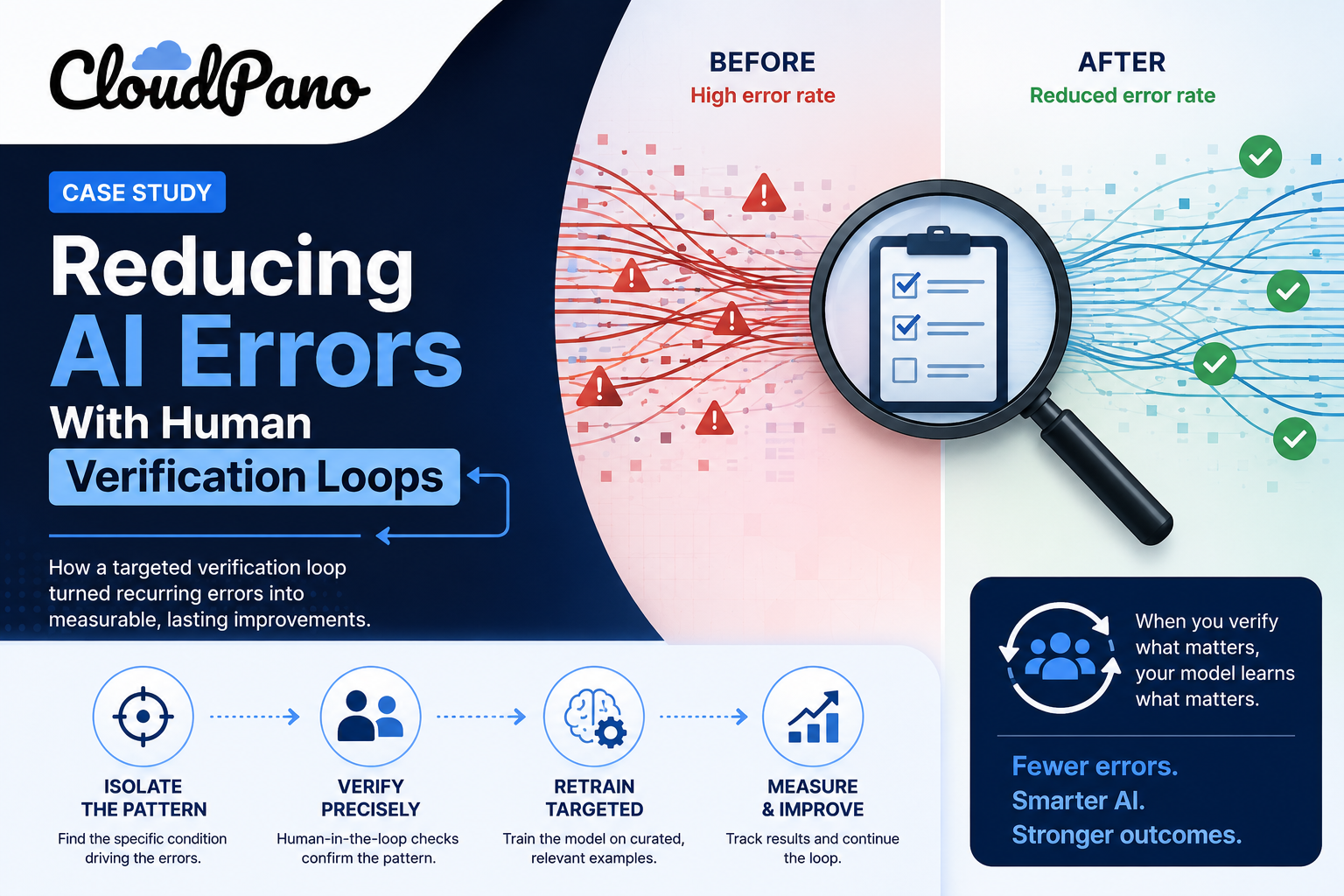
This human verification AI case study follows a manufacturing computer vision team running an automated visual inspection system for surface defects on a production line. The system worked well overall, but it had a specific, recurring blind spot: a category of subtle surface defects that looked similar to acceptable variation under certain lighting conditions.
The team's first instinct was to keep retraining on more general defect data. That didn't resolve the pattern, because the problem wasn't a lack of data volume — it was a specific, identifiable ambiguity the model consistently handled the same wrong way. This is where a targeted human-in-the-loop AI example actually applies.
Errors that repeat in a specific, identifiable pattern are different from random noise, and treating them the same way — with more general training data — rarely resolves them. Google Research's "Data Cascades" study documented how unaddressed, specific data and model issues compound over time into larger problems that get harder to trace the longer they go unaddressed (Sambasivan et al., Google Research).
NIST's AI Risk Management Framework treats ongoing monitoring and targeted correction as a distinct, necessary function of a trustworthy AI system, not something a general retraining pass automatically covers (NIST AI RMF).
Getting this right matters more given how quickly manufacturing and other operational AI systems are being deployed at scale. Stanford HAI's AI Index has tracked the growing footprint of AI in operational and industrial contexts (Stanford HAI, AI Index Report), and a recurring, unaddressed error pattern in a production system carries a real, ongoing cost the longer it goes uncorrected.
In this scenario, the team built a verification loop around the specific error pattern rather than a general review process across all model outputs.
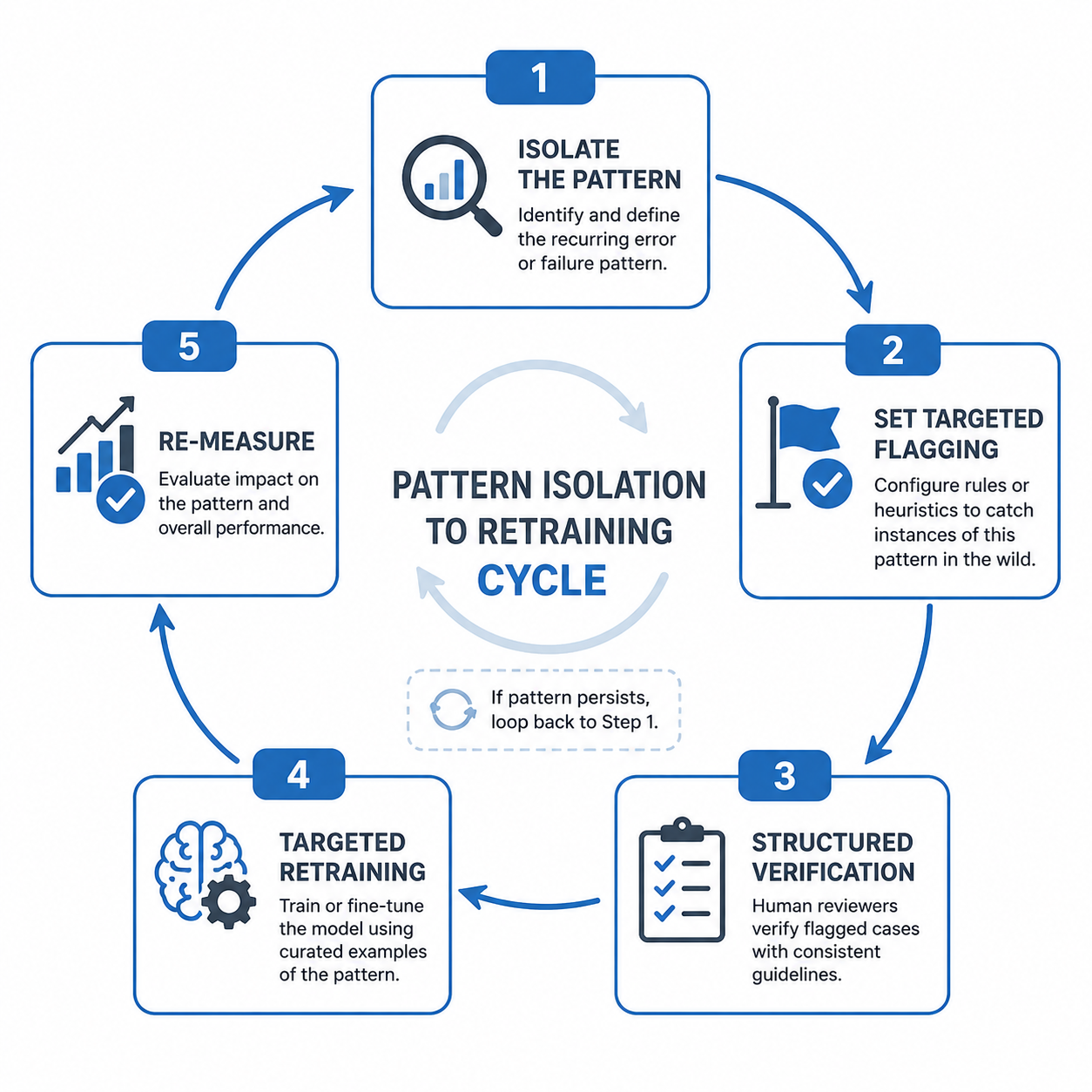
Isolating the pattern. Before designing any verification step, the team reviewed a sample of the model's errors and confirmed they clustered around a specific condition — a particular lighting angle combined with a specific surface texture — rather than being randomly distributed.
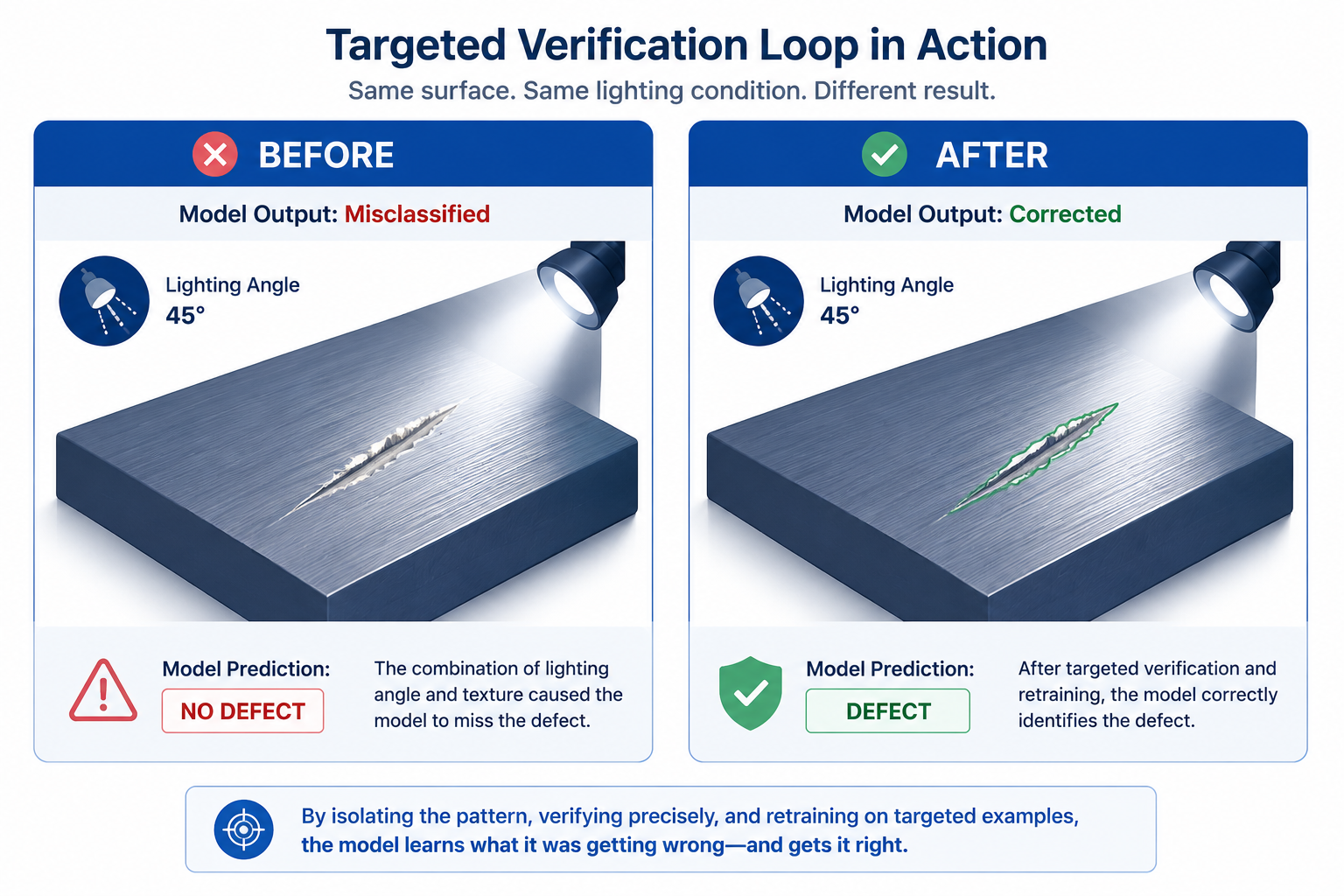
Targeted confidence flagging. Rather than reviewing every inspection, the team set a trigger specifically for cases matching that condition, routing only those to human verification.
Structured verification, not generic re-labeling. Verifiers were given the specific ambiguity the model was struggling with, along with clear criteria for the distinction, rather than being asked to relabel from scratch.
Feedback into targeted retraining. Verified corrections were used specifically to retrain on that error pattern, rather than added to the general training pool without any priority signal attached.
This is what separates an AI quality assurance case study with a real, measurable outcome from a generic "we added human review" story: our training data services team consistently sees that targeting the specific pattern, rather than reviewing broadly, is what actually moves the error rate.
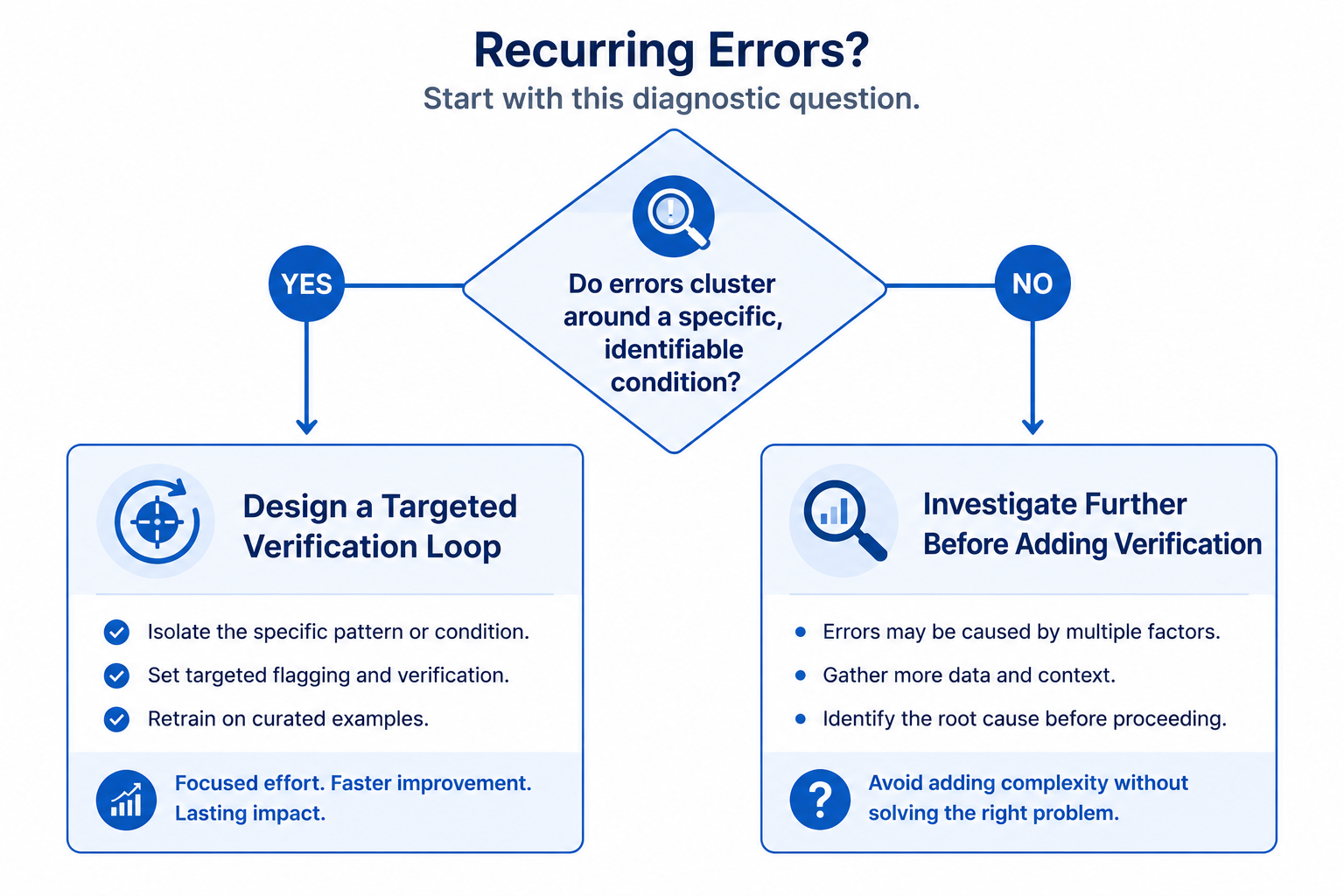
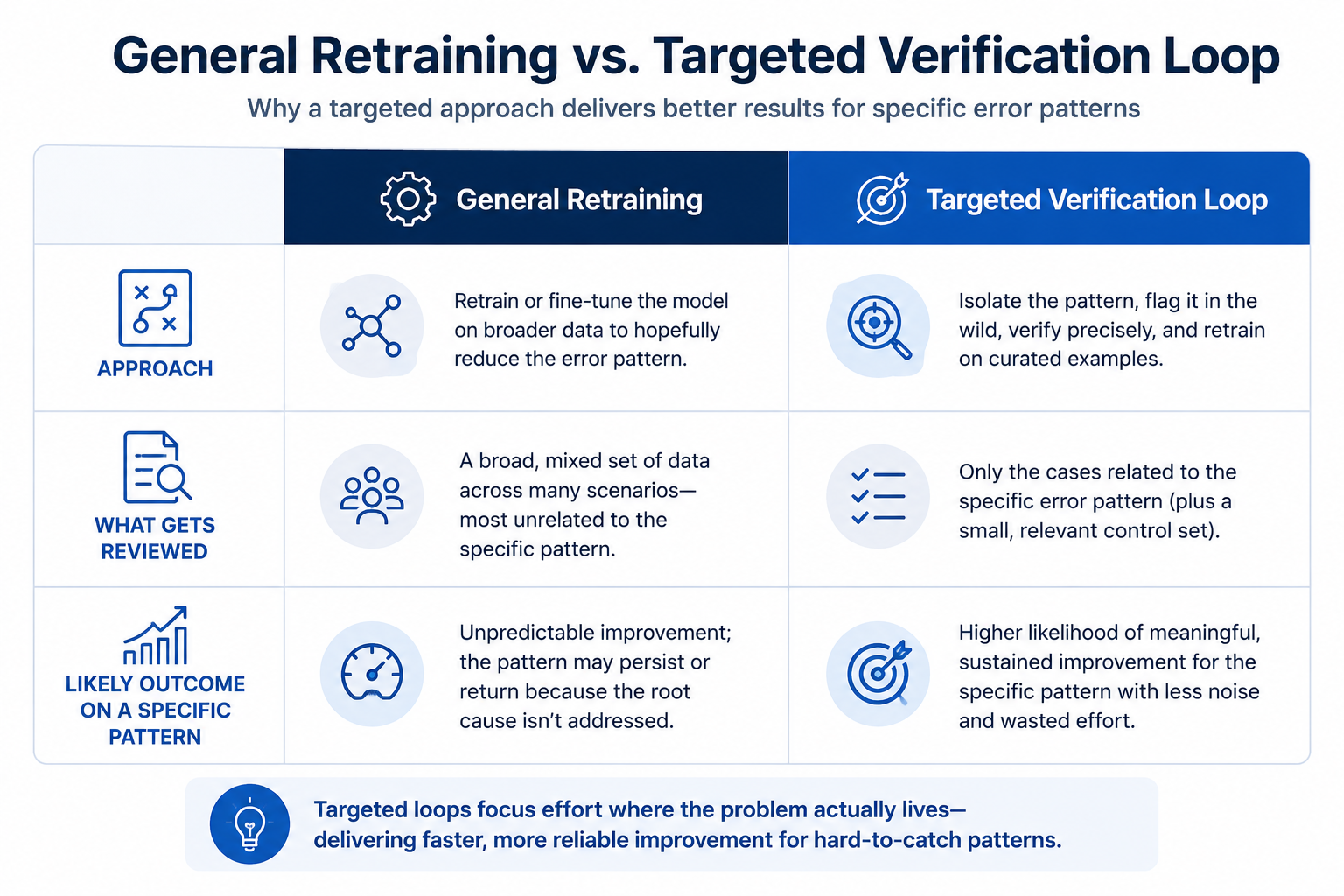
Isolating a specific, recurring error pattern, flagging only cases matching that condition for review, giving verifiers precise criteria, and feeding corrections back into targeted retraining.
Because the error wasn't due to a lack of data volume — it traced to a specific, identifiable ambiguity the model consistently handled the same way, which broader training data didn't specifically address.
It concentrates human attention on cases matching a specific, identified error pattern, which is more efficient and effective than reviewing everything with equal priority.
Sample and review a set of errors to check whether they cluster around a specific, identifiable condition, rather than being distributed randomly across otherwise normal cases.
Precise criteria describing the specific ambiguity the model is struggling with, not a general instruction to check for errors broadly.
Re-measure the error rate specifically on the original condition that triggered the verification loop, rather than relying only on overall accuracy metrics, which can mask whether the targeted pattern improved.
Not always. The pattern may narrow over successive cycles rather than resolve completely in one pass, so re-checking in subsequent retraining cycles is part of the process.
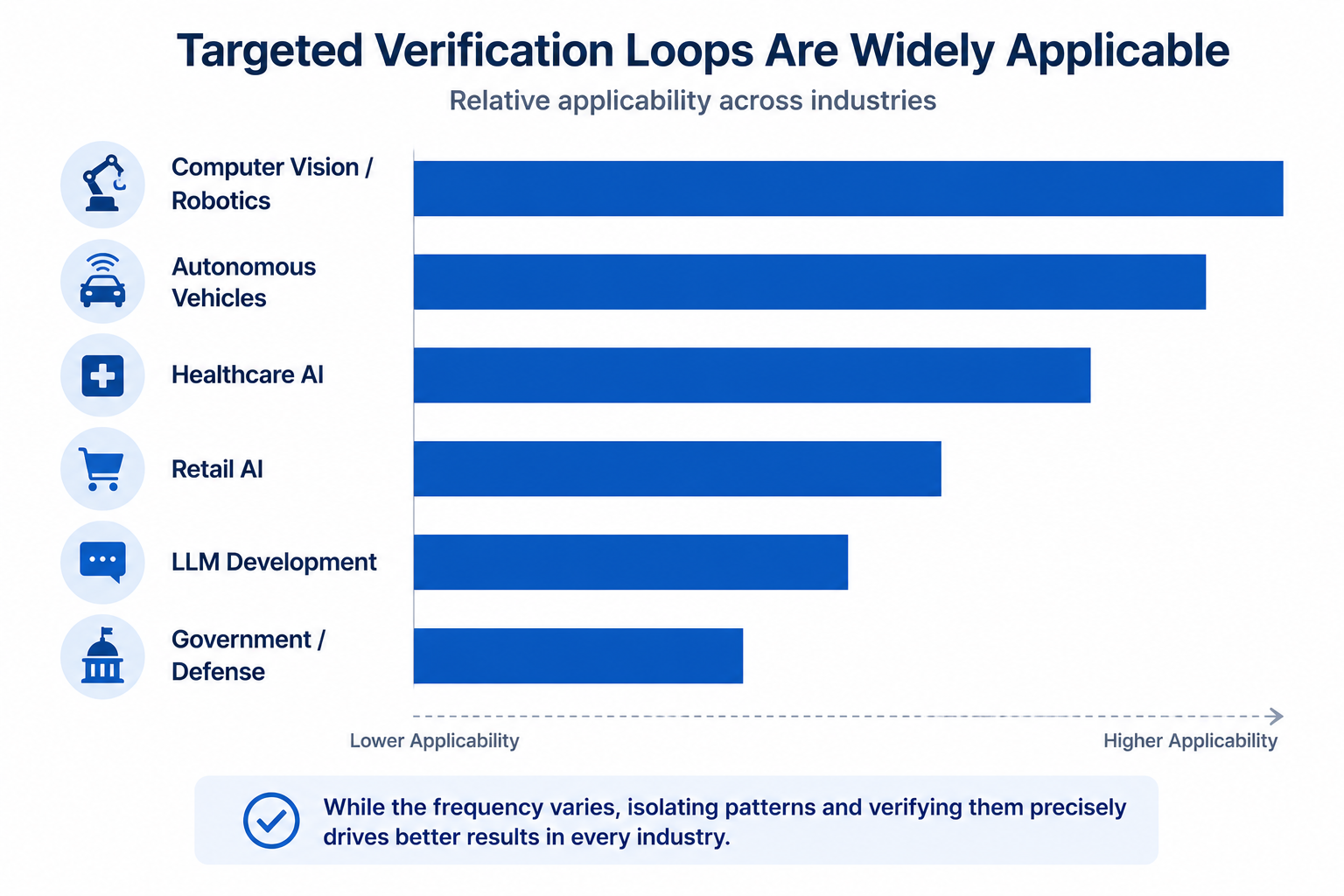
This human verification AI case study illustrates a pattern that applies well beyond manufacturing inspection: a specific, recurring error is rarely solved by more general data. Isolating the exact condition driving the error, targeting verification at that condition specifically, and feeding corrections into focused retraining is what actually resolves the pattern — and it's a repeatable process for whatever new recurring error a system develops next.


Compact, ready to go anywhere
Interchangeable lens that’s upgradeable
Dual 1-inch sensors for improved clarity and low light performance
Dynamic range and 6K 360° capture
360° photo resolution at 21MP

8K 360° video recording for ultra-detailed visuals.
4K single-lens mode for traditional wide-angle shots.
Invisible selfie stick effect for drone-like perspectives.
2.5-inch touchscreen with Gorilla Glass protection.
Waterproof up to 33ft for underwater shooting.

360° photo resolution in 23MP
Slim design at 24 mm thick
Built-in image stabilization for smooth video capture.
Internal 19GB storage for photo and video storage.
Wireless connectivity for remote control and sharing.

60MP 360° still images for high-resolution photography.
5.7K 360° video recording at 30fps.
2.25-inch touchscreen for intuitive control.
USB Type-C port for fast charging and data transfer.
MicroSD card slot for expandable storage.
.png)

.png)

Try it free. No credit card required. Instant set-up.







.svg)


.svg)