


.png)


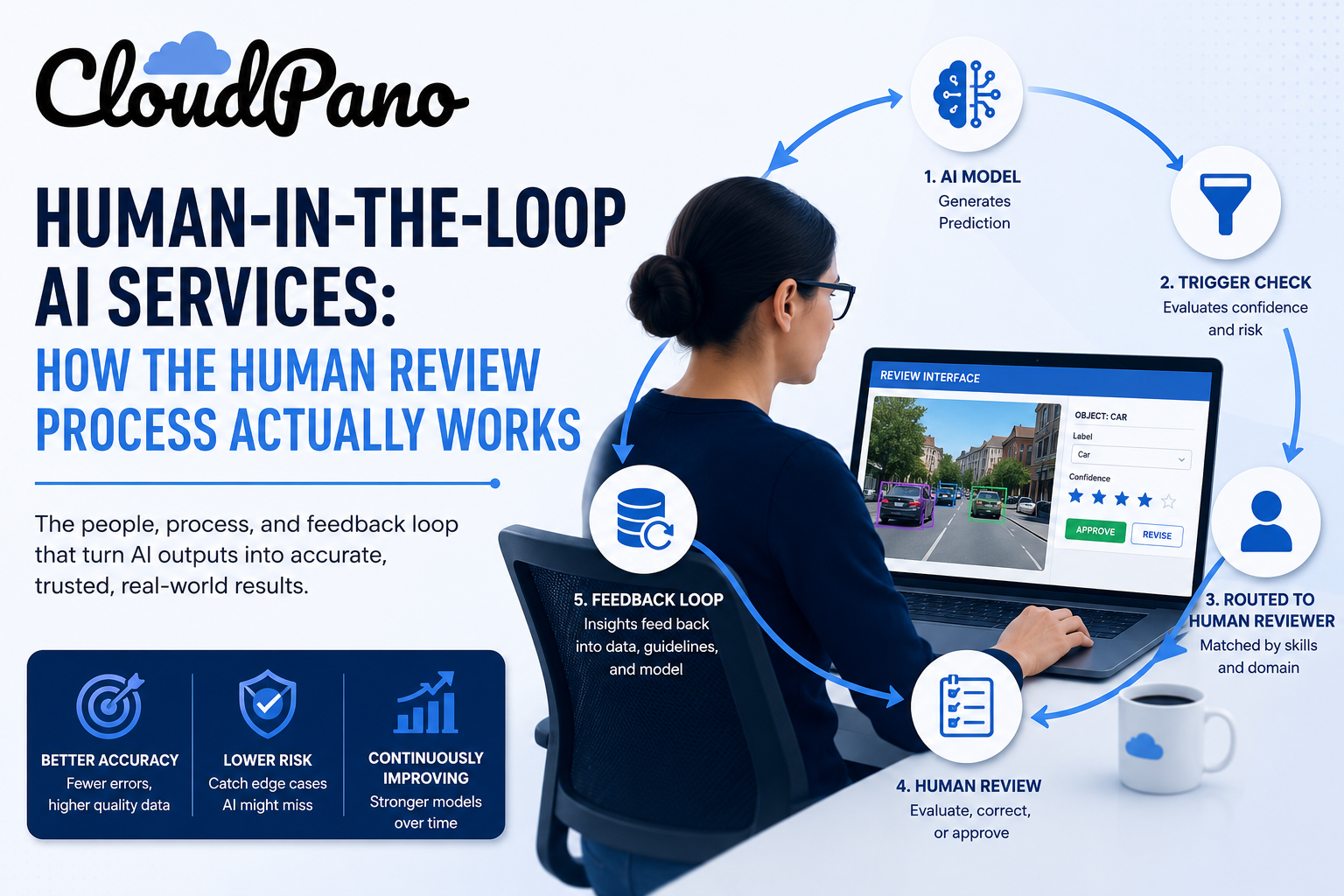
Human-in-the-loop AI services get talked about as a general concept far more often than as an actual operational service — something with defined triggers, review roles, and a feedback path back into the model. That gap makes it hard to scope as a distinct offering rather than a vague best practice everyone nods along to.
The useful version of human-in-the-loop isn't "have people check the model sometimes." It's a structured process: specific conditions that route a case to a human, a defined reviewer role suited to that case type, and a clear path for the review outcome to improve the system going forward.
Models fail predictably in specific, identifiable ways — low-confidence predictions, ambiguous inputs, and rare edge cases — and a human-in-the-loop process is only valuable if it's built to catch exactly those failure modes rather than reviewing arbitrarily. Google Research's "Data Cascades" study documented how unaddressed data and model issues compound over time, and a well-targeted human review process is one of the more direct ways to interrupt that pattern before it compounds (Sambasivan et al., Google Research).
NIST's AI Risk Management Framework specifically discusses human oversight as a component of trustworthy AI systems, treating it as a designed control rather than an informal backstop — which is a useful standard for evaluating whether a human-in-the-loop machine learning process is genuinely structured or just nominal (NIST AI RMF).
The stakes of getting this right rise with how quickly models move into production. Stanford HAI's AI Index has tracked the accelerating pace of enterprise AI deployment (Stanford HAI, AI Index Report), and a poorly designed review process can become a bottleneck exactly when a team needs to move fastest.
A functioning human-in-the-loop service has three connected components.

Trigger conditions. Rules that route a specific case to human review — typically a confidence threshold below which the model shouldn't decide alone, a flagged category of high-stakes decision, or a case type the model has historically handled poorly.
Reviewer role and expertise. The actual person or team reviewing flagged cases, matched to the complexity and domain of what's being reviewed — a generalist reviewer for straightforward ambiguity, a domain specialist for technical or clinical cases.

Feedback integration. How a review outcome gets used — correcting a specific prediction, but also feeding back into training data, guideline revisions, or model retraining so the same failure mode becomes less frequent over time.
Understanding how these workflows operate as these three connected pieces — not a vague "add human oversight" instruction — is what separates a human-in-the-loop data annotation process that actually improves outcomes from one that just adds a review step without a clear purpose.


Structured services that route specific model outputs — based on defined trigger conditions like low confidence or high-stakes category — to human reviewers, with review outcomes feeding back into training data or model improvement.
It's built around specific, defined trigger conditions and a documented feedback loop, rather than informal or arbitrary review, which is what makes it a structured process instead of a general safeguard.
Common triggers include predictions below a confidence threshold, cases from a category the model has historically handled poorly, and decisions flagged as high-stakes regardless of model confidence.
Reviewer expertise should match the case type — generalist reviewers for straightforward ambiguity, domain specialists (clinical, technical, safety-critical) for cases requiring that specific expertise.
Through a feedback loop that routes review outcomes into training data corrections, guideline revisions, or flagged patterns for retraining, rather than treating each review as a one-off fix.
No, though it matters most visibly there. It's also widely used for tasks like content moderation, subjective judgment calls, and any case type where automation is known to be less reliable.
Periodically, as the model improves on previously flagged case types and potentially develops new failure modes that weren't part of the original trigger conditions.
Human-in-the-loop AI services deliver value when they're built as a structured process — specific trigger conditions, appropriately matched reviewer expertise, and a real feedback loop back into the model — rather than a vague commitment to "keep a human in the loop." Teams that design it this way get targeted accuracy improvement exactly where automation is weakest, not just a general sense of added oversight.


Compact, ready to go anywhere
Interchangeable lens that’s upgradeable
Dual 1-inch sensors for improved clarity and low light performance
Dynamic range and 6K 360° capture
360° photo resolution at 21MP

8K 360° video recording for ultra-detailed visuals.
4K single-lens mode for traditional wide-angle shots.
Invisible selfie stick effect for drone-like perspectives.
2.5-inch touchscreen with Gorilla Glass protection.
Waterproof up to 33ft for underwater shooting.

360° photo resolution in 23MP
Slim design at 24 mm thick
Built-in image stabilization for smooth video capture.
Internal 19GB storage for photo and video storage.
Wireless connectivity for remote control and sharing.

60MP 360° still images for high-resolution photography.
5.7K 360° video recording at 30fps.
2.25-inch touchscreen for intuitive control.
USB Type-C port for fast charging and data transfer.
MicroSD card slot for expandable storage.
.png)

.png)

Try it free. No credit card required. Instant set-up.




.svg)


.svg)