Human-in-the-Loop vs. Automated AI Pipeline: When Human Oversight Matters

Cloudpano
July 24, 2026
5 min read
Share this post

Human-in-the-Loop vs. Automated AI Pipeline: When Human Oversight Matters

Framed as a single choice, the human-in-the-loop vs automated AI pipeline question is a false binary. Almost no real production pipeline is purely one or the other — the useful question is which specific stages of a pipeline benefit from automation and which specific stages need human oversight built in.

Teams that default to full automation everywhere save time until they hit a stage where that trade-off costs more than it saved. Teams that default to human review everywhere build in unnecessary bottlenecks on stages automation already handles reliably. The actual decision happens stage by stage, not once for the whole pipeline.

Why It Matters

Getting the automation-versus-oversight balance wrong at the pipeline level doesn't fail obviously — it shows up as either a slow, over-reviewed system or a fast system that quietly fails on the cases automation handles worst. Google Research's "Data Cascades" study documented how unaddressed weak points in a pipeline compound into larger, harder-to-diagnose problems over time, which is exactly what happens when a pipeline automates a stage that actually needed oversight (Sambasivan et al., Google Research).

NIST's AI Risk Management Framework explicitly treats human oversight as a design decision to be made deliberately at specific points in a system, not a blanket policy applied uniformly — which is the right way to think about where a human-in-the-loop AI workflow actually belongs in your pipeline (NIST AI RMF).

The cost of getting this wrong grows with how quickly pipelines move into production. Stanford HAI's AI Index has tracked the accelerating pace of enterprise AI deployment (Stanford HAI, AI Index Report), which means a pipeline architected with the wrong automation-versus-oversight balance has less runway to correct course before it affects real outcomes.

How It Works

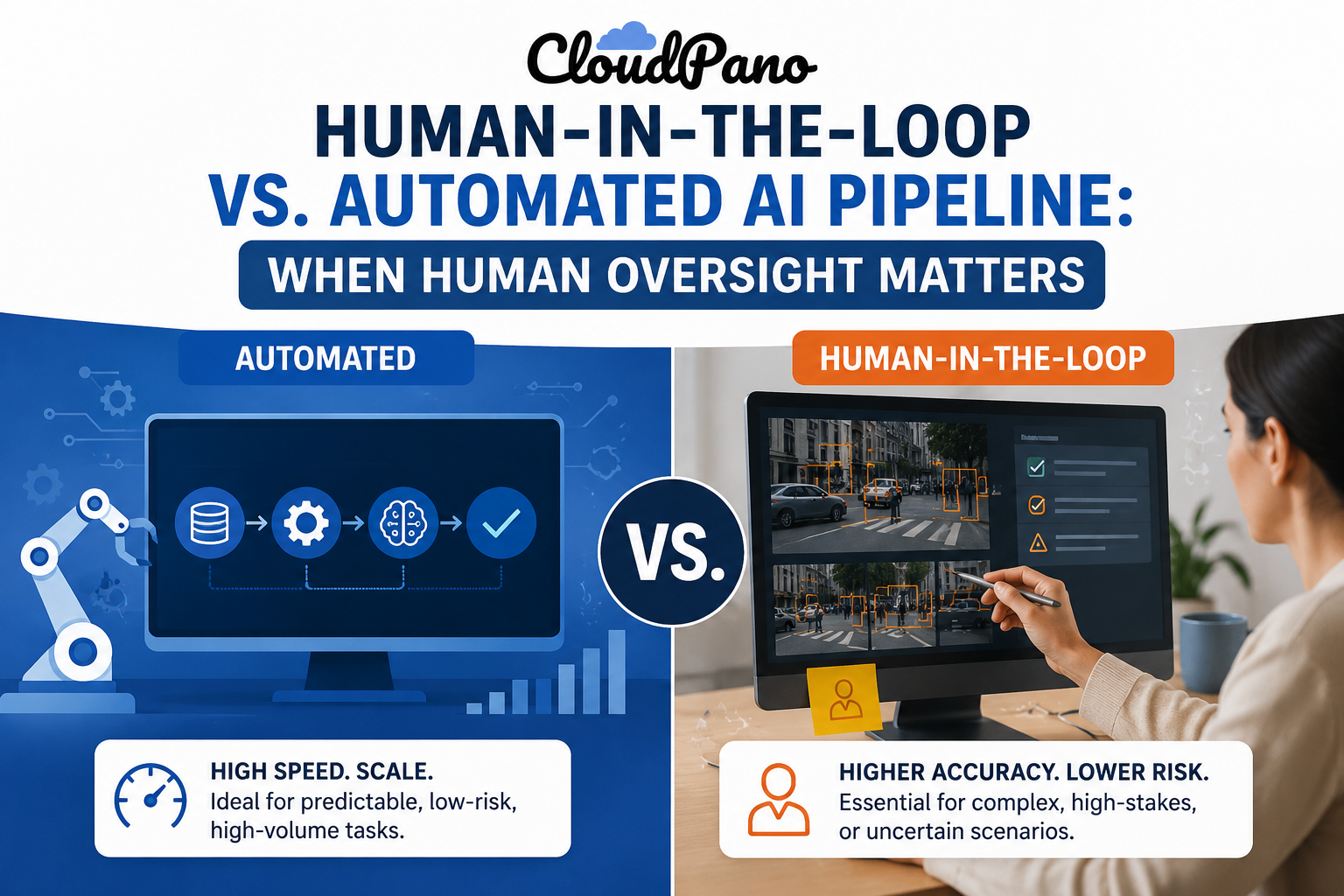
An automated machine learning pipeline runs a stage — data labeling, inference, decision-making — entirely through the model or a rules-based system, with no person in that specific step. It's fast, consistent, and scales without proportional cost increases, but it inherits whatever blind spots exist in the model or rules driving it.
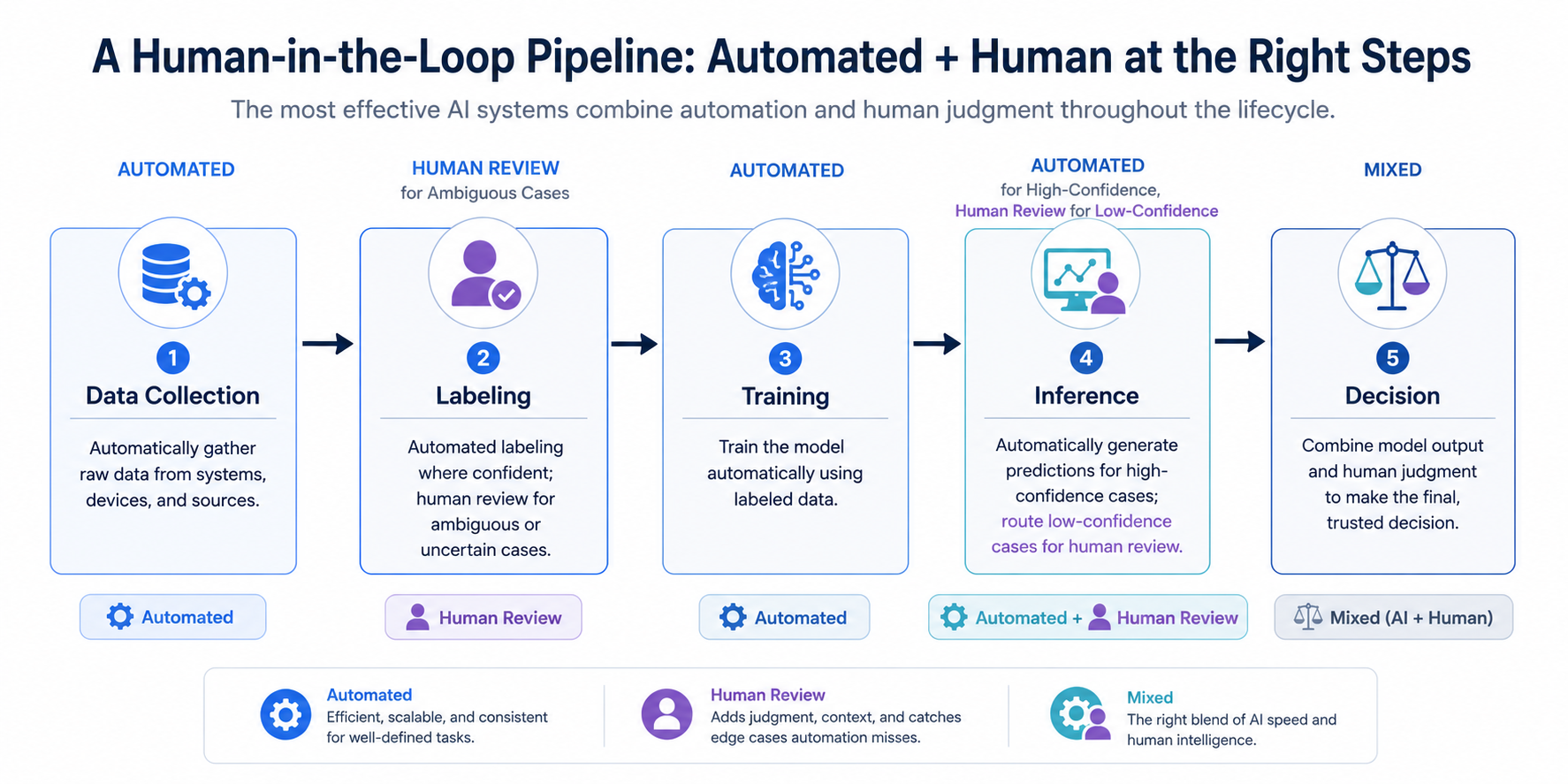
Diagram of a pipeline combining automated and human-in-the-loop stages

A human-in-the-loop stage inserts a person at a specific point — reviewing, correcting, or deciding — where the pipeline's automated component isn't reliable enough to trust alone. This isn't a fallback for a broken system; it's a deliberate design choice for stages where uncertainty, novelty, or stakes are high enough to warrant it.

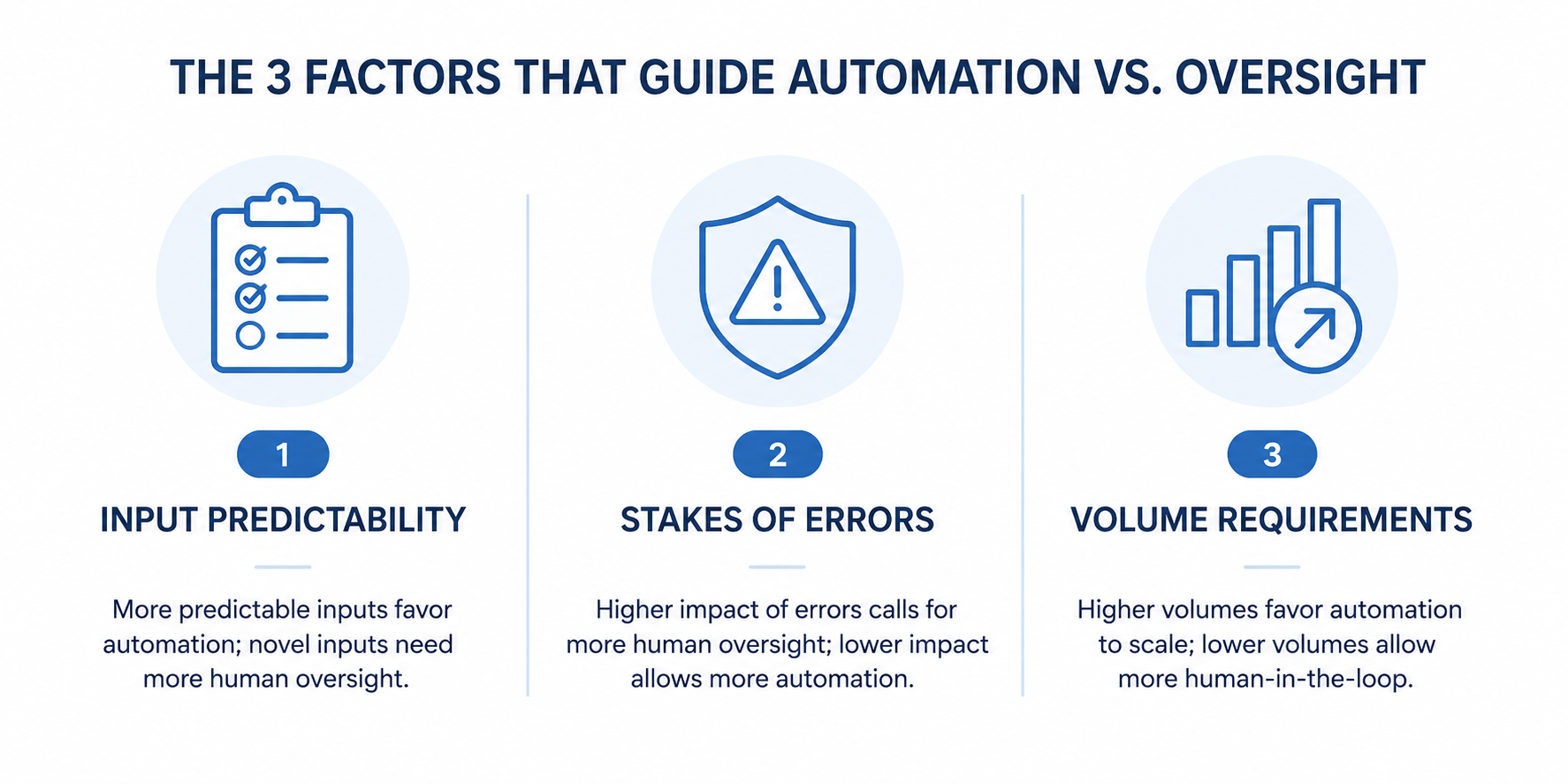
AI human review vs automation isn't decided once for an entire pipeline — it's decided stage by stage, based on three factors: how well-understood the input distribution is at that stage, how high the stakes are if that stage gets something wrong, and how much volume that stage needs to handle.
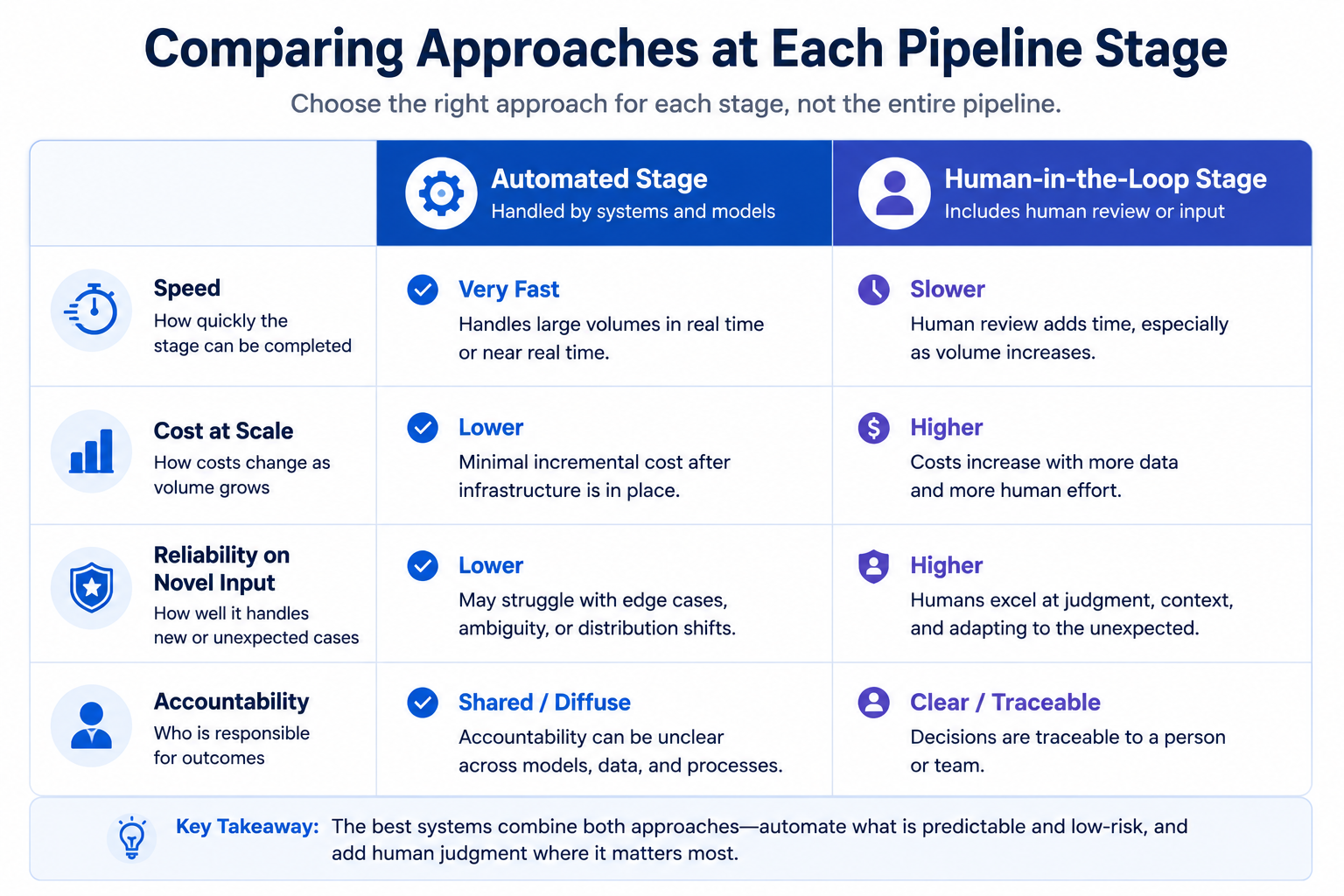
 Comparison table of automated vs human-in-the-loop AI pipeline stages

Understanding how these workflows operate at the stage level, rather than architecting a pipeline as uniformly automated or uniformly reviewed, is what actually produces a system that's both efficient and reliable where it matters.
Step-by-Step Workflow

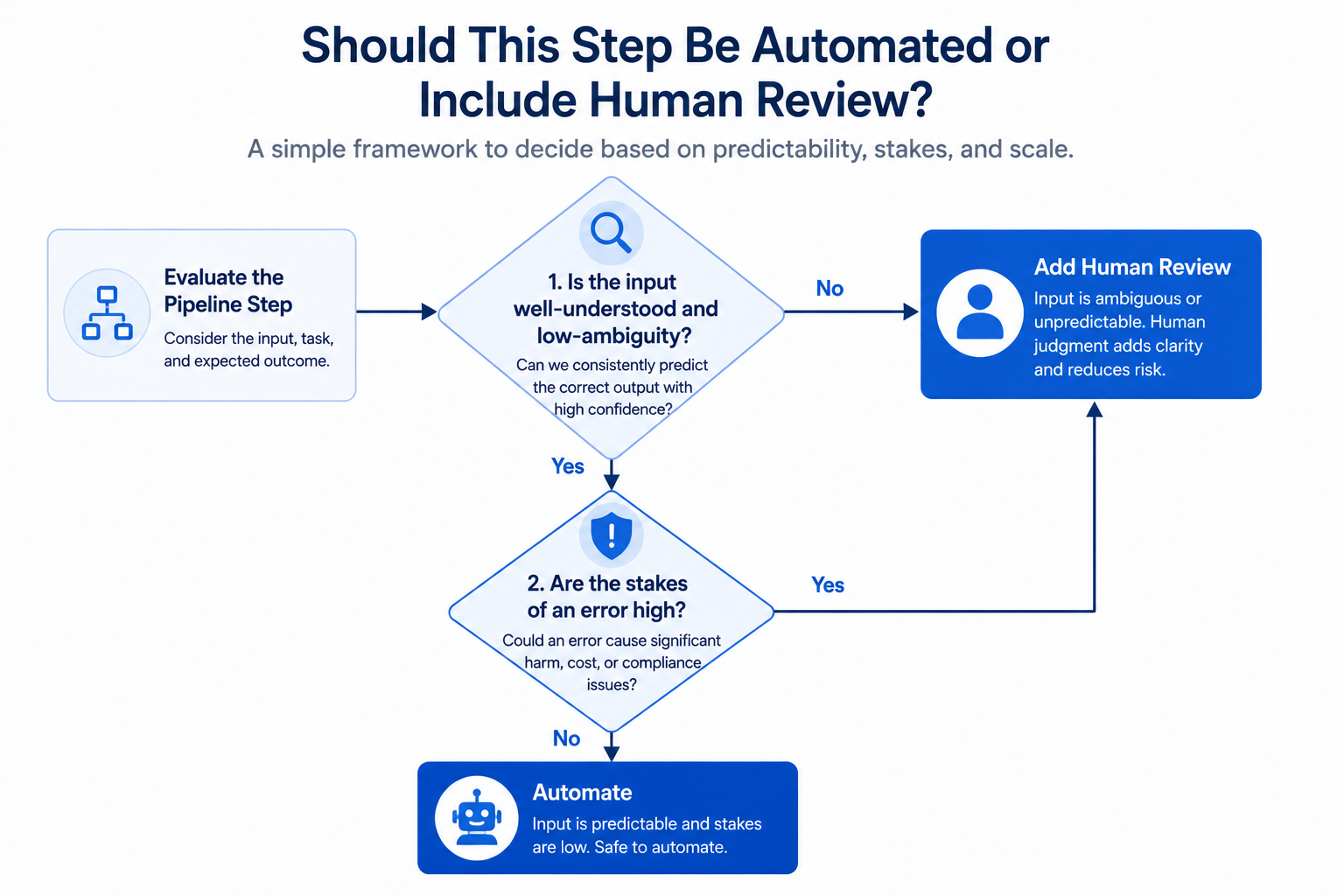
Flowchart for deciding automation vs human oversight at each AI pipeline stage
  • Map every stage of your pipeline individually. Data collection, labeling, training, inference, and decision-making each have different automation-versus-oversight needs.
  • Assess input predictability at each stage. Stages handling well-understood, high-volume, low-ambiguity input are strong automation candidates.
  • Assess stakes at each stage. Stages where an error has significant real-world consequences deserve oversight regardless of how well-understood the input generally is.
  • Assess volume at each stage. High-volume stages need automation to be sustainable, even if some oversight is layered in for the highest-risk subset.
Infographic of three factors that determine automation vs human oversight in AI pipelines
  • Decide automation versus oversight stage by stage, not for the whole pipeline at once. A pipeline can be automated at data ingestion, human-reviewed at labeling for ambiguous cases, and automated again at inference for high-confidence predictions.
  • Build clear handoff points between automated and human-reviewed stages. Define exactly what triggers a case moving from automation into human review.
  • Revisit the balance as the pipeline matures. A stage that needed heavy oversight early on may need less as the model improves on that specific task.

Industry Use Cases

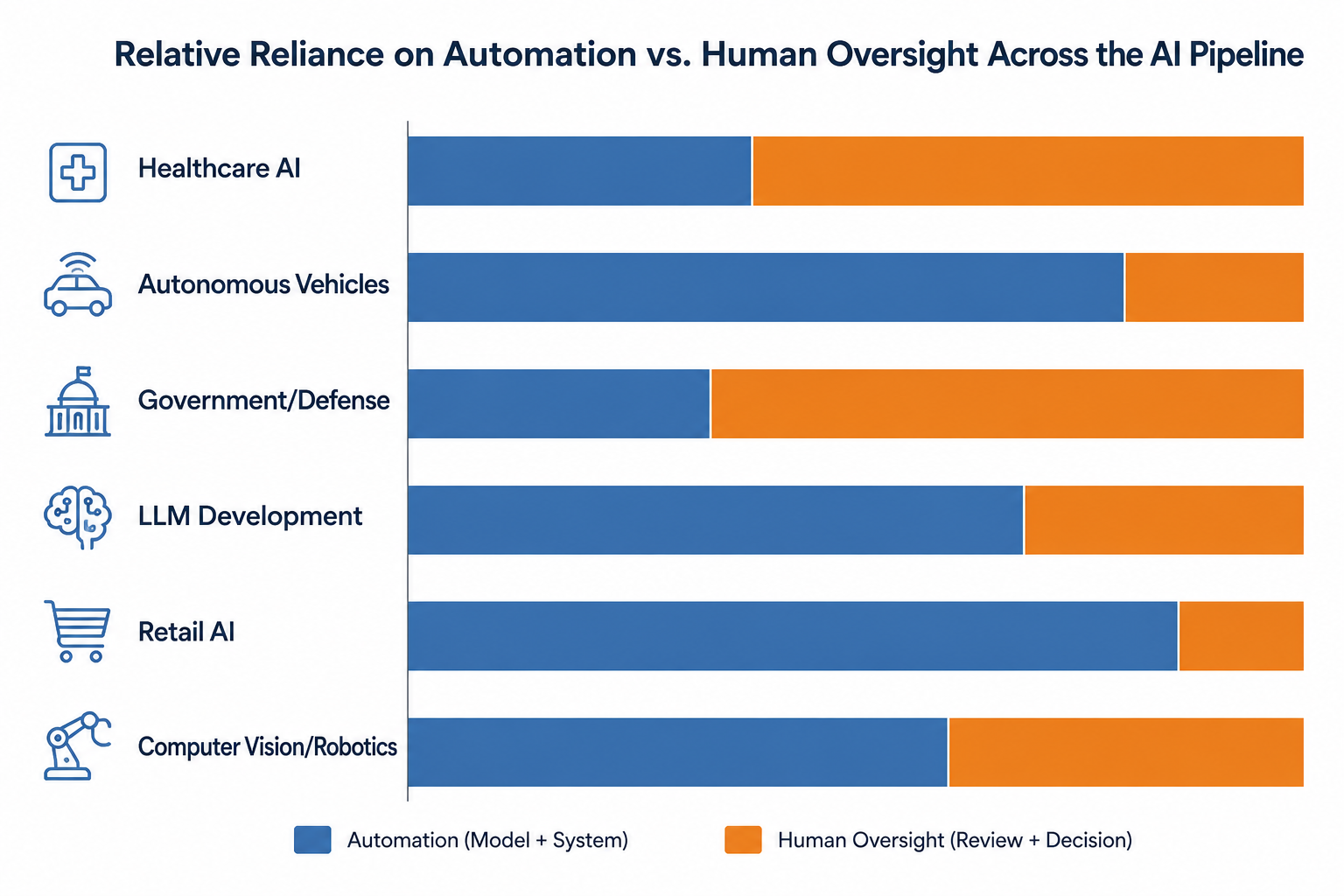
 Bar chart showing automation vs human oversight balance across AI industries
  • Computer vision / robotics: Data collection and routine object detection are typically strong automation candidates, while review of low-confidence detections or novel object types benefits from human oversight.
  • Autonomous vehicles: Routine driving inference runs automated at scale, while rare or safety-critical scenario handling and evaluation typically require human oversight.
  • Healthcare AI: Data preprocessing and routine classification can often be automated, while diagnostic decisions frequently require human oversight by policy, independent of model confidence.
  • Retail AI: High-volume, low-ambiguity product categorization is a strong automation fit, while content moderation edge cases benefit from human review.
  • LLM developers: Bulk text classification runs well automated, while preference alignment and safety-sensitive outputs typically depend on human review to shape behavior correctly.
  • Government & defense: Automation handles routine data processing, while classification-sensitive decisions frequently require mandated human oversight regardless of the pipeline stage's general reliability.

Benefits of a Stage-by-Stage Approach

  • Efficient use of automation where it's reliable. Automating high-volume, well-understood stages avoids unnecessary bottlenecks.
  • Targeted oversight where it actually matters. Concentrating human review on high-stakes or high-uncertainty stages produces better risk coverage than reviewing everything or nothing.
  • A pipeline that scales without abandoning reliability. Volume can grow on automated stages while oversight scales more deliberately on the stages that need it.
  • Clearer accountability. Defined handoff points between automated and human-reviewed stages make it easier to trace where a decision was made and by what process.
  • A framework that adapts as the pipeline matures. Reassessing stage by stage allows automation to expand into areas that no longer need heavy oversight, without a wholesale pipeline redesign.

Common Mistakes

  • Treating automation versus oversight as one decision for the whole pipeline. Missing that different stages have genuinely different risk and reliability profiles.
  • Defaulting to full automation for speed without assessing stakes. Optimizing for throughput on a stage where errors carry real consequences.
  • Defaulting to full human review out of caution. Creating unnecessary bottlenecks on stages the model already handles reliably.
  • Not defining clear handoff triggers between automated and reviewed stages. Leaving it ambiguous when a case should move from automation into human review.
  • Never reassessing the balance as the pipeline matures. Continuing heavy oversight on a stage the model has since learned to handle well, or missing new gaps that emerged as the pipeline scaled.
  • Ignoring volume constraints when deciding where to add oversight. Adding human review at a stage with volume too high to sustain it.

Best Practices

  • Assess automation-versus-oversight needs stage by stage, not as a single decision for the entire pipeline.
  • Weight input predictability, stakes, and volume together when deciding where human review belongs.
  • Define specific, documented handoff triggers between automated and human-reviewed stages.
  • Concentrate human oversight on the highest-stakes or highest-uncertainty points rather than spreading it evenly.
  • Reassess the balance periodically as the model improves and the pipeline's use case evolves.
  • Treat automation and oversight as complementary design choices within one pipeline, not opposing philosophies to choose between. McKinsey's research on generative AI adoption notes that data readiness — including how deliberately organizations balance automation and oversight across a pipeline's stages — remains a consistently underestimated factor in AI project outcomes (McKinsey, "The economic potential of generative AI").

FAQ

Is human-in-the-loop vs automated AI pipeline really an either/or decision?

No. Most effective pipelines combine both, deciding automation versus human oversight stage by stage rather than choosing one approach for the entire pipeline.

Which pipeline stages are usually good candidates for full automation?

High-volume, well-understood stages with low ambiguity and low individual stakes, such as routine data ingestion or high-confidence classification tasks.

Which pipeline stages usually need human oversight?

Stages with high stakes, high uncertainty, or novel input the model hasn't reliably learned to handle, regardless of how well-automated the rest of the pipeline is.

How do I decide where to add human review in an automated machine learning pipeline?

Assess each stage individually against input predictability, stakes, and volume, then add oversight specifically where those factors indicate automation alone isn't reliable enough.

Does adding human-in-the-loop review always slow down a pipeline?

It can add time at the specific stages where it's applied, but a well-designed pipeline reserves review for a targeted subset of cases, keeping most volume moving through automation quickly.

How does AI human review vs automation change as a model matures?

A stage that needed significant oversight early on may need less as the model improves on that specific task, which is why the balance should be reassessed periodically rather than fixed permanently.

What happens if a pipeline is fully automated with no human oversight at any stage?

It risks unaddressed failure on the specific cases automation handles least reliably, since there's no mechanism to catch or correct those errors before they affect real outcomes.

Conclusion

Human-in-the-loop vs automated AI pipeline isn't a single decision made once — it's a series of stage-specific choices based on input predictability, stakes, and volume. Pipelines that get this right treat automation and human oversight as complementary tools applied deliberately at the stages where each one actually performs best, rather than defaulting to one philosophy across an entire system.

🚀 Your All‑In‑One Virtual Experience Stack
🎬
PhotoAIVideo
Turn photos into scroll‑stopping AI videos.
Get Started →
🏡
Pictastic
Instantly stage listings with AI.
Try Staging →
🌀
CloudPano
Create stunning 360° tours in minutes.
Launch Tour →
💰
VirtualTourProfit
Build a profitable virtual tour business.
Learn More →
🤝
CloudPano Reseller
Resell AI visual software without building it.
Become a Reseller →
🚗
Auto CloudPano
Sell more vehicles with 360° experiences.
Explore Auto →
🏗️
AI Floor Plan Builder
Generate detailed floor plans with AI.
Build Now →
📐
3D Measure
Capture accurate floor plans & 3D measurements.
Measure Now →
🧠
AI Training Data
Custom AI training data services.
Learn More →
Share this post
Cloudpano

Choose The Right 360° Camera

Insta360 ONE RS 1-Inch 360 Edition

  • Compact, ready to go anywhere

  • Interchangeable lens that’s upgradeable

  • Dual 1-inch sensors for improved clarity and low light performance

  • Dynamic range and 6K 360° capture

  • 360° photo resolution at 21MP

Learn More

Insta360 X4

  • 8K 360° video recording for ultra-detailed visuals.

  • 4K single-lens mode for traditional wide-angle shots.

  • Invisible selfie stick effect for drone-like perspectives.

  • 2.5-inch touchscreen with Gorilla Glass protection.

  • Waterproof up to 33ft for underwater shooting.

Learn More

Ricoh Theta Z1

  • 360° photo resolution in 23MP

  • Slim design at 24 mm thick

  • Built-in image stabilization for smooth video capture.

  • Internal 19GB storage for photo and video storage.

  • Wireless connectivity for remote control and sharing.

Learn More

Ricoh Theta X

  • 60MP 360° still images for high-resolution photography.

  • 5.7K 360° video recording at 30fps.

  • 2.25-inch touchscreen for intuitive control.

  • USB Type-C port for fast charging and data transfer.

  • MicroSD card slot for expandable storage.

Learn More
Property Marketing
Allows potential buyers to explore properties in detail from anywhere, enhancing the real estate marketing process.
Automotive Spins
Create an interactive virtual showroom and engage affluent digital buyers with live 360º video calls, all through the CloudPano mobile app for a complete automotive sales solution.
Interactive Floor Plans
Create 2D and 3D floor plans with measurements in 4 minutes or less, all from your phone. Download the Floor Plan Scanner app and get your first scan free.

360 Virtual Tours With CloudPano.com. Get Started Today.

Try it free. No credit card required. Instant set-up.
Try it free
Latest posts

See our other posts

Interviews, tips, guides, industry best practices, and news.

Case Study: Reducing AI Errors With Human Verification Loops

A human verification AI case study typically shows a model with a specific, recurring error pattern — often on rare or ambiguous cases — resolved by adding targeted human review at that exact point, with corrections fed back into retraining. The error pattern narrows over successive cycles rather than disappearing immediately.
Read post

Human-in-the-Loop vs. Automated AI Pipeline: When Human Oversight Matters

A human-in-the-loop vs automated AI pipeline decision comes down to risk and reliability at each pipeline stage, not an all-or-nothing choice. Automation handles high-volume, well-understood tasks efficiently, while human oversight matters most at points of high uncertainty, high stakes, or novel input the system hasn't reliably learned to handle.
Read post

How a Human-in-the-Loop Workflow Improves Model Accuracy After Deployment

A human-in-the-loop workflow improves model accuracy post-deployment by routing low-confidence or flagged production outputs to human reviewers, tracking where the model's accuracy is actually drifting, and feeding corrected cases back into retraining. This turns real-world performance monitoring into a measurable, ongoing accuracy improvement cycle rather than a one-time launch check.
Read post