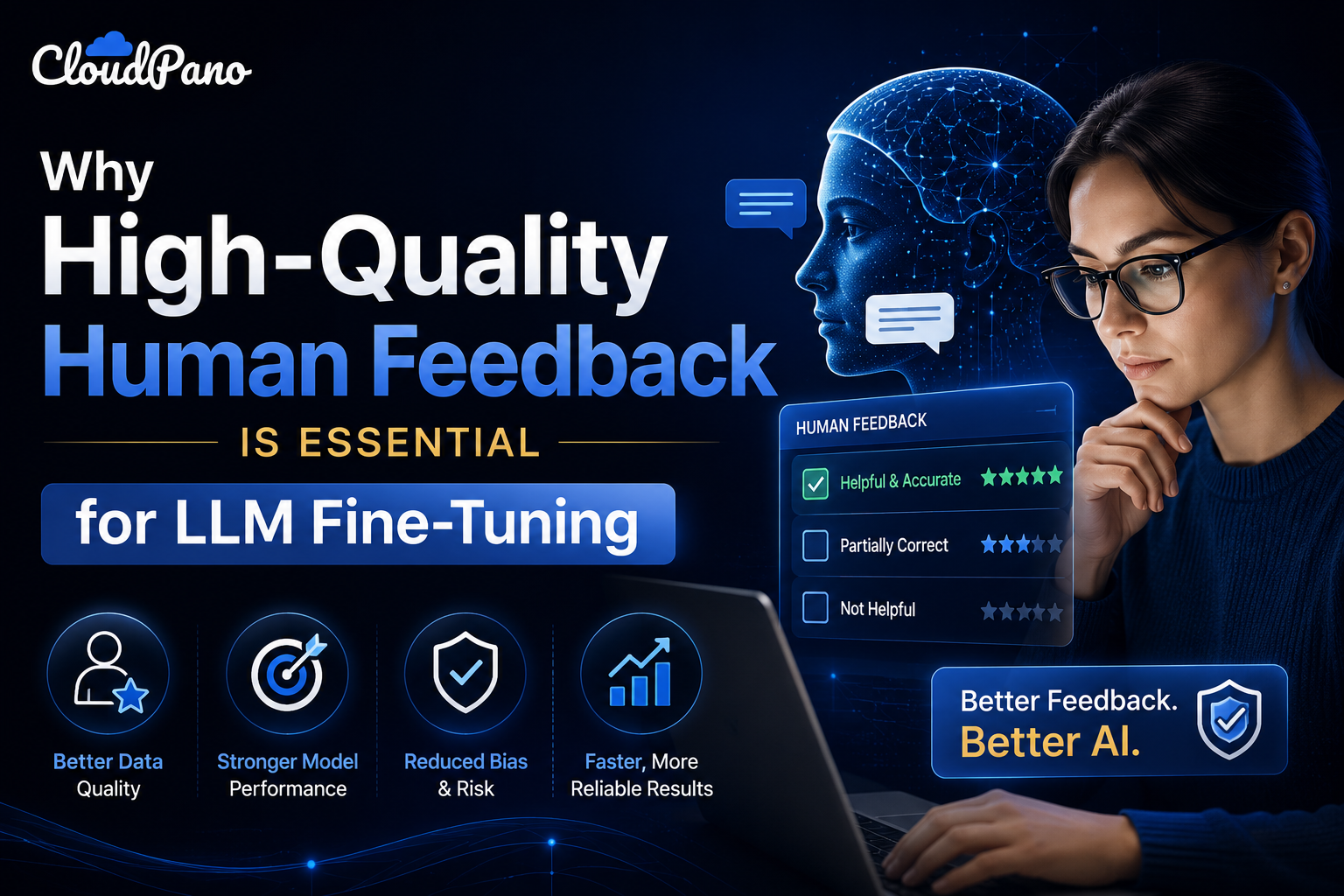
Why High-Quality Human Feedback Is Essential for LLM Fine-Tuning

Cloudpano
July 30, 2026
5 min read
Share this post

Why High-Quality Human Feedback Is Essential for LLM Fine-Tuning

More reviewers providing more comparisons doesn't automatically produce better fine-tuning results. Human evaluation for LLM fine tuning only improves a model when the people doing the evaluating are actually qualified for the specific judgment being asked of them — and that's a distinct question from whether a pipeline exists to collect their feedback at all.

Human feedback AI systems learn whatever pattern the underlying comparisons contain, good or bad. A reviewer who doesn't understand the domain, who applies inconsistent standards, or who wasn't properly trained on the specific judgment task produces data that can move a model's behavior in an unhelpful direction just as easily as a helpful one.

Why It Matters

The quality gap between a qualified and an unqualified reviewer doesn't show up as an obvious data problem — it shows up later as a fine-tuned model with subtly wrong instincts that are hard to trace back to their source. Google Research's "Data Cascades" study documented exactly this pattern: unaddressed quality issues at an early stage compound into problems that are much harder to diagnose once they've propagated through a model's training (Sambasivan et al., Google Research).
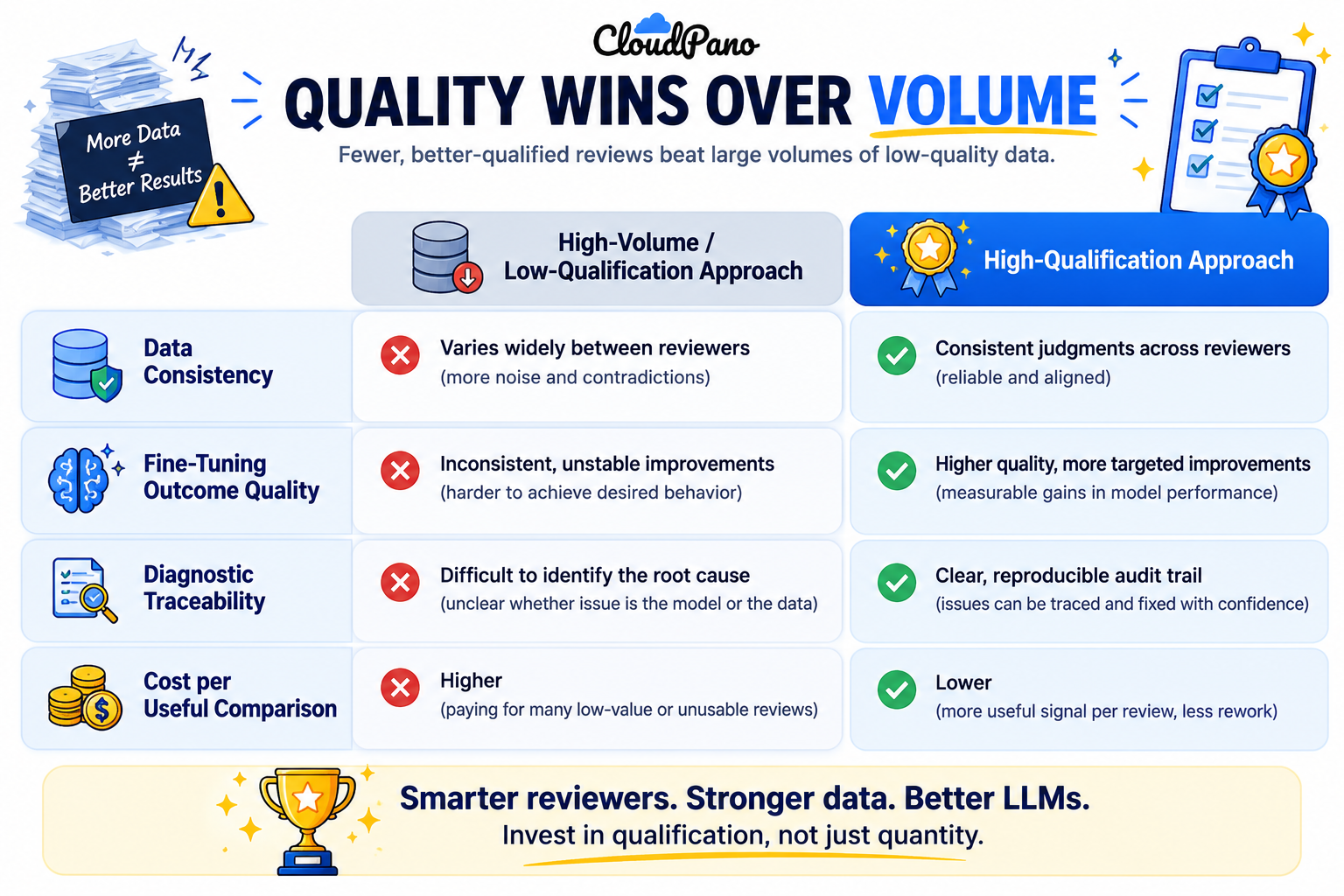
Comparison table of reviewer quality vs volume trade-offs in LLM fine-tuning

NIST's AI Risk Management Framework treats the qualification and competence of people involved in an AI system's development as a relevant factor in trustworthiness, not an incidental detail — directly applicable to how RLHF human reviewers are selected and trained, not just how many of them are recruited (NIST AI RMF).

The stakes of getting reviewer quality right grow with how central fine-tuning has become to LLM development. Stanford HAI's AI Index has tracked how widely techniques like RLHF are now used in production language model development (Stanford HAI, AI Index Report), meaning reviewer quality issues affect an increasingly large share of what shapes a widely deployed model's behavior.

How It Works

Infographic of four dimensions of reviewer qualification for LLM fine-tuning

AI quality improvement through human feedback depends on reviewer qualification across a few specific dimensions.

Domain expertise matched to the task. A reviewer judging clinical accuracy needs different qualifications than one judging general conversational tone — matching expertise to the actual judgment required is a prerequisite, not a nice-to-have.

Demonstrated consistency under a defined rubric. Qualified reviewers apply the same standard across similar cases, which is testable through agreement checks against known-good comparisons before a reviewer contributes to production data.

Understanding of the downstream training objective. Reviewers who understand what the fine-tuning is actually trying to achieve make more useful judgment calls than those simply told to "rate quality" in the abstract.

Ongoing performance monitoring, not just initial qualification. A reviewer's judgment can drift over time, so qualification isn't a one-time gate — it's a standard reviewers need to keep meeting.

Understanding how these workflows operate — reviewer qualification as an active, ongoing standard rather than a one-time hiring filter — is what separates human feedback that reliably improves a model from feedback that just adds noise dressed up as signal.
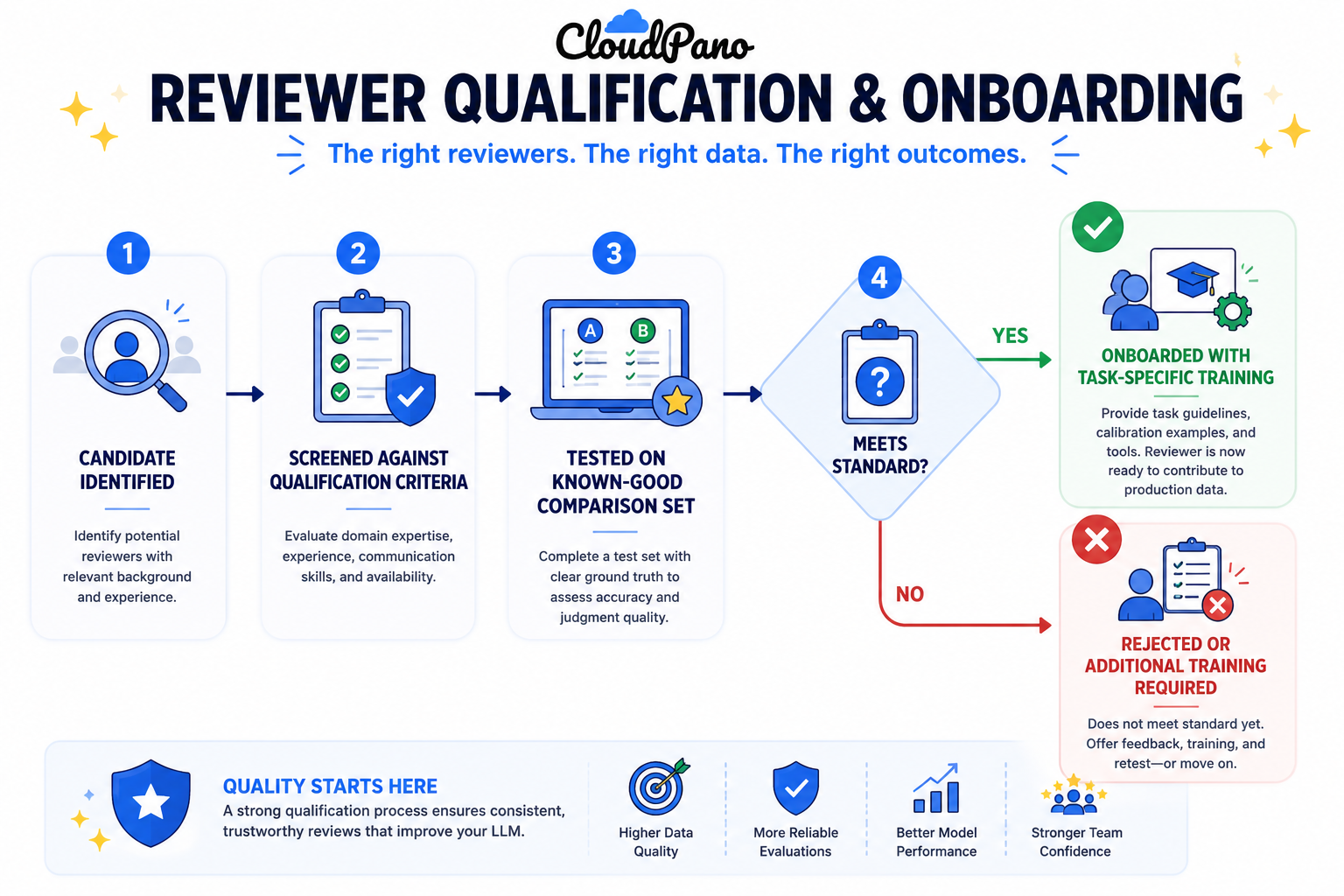
Step-by-Step Workflow

  • Define what qualifies as expertise for your specific fine-tuning task. Be concrete about domain knowledge, judgment skill, or experience the task actually requires.
  • Screen candidate reviewers against that specific qualification bar. Avoid recruiting based on general availability or cost alone.
  • Test candidates against a known-good comparison set before onboarding. Confirm their judgment aligns with an established standard before they contribute to real fine-tuning data.
Flowchart of reviewer qualification and onboarding for LLM fine-tuning
  • Provide task-specific training on the fine-tuning objective. Give reviewers context on what the model is being trained to do, not just abstract rating instructions.
  • Monitor reviewer consistency on an ongoing basis. Track agreement rates over time, not just at initial qualification.
  • Address drift or inconsistency directly and specifically. Provide targeted retraining or, where necessary, remove reviewers whose judgment no longer meets the standard.
  • Trace fine-tuning outcomes back to reviewer-level data where problems emerge. If a model develops an unhelpful pattern, check whether it traces to a specific reviewer or subset of reviewers.

Industry Use Cases

  • LLM developers: Reviewer qualification directly shapes fine-tuning outcomes for conversational and generative models, making this a central quality lever in development.
  • Healthcare AI: Human evaluation for clinical documentation or patient-facing assistants requires reviewers with genuine clinical background, not general raters applying surface-level judgment.
  • Retail AI: Reviewer qualification for customer-facing assistants often needs brand and domain familiarity to judge tone and helpfulness accurately.
  • Government & defense: Reviewer qualification requirements often include security clearance alongside subject-matter expertise, given the sensitivity of the content being judged.
  • Computer vision / robotics: This specific reviewer-qualification framework is built around language model fine-tuning and doesn't map directly onto computer vision annotation work.
  • Autonomous vehicles: Similarly, this specific approach to human evaluation has limited direct application, though the underlying principle that reviewer expertise shapes data quality applies broadly.

Benefits

Line graph showing fine-tuning outcome quality by reviewer qualification level
  • Fine-tuning that actually improves the model. Qualified reviewers produce feedback that reliably moves a model toward better behavior, rather than just different behavior.
  • Fewer subtle, hard-to-trace behavioral issues. Reviewer quality control catches problems before they propagate into a fine-tuned model's instincts.
  • More efficient use of fine-tuning resources. High-quality feedback data produces better results per training cycle than a larger volume of lower-quality comparisons.
  • Easier diagnosis when problems do emerge. Reviewer-level tracking makes it possible to trace an unhelpful pattern back to its specific source.
  • A more defensible development process. Documented reviewer qualification standards support accountability for how a model's training data was produced.

Common Mistakes

  • Prioritizing reviewer volume over reviewer qualification. Assuming more comparisons from more people automatically produces better fine-tuning data, regardless of reviewer expertise.
  • Skipping qualification testing before onboarding. Assuming a reviewer's general background implies task-specific judgment competence without verifying it directly.
  • Not explaining the fine-tuning objective to reviewers. Leaving reviewers to guess at what "quality" means in the abstract rather than grounding their judgment in the actual training goal.
  • Treating qualification as a one-time gate. Not monitoring reviewer consistency over time, missing drift that degrades data quality gradually.
  • Not tracing model issues back to reviewer-level data. Investigating an unhelpful fine-tuned behavior without checking whether it traces to a specific reviewer's judgment pattern.
  • Assuming cheaper reviewers produce equivalent data. Underestimating how much reviewer qualification affects data quality, treating human feedback as an interchangeable commodity input.

Best Practices

  • Define specific qualification criteria for each fine-tuning task before recruiting or assigning reviewers.
  • Test candidate reviewers against known-good comparisons before allowing them to contribute to production data.
  • Provide reviewers with context on the actual fine-tuning objective, not just abstract rating instructions.
  • Monitor reviewer consistency continuously, treating qualification as an ongoing standard rather than a one-time hiring filter.
  • Trace fine-tuning problems back to reviewer-level data when they emerge, rather than assuming the issue lies elsewhere.
  • Weigh reviewer quality more heavily than reviewer cost or volume when scoping a fine-tuning project's human feedback budget.

FAQ

Why does reviewer quality matter more than reviewer volume for LLM fine-tuning?

Because a model learns whatever pattern the underlying feedback data contains; unqualified reviewers can produce inconsistent or misdirected comparisons just as easily as helpful ones, regardless of how many comparisons are collected.

What qualifications should human feedback AI reviewers have?

Domain expertise matched to the specific judgment task, demonstrated consistency under a defined rubric, and a clear understanding of the fine-tuning objective they're actually supporting.

How do you test whether a reviewer is qualified before onboarding?

By having them evaluate a known-good comparison set and checking whether their judgments align with an established standard before they contribute to production fine-tuning data.

Do RLHF human reviewers need to understand the model's training objective?

Yes. Reviewers who understand what the fine-tuning is trying to achieve make more useful, consistent judgment calls than those given only abstract instructions to "rate quality."

How often should reviewer qualification be reassessed?

On an ongoing basis, since reviewer judgment can drift over time; qualification works best as a continuously monitored standard, not a one-time hiring filter.

Can a smaller number of highly qualified reviewers outperform a larger number of less qualified ones?

Often, yes. Fine-tuning outcomes depend on feedback data quality, and a smaller pool of well-qualified reviewers can produce more useful training signal than a larger, less consistent group.

How do you trace a fine-tuning problem back to human feedback quality?

By checking whether an unhelpful model pattern correlates with data from a specific reviewer or subset of reviewers, rather than assuming the issue lies elsewhere in the training process.

Conclusion

AI quality improvement through fine-tuning depends directly on the quality of the human judgment behind it, not just the existence of a feedback pipeline or the volume of comparisons collected. Reviewer qualification, ongoing consistency monitoring, and a clear connection to the actual training objective are what turn human feedback into genuine model improvement rather than a different, still-inconsistent set of patterns.

🚀 Your All‑In‑One Virtual Experience Stack
🎬
PhotoAIVideo
Turn photos into scroll‑stopping AI videos.
Get Started →
🏡
Pictastic
Instantly stage listings with AI.
Try Staging →
🌀
CloudPano
Create stunning 360° tours in minutes.
Launch Tour →
💰
VirtualTourProfit
Build a profitable virtual tour business.
Learn More →
🤝
CloudPano Reseller
Resell AI visual software without building it.
Become a Reseller →
🚗
Auto CloudPano
Sell more vehicles with 360° experiences.
Explore Auto →
🏗️
AI Floor Plan Builder
Generate detailed floor plans with AI.
Build Now →
📐
3D Measure
Capture accurate floor plans & 3D measurements.
Measure Now →
🧠
AI Training Data
Custom AI training data services.
Learn More →
Share this post
Cloudpano

Choose The Right 360° Camera

Insta360 ONE RS 1-Inch 360 Edition

  • Compact, ready to go anywhere

  • Interchangeable lens that’s upgradeable

  • Dual 1-inch sensors for improved clarity and low light performance

  • Dynamic range and 6K 360° capture

  • 360° photo resolution at 21MP

Learn More

Insta360 X4

  • 8K 360° video recording for ultra-detailed visuals.

  • 4K single-lens mode for traditional wide-angle shots.

  • Invisible selfie stick effect for drone-like perspectives.

  • 2.5-inch touchscreen with Gorilla Glass protection.

  • Waterproof up to 33ft for underwater shooting.

Learn More

Ricoh Theta Z1

  • 360° photo resolution in 23MP

  • Slim design at 24 mm thick

  • Built-in image stabilization for smooth video capture.

  • Internal 19GB storage for photo and video storage.

  • Wireless connectivity for remote control and sharing.

Learn More

Ricoh Theta X

  • 60MP 360° still images for high-resolution photography.

  • 5.7K 360° video recording at 30fps.

  • 2.25-inch touchscreen for intuitive control.

  • USB Type-C port for fast charging and data transfer.

  • MicroSD card slot for expandable storage.

Learn More
Property Marketing
Allows potential buyers to explore properties in detail from anywhere, enhancing the real estate marketing process.
Automotive Spins
Create an interactive virtual showroom and engage affluent digital buyers with live 360º video calls, all through the CloudPano mobile app for a complete automotive sales solution.
Interactive Floor Plans
Create 2D and 3D floor plans with measurements in 4 minutes or less, all from your phone. Download the Floor Plan Scanner app and get your first scan free.

360 Virtual Tours With CloudPano.com. Get Started Today.

Try it free. No credit card required. Instant set-up.

Try it free
Latest posts

See our other posts

Interviews, tips, guides, industry best practices, and news.

Computer Vision Annotation Services: Techniques, Workflow, and Quality

Computer vision annotation services apply structured labels to images and video for AI training — bounding boxes, segmentation masks, keypoints, and 3D cuboids among them — matched to what a model needs to detect or understand. The right technique depends on the specific spatial detail your model's task actually requires.
Read post

Why High-Quality Human Feedback Is Essential for LLM Fine-Tuning

Human evaluation for LLM fine tuning works best when reviewers are qualified specifically for the judgment task, not just recruited in volume. Domain expertise, consistency under a defined rubric, and calibration against known-good examples determine whether feedback data actually improves a model or just teaches it a different, still-inconsistent pattern.
Read post

Enterprise LLM Evaluation: Building Trustworthy AI for Production

Enterprise LLM evaluation goes beyond technical testing to include a governance structure — documented bias testing across relevant groups, formal safety sign-off, and audit trails that let legal, compliance, and leadership stakeholders trust a production deployment decision. It's the organizational process around evaluation, not just the metrics themselves.
Read post