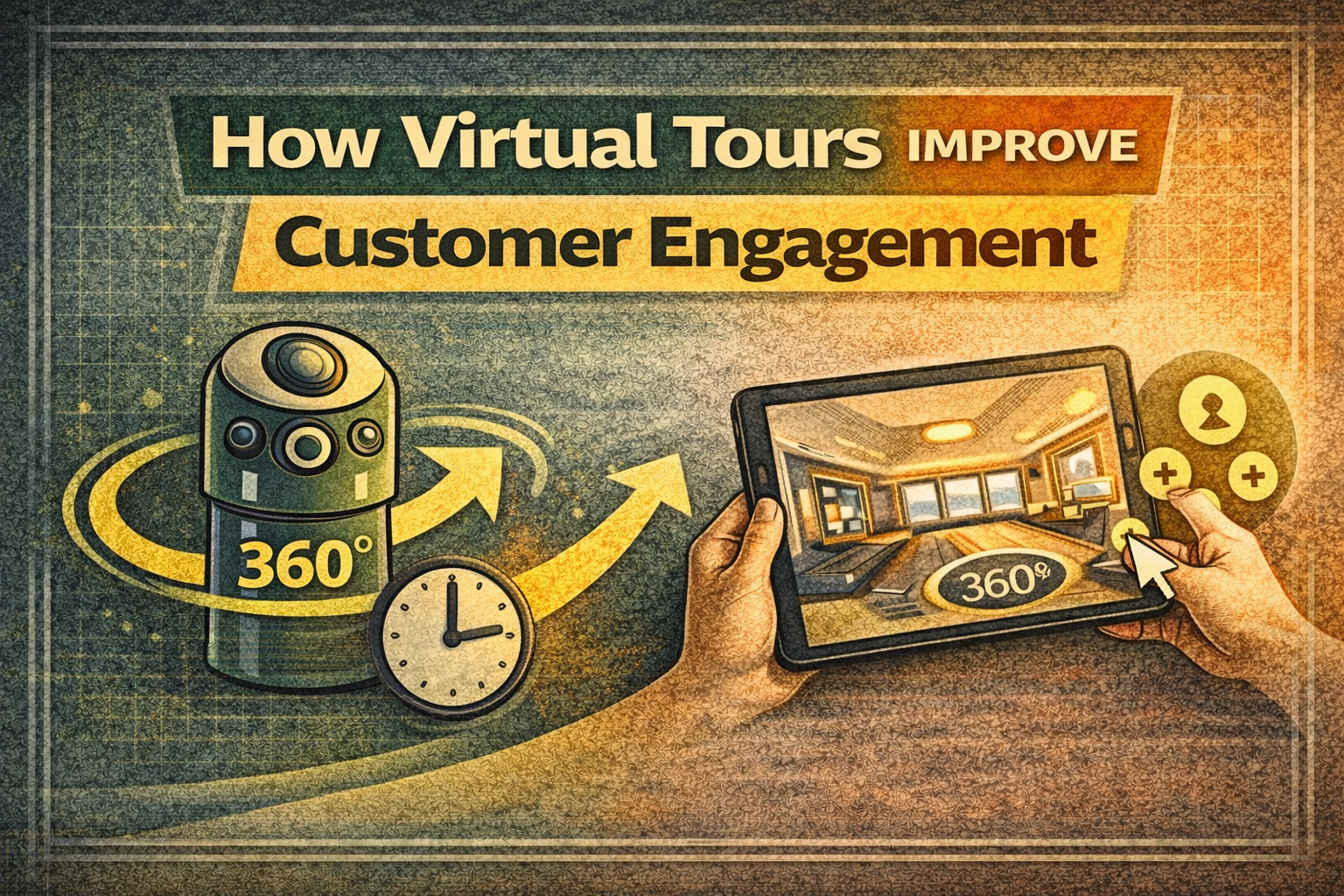
How Virtual Tours Improve Customer Engagement

Cloudpano
January 11, 2026
5 min read
Share this post

How Virtual Tours Improve Customer Engagement 🤝📸

Why Immersive Virtual Tours Are One of the Best Customer Engagement Tools Today

If you run a business (or market for one), you’ve probably noticed something frustrating:

Getting attention online is hard.
Keeping attention is even harder.

You can spend money on ads, SEO, social content, and promotions—yet still struggle with the one metric that matters most:

customer engagement

Because engagement is what turns:

  • viewers into visitors
  • visitors into leads
  • leads into customers
  • customers into repeat buyers

That’s why immersive virtual tours have become one of the smartest assets a business can add to its marketing stack.

They don’t just look cool.

They increase engagement in a measurable way by giving customers a real experience instead of a basic sales message.

In this guide, you’ll learn how virtual tours improve customer engagement, why immersive tours work so well, and how to use them as modern customer engagement tools across websites, social media, and business listings. 🚀

What Customer Engagement Really Means 🧠

Customer engagement is more than likes or comments.

True engagement means:

  • people spend time with your brand
  • they interact with your content
  • they feel trust and curiosity
  • they take action

In simple terms:

Engagement is attention + interaction.

And interaction is the part most businesses struggle with.

Most marketing is passive:

  • text posts
  • photos
  • brochures
  • static pages

Virtual tours are different because they invite the customer to participate.

That participation creates stronger engagement instantly.

Why Immersive Virtual Tours Work (Psychology of Engagement) 🎯

Humans engage with what feels real.

That’s why:

  • videos outperform photos
  • photos outperform plain text
  • interactive content beats everything else

Immersive virtual tours tap into this psychological advantage:

✅ They simulate “being there”
✅ They reduce uncertainty
✅ They increase curiosity
✅ They let customers explore freely

Instead of reading about your business, the customer experiences it.

That’s why immersive tours are so effective for engagement-based marketing.
Virtual Tours Turn Browsers Into Explorers 🧭

Here’s the big shift:

Traditional content makes people scroll.

Virtual tours make people explore.

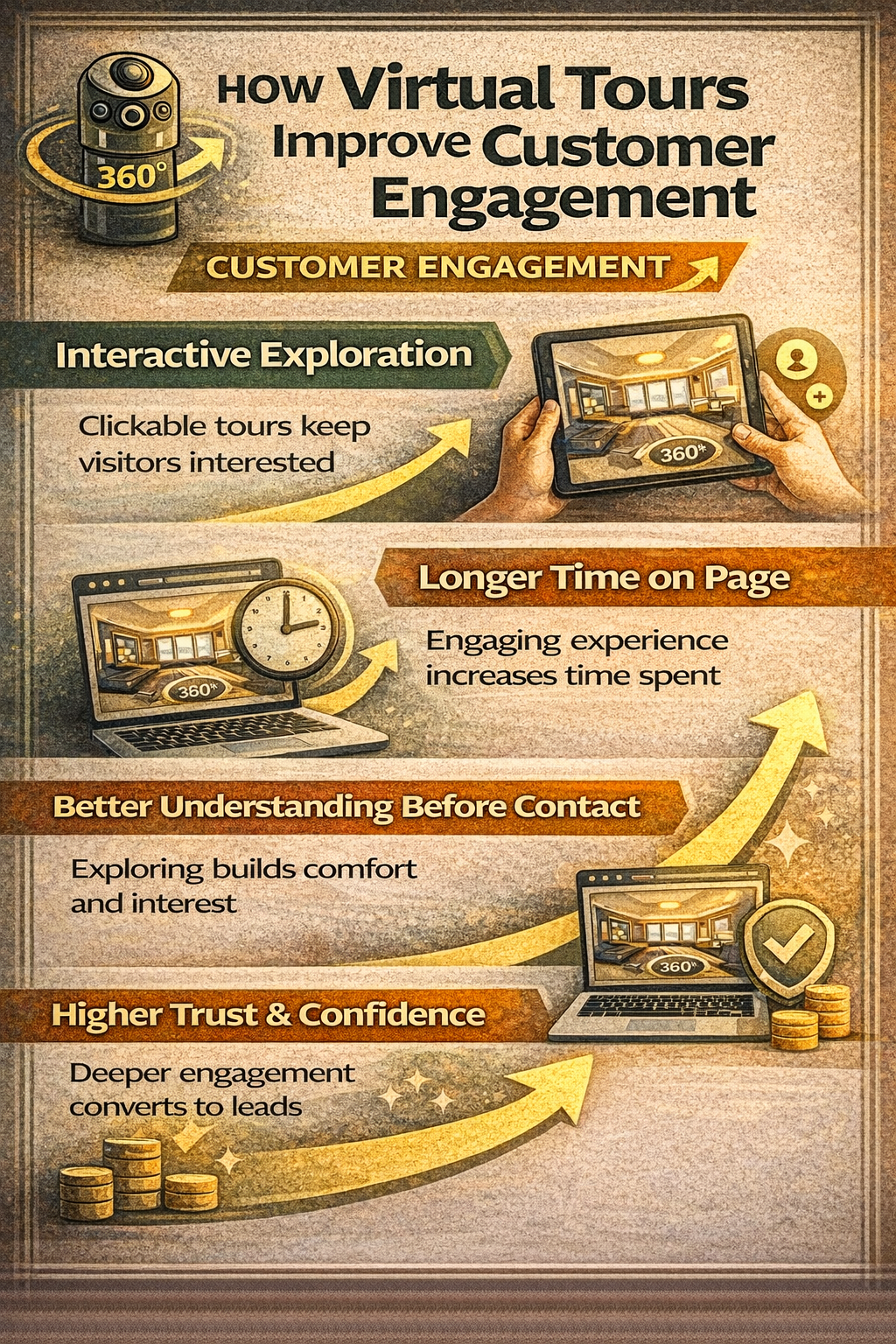
When someone opens a tour, they naturally:

  • click to move rooms
  • zoom in on details
  • look around
  • check highlights
  • spend more time

That increases key engagement signals like:

  • time on page
  • interaction rate
  • return visits

And those signals often correlate directly with more conversions.

Virtual Tours Create “Sticky” Content (People Don’t Leave Fast) ⏱️

One of the biggest challenges in marketing is bounce rate.

People land on your site and leave in seconds.

But virtual tours reduce bounce rate because:

  • they’re interactive
  • they’re immersive
  • they hold attention

Even 30–90 extra seconds of engagement can make a major impact on:

  • lead conversion
  • booking rates
  • walk-in traffic

That’s why immersive virtual tours are among the best customer engagement tools you can add to a website.

Engagement Improves Trust (And Trust Improves Sales) ✅

Engagement isn’t just attention.

It also builds trust.

A virtual tour quietly answers questions customers may not even ask out loud:

  • Is this place clean?
  • Is it professional?
  • Is it worth visiting?
  • Will I feel comfortable here?

This is especially important for businesses where people are cautious:

  • dentists and doctors 🩺
  • gyms and studios 🏋️
  • restaurants 🍽️
  • senior living 👵
  • daycare and schools 🎓
  • salons and spas 💇

When people can explore first, they feel safer.

And when they feel safer, they take action.

Virtual Tours Improve Engagement at Every Stage of the Buyer Journey 🔁

Stage 1: Discovery

A virtual tour increases engagement by creating:

  • a strong “wow” moment
  • a clear competitive difference

Stage 2: Consideration

Buyers use the tour to evaluate:

  • layout
  • features
  • experience
  • comfort

Stage 3: Decision

Tours reduce hesitation and speed up action:

  • bookings
  • calls
  • visits
  • applications

That’s why immersive virtual tours aren’t just “top of funnel” content.

They’re a full journey tool.

Virtual Tours vs Photos: Why Tours Win Engagement 📷➡️🎥

Photos show highlights.

Virtual tours show reality.

Photos allow the viewer to “assume” details.

Virtual tours make details obvious.

That’s why virtual tours often outperform photos when it comes to engagement:

  • more time spent
  • more clicks
  • more repeat viewing

Photos are still necessary.

But tours create a deeper experience.

That’s why they’re a powerful add-on to any content strategy.

Virtual Tours vs Video: Engagement Differences 🎬

Video tours are great for:

  • storytelling
  • fast attention
  • social media performance

But immersive virtual tours are better for:

  • exploration
  • control
  • high-intent engagement

A smart strategy is:
🎬 video for attention
🖱️ virtual tour for interaction

That pairing becomes a full engagement system.

Where to Use Virtual Tours for Maximum Customer Engagement 🌍

Here are the highest impact placements:

✅ Website Homepage

Put a CTA like:

  • “Explore Our Space”
  • “Take a Virtual Tour”
  • “See Inside Before You Visit”

✅ Service Pages

Example:

  • “Our Dental Office Tour”
  • “Tour Our Gym”
  • “Walk Through Our Venue”

✅ Google Listings / Map Visibility

Virtual tours help people engage before they even reach your site.

✅ Social Media Bio Links

Add the tour link to:

  • Instagram bio
  • Facebook page
  • LinkedIn company page

✅ Follow-Up Messages

Send the tour after someone requests info:

“Here’s a quick tour so you can see what to expect.”

This increases conversion and engagement.

Virtual Tours Make Engagement Measurable 📊

One of the biggest benefits of using immersive virtual tours is:

You can measure interaction.

Depending on your platform, you can track:

  • clicks
  • viewer activity
  • hotspots
  • time in tour
  • sessions

This gives you something most marketing lacks:

A clear engagement signal tied to a real business asset.

That makes tours valuable as customer engagement tools, not just visuals.

How to Boost Engagement Inside the Tour (Hotspots + CTAs) 🎯

If you want more than “wow,” add interaction triggers.

Examples of high-performing hotspots:

  • ✅ “Book Now”
  • ✅ “Call”
  • ✅ “Get Directions”
  • ✅ “View Menu”
  • ✅ “See Pricing”
  • ✅ “Apply Now”
  • ✅ “Tour Availability”

Hotspots convert engagement into action.

That’s the difference between:
a virtual tour that’s cool
and a virtual tour that makes money 💰

Best Industries for Immersive Virtual Tours (Engagement Winners) 🏆

Almost any business can benefit, but these niches see huge engagement impact:

  • Apartments & leasing 🏢
  • Restaurants 🍽️
  • Gyms 🏋️
  • Medical / dental 🩺
  • Schools & childcare 🎓
  • Event venues 💍
  • Retail showrooms 🛍️
  • Hotels & tourism 🏨

If the customer experience matters, immersive tours win.

Don’t Miss These Articles:

How Virtual Tours Create Repeat Engagement 🔁

Virtual tours don’t just engage once.

People come back.

Common behaviors include:

  • revisiting before a visit
  • sharing with spouse/family
  • exploring again before booking
  • using the tour as reassurance

This increases brand familiarity.

And familiarity increases conversions.

Common Mistakes That Reduce Engagement ❌

Avoid these problems:

  • too many scenes (fatigue)
  • confusing navigation
  • slow loading
  • dark, low-quality images
  • cluttered hotspot overload
  • no call-to-action

Your tour should be:
✅ clean
✅ easy
✅ fast
✅ action-oriented

Engagement depends on simplicity.

Final Thoughts: Virtual Tours Are Engagement Multipliers 🚀

Most marketing content is passive.

Virtual tours are active.

That’s why immersive virtual tours outperform traditional media in engagement:

  • they hold attention longer
  • they invite interaction
  • they build trust faster
  • they increase conversion confidence

And that’s why they’re now one of the most valuable customer engagement tools for any business that depends on local customers, bookings, or in-person visits.

If you want customers to stay longer, interact more, and choose you faster:

Virtual tours are one of the smartest upgrades you can make. ✅📸✨

🚀 Your All-In-One Virtual Experience Stack Starts Here

Share this post
Cloudpano

Choose The Right 360° Camera

Insta360 ONE RS 1-Inch 360 Edition

  • Compact, ready to go anywhere

  • Interchangeable lens that’s upgradeable

  • Dual 1-inch sensors for improved clarity and low light performance

  • Dynamic range and 6K 360° capture

  • 360° photo resolution at 21MP

Learn More

Insta360 X4

  • 8K 360° video recording for ultra-detailed visuals.

  • 4K single-lens mode for traditional wide-angle shots.

  • Invisible selfie stick effect for drone-like perspectives.

  • 2.5-inch touchscreen with Gorilla Glass protection.

  • Waterproof up to 33ft for underwater shooting.

Learn More

Ricoh Theta Z1

  • 360° photo resolution in 23MP

  • Slim design at 24 mm thick

  • Built-in image stabilization for smooth video capture.

  • Internal 19GB storage for photo and video storage.

  • Wireless connectivity for remote control and sharing.

Learn More

Ricoh Theta X

  • 60MP 360° still images for high-resolution photography.

  • 5.7K 360° video recording at 30fps.

  • 2.25-inch touchscreen for intuitive control.

  • USB Type-C port for fast charging and data transfer.

  • MicroSD card slot for expandable storage.

Learn More
Property Marketing
Allows potential buyers to explore properties in detail from anywhere, enhancing the real estate marketing process.
Automotive Spins
Create an interactive virtual showroom and engage affluent digital buyers with live 360º video calls, all through the CloudPano mobile app for a complete automotive sales solution.
Interactive Floor Plans
Create 2D and 3D floor plans with measurements in 4 minutes or less, all from your phone. Download the Floor Plan Scanner app and get your first scan free.

360 Virtual Tours With CloudPano.com. Get Started Today.

Try it free. No credit card required. Instant set-up.
Try it free
Latest posts

See our other posts

Interviews, tips, guides, industry best practices, and news.

Property Manager Video Hub: Scaling Rental Visibility with AI Photo-to-Video Workflows

This article explains how property managers can use PhotoAIVideo to build a property manager video hub: a repeatable system for turning rental photos, amenity images, floor plans, exterior shots, and neighborhood visuals into reusable rental marketing videos. The main idea is that property managers do not just need more listing exposure. They need clearer visual answers that help renters decide whether to schedule a tour. PhotoAIVideo is positioned as a practical tool for creating: Unit availability videos Amenity highlight videos Neighborhood videos Tour reminder clips Leasing follow-up videos Owner marketing proof videos Social media rental teasers Application or availability reminder videos Key takeaways: Property managers already have the media they need; the challenge is organizing it and turning it into reusable video assets. A video hub helps teams create consistent videos across units, floor plans, amenities, communities, and owner updates. Rental videos can reduce friction by answering renter questions about layout, condition, amenities, parking, pet features, and community feel. One rental photo set can become multiple video outputs for listings, social media, email, text follow-up, tour reminders, and owner reporting. Photographers can sell AI rental video packages to property managers as an upsell. Brokerages with property management divisions can use the same workflow to standardize leasing content. The article ends with a step-by-step process, video hub framework, mistakes to avoid, visual recommendations, FAQs, and a CTA encouraging readers to use PhotoAIVideo to turn rental photos into a scalable video system for rental visibility.
Read post

YouTube Shorts Listing Teasers: The 3-Scene Structure for Higher Property Clicks

This article explains how real estate agents, photographers, brokerages, and property managers can use YouTube Shorts listing teasers to drive more property clicks and showing requests. The main idea is that a YouTube Short should not try to show the entire house. Instead, it should use a simple 3-scene structure: Scene 1: Hook — stop the scroll with the strongest property feature. Scene 2: Proof — show the visuals that support the hook. Scene 3: Click Path — tell the viewer what to do next. The article positions PhotoAIVideo as a practical tool for turning listing photos into short vertical videos for YouTube Shorts, Reels, open house promotion, and listing campaigns. Key takeaways: YouTube Shorts should create curiosity, not replace the full listing video. The strongest property feature should appear first, not necessarily the front exterior. Agents should build each Short around one click reason, such as backyard, kitchen, layout, neighborhood, open house, or price point. One listing can become multiple Shorts instead of one generic video. Photographers can offer YouTube Shorts teaser packs as a video upsell. Brokerages can standardize the 3-scene structure across agents. Property managers can use the same structure to promote rentals and tours. The article ends with practical scripts, visual recommendations, FAQs, a visual placement guide, and a CTA encouraging readers to use PhotoAIVideo to create YouTube Shorts listing teasers from property photos.
Read post

Video Retargeting for Listings: Turning Photo-Based AI Videos into Appointment Follow-Up

This article explains how Realtors, photographers, brokerages, and property managers can use photo-based AI videos as follow-up assets after someone shows interest in a listing. The main idea is that most real estate marketing focuses on getting the first click, but many buyers and sellers need multiple touchpoints before booking a showing or appointment. Video retargeting helps agents re-engage people who already clicked a listing, watched a Reel, opened an email, attended an open house, asked about a property, or went quiet after showing interest. PhotoAIVideo is positioned as a practical tool for turning listing photos into short follow-up videos, including: Feature reminder videos Layout explainer videos Neighborhood fit videos Open house recap videos Price update videos Seller proof videos Showing request videos Rental tour recovery videos Key takeaways: A first-touch listing video introduces the property, while a retargeting video answers the next likely question. Follow-up videos should be short, usually 10–30 seconds, and focused on one action. Agents should send different videos based on behavior, such as email clicks, open house attendance, listing views, or showing interest. A good video follow-up feels helpful, not pushy. Photographers can package retargeting video clips as an upsell. Brokerages can standardize video retargeting workflows across agents. Property managers can use the same strategy to recover rental leads and book tours. The article ends with a simple retargeting sequence, visual recommendations, FAQs, and a CTA encouraging readers to use PhotoAIVideo to turn listing photos into appointment-driving follow-up videos.
Read post