


.png)


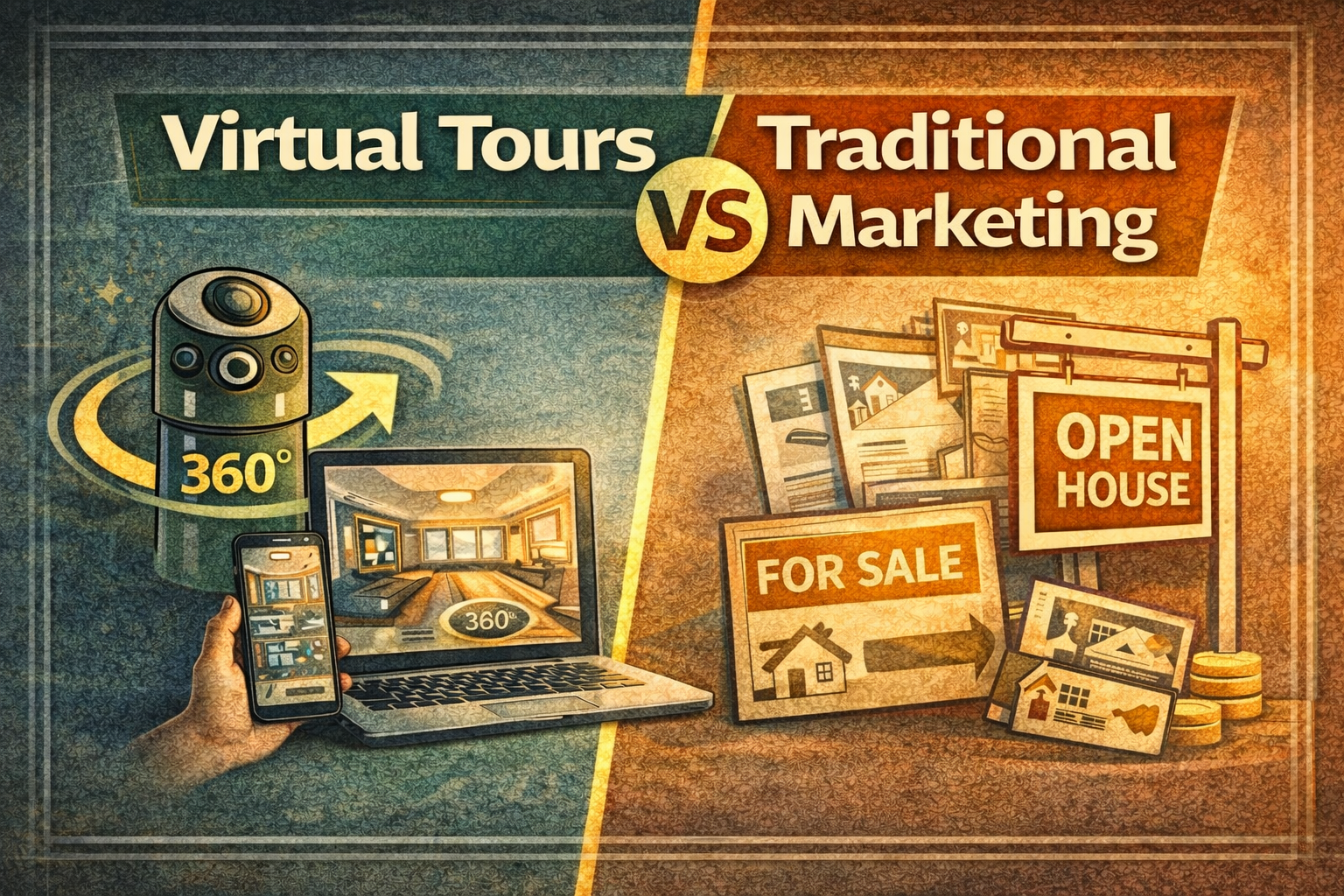
Real estate marketing has changed dramatically over the last decade.
Not long ago, agents could sell a home with:
And it worked.
But today’s buyers are different. They don’t want to “discover” the home by driving across town. They want to evaluate it instantly—online—before they invest time, energy, and emotion into scheduling a showing.
That’s why virtual tour marketing has become one of the most effective listing strategies available.
In this guide, we’re going to break down virtual tours vs traditional marketing in real estate in a clear side-by-side comparison, covering what each strategy does well, where each one falls short, and what modern buyers respond to most.
We’ll also explore a common question agents ask when building a listing media package:
✅ virtual tours vs video — which performs better, and when should you use both?
Let’s dive in. 🚀
Here’s the truth:
The first “showing” happens online.
Most buyers start here:
📱 Zillow / Realtor / Redfin
📱 Google search results
📱 Instagram and Facebook
📱 Agent websites and listing pages
They scroll fast.
They compare options quickly.
And they decide what to eliminate within minutes.
So if your marketing can’t:
That’s the real advantage of virtual tours: they match how buyers shop today.
Traditional real estate marketing typically includes:
Traditional marketing still has value—especially for local visibility and neighborhood-driven sales.
But it also has a major limitation:
It’s not interactive, and it’s not always convenient.

Virtual tour marketing refers to using immersive media—usually 360° or interactive walk-throughs—to help buyers explore a property online.
A modern real estate virtual tour can include:
Virtual tours are designed to do one thing extremely well:
✅ turn curiosity into confidence
And confidence turns into showings and offers.
Let’s compare these strategies across the categories that actually matter.
It’s very hard to hold attention using traditional assets alone.
Virtual tours keep buyers engaged because they’re interactive.
Buyers can:
Engagement goes way up when people can interact instead of just “looking.”
✅ More engagement → more interest
✅ More interest → more inquiries
This is why virtual tour marketing has become a strong competitive edge.
Traditional marketing still relies heavily on:
This works, but it leaves gaps. Buyers still wonder:
Virtual tours solve this instantly by showing:
They feel closer to “being there.”
And when buyers feel clarity, they move forward faster.
Traditional marketing requires:
It’s inconvenient, especially for:
Virtual tours offer:
✅ 24/7 showings
✅ instant exploration
✅ faster shortlisting
This matters because buyers want to eliminate options quickly.
The easier it is to evaluate, the more likely they are to engage.
Traditional marketing attracts:
Some are serious buyers. Many are not.
Virtual tours increase lead quality because:
A buyer who completes a tour is more serious than someone who only clicked 2 photos.
That means fewer wasted showings and better prospects.
Traditional marketing often has ongoing costs:
It also costs time:
Virtual tours may cost more upfront, but:
One virtual tour can drive results across:
It’s a long-term asset, not a disposable flyer.
Flyers and signs don’t get forwarded.
You can’t easily “send a postcard” to a relative.
Virtual tours are insanely shareable.
Buyers share tours via:
This creates built-in virality that traditional marketing simply can’t match.
This is a huge question, and it matters because many agents only choose one.
Let’s break down virtual tours vs video clearly.
Video tours (cinematic walkthrough videos) are great for:
Video creates emotion.
Emotion creates desire.
This is why video works so well on social platforms like:
Virtual tours are better for:
If video is a movie…
Virtual tours are the interactive experience.
If you’re trying to maximize listing performance, the best strategy is:
🎥 Video for attention
🖱️ Virtual tour for conversion
Video pulls people in.
Virtual tours help them decide.
This is the perfect blend for modern listings.
It’s important to understand:
Virtual tours don’t need to replace traditional marketing.
They enhance it.
Here’s how they stack together:
Traditional marketing becomes more powerful when it has an interactive destination.
That destination is the virtual tour.
Virtual tours provide something traditional marketing cannot:
✅ A showing at midnight.
Buyers browse after work.
They explore after kids go to bed.
They compare properties in the evening.
If your listing has a tour, they can “walk it” instantly—without needing you.
That’s why virtual tour marketing increases buyer activity and speeds up decisions.
Even if you already have buyers…
Virtual tours help you win sellers.
Because sellers want marketing that:
When you pitch:
“Every listing includes a virtual tour so buyers can explore 24/7.”
That sounds like a plan.
And sellers choose agents with plans.
If you’re a photographer or media provider, virtual tours aren’t just a service.
They’re a business model.
Virtual tours help you:
✅ increase your average order value
✅ upsell floor plans and video
✅ build subscriptions (hosting + refresh)
✅ create repeatable delivery systems
This is exactly how you can scale virtual tour business operations without burning out.
Once your workflow is standardized, you can:
That’s scalable.
Traditional marketing still matters. It creates awareness.
But in today’s market, awareness isn’t enough.
Buyers want:
That’s what virtual tour marketing delivers.
And when you compare virtual tours vs video, the best approach becomes obvious:
🎥 Use video to generate attention
🖱️ Use virtual tours to generate decisions
If you want faster interest, higher-quality leads, and stronger listing presentation, virtual tours are no longer optional.
They’re the edge. 🏡🚀


Compact, ready to go anywhere
Interchangeable lens that’s upgradeable
Dual 1-inch sensors for improved clarity and low light performance
Dynamic range and 6K 360° capture
360° photo resolution at 21MP

8K 360° video recording for ultra-detailed visuals.
4K single-lens mode for traditional wide-angle shots.
Invisible selfie stick effect for drone-like perspectives.
2.5-inch touchscreen with Gorilla Glass protection.
Waterproof up to 33ft for underwater shooting.

360° photo resolution in 23MP
Slim design at 24 mm thick
Built-in image stabilization for smooth video capture.
Internal 19GB storage for photo and video storage.
Wireless connectivity for remote control and sharing.

60MP 360° still images for high-resolution photography.
5.7K 360° video recording at 30fps.
2.25-inch touchscreen for intuitive control.
USB Type-C port for fast charging and data transfer.
MicroSD card slot for expandable storage.
.png)

.png)

Try it free. No credit card required. Instant set-up.





.svg)


.svg)