


.png)


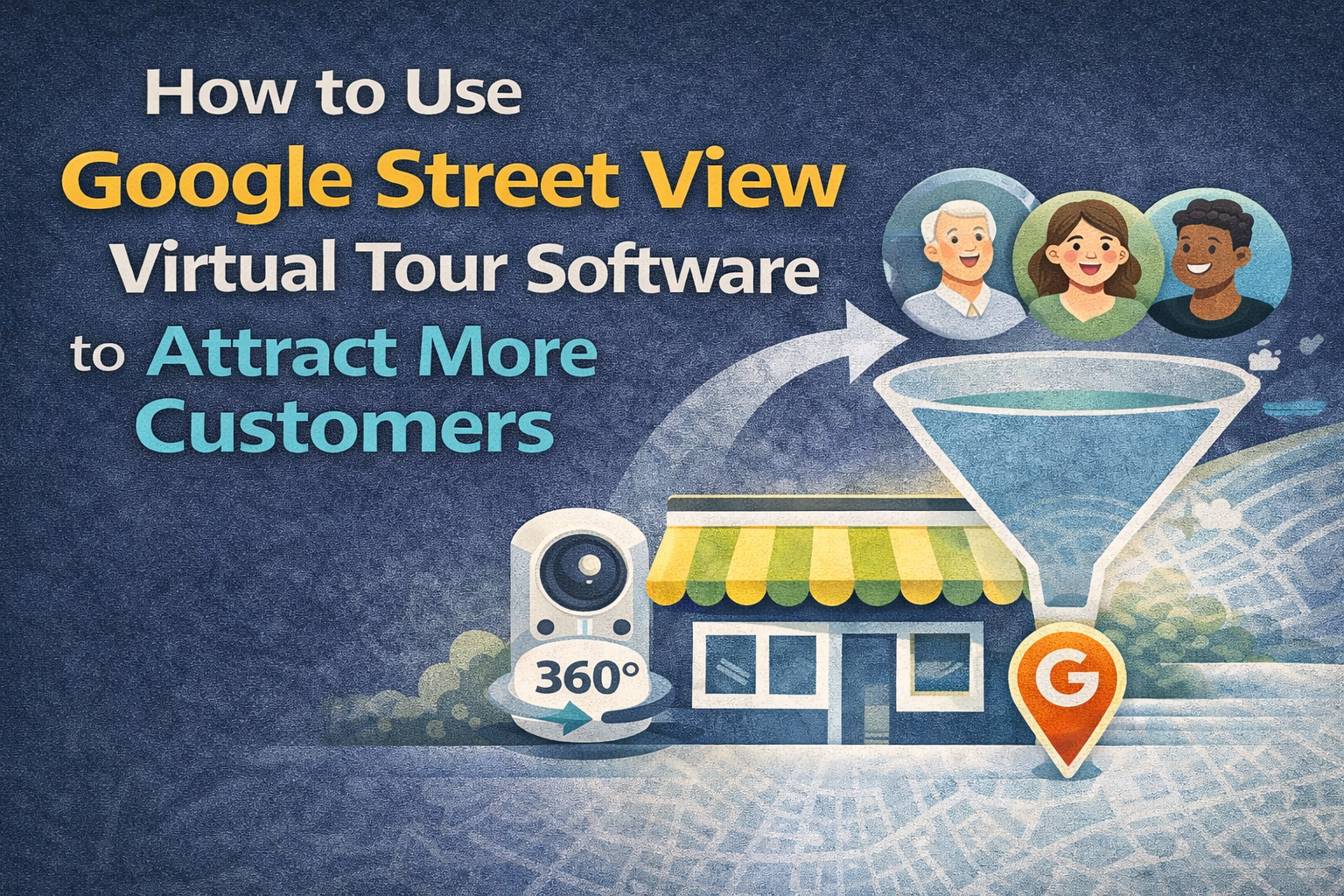
If you run a business with a physical location, your biggest marketing challenge isn’t just getting found…
It’s getting chosen.
When customers search on Google Maps or Google Search, they typically compare a few local options, glance at reviews, look at photos, and decide quickly who feels most trustworthy.
That’s why Google Street View virtual tours for businesses have become one of the strongest tools for modern customer acquisition.
A Street View tour doesn’t just show your business.
It sells the experience.
And with the right Google Street View virtual tour software, you can create a high-trust, high-engagement tour that helps you stand out from competitors and attract more customers—without needing to run ads 24/7.
In this guide, you’ll learn how to use Street View tours strategically, build a complete Google Street View marketing strategy, and use virtual tours to increase customer engagement long after publishing. A real estate video app helps realtors showcase properties with immersive video content buyers expect to see today.
Let’s jump in. ✅
Google Street View virtual tour software is a platform used to create, connect, and publish interactive 360° tours that customers can explore on:
Instead of uploading one panoramic photo, the software lets you build a full walkthrough experience by linking multiple 360 scenes together.
In simple terms:
📌 It turns 360 photos into an interactive “walk-through” of your business.
This is the foundation for using Google Street View virtual tours for businesses as a customer-attraction tool.

Customers want confidence.
When someone is deciding where to go, they’re asking (even subconsciously):
A Street View tour answers all of that instantly.
That’s why so many businesses use virtual tours to:
✅ shorten the decision-making process
✅ reduce hesitation
✅ increase conversions from Google listings
If your competitors don’t have a virtual tour, it’s even more powerful.
Many business owners assume Street View is just a “cool add-on.”
But in reality, the goal is:
✅ virtual tours to increase customer engagement
✅ attract customers with virtual tours
✅ strengthen trust before a visit
A tour turns your Google listing from a static directory entry into a real experience.
And experience drives action.
The best Street View tours don’t show everything randomly.
They guide a visitor through a story.
Think of your tour like a first-time customer visit:
Your tour should match that mental flow.
For example:
Because the first scene sets the tone.
To attract customers with virtual tours, you need to capture what customers care about most.
These usually include:
People don’t just want to see the building.
They want to see what their experience will feel like.
That’s how you win the decision.
Virtual tours attract customers… but only if they look good.
A messy, dark, cluttered tour can do the opposite.
✅ Clean everything
✅ Remove clutter
✅ Turn on lights
✅ Stage the space (like a photo shoot)
✅ Hide private info (papers, screens, staff lists)
A high-quality tour creates confidence.
A low-quality tour creates doubt.
Your tour needs to be properly connected to your business location so it appears where customers actually search.
That means:
Publishing correctly is what makes the difference between:
This step is where a proper Google Street View marketing strategy begins.
Here’s a pro move:
Treat your virtual tour like a marketing tool—not a visual upgrade.
Once it’s live, reuse it everywhere.
✅ website homepage
✅ contact page (“See inside before your visit”)
✅ service pages (“Explore our facility”)
✅ emails (“Take a quick tour before your appointment”)
✅ social posts
✅ QR code in-store (“Explore our space in 360°”)
This amplifies your tour’s power beyond Google Maps.
And it supports long-term visibility and engagement.
A Street View tour becomes dramatically more effective when paired with a simple strategy.
Here’s a beginner-friendly Google Street View marketing strategy you can use:
You don’t need to spam.
Just rotate it into content:
This is huge.
If you get inquiries from:
Send:
✅ “Here’s a quick virtual tour so you know what to expect.”
This builds trust without extra sales pressure.
Let’s focus on a key keyword you requested:
✅ virtual tours to increase customer engagement
Engagement isn’t just likes and comments.
Engagement includes:
A virtual tour increases these because it creates interaction.
That’s how you go from “views” to real customers.
Customers often compare 3–5 local businesses.
And most look the same on Google:
A Street View tour makes your listing feel premium and “verified.”
It signals:
✅ professionalism
✅ confidence
✅ transparency
That drives decision-making fast.
This is one of the most underrated benefits of Google Street View virtual tours for businesses.
Virtual tours work best when your physical space influences buying decisions.
If customers want to “see the place first,” a virtual tour will help you attract more of them.
When promoting your tour, use plain language.
Avoid tech terms.
This is how you attract customers without sounding salesy.
Avoid these if you want the tour to actually attract customers:
A tour is valuable only if people see it.
Don’t capture while the business is messy, under construction, or poorly staged.
A 2-point tour feels incomplete.
People want to see where they’ll be—not storage rooms.
A Street View tour isn’t like an ad that disappears.
It stays visible where customers are already searching:
✅ Google Maps
✅ Google Search
✅ your business listing
That’s what makes it evergreen.
It continues helping you attract customers for months and years without constant effort.
So if you want marketing that compounds over time, virtual tours are one of the best assets you can build.
If you want to attract more customers, the best strategy isn’t always to spend more.
Often, the smartest move is to increase trust and engagement at the moment of decision.
That’s exactly what Google Street View virtual tour software helps you do.
It helps you:
✅ attract customers with virtual tours
✅ build a real Google Street View marketing strategy
✅ use virtual tours to increase customer engagement
✅ convert Google visibility into real walk-ins, calls, and bookings
If your business depends on local customers, this is one of the highest-value upgrades you can make.


Compact, ready to go anywhere
Interchangeable lens that’s upgradeable
Dual 1-inch sensors for improved clarity and low light performance
Dynamic range and 6K 360° capture
360° photo resolution at 21MP

8K 360° video recording for ultra-detailed visuals.
4K single-lens mode for traditional wide-angle shots.
Invisible selfie stick effect for drone-like perspectives.
2.5-inch touchscreen with Gorilla Glass protection.
Waterproof up to 33ft for underwater shooting.

360° photo resolution in 23MP
Slim design at 24 mm thick
Built-in image stabilization for smooth video capture.
Internal 19GB storage for photo and video storage.
Wireless connectivity for remote control and sharing.

60MP 360° still images for high-resolution photography.
5.7K 360° video recording at 30fps.
2.25-inch touchscreen for intuitive control.
USB Type-C port for fast charging and data transfer.
MicroSD card slot for expandable storage.
.png)

.png)

Try it free. No credit card required. Instant set-up.




.svg)


.svg)