


.png)


The gap between "I shoot great virtual tours" and "agents actually book me" is almost always the pitch, not the work itself. Knowing how to pitch virtual tours to real estate agents — what to say, when to say it, and how to handle the inevitable pushback — is what separates photographers who stay stuck doing occasional favors from ones who build a genuine, repeat-client business.
This guide breaks the pitch down into its practical pieces: how to frame a virtual tour sales pitch real estate agents actually respond to, sample cold email approaches, and how to handle the objections you'll hear most often. For the broader picture of building a full business around this, the full guide to selling virtual tour services to agents covers pricing, positioning, and long-term client relationships — this article focuses specifically on the pitch itself.
The single biggest mistake in pitching agents is leading with features instead of outcomes. Agents don't wake up wanting a "360-degree stitched panoramic tour" — they want more qualified enquiries, a stronger listing presentation, and one less thing to coordinate themselves before an open home.
A strong pitch leads with a specific, concrete benefit tied to something the agent already cares about: helping a listing stand out against near-identical competing properties in the same suburb, giving interstate or overseas buyers a genuine way to evaluate a property remotely, or simply making the agent's own marketing look more professional than a competitor's. Keep the pitch short — a few sentences, not a full presentation — and always attach it to something specific and current, like an upcoming or recently listed property, rather than a vague general introduction.
Different agents respond to different angles, so it's worth having more than one version of this pitch ready rather than a single fixed script. A busy, high-volume agent tends to respond best to a time-saving angle — one less vendor to manage, one less coordination headache before an open home. An agent working a competitive or premium suburb often responds better to a differentiation angle — standing out visually against near-identical listings nearby. And an agent specifically handling a listing likely to attract interstate, overseas, or otherwise remote buyers responds well to the practical accessibility angle — letting a buyer who can't easily attend an inspection genuinely evaluate the property first.
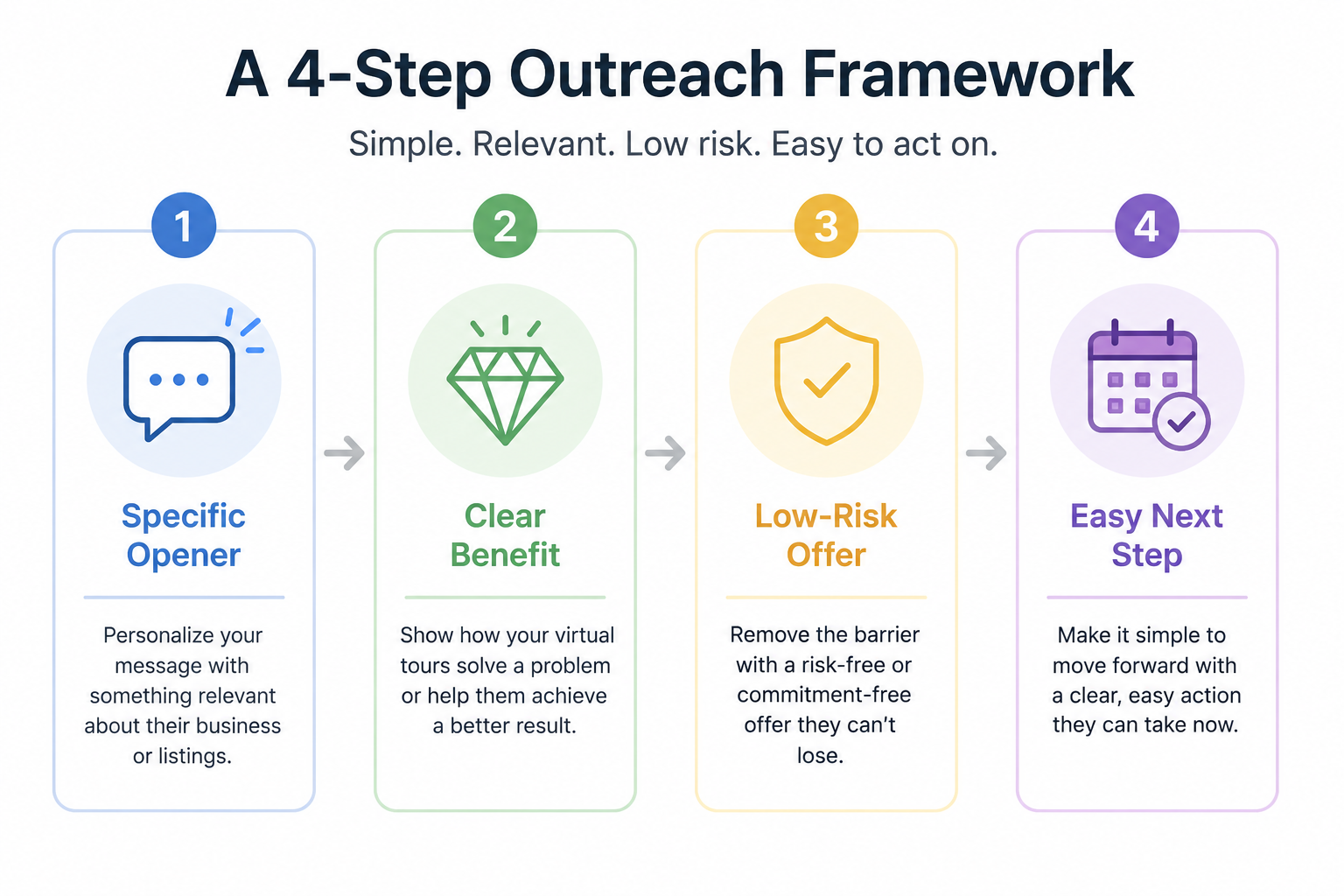
A well-structured cold email real estate agents virtual tour message follows a simple pattern: a specific, relevant opening line, a short statement of the concrete benefit, a low-friction offer, and a clear, easy next step.
A workable structure looks something like this: open by referencing a specific listing you noticed ("I saw your listing at [property] — congratulations on picking it up"), follow with the benefit framed around that specific property ("a virtual tour would let interstate buyers walk through it before booking an inspection"), make a low-risk offer ("I'd love to shoot one at no cost so you can see the result firsthand"), and close with a specific, easy-to-answer question ("would this Thursday or Friday work for a quick shoot?"). Avoid long paragraphs explaining your background or equipment in a first email — that information matters once an agent is interested, not before.
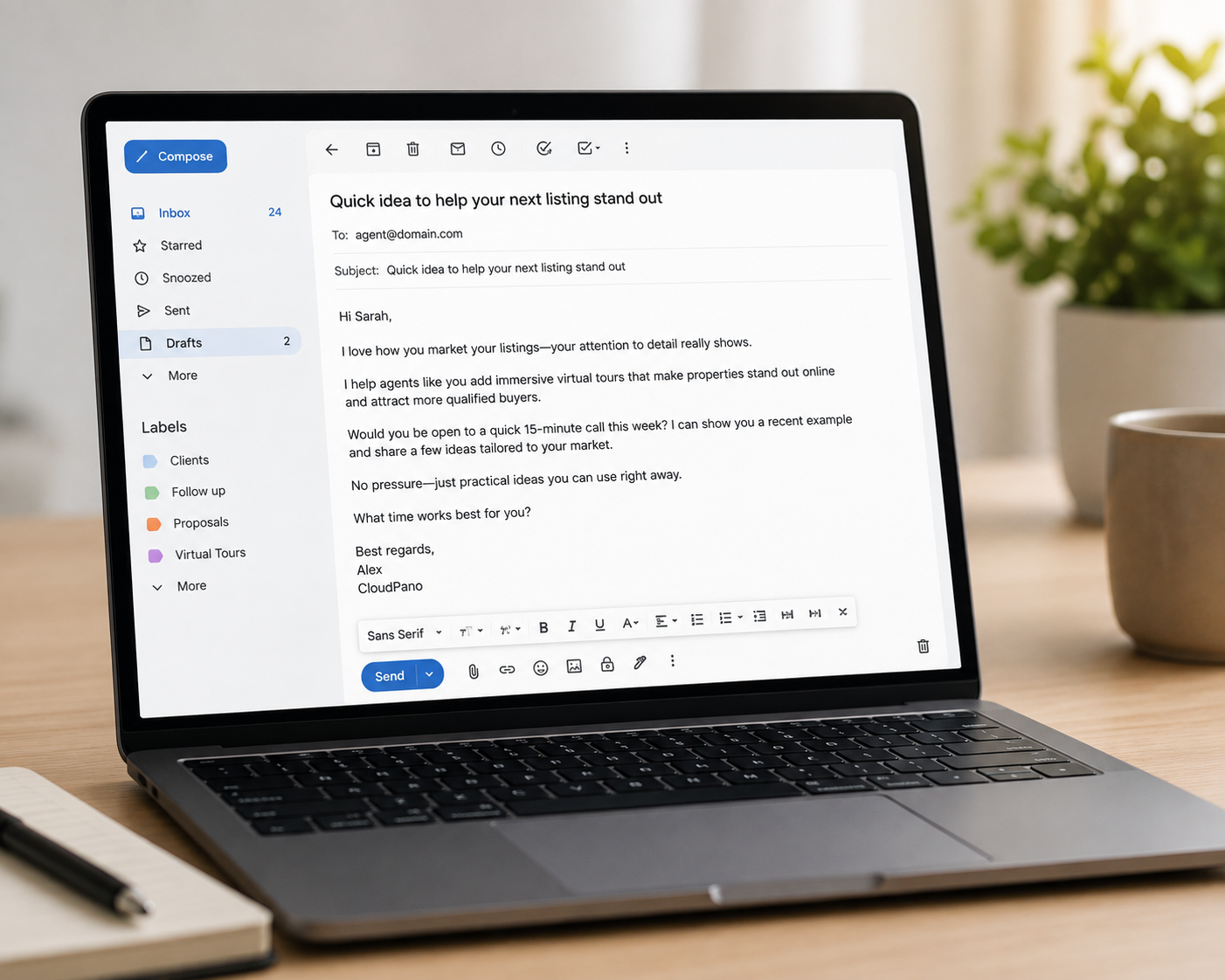
Follow-up matters as much as the first message. A single polite follow-up a week later, referencing the same listing, catches agents who simply missed or deprioritized the first email rather than actively declining it — most agents are managing a high volume of inbound messages, and a follow-up isn't pushy, it's often necessary.
Timing the email around the listing lifecycle also matters more than most new photographers expect. Reaching out the moment a listing goes live, before the agent has already committed to a photography and marketing plan, catches the decision at the point it's actually being made — a message that arrives weeks after a listing is already fully marketed is far less likely to get a response, simply because there's no live decision left for it to influence. Keeping a casual eye on new listings in your target area, through whatever channel is easiest, is a small habit that meaningfully improves reply rates over blasting emails on a fixed weekly schedule regardless of timing.
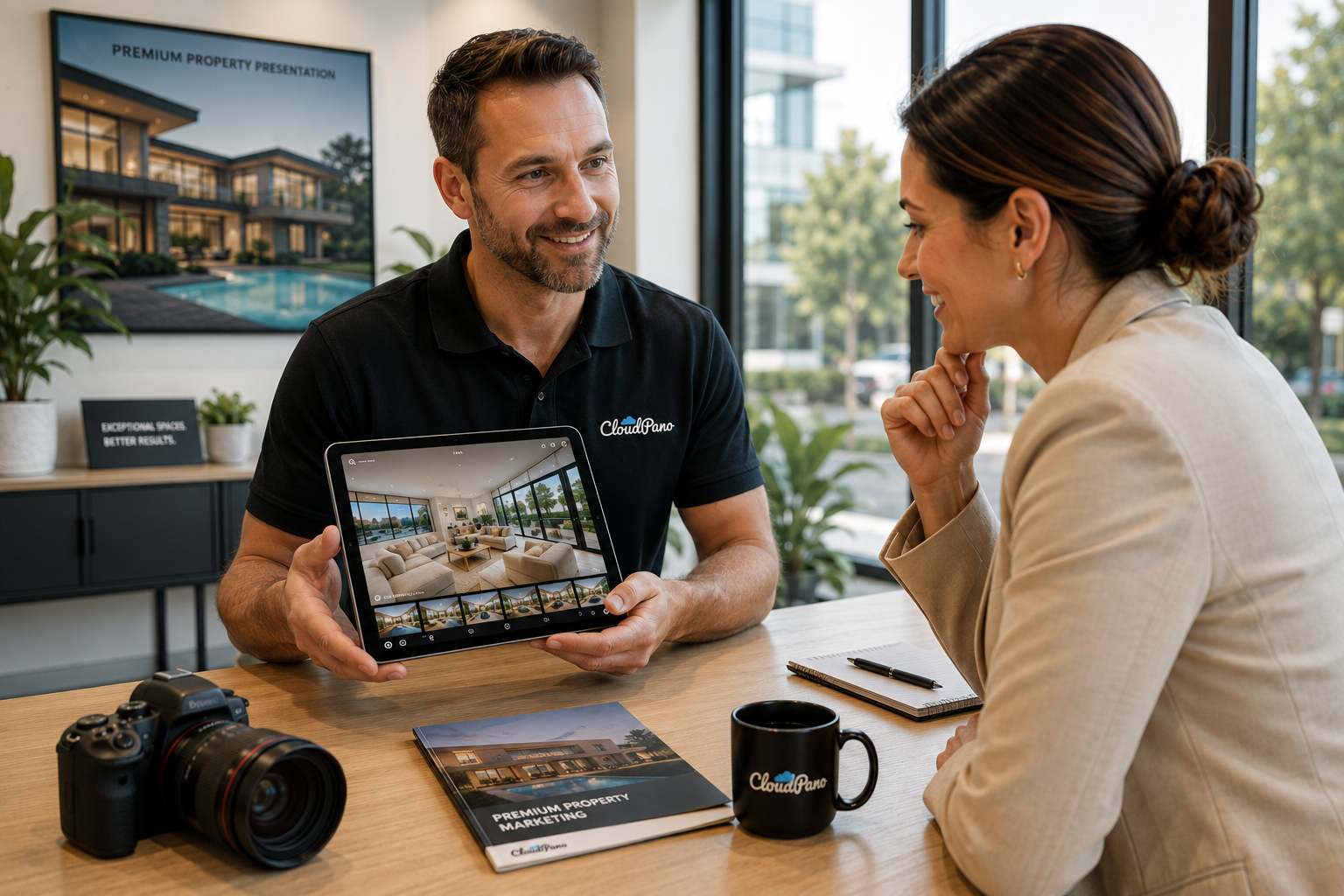
Cold email works, but an in-person conversation — at an open home, an agency office, or a local industry event — tends to convert at a noticeably higher rate, since agents are more likely to remember and trust someone they've actually met. If you have the opportunity for an in-person pitch, bring a sample tour on your phone or tablet that you can show immediately rather than describing verbally, and have your pricing and turnaround time ready to state clearly and confidently if asked.
It also helps enormously to have a portfolio strong enough to win agent clients on its own — a handful of genuinely strong, varied examples across different property types that you can pull up in seconds, rather than relying purely on your verbal pitch to carry the conversation. Dress and present yourself the way you would for any professional service meeting, since agents are effectively evaluating whether you'll represent their brand well in front of their own clients — a scruffy first impression undercuts even a strong sample portfolio.
It's worth preparing for the practical logistics of an in-person pitch too: have your pricing memorized rather than needing to check notes, know your typical turnaround time without hesitation, and be ready to book a tentative date on the spot if the agent shows interest. Momentum matters in these conversations — an agent who's mentally said yes in the moment is far more likely to follow through if you can lock in a specific next step immediately, rather than leaving it as "I'll follow up by email" and losing that momentum to a busy week.
Almost every conversation aimed at trying to convince agents to use virtual tours runs into a small, predictable set of objections, and having a calm, honest response ready for each one matters more than any scripted pitch.
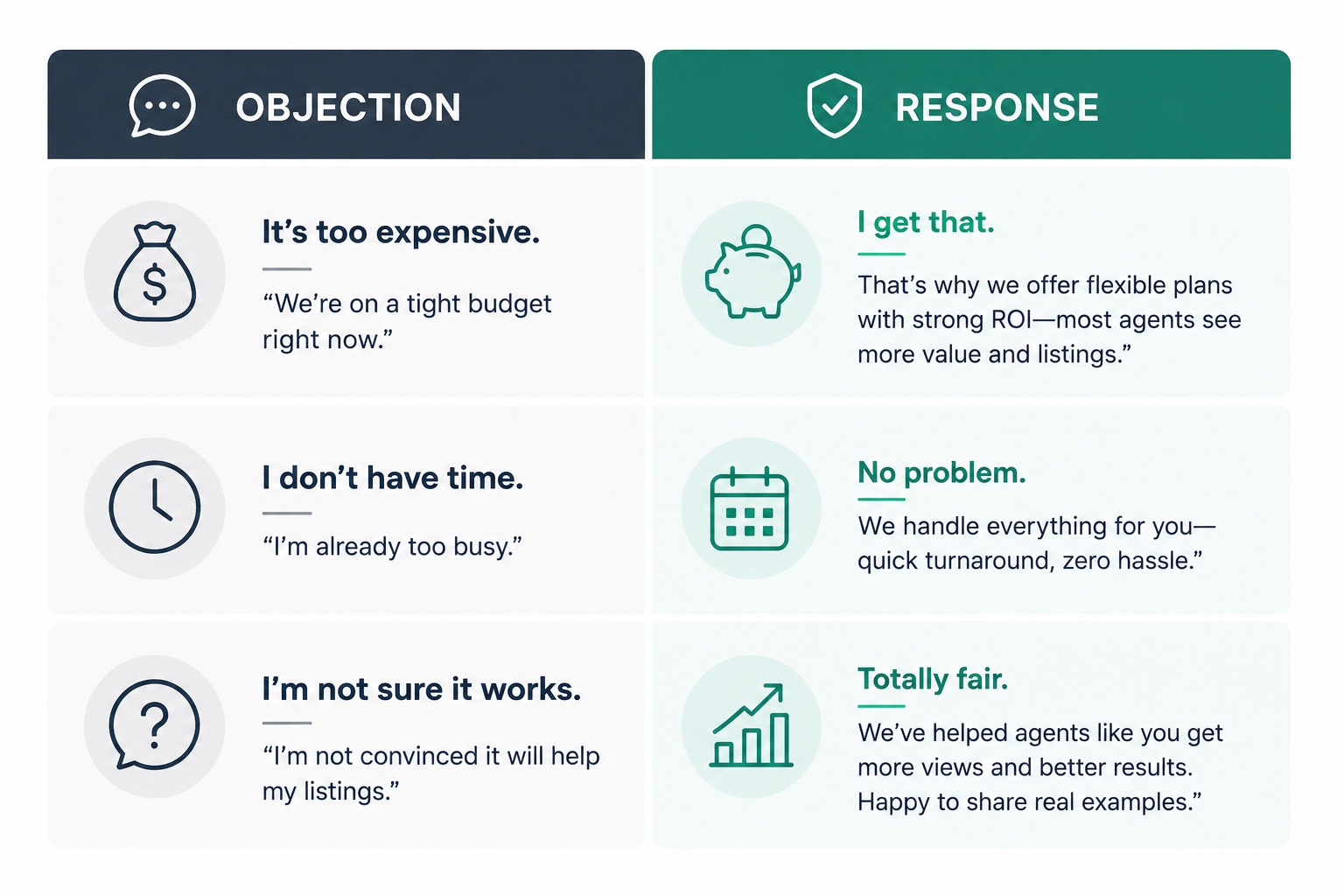
"I already have a photographer" is common and shouldn't be treated as a dead end — ask what their current media package includes, since many photographers still don't offer proper stitched virtual tours, only basic panoramas or none at all. "I'm not sure it's worth the cost" is best addressed by reframing the tour as part of the marketing package rather than a separate line item, similar to how professional photography or floor plans are already bundled into most listings. "Sellers won't want to pay extra" is worth countering with a low-cost or free trial offer for the first listing, removing the financial objection entirely until the agent has seen a real result. If an agent raises genuine skepticism about whether tours actually help, the data on whether virtual tours actually improve listing performance is worth having ready, since a specific, credible answer lands far better than a general assurance.
A successful first pitch is the beginning, not the end goal. Once you've delivered a strong first tour, following up specifically to ask how it performed — enquiry volume, feedback from the agent, anything notable — does two things at once: it shows genuine interest in the agent's results rather than just the transaction, and it opens a natural opportunity to ask about upcoming listings before the agent has to think to reach out to you again.
Consistency in delivery from that point forward is what actually converts a single booking into a standing relationship. The agents worth pitching hardest for aren't necessarily the biggest ones — they're the ones who list frequently and communicate clearly, since a smaller agent who lists reliably every month is often more valuable long-term than a single large one-off job, and that steady, predictable volume is usually what actually builds a sustainable business over time.
Learning how to pitch virtual tours to real estate agents comes down to a handful of repeatable fundamentals: lead with outcomes rather than features, keep cold outreach short and specific to a real listing, bring tangible proof rather than description alone, and respond to objections with honesty rather than defensiveness. None of this requires an aggressive sales style — it requires being specific, low-friction, and genuinely useful to a busy agent's actual priorities, delivered consistently enough that saying yes to you becomes the easy, obvious choice.
If you're ready to back that pitch with a consistently professional result, CloudPano makes it easy to deliver the kind of polished tour that turns a single trial pitch into a repeat client — so the quality of the work does as much of the follow-up selling as your original conversation did.


Compact, ready to go anywhere
Interchangeable lens that’s upgradeable
Dual 1-inch sensors for improved clarity and low light performance
Dynamic range and 6K 360° capture
360° photo resolution at 21MP

8K 360° video recording for ultra-detailed visuals.
4K single-lens mode for traditional wide-angle shots.
Invisible selfie stick effect for drone-like perspectives.
2.5-inch touchscreen with Gorilla Glass protection.
Waterproof up to 33ft for underwater shooting.

360° photo resolution in 23MP
Slim design at 24 mm thick
Built-in image stabilization for smooth video capture.
Internal 19GB storage for photo and video storage.
Wireless connectivity for remote control and sharing.

60MP 360° still images for high-resolution photography.
5.7K 360° video recording at 30fps.
2.25-inch touchscreen for intuitive control.
USB Type-C port for fast charging and data transfer.
MicroSD card slot for expandable storage.
.png)

.png)

Try it free. No credit card required. Instant set-up.





.svg)


.svg)