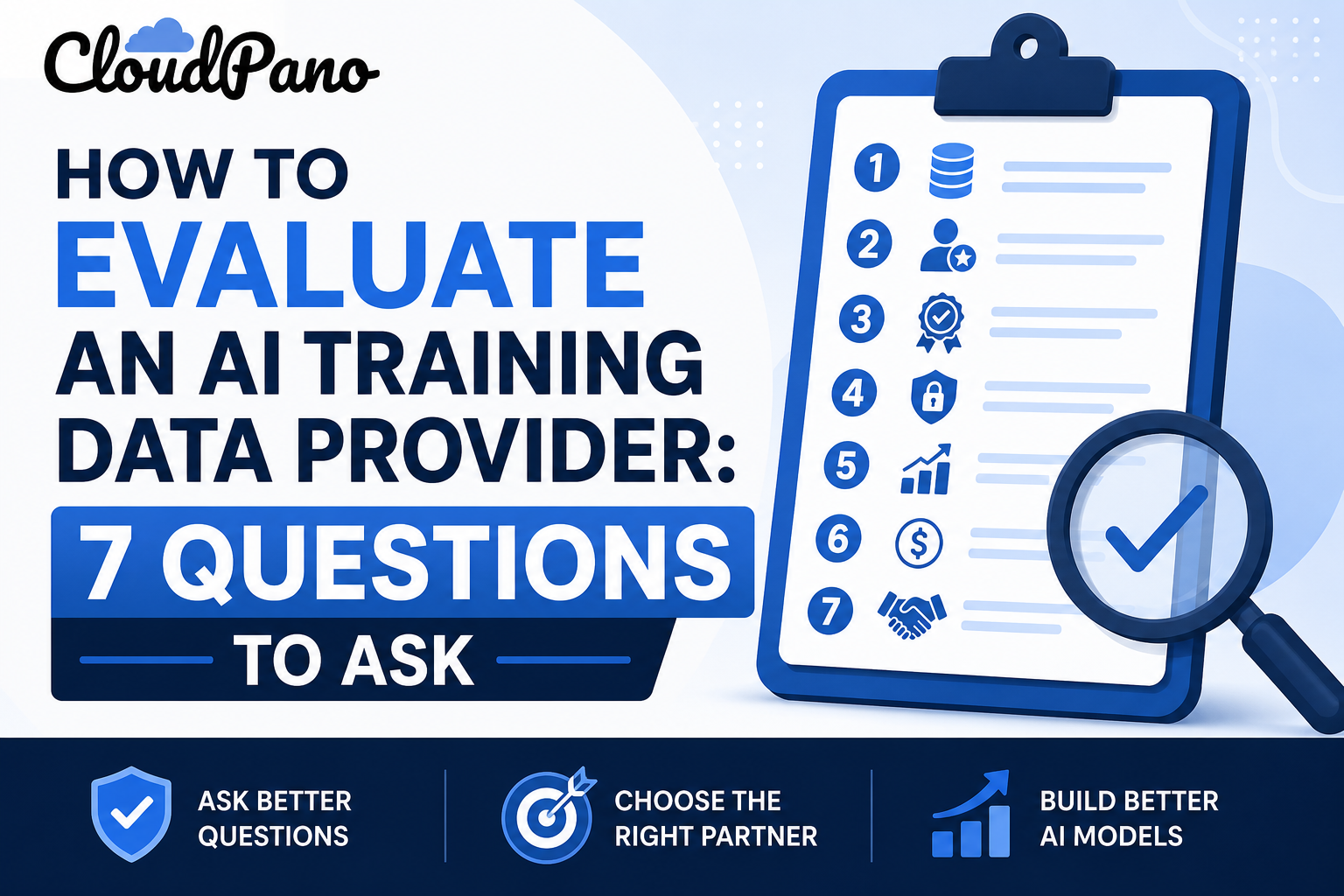
How to Evaluate an AI Training Data Provider: 7 Questions to Ask

Cloudpano
July 22, 2026
5 min read
Share this post

How to Evaluate an AI Training Data Provider: 7 Questions to Ask

Most teams start how to evaluate an AI training data provider research with a demo call and a proposal, then realize partway through that they never defined a consistent set of questions to compare candidates against. Each conversation ends up shaped by whatever the vendor chose to emphasize.

A repeatable checklist fixes that. Asking the same seven questions of every candidate — regardless of how polished their pitch is — surfaces the differences that actually matter and makes the final comparison an apples-to-apples one instead of a gut call.

Why It Matters

An inconsistent evaluation process doesn't just risk picking the wrong provider — it risks not noticing the mismatch until well into the engagement, when correcting course is expensive. Google Research's "Data Cascades" study documented how problems introduced early in data work compound into significant downstream issues that are difficult to trace back to their source (Sambasivan et al., Google Research).

NIST's AI Risk Management Framework treats data quality and provenance as foundational to trustworthy AI, which is a useful reminder that provider evaluation is a risk-management exercise, not just a procurement one (NIST AI RMF).

The pace of enterprise AI deployment raises the stakes further. Stanford HAI's AI Index has tracked how quickly organizations are moving models into production (Stanford HAI, AI Index Report), leaving little room for a full re-evaluation if a provider mismatch surfaces mid-project.

How It Works

An AI training data provider checklist works best structured around a consistent set of questions asked identically across every candidate, rather than an open-ended conversation shaped by each vendor's own pitch. Applying how these workflows operate as a lens for each question — not just accepting a vendor's description of their own process — is what makes the evaluation reliable.

Question 1 — What's their actual data capability? Do they only label data you provide, or can they also source, collect, or generate data you don't yet have?

Question 2 — What domain expertise do their annotators have? General-purpose annotation and specialized (clinical, technical, safety-critical) annotation require very different workforce training.

Question 3 — What's their quality assurance methodology? Ask specifically how they measure and report accuracy — gold-standard testing, consensus labeling, inter-annotator agreement — not just that they "guarantee quality."

Question 4 — What's their security and compliance posture? Data handling certifications, residency options, and audit trails, verified in writing rather than taken on trust.

Question 5 — How do they scale? Can workforce and quality assurance both scale to your actual volume, or only to pilot-scale throughput?

Question 6 — Is their pricing transparent? Per-label rates, minimum commitments, and rework costs for rejected batches should all be clear upfront, not discovered later.

Question 7 — Will they run a real pilot on your data? A provider's willingness to be evaluated on your actual data, not their demo dataset, is itself a signal worth weighing.

Step-by-Step Workflow

Flowchart of the AI training data provider evaluation process to final agreement
  • Write out the seven questions before contacting any provider. Having them defined in advance prevents the evaluation from being shaped by whichever vendor pitches first.
  • Ask every candidate the same seven questions, in writing where possible. Written answers are easier to compare directly than notes from a verbal conversation.
 Scoring sheet table for evaluating AI training data provider candidates
  • Score each answer against your project's actual requirements. A strong answer to "what's your QA methodology" only matters if it fits the accuracy bar your project needs.
  • Request references specific to your data type and volume. A reference from a very different use case tells you less than one from a similar project.
  • Run a paid pilot with your top one or two candidates. Use the pilot specifically to verify the claims made in their answers to the seven questions.
  • Compare pilot results against your own independent audit, not just the provider's self-reported metrics. This is where an AI training data quality assessment actually gets tested.
  • Negotiate an SLA that reflects what was verified in the pilot. Written commitments on accuracy and turnaround should match what the provider demonstrated, not just what they proposed.

Industry Use Cases

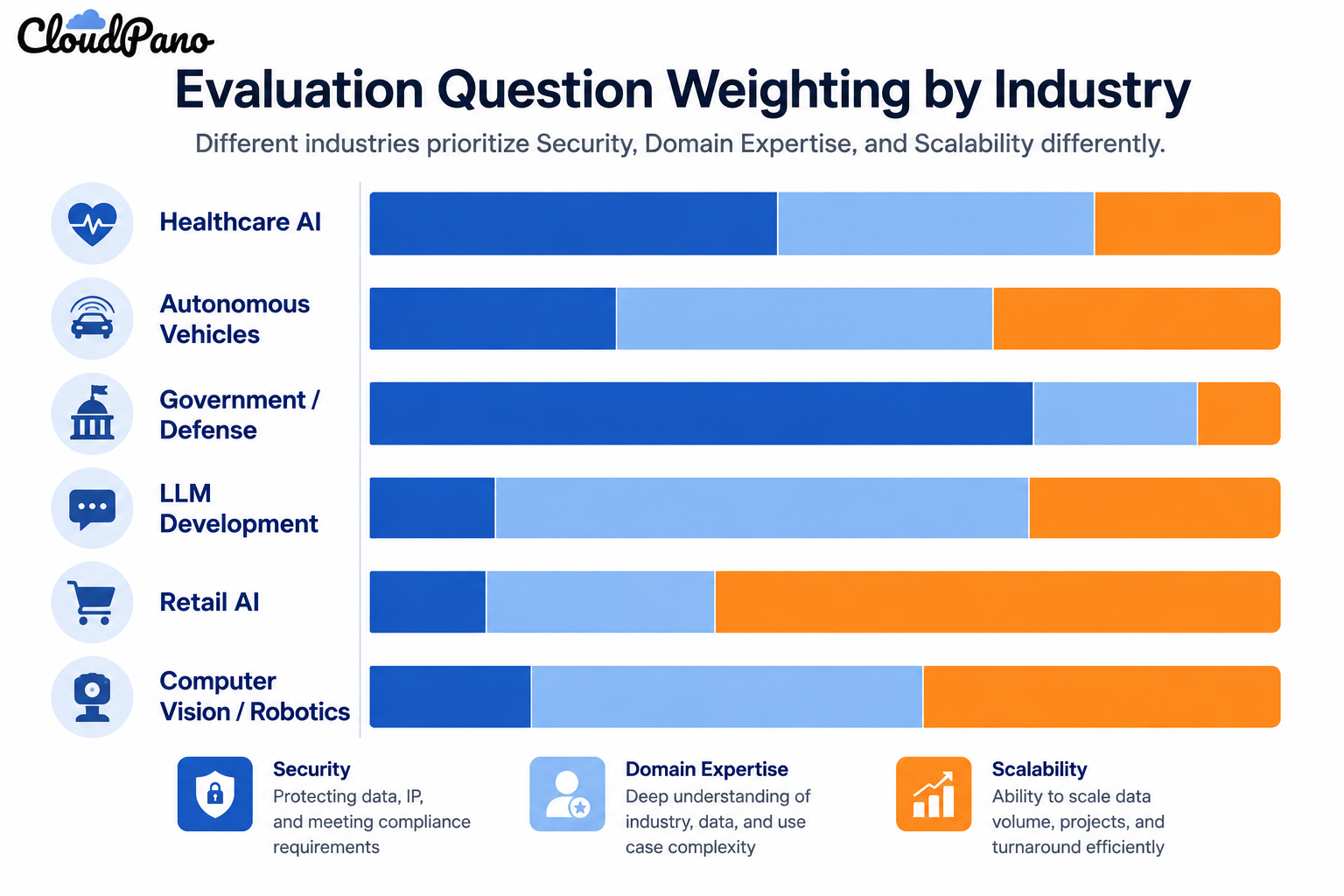
  • Computer vision / robotics: Data capability and scalability questions matter most, since projects often need high volume and sometimes custom data collection beyond pure labeling.
  • Autonomous vehicles: Quality assurance methodology and security posture carry the highest weight, given the direct link between labeling accuracy and safety outcomes.
  • Healthcare AI: Domain expertise and compliance questions dominate the evaluation, often outweighing pricing or scalability considerations entirely.
  • Retail AI: Scalability and pricing transparency typically matter most, since retail projects tend to be high-volume with lower per-item complexity.
  • LLM developers: Domain expertise in nuanced tasks like preference labeling and quality assurance methodology for subjective judgment calls are the most differentiating questions here.
  • Government & defense: Security and compliance posture often narrows the field before any other question gets asked, given clearance and data residency requirements.

Benefits of a Structured Evaluation Checklist

  • Consistent, comparable answers. Asking the same seven questions of every candidate makes the final comparison apples-to-apples instead of shaped by each vendor's own pitch.
  • Fewer blind spots. A defined checklist surfaces questions — like data provenance or synthetic data capability — that an open-ended conversation might never reach.
  • Faster decision-making. A structured process moves a team from research to a shortlist much faster than an unstructured series of demo calls.
  • A documented rationale. Written answers to defined questions make it easier to justify and revisit the decision later.
  • Reduced risk of a late-stage mismatch. Verifying capability and quality claims through a pilot, rather than trusting a proposal, catches problems before they become expensive.

Common Mistakes

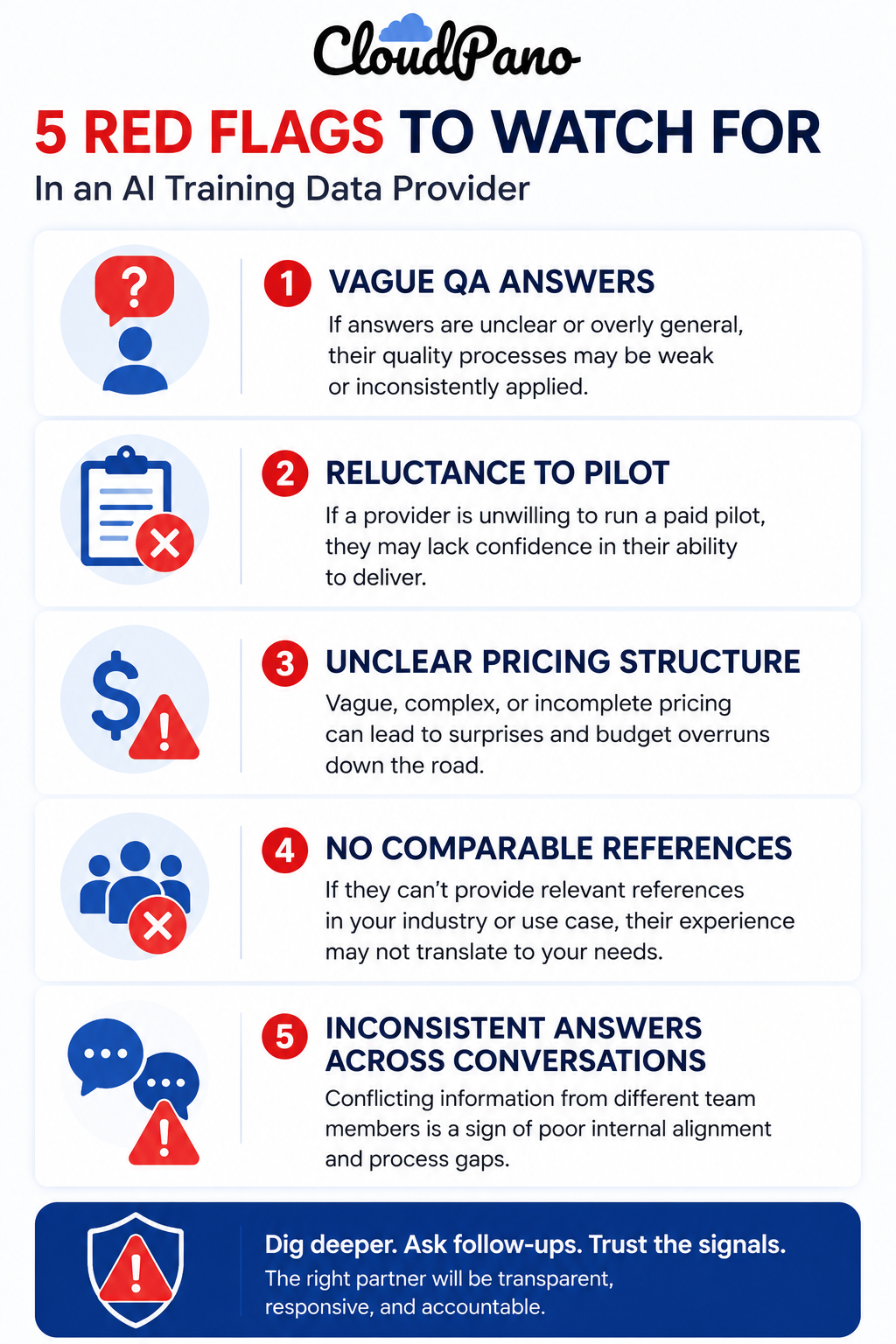
Infographic of red flags to watch for when evaluating an AI training data provider
  • Letting each vendor conversation follow its own structure. Without a defined checklist, evaluations become inconsistent and hard to compare directly.
  • Accepting quality claims without verification. Trusting a provider's self-reported accuracy metrics instead of independently auditing pilot results.
  • Skipping the pilot to save time. Assuming a strong proposal or reference list substitutes for testing on your actual data.
  • Not weighting questions by project relevance. Treating all seven questions as equally important regardless of whether your specific project depends more on security, domain expertise, or scale.
  • Evaluating pricing before capability fit. Comparing cost across providers before confirming they can even do what your project needs.
  • Assuming a good demo means a good production relationship. Not checking scalability or account structure, both of which matter more once a project moves past pilot volume.

Best Practices

  • Define your seven-question checklist and weighting before contacting any provider.
  • Request written answers where possible, since they're easier to compare consistently across candidates.
  • Always verify quality assurance claims through an independent audit of pilot results, not the provider's own reporting.
  • Weight the seven questions according to your specific project's requirements rather than treating them as equally important by default.
  • Negotiate SLA terms based on what was actually verified in the pilot, not just what was proposed.
  • Revisit the evaluation checklist periodically as your organization's projects and requirements evolve. McKinsey's research on generative AI adoption notes that data readiness — including how rigorously organizations evaluate their data partners — remains one of the most consistently underestimated factors in AI project outcomes (McKinsey, "The economic potential of generative AI").

FAQ

What are the most important questions to ask when evaluating an AI training data provider?

Their actual data capability (labeling only versus sourcing and generation too), domain expertise, quality assurance methodology, security and compliance posture, scalability, pricing transparency, and willingness to run a real pilot.

How is an AI training data provider checklist different from just comparing pricing?

A checklist evaluates capability, quality process, security, and scalability alongside cost, rather than defaulting to whichever provider quotes the lowest rate regardless of fit.

What does an AI training data quality assessment actually involve?

Independently auditing pilot results against your own gold-standard sample, rather than accepting a provider's self-reported accuracy metrics at face value.

Should I always run a pilot before choosing a provider?

Yes. A pilot on your actual data is the most reliable way to verify the claims made in response to your evaluation questions, regardless of how strong a provider's proposal or references look.

How do I weight the seven evaluation questions for my specific project?

Prioritize the questions most tied to your project's risk profile — security and compliance for regulated data, domain expertise for technical or clinical data, scalability for high-volume projects.

What red flags should I watch for during enterprise AI data vendor evaluation?

Vague answers to quality assurance questions, reluctance to run a real pilot, unclear pricing structure, and an inability to provide references from projects similar to yours in data type and volume.

How often should I revisit my provider evaluation criteria?

Whenever your project requirements change significantly — new data types, higher volume, stricter compliance needs — since the questions that mattered most for one project may not weight the same for the next.

Conclusion

Evaluating an AI training data provider gets far more reliable once it's built around a consistent set of questions rather than an open-ended conversation shaped by each vendor's pitch. Asking the same seven questions of every candidate, verifying the answers through a real pilot, and weighting the results against your specific project's requirements leads to a decision you can actually defend later.

🚀 Your All‑In‑One Virtual Experience Stack
🎬
PhotoAIVideo
Turn photos into scroll‑stopping AI videos.
Get Started →
🏡
Pictastic
Instantly stage listings with AI.
Try Staging →
🌀
CloudPano
Create stunning 360° tours in minutes.
Launch Tour →
💰
VirtualTourProfit
Build a profitable virtual tour business.
Learn More →
🤝
CloudPano Reseller
Resell AI visual software without building it.
Become a Reseller →
🚗
Auto CloudPano
Sell more vehicles with 360° experiences.
Explore Auto →
🏗️
AI Floor Plan Builder
Generate detailed floor plans with AI.
Build Now →
📐
3D Measure
Capture accurate floor plans & 3D measurements.
Measure Now →
🧠
AI Training Data
Custom AI training data services.
Learn More →
Share this post
Cloudpano

Choose The Right 360° Camera

Insta360 ONE RS 1-Inch 360 Edition

  • Compact, ready to go anywhere

  • Interchangeable lens that’s upgradeable

  • Dual 1-inch sensors for improved clarity and low light performance

  • Dynamic range and 6K 360° capture

  • 360° photo resolution at 21MP

Learn More

Insta360 X4

  • 8K 360° video recording for ultra-detailed visuals.

  • 4K single-lens mode for traditional wide-angle shots.

  • Invisible selfie stick effect for drone-like perspectives.

  • 2.5-inch touchscreen with Gorilla Glass protection.

  • Waterproof up to 33ft for underwater shooting.

Learn More

Ricoh Theta Z1

  • 360° photo resolution in 23MP

  • Slim design at 24 mm thick

  • Built-in image stabilization for smooth video capture.

  • Internal 19GB storage for photo and video storage.

  • Wireless connectivity for remote control and sharing.

Learn More

Ricoh Theta X

  • 60MP 360° still images for high-resolution photography.

  • 5.7K 360° video recording at 30fps.

  • 2.25-inch touchscreen for intuitive control.

  • USB Type-C port for fast charging and data transfer.

  • MicroSD card slot for expandable storage.

Learn More
Property Marketing
Allows potential buyers to explore properties in detail from anywhere, enhancing the real estate marketing process.
Automotive Spins
Create an interactive virtual showroom and engage affluent digital buyers with live 360º video calls, all through the CloudPano mobile app for a complete automotive sales solution.
Interactive Floor Plans
Create 2D and 3D floor plans with measurements in 4 minutes or less, all from your phone. Download the Floor Plan Scanner app and get your first scan free.

360 Virtual Tours With CloudPano.com. Get Started Today.

Try it free. No credit card required. Instant set-up.
Try it free
Latest posts

See our other posts

Interviews, tips, guides, industry best practices, and news.

Best Real Estate Video AI Software: Top AI Video Apps and Generators for Real Estate

Discover how real estate video AI software helps agents, photographers, brokerages, and property managers turn listing photos into polished property videos. This guide explains the most important features to compare, including photo animation, branding controls, vertical and horizontal formats, music, text overlays, voiceovers, and MLS-friendly exports. You will also learn the advantages, limitations, and practical steps for choosing the right AI video app for your real estate marketing workflow.
Read post

Professional MLS-Safe Listing Video Software

Professional MLS-safe listing video software helps real estate professionals create polished property videos while reducing the risk of including restricted branding, contact information, logos, or promotional elements. This guide explains how MLS-safe video tools work, what features to look for, and how to create separate branded and unbranded versions for MLS platforms, social media, websites, and advertising.
Read post

Scale AI, Appen, and Sama Alternatives: What to Look For

Scale AI, Appen, Sama alternatives are worth considering when a team needs more specialized domain expertise, a more direct account relationship, or pricing better suited to their volume than a large-scale generalist provider offers. The right alternative depends on matching provider capability to your specific data type, industry, and scale.
Read post