How to Choose the Best Virtual Tour Platform

Cloudpano
January 31, 2026
5 min read
Share this post

How to Choose the Best Virtual Tour Platform (and Avoid Getting Locked In) 🏠📸

Choosing the best virtual tour platform isn’t just about how your tours look today—it’s about whether your tours will still work everywhere you need them next year (and five years from now). The real estate tech ecosystem has been shifting fast: listing portals are building their own tools, platforms are consolidating, and distribution rules can change overnight. ⚡

This guide is an evergreen, practical virtual tour software comparison that helps you pick future-proof virtual tour platforms based on control, portability, workflow, and risk—plus a deep look at what the CoStar Group / Zillow / Matterport dispute taught the industry. 🧠

You’ll also get an accurate breakdown of CloudPano vs. Matterport—and why CloudPano is the better choice for most photographers, agents, and media teams that want flexibility and long-term distribution. 🚀

Why “platform choice” matters more than features 🎯

Most people start by comparing features: hotspots, branding, floor plans, VR mode, dollhouse view, analytics. Those matter—but they’re not the foundation.

The foundation is this question:

Can you reliably publish and share your tours across every channel you depend on—without being at the mercy of one portal’s policy or one vendor’s walled garden?

Over the last few years, portals and property-data companies have pushed harder to “own the experience.” That means your tour platform isn’t just software—it’s a distribution strategy. 🌐
The “future-proof” checklist: how to choose virtual tour software ✅

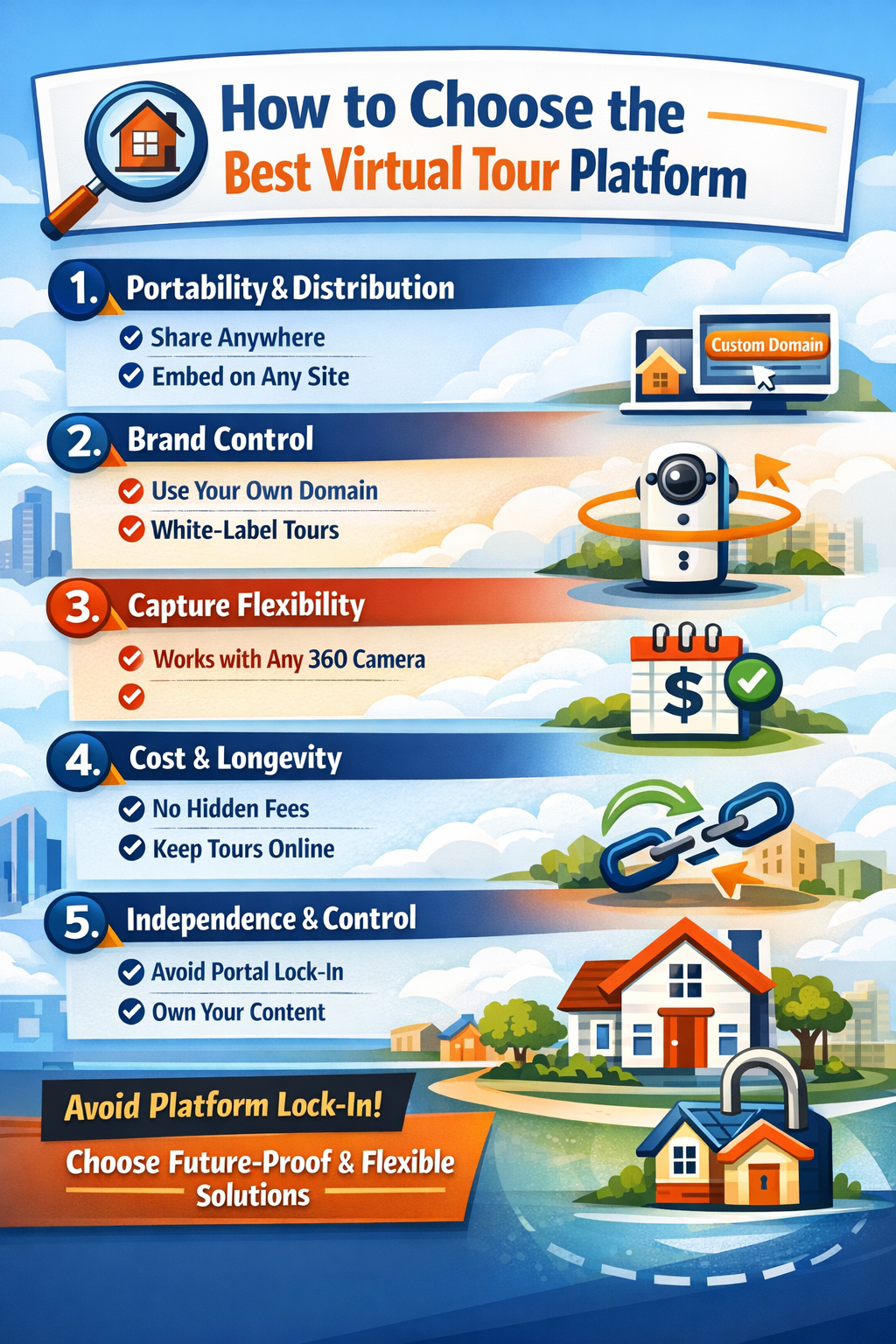
If you’re researching how to choose virtual tour software, use this checklist first. A platform is “future-proof” when it performs well across these five categories.

1) Portability: can your tours live everywhere? 🌍

A future-proof platform makes it easy to:

  • Share by direct link
  • Embed on any website
  • Publish to channels you don’t control (MLS/IDX, portals, social, email, SMS)
  • Avoid “single-portal dependency”

2) Brand control: can you white-label and use your own domain? 🏷️

For many pros, your tours are your product. If your tour link advertises someone else’s brand, you’re building their equity, not yours.

Look for:

  • White label / private label viewing
  • Custom domain support
  • Custom logos and UI control

CloudPano explicitly supports using your own domain and removing platform branding. That’s huge for agencies and photographers building long-term businesses. 💼

3) Capture flexibility: are you locked into specific hardware? 🎥

Some ecosystems work best when you use their preferred capture flow or camera stack. That can be fine—until your costs rise, your team expands, or you need multiple capture options.

A future-proof platform should work with common 360 cameras and workflows, not just one “approved” path. Flexibility = scalability. 📈

4) Cost structure: do you pay forever to keep a tour alive? 💸

Virtual tours feel like a “deliverable,” but many platforms treat them like “hosted inventory.” If you stop paying, your client’s link breaks. That can be a nightmare.

When comparing platforms, ask:

  • What happens to old tours if I downgrade?
  • Is there a limit on hosted tours/spaces?
  • Is pricing predictable as I grow?

5) Risk surface: can a third party break your workflow? ⚠️

This is the sleeper category. You want to reduce dependency on:

  • One portal
  • One API agreement
  • One corporate owner’s strategic priorities

Which brings us to the biggest real-world example of platform risk: the CoStar–Zillow–Matterport conflict.

Deep research: what the CoStar–Zillow–Matterport dispute revealed 🔍

In 2024, CoStar Group announced it would acquire Matterport for $1.6 billion, positioning Matterport’s digital twin technology as a competitive advantage in the portal wars. That deal officially closed in early 2025. 🏢💰Source: CoStar Group to Acquire Matterport, Leader in 3D Digital Twin Technology

This acquisition changed incentives overnight

  • Matterport went from being a broadly partnered vendor
  • To being owned by a major marketplace operator competing with other portals

That made other listing platforms more cautious about how Matterport content would be distributed.

What happened next? 🚨

In October 2025, Zillow removed Matterport 3D tours from its listings. Reports indicated the issue centered around API terms and distribution rights after the CoStar acquisition. Source: Zillow removes Matterport tours amid CoStar API dispute.

Zillow publicly stated the existing terms presented risk and that it preferred clearly defined, public-facing agreements. Zillow also emphasized it would continue promoting its own in-house Zillow 3D Home product.

CoStar responded by saying that subscriber-created Matterport tours could still be posted widely and that restrictions mainly applied to media created specifically for CoStar-owned platforms.

The real takeaway for professionals 🧩

No matter who you believe was “right,” one thing became crystal clear:

If your virtual tour distribution depends on a single portal’s policy or a single vendor’s corporate strategy, you don’t fully control your product.

That’s the heart of choosing future-proof virtual tour platforms. Control and independence matter just as much as features. 🛡️

Next-generation virtual tour technology: what actually matters 🤖

When people talk about next-generation virtual tour technology, they often mean:

  • AI scene enhancements
  • Automatic floor plans
  • 3D reconstruction
  • Measurement tools

Those are valuable. But the more important next-gen shift is distribution resilience:

  • Tours that embed anywhere
  • Tours that carry your brand
  • Tours that don’t vanish when one channel changes rules

In other words: the platform that gives you the most control becomes the most future-proof. 🔮

CloudPano vs Matterport: accurate differences ⚖️

Matterport is widely known for its “digital twin” experience and strong 3D visualization features. It’s often used in AEC, facilities, and enterprise environments where precise spatial modeling is critical.

CloudPano, on the other hand, is designed around speed, portability, and branding control for media creators, real estate marketers, and agencies.

Where Matterport tends to win 🧱

Matterport is a strong choice when you specifically need:

  • A detailed digital twin-style walkthrough
  • Advanced spatial data capture
  • Enterprise-focused 3D workflows

If your work revolves around architecture, engineering, or facility documentation, that ecosystem can make sense.

Where CloudPano wins (and why it’s better for most tour businesses) 🏆

For photographers, agencies, and real estate marketing teams, CloudPano wins where it counts most.

1) You control the brand
CloudPano supports white-label tours and custom domains. Your links look like your product, not someone else’s platform. That’s critical for building a business, not just delivering files. 💼✨

2) You reduce portal/platform risk
Because CloudPano is built around portability and embedding, your tours aren’t tied to one ecosystem. If one portal changes policy, your whole business doesn’t break. 🔄

3) Google visibility becomes a growth engine
CloudPano emphasizes publishing to Google Street View and Google Maps. That turns your tours into long-term SEO assets, not just listing add-ons. 📍🔍

4) Faster workflow = faster cash
Speed matters. CloudPano focuses on quick uploads, simple linking, and easy sharing without complex hardware or processing pipelines. That means faster delivery and more scalable operations. 💨💵

Bottom line: Matterport shines in digital twin–centric environments. CloudPano is stronger for businesses that want control, branding, and distribution flexibility.

A simple decision framework you can use today 🧭

When doing a virtual tour software comparison, don’t start with “Which looks coolest?” Start here:

1️⃣ Where will clients need to view the tour?
2️⃣ Do you need white-label control?
3️⃣ What happens if you stop paying or downgrade?
4️⃣ How dependent are you on one portal partnership?
5️⃣ Can you scale across multiple cameras and team members?

If your answers point toward flexibility, branding, and multi-channel growth, CloudPano is the safer and more future-proof option. 🛡️

Final thoughts: pick the platform you control 🏁

The best virtual tour platform is the one that protects your work from:

  • Portal policy shifts
  • API disputes
  • Vendor lock-in
  • Surprise pricing changes
  • Brand dilution

The CoStar–Zillow–Matterport situation showed the entire industry one thing:

Distribution is political. It changes. And you don’t want your business caught in the middle.

So if you want a long-term, resilient setup, choose future-proof virtual tour platforms that keep you in control—your branding, your links, your publishing options, and your ability to adapt as the ecosystem evolves. 🌍🚀

🚀 Your All-In-One Virtual Experience Stack Starts Here

Share this post
Cloudpano

Choose The Right 360° Camera

Insta360 ONE RS 1-Inch 360 Edition

  • Compact, ready to go anywhere

  • Interchangeable lens that’s upgradeable

  • Dual 1-inch sensors for improved clarity and low light performance

  • Dynamic range and 6K 360° capture

  • 360° photo resolution at 21MP

Learn More

Insta360 X4

  • 8K 360° video recording for ultra-detailed visuals.

  • 4K single-lens mode for traditional wide-angle shots.

  • Invisible selfie stick effect for drone-like perspectives.

  • 2.5-inch touchscreen with Gorilla Glass protection.

  • Waterproof up to 33ft for underwater shooting.

Learn More

Ricoh Theta Z1

  • 360° photo resolution in 23MP

  • Slim design at 24 mm thick

  • Built-in image stabilization for smooth video capture.

  • Internal 19GB storage for photo and video storage.

  • Wireless connectivity for remote control and sharing.

Learn More

Ricoh Theta X

  • 60MP 360° still images for high-resolution photography.

  • 5.7K 360° video recording at 30fps.

  • 2.25-inch touchscreen for intuitive control.

  • USB Type-C port for fast charging and data transfer.

  • MicroSD card slot for expandable storage.

Learn More
Property Marketing
Allows potential buyers to explore properties in detail from anywhere, enhancing the real estate marketing process.
Automotive Spins
Create an interactive virtual showroom and engage affluent digital buyers with live 360º video calls, all through the CloudPano mobile app for a complete automotive sales solution.
Interactive Floor Plans
Create 2D and 3D floor plans with measurements in 4 minutes or less, all from your phone. Download the Floor Plan Scanner app and get your first scan free.

360 Virtual Tours With CloudPano.com. Get Started Today.

Try it free. No credit card required. Instant set-up.
Try it free
Latest posts

See our other posts

Interviews, tips, guides, industry best practices, and news.

Property Manager Video Hub: Scaling Rental Visibility with AI Photo-to-Video Workflows

This article explains how property managers can use PhotoAIVideo to build a property manager video hub: a repeatable system for turning rental photos, amenity images, floor plans, exterior shots, and neighborhood visuals into reusable rental marketing videos. The main idea is that property managers do not just need more listing exposure. They need clearer visual answers that help renters decide whether to schedule a tour. PhotoAIVideo is positioned as a practical tool for creating: Unit availability videos Amenity highlight videos Neighborhood videos Tour reminder clips Leasing follow-up videos Owner marketing proof videos Social media rental teasers Application or availability reminder videos Key takeaways: Property managers already have the media they need; the challenge is organizing it and turning it into reusable video assets. A video hub helps teams create consistent videos across units, floor plans, amenities, communities, and owner updates. Rental videos can reduce friction by answering renter questions about layout, condition, amenities, parking, pet features, and community feel. One rental photo set can become multiple video outputs for listings, social media, email, text follow-up, tour reminders, and owner reporting. Photographers can sell AI rental video packages to property managers as an upsell. Brokerages with property management divisions can use the same workflow to standardize leasing content. The article ends with a step-by-step process, video hub framework, mistakes to avoid, visual recommendations, FAQs, and a CTA encouraging readers to use PhotoAIVideo to turn rental photos into a scalable video system for rental visibility.
Read post

YouTube Shorts Listing Teasers: The 3-Scene Structure for Higher Property Clicks

This article explains how real estate agents, photographers, brokerages, and property managers can use YouTube Shorts listing teasers to drive more property clicks and showing requests. The main idea is that a YouTube Short should not try to show the entire house. Instead, it should use a simple 3-scene structure: Scene 1: Hook — stop the scroll with the strongest property feature. Scene 2: Proof — show the visuals that support the hook. Scene 3: Click Path — tell the viewer what to do next. The article positions PhotoAIVideo as a practical tool for turning listing photos into short vertical videos for YouTube Shorts, Reels, open house promotion, and listing campaigns. Key takeaways: YouTube Shorts should create curiosity, not replace the full listing video. The strongest property feature should appear first, not necessarily the front exterior. Agents should build each Short around one click reason, such as backyard, kitchen, layout, neighborhood, open house, or price point. One listing can become multiple Shorts instead of one generic video. Photographers can offer YouTube Shorts teaser packs as a video upsell. Brokerages can standardize the 3-scene structure across agents. Property managers can use the same structure to promote rentals and tours. The article ends with practical scripts, visual recommendations, FAQs, a visual placement guide, and a CTA encouraging readers to use PhotoAIVideo to create YouTube Shorts listing teasers from property photos.
Read post

Video Retargeting for Listings: Turning Photo-Based AI Videos into Appointment Follow-Up

This article explains how Realtors, photographers, brokerages, and property managers can use photo-based AI videos as follow-up assets after someone shows interest in a listing. The main idea is that most real estate marketing focuses on getting the first click, but many buyers and sellers need multiple touchpoints before booking a showing or appointment. Video retargeting helps agents re-engage people who already clicked a listing, watched a Reel, opened an email, attended an open house, asked about a property, or went quiet after showing interest. PhotoAIVideo is positioned as a practical tool for turning listing photos into short follow-up videos, including: Feature reminder videos Layout explainer videos Neighborhood fit videos Open house recap videos Price update videos Seller proof videos Showing request videos Rental tour recovery videos Key takeaways: A first-touch listing video introduces the property, while a retargeting video answers the next likely question. Follow-up videos should be short, usually 10–30 seconds, and focused on one action. Agents should send different videos based on behavior, such as email clicks, open house attendance, listing views, or showing interest. A good video follow-up feels helpful, not pushy. Photographers can package retargeting video clips as an upsell. Brokerages can standardize video retargeting workflows across agents. Property managers can use the same strategy to recover rental leads and book tours. The article ends with a simple retargeting sequence, visual recommendations, FAQs, and a CTA encouraging readers to use PhotoAIVideo to turn listing photos into appointment-driving follow-up videos.
Read post