To build an AI agent evaluation dataset, define measurable success criteria, collect representative user tasks, include challenging scenarios, and establish clear evaluation rubrics. Test both final responses and intermediate agent actions, including tool calls and task completion. Combine automated scoring with human review, then regularly update the dataset using real-world failures and changing requirements.
AI agents are becoming more capable of handling tasks that once required constant human involvement. They can answer customer questions, retrieve information, analyze documents, write code, and interact with external tools.
But how do you know whether an AI agent can perform these tasks accurately, consistently, and safely?
The answer starts with evaluation data.
A well-designed AI agent evaluation dataset helps developers test how an agent behaves across realistic scenarios, identify recurring failures, and measure improvements over time.
Unlike traditional language model benchmarks, agent evaluations often need to examine more than the final response. They may also assess tool usage, decision-making, task completion, and compliance with instructions.
This guide explains how to build an effective evaluation dataset, what examples to include, and how to maintain reliable testing as your AI agent evolves.
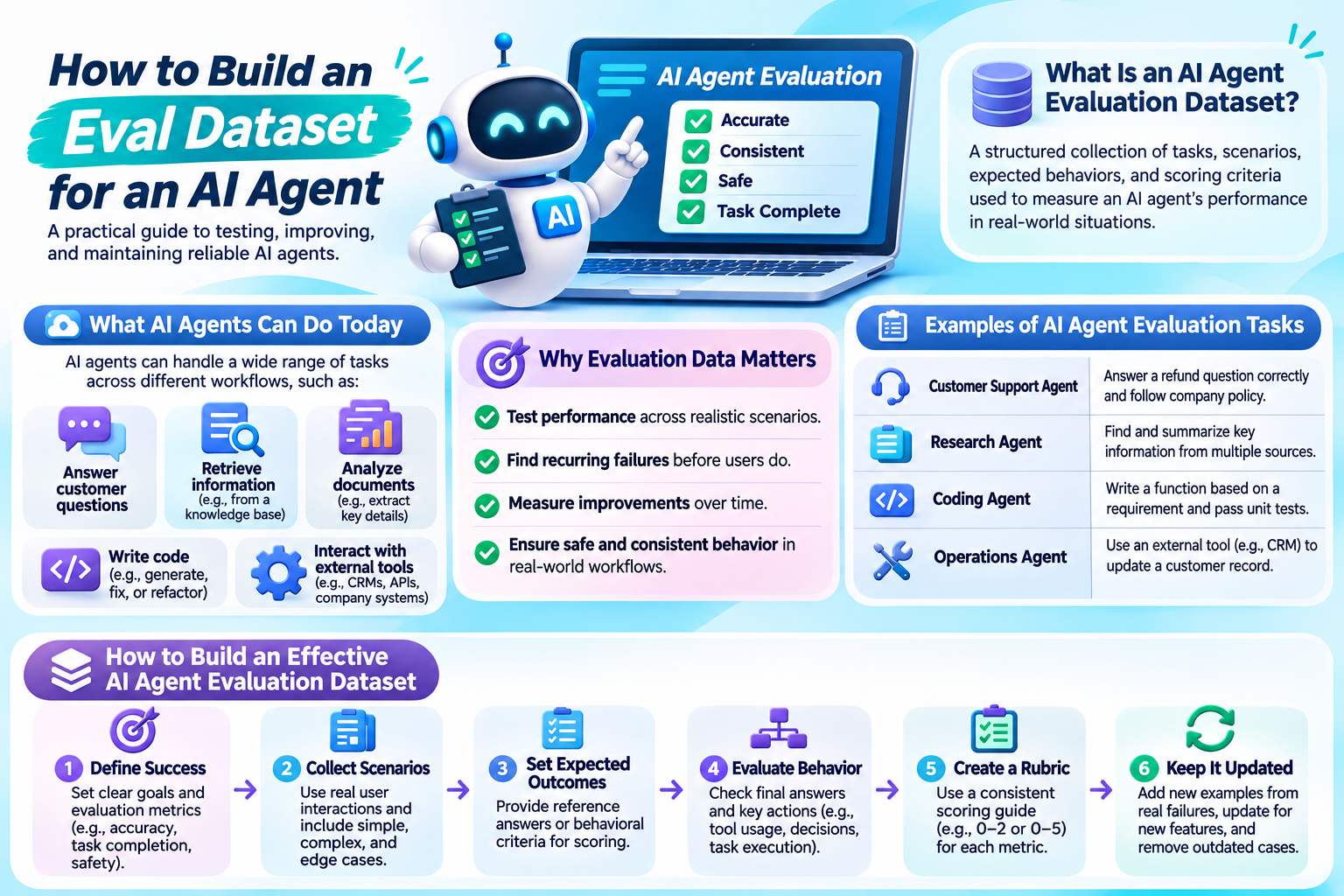
An AI agent evaluation dataset is a structured collection of tasks, scenarios, expected behaviors, and scoring criteria used to measure an AI agent's performance.
Each example represents a situation the agent might encounter while performing its intended responsibilities.
For example, a customer support agent might be evaluated on its ability to:
A coding agent might instead be evaluated on whether it produces functional code, uses development tools correctly, and completes requested changes without introducing new errors.
The dataset provides a repeatable way to test these capabilities.
Traditional language model evaluations often focus on individual prompts and responses.
AI agents introduce additional complexity because they may perform several actions before producing a final answer.
An agent might retrieve documents, call an API, analyze the results, update a record, and then respond to the user.
A useful evaluation must consider whether those actions were appropriate and whether the overall task succeeded.
This makes agent evaluation closer to testing a complete workflow than checking a single generated response.
An AI agent can perform well on a small collection of demonstration tasks and still struggle in production.
Real users rarely follow perfectly predictable patterns.
They provide incomplete instructions, ask ambiguous questions, change their minds, and occasionally request actions that conflict with system rules.
A representative AI agent evaluation dataset helps reveal how the agent handles these situations.
Evaluation examples can expose problems such as incorrect tool selection, inaccurate information retrieval, incomplete task execution, or unsafe actions.
Finding these issues during testing gives teams an opportunity to improve the system before users encounter them.
When developers change an agent's model, prompts, tools, or retrieval system, evaluation data provides a consistent basis for comparison.
Running the same tests before and after a change can reveal whether performance improved or whether new regressions appeared.
For business applications, an agent's usefulness depends on completing tasks correctly.
A customer support agent that gives a convincing answer but violates a refund policy has not succeeded.
Evaluation datasets should therefore measure meaningful outcomes rather than simply rewarding fluent responses.
Before collecting examples, identify what the agent is expected to accomplish.
Different applications require different evaluation criteria.
For a customer support agent, success might mean providing accurate answers while following company policies.
For a research agent, success might involve retrieving reliable information, identifying relevant evidence, and producing a grounded summary.
For a coding agent, success may require implementing a requested change and passing automated tests.
Common evaluation dimensions include:
Task completion: Did the agent accomplish the user's objective?
Accuracy: Was the information correct and supported by available evidence?
Tool usage: Did the agent select appropriate tools and use them correctly?
Instruction following: Did the agent respect user requirements and system constraints?
Safety: Did the agent avoid unauthorized, harmful, or inappropriate actions?
Efficiency: Did the agent complete the task without unnecessary tool calls or excessive resource consumption?
Each metric should have a clear definition so reviewers can apply it consistently.
Once success criteria are established, begin collecting representative tasks.
The goal is not to create the largest possible dataset. It is to capture the situations that matter most.
Where permitted, production interactions can provide valuable evaluation examples.
Customer questions, support tickets, agent logs, and previously failed tasks can reveal how users actually communicate.
Before including these examples, remove or protect personal information, confidential business data, and other sensitive material.
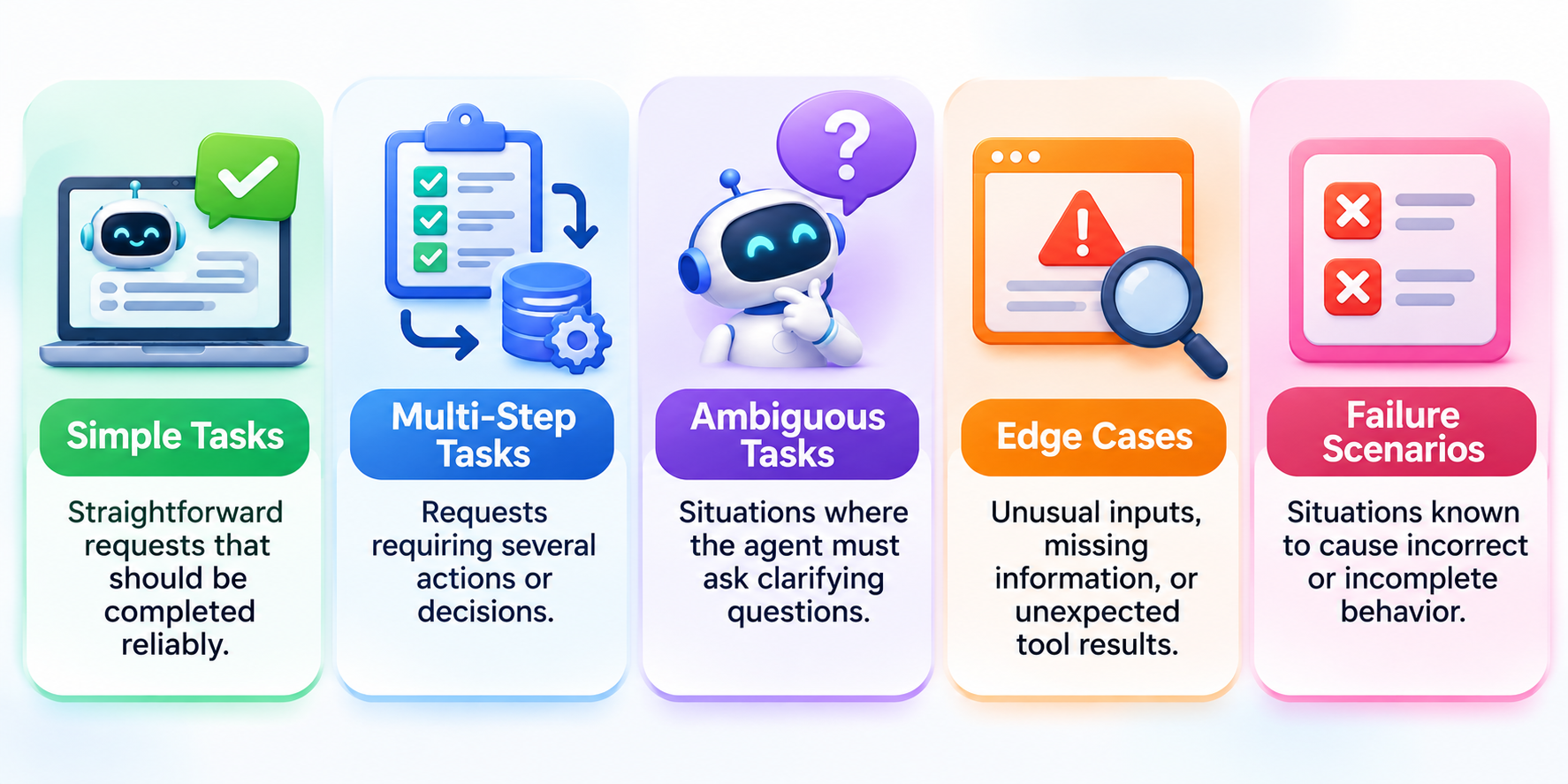
A strong AI agent evaluation dataset should contain several types of scenarios.
Simple tasks: Straightforward requests that should be completed reliably.
Multi-step tasks: Requests requiring several actions or decisions.
Ambiguous tasks: Situations where the agent must ask clarifying questions.
Edge cases: Unusual inputs, missing information, or unexpected tool results.
Failure scenarios: Situations known to cause incorrect or incomplete behavior.
This variety helps prevent an agent from appearing reliable simply because the test cases are too easy.
Every evaluation example needs a definition of success.
However, the expected outcome does not always need to be one exact sentence.
For example, if an agent is asked to summarize a document, several different summaries may be acceptable.
The evaluation should focus on whether the response captures the required facts accurately and avoids unsupported claims.
Reference answers work well for tasks with clear factual or structured outcomes.
Examples include extracting an invoice total, identifying a document date, or returning a valid API parameter.
Some tasks require flexible evaluation.
A customer support response might be considered successful if it provides the correct policy, communicates respectfully, and gives an appropriate next step.
The exact wording can vary without changing the quality of the outcome.
An agent may complete a task through more than one valid sequence of actions.
Avoid requiring one exact tool path unless that sequence is necessary for security, correctness, or compliance.
This helps prevent the dataset from penalizing legitimate solutions.
One of the most important differences between agent testing and ordinary response evaluation is the need to inspect intermediate actions.
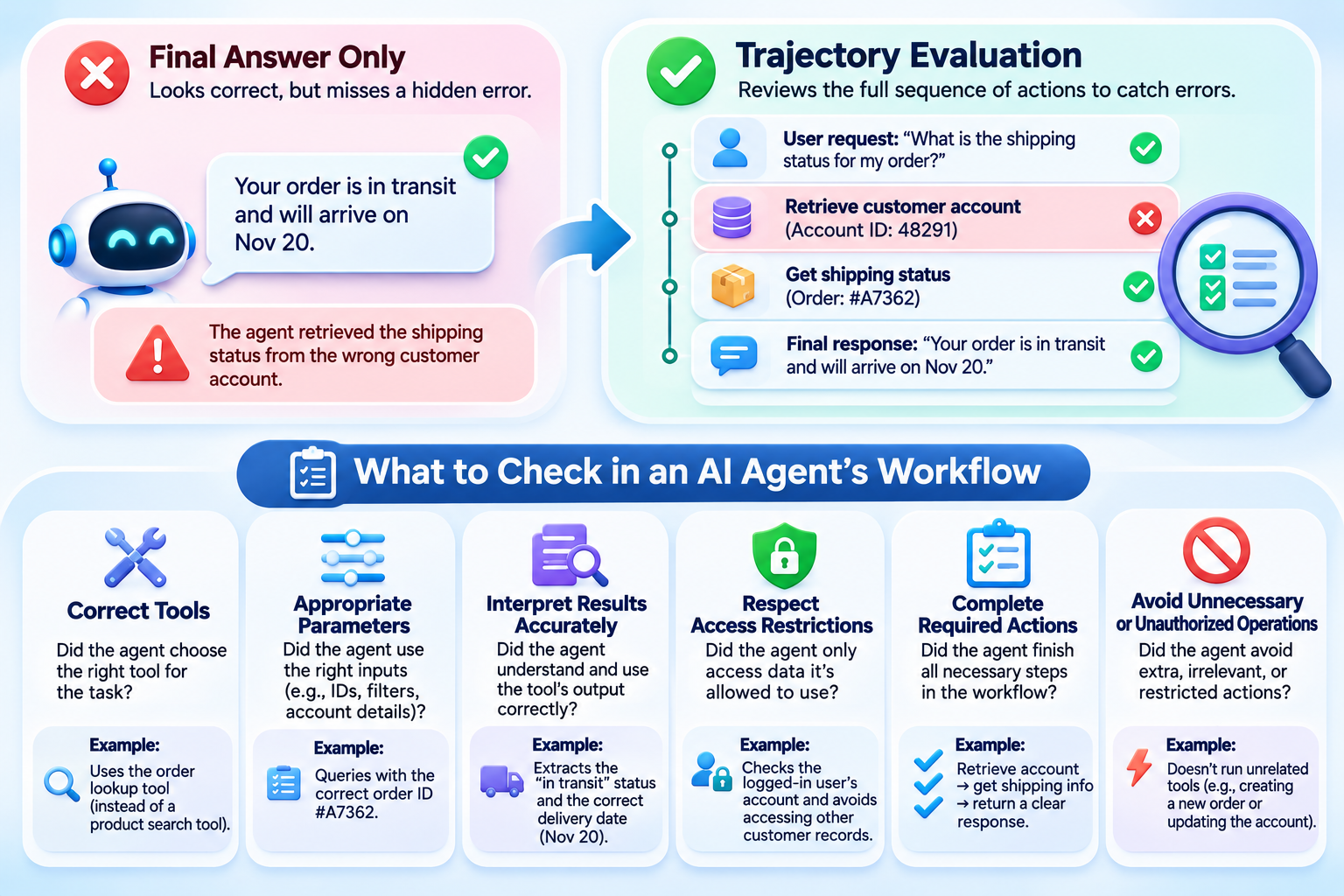
An agent trajectory is the sequence of observable steps taken during task execution.
It may include tool calls, retrieved information, tool responses, and the final answer.
Imagine an agent provides the correct shipping status to a customer.
The final response looks accurate.
However, the agent may have retrieved information from the wrong customer account before arriving at that answer.
An evaluation focused only on the final message could miss this serious problem.
Trajectory evaluation helps identify errors involving tool permissions, information retrieval, and workflow execution.
Review whether the agent:
The goal is to evaluate observable behavior without assuming access to the model's private internal reasoning.
An evaluation dataset becomes more useful when its examples can be scored consistently.
A rubric explains how reviewers or automated systems should judge performance.
For example, task completion could use a simple three-point scale.
Score 0 — Failed: The agent did not complete the task or produced an incorrect outcome.
Score 1 — Partially successful: The agent completed some requirements but missed important details.
Score 2 — Successful: The agent completed the task accurately and satisfied the relevant requirements.
Separate scores can be assigned for accuracy, tool usage, safety, and instruction following.
When humans evaluate agent behavior, different reviewers may interpret the same response differently.
Calibration sessions help reduce these disagreements.
Provide example responses, explain the expected scores, and establish procedures for resolving ambiguous cases.
Reviewers should also be able to flag examples where the rubric itself is unclear.
Not every evaluation requires manual inspection.
Automated checks are useful for requirements that can be measured consistently.
Examples include:
Human reviewers are particularly valuable when judging nuanced qualities such as helpfulness, factual grounding, ambiguous instructions, and context-dependent decisions.
Another language model can evaluate responses against a defined rubric.
This approach can help process larger evaluation volumes, but model-generated judgments are not automatically reliable.
Evaluators may show biases, overlook subtle errors, or reward confident but incorrect answers.
Compare model-based scores against human-reviewed examples and investigate disagreements.
For many organizations, combining automated checks, calibrated model-based evaluation, and targeted human review provides a practical balance.
A production-ready AI agent evaluation dataset should be structured so examples can be reused and maintained.
Each record may contain:
Keep a stable collection of regression tests so developers can compare system versions over time.
You can also maintain a separate development dataset for experimenting with new prompts, tools, and workflows.
Avoid repeatedly optimizing an agent against the same visible examples until it effectively memorizes them.
Maintain a separate holdout dataset for independent testing.
This helps determine whether improvements generalize beyond familiar evaluation scenarios.
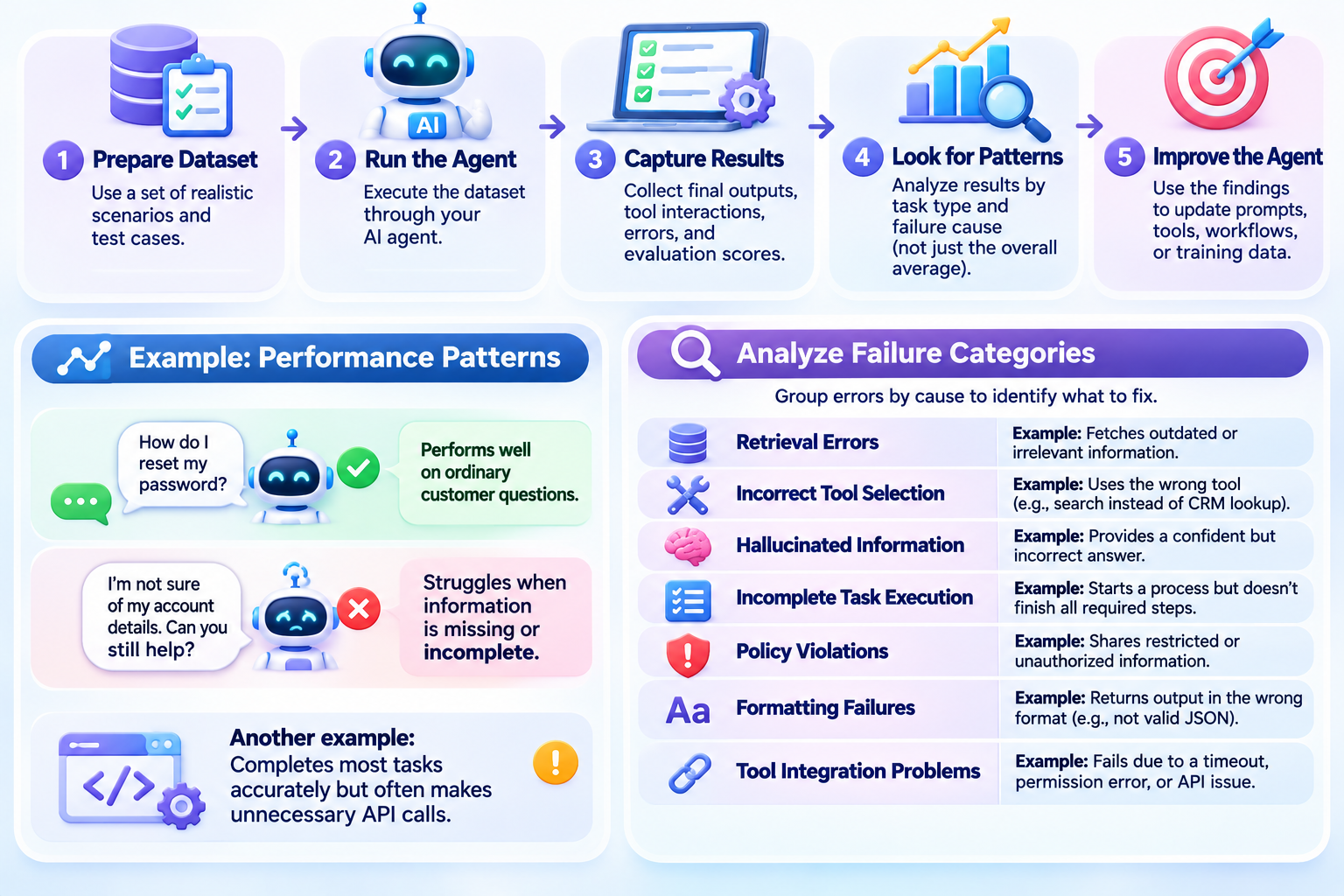
After assembling the dataset, run it through the agent.
Capture the final outputs, tool interactions, errors, and evaluation scores.
Look for patterns rather than focusing only on an overall average.
For example, an agent might perform well on ordinary customer questions but struggle when information is missing.
Another agent might complete most tasks accurately while frequently making unnecessary API calls.
These patterns reveal where improvements are needed.
Group failures by cause, such as:
This makes evaluation results actionable.
Instead of knowing only that the agent failed, developers can identify which component or behavior needs attention.\
Evaluation datasets should evolve alongside the systems they test.
New features introduce new behaviors.
Updated tools create different failure possibilities.
Changes in user expectations may also affect what successful task completion looks like.
Regularly review production incidents, failed evaluations, and newly discovered edge cases.
Add representative examples while removing duplicates, correcting outdated expectations, and updating scoring guidelines.
Not every production interaction needs to become a permanent test case.
Prioritize examples that reveal important failure modes, represent common tasks, or test critical business requirements.
A smaller, carefully maintained dataset can be more informative than a large collection of repetitive examples.
Even well-intentioned evaluation projects can produce misleading results.
Simple tasks are useful, but they rarely reveal how an agent behaves under realistic pressure.
Include complex workflows and ambiguous requests.
A correct answer does not guarantee that the agent followed an appropriate process.
Evaluate important tool actions and task outcomes.
Instructions such as "score the answer based on quality" leave too much room for interpretation.
Define specific, observable requirements.
Outdated examples can penalize correct behavior after legitimate product or policy changes.
Review evaluation data regularly.
An overall success rate can hide serious safety or reliability problems.
Track important evaluation dimensions separately.
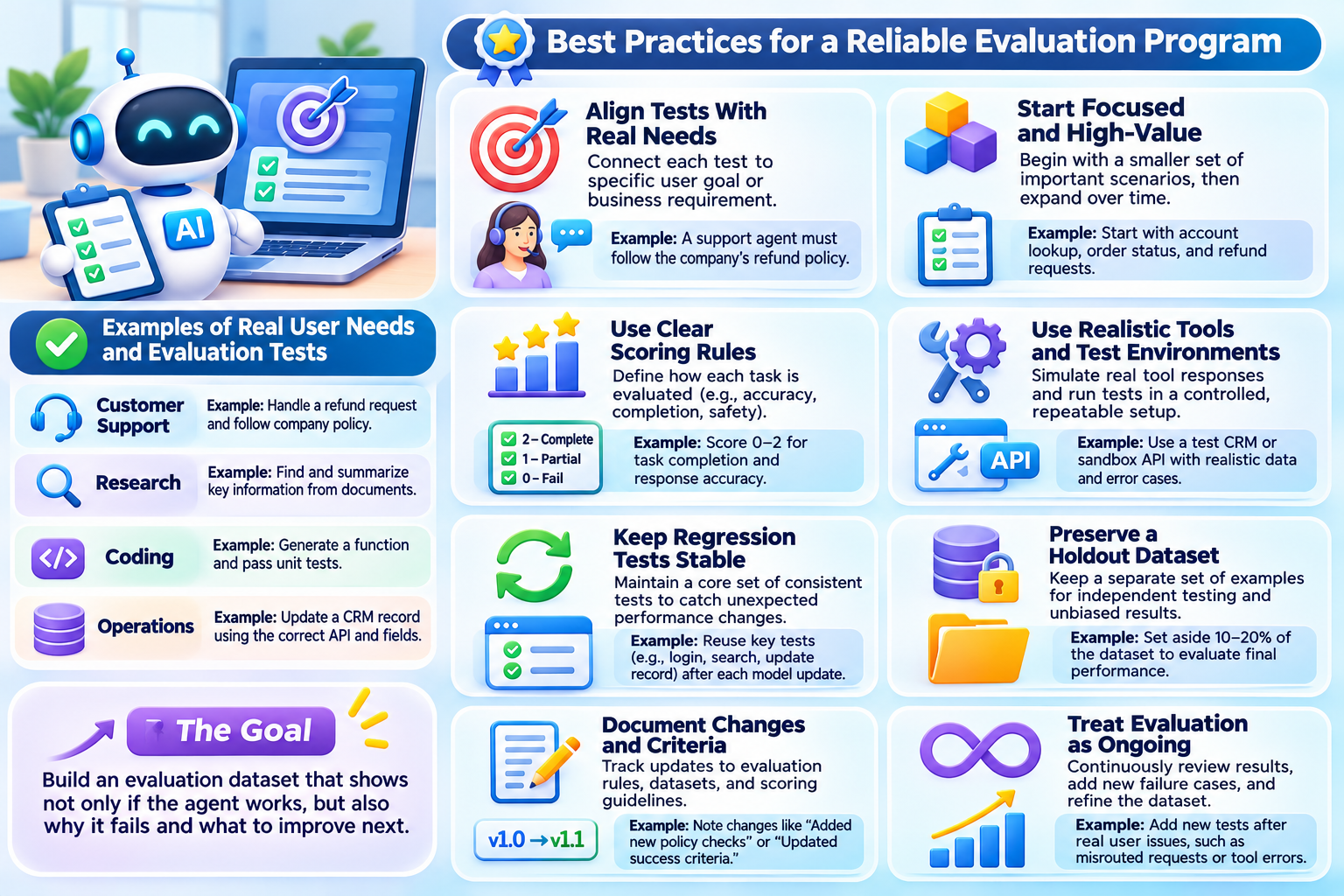
To make your evaluation program more dependable, connect every test to a real user need or business requirement.
Start with a manageable set of high-value scenarios, establish clear scoring rules, and expand coverage based on observed failures.
Use realistic tool responses and controlled test environments where possible.
Keep critical regression tests stable, preserve independent holdout examples, and document changes to your evaluation criteria.
Most importantly, treat evaluation as an ongoing engineering practice rather than a one-time benchmark.
A useful dataset should help teams understand not only whether an agent succeeds, but also why it fails and what needs improvement.
Building an effective AI agent evaluation dataset requires more than collecting prompts and checking answers.
Organizations need realistic scenarios, measurable success criteria, clear scoring rubrics, and visibility into how agents complete tasks.
The strongest evaluation programs combine automated testing with human judgment, maintain representative regression tests, and continuously incorporate new failure cases.
As AI agents take on more complex responsibilities, evaluation datasets become essential for identifying weaknesses, measuring progress, and maintaining dependable performance.
The goal is not simply to achieve a higher benchmark score.
It is to build AI agents that can complete meaningful tasks accurately, safely, and consistently in real-world environments.
An AI agent evaluation dataset is a collection of test scenarios used to measure an agent's ability to complete tasks accurately, safely, and consistently. It typically includes user requests, relevant context, expected outcomes, and scoring criteria. Some datasets also evaluate tool calls and intermediate actions.
There is no universal minimum. The appropriate size depends on task complexity, business risk, and the diversity of expected user interactions. Teams can begin with a focused set of representative examples and expand coverage as new failures emerge. Dataset quality and relevance matter more than raw example count.
A useful dataset should include realistic user tasks, expected outcomes, evaluation rubrics, relevant context, and applicable tool permissions. It should also cover common workflows, difficult scenarios, ambiguous requests, and known failure cases. These elements help assess both final responses and observable agent behavior.
Automated evaluations can efficiently check measurable requirements such as formatting, tool arguments, and task completion. However, human reviewers remain valuable for nuanced judgments involving accuracy, safety, context, and user experience. Combining both approaches generally provides more reliable evaluation coverage than relying exclusively on either method.
Evaluation datasets should be reviewed whenever an agent's capabilities, tools, policies, or operating environment change. Teams should also incorporate representative production failures and newly discovered edge cases. Maintaining stable regression tests alongside updated scenarios helps identify performance changes without losing historical comparability.


Compact, ready to go anywhere
Interchangeable lens that’s upgradeable
Dual 1-inch sensors for improved clarity and low light performance
Dynamic range and 6K 360° capture
360° photo resolution at 21MP

8K 360° video recording for ultra-detailed visuals.
4K single-lens mode for traditional wide-angle shots.
Invisible selfie stick effect for drone-like perspectives.
2.5-inch touchscreen with Gorilla Glass protection.
Waterproof up to 33ft for underwater shooting.

360° photo resolution in 23MP
Slim design at 24 mm thick
Built-in image stabilization for smooth video capture.
Internal 19GB storage for photo and video storage.
Wireless connectivity for remote control and sharing.

60MP 360° still images for high-resolution photography.
5.7K 360° video recording at 30fps.
2.25-inch touchscreen for intuitive control.
USB Type-C port for fast charging and data transfer.
MicroSD card slot for expandable storage.


Try it free. No credit card required. Instant set-up.