


.png)



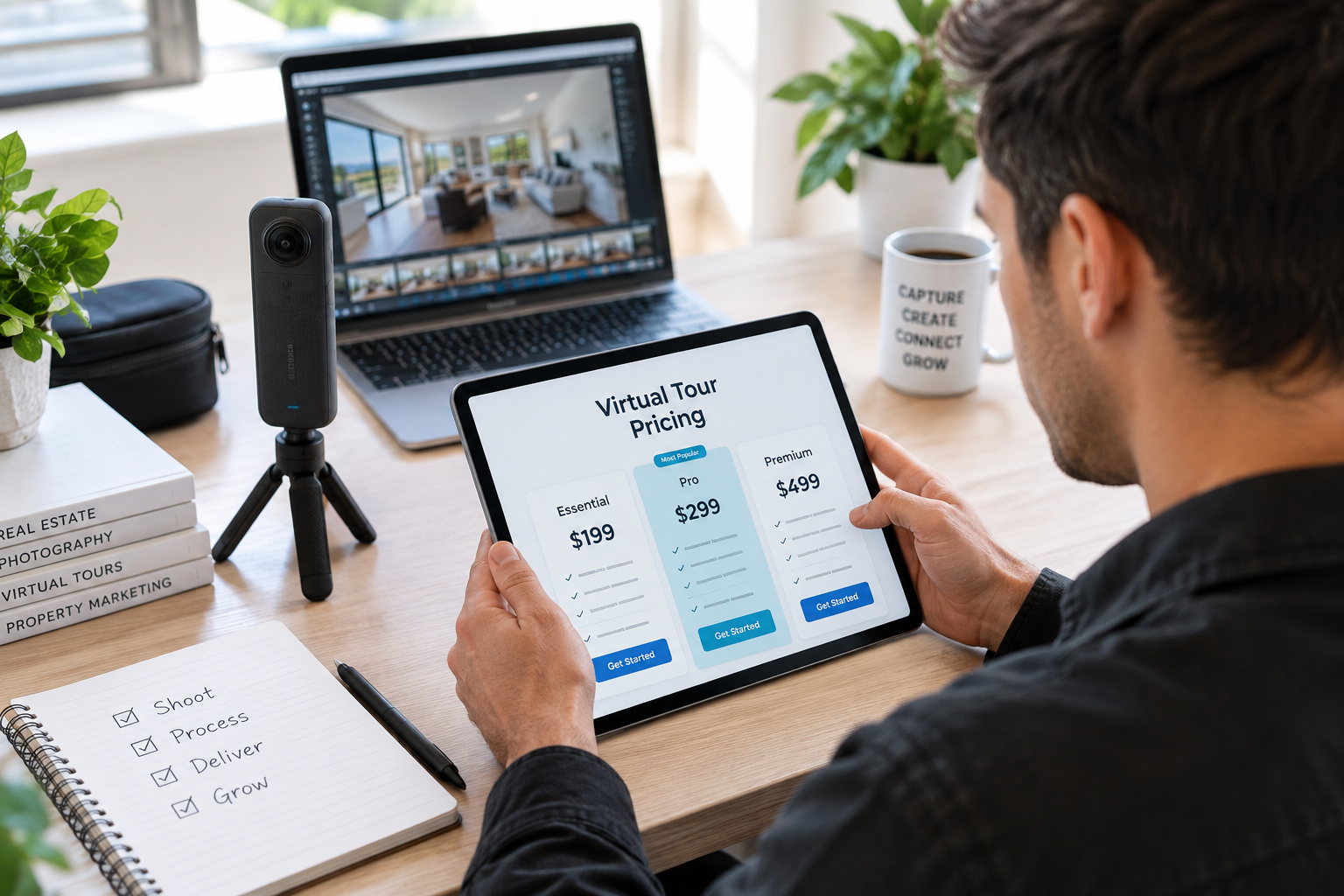
Price too low and you're working unsustainably hard for what the job is actually worth; price too high with no clear justification and agents quietly go elsewhere. Working out how much to charge for virtual tour real estate listings is less about finding one magic number and more about building a pricing structure that reflects your actual costs, time, and the value an agent gets from the finished tour.
This guide walks through the factors that should drive your pricing, how to structure virtual tour pricing packages Australia photographers commonly use, and how to set rates you can defend confidently in a conversation with an agent. For the bigger picture of selling this as a service in the first place, the complete guide to selling virtual tour services to agents covers the pitching and relationship-building side — this article is specifically about getting the numbers right.
Before settling on a number, it helps to understand what should genuinely influence real estate virtual tour cost, rather than picking a rate purely by guessing what feels reasonable. Property size and complexity is the biggest driver — a compact one-bedroom apartment takes meaningfully less time to shoot, stitch, and review than a large multi-level house or a commercial space with multiple tenancies, so it's reasonable for price to scale with that added time.
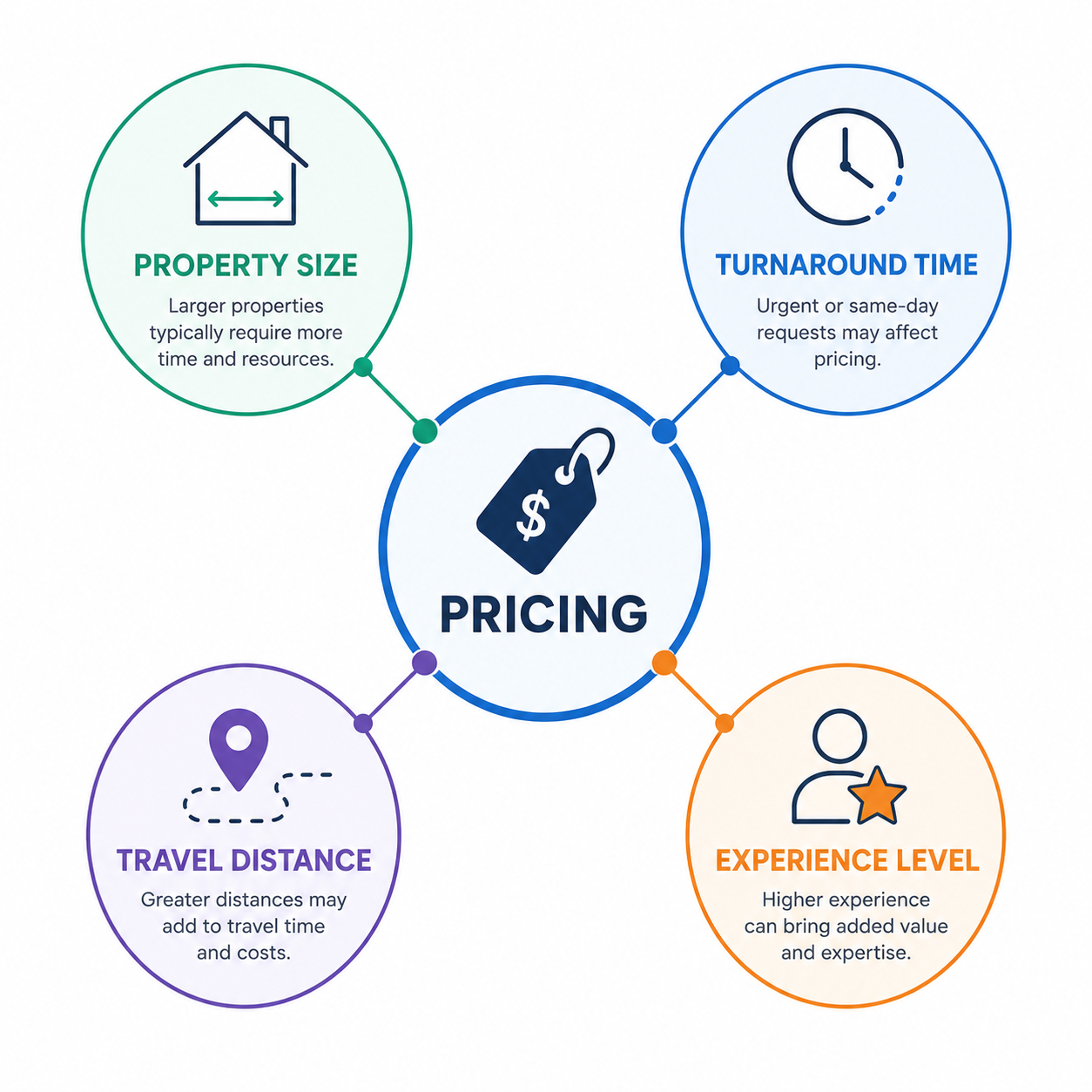
Turnaround time matters too: a client asking for same-day or next-day delivery is asking you to prioritize their job ahead of others, which is a legitimate reason to charge a premium over your standard turnaround. Travel distance, especially for regional or semi-rural properties well outside your usual service area, is worth factoring in explicitly rather than absorbing quietly, since fuel and time both have a real cost. And your own experience and equipment quality play a role too — a photographer producing consistently premium, error-free results with professional-grade equipment has a reasonable case for pricing above someone just starting out with a budget setup.
Access complexity is another factor that's easy to overlook until it costs you time. A vacant, easily accessible home is straightforward, but a tenanted property requiring coordinated access, a commercial space only available outside business hours, or a property requiring special permission or security arrangements all add genuine friction and time to the job. Building a small, clearly defined surcharge for these situations into your pricing structure — rather than absorbing the extra hassle silently — keeps your effective hourly return consistent across genuinely different levels of job complexity.
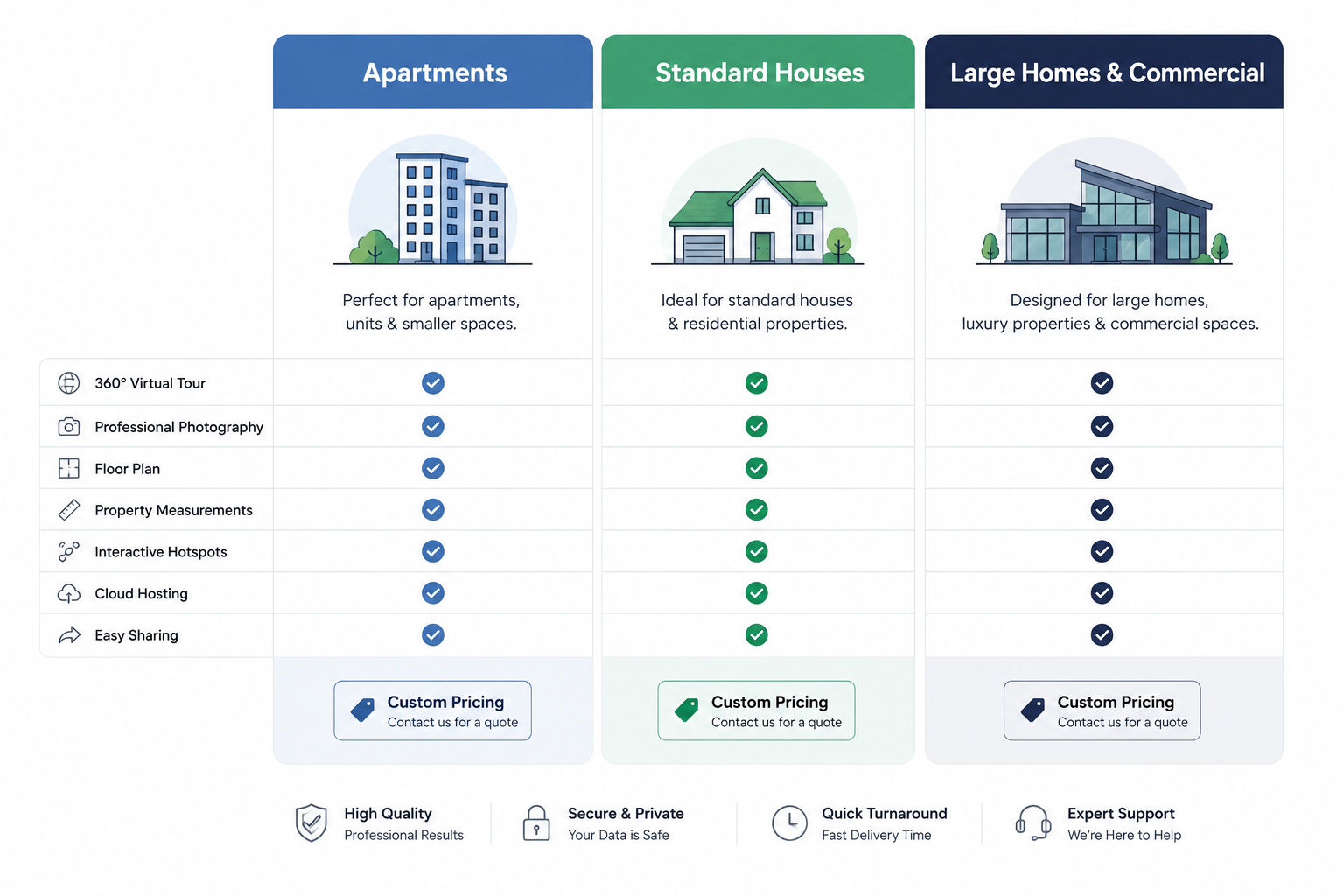
Rather than quoting every job individually from scratch, most successful photographers build a small number of clear, published virtual tour pricing packages Australia agents can understand at a glance. A simple tiered structure by property size tends to work well: one tier for studios and one-bedroom apartments, a middle tier for standard three- to four-bedroom houses, and a top tier — or a case-by-case quote — for larger homes and commercial properties.
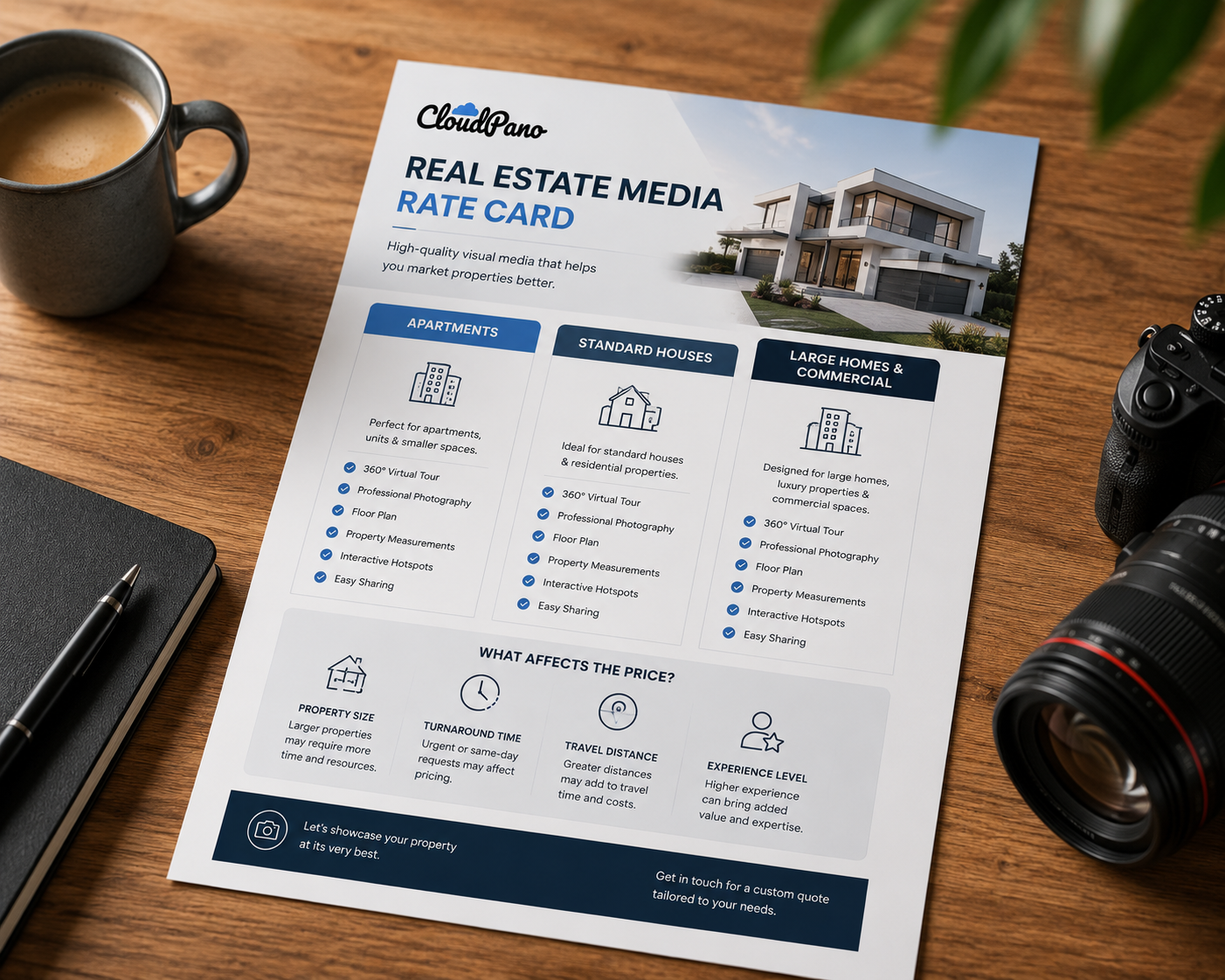
A tiered structure has two real advantages beyond convenience: it's easy for an agent to understand and compare at a glance, and it removes the awkwardness of negotiating every single job individually, since the structure itself does that work for you. It's worth publishing this pricing openly — on a simple rate card, a one-page PDF, or your website — rather than only sharing it when directly asked, since transparent pricing builds trust with agents evaluating multiple vendors.
Some photographers prefer a subscription or volume-based model instead of pure per-job pricing, particularly once they're working regularly with a small number of agencies. A monthly or quarterly retainer covering a set number of tours can suit an agency with predictable, ongoing listing volume, offering them cost certainty in exchange for guaranteed work on your side — though it's worth building in a clear process for handling volume that exceeds the agreed amount, so an unusually busy month doesn't quietly erode your margin. Neither model is inherently better than the other; the right choice depends on whether your client base is mostly one-off bookings or a smaller number of high-volume, ongoing relationships.
Whatever numbers you land on, virtual tour photography rates should be something you can explain confidently if an agent asks why the price is what it is, rather than a number you picked arbitrarily and hope nobody questions. Being able to say "this tier reflects roughly X hours of shooting, editing, and review time" or "this includes unlimited revisions within 48 hours" gives your pricing a clear, defensible logic rather than leaving it feeling arbitrary.
It's worth revisiting your rates periodically rather than setting them once and never adjusting. As your speed improves, your equipment gets better, or demand for your services grows, your pricing should reflect that — many photographers under-price for far longer than necessary simply because they never revisit an initial rate set when they were still building experience and confidence.
A useful trigger for reviewing your rates is capacity, not just the calendar. If you're consistently fully booked and regularly turning away work, that's a clear, practical signal that your current pricing is below what the market will bear, and a modest increase is unlikely to meaningfully reduce demand. Conversely, if bookings are consistently slow despite active outreach, it's worth honestly assessing whether pricing, quality, or marketing reach is the actual bottleneck before assuming a lower price alone will solve it.
Beyond a base virtual tour price, many photographers build additional revenue through optional add-ons: a floor plan, still photography bundled with the tour, drone photography for larger properties, or virtual staging for vacant homes. Bundling these into a package priced slightly below buying each service separately gives agents an incentive to book more from you in a single transaction, while still increasing your total revenue per job compared to the base tour alone.
It's also worth deciding upfront how you'll handle revisions and rush requests, since these situations come up regularly and are much easier to navigate with a policy already decided than to negotiate case by case under time pressure. A simple, clearly stated policy — a set number of free minor revisions, a defined rush fee for expedited turnaround — removes friction from what could otherwise become an awkward conversation.
Cancellations and rescheduling deserve the same upfront clarity. Real estate schedules shift constantly — a settlement falls through, a seller delays, an agent needs to push a shoot back a week — and having a simple, fair policy decided in advance (a free reschedule with reasonable notice, a small fee for last-minute cancellations) protects your time without souring the relationship over what's usually a genuine scheduling conflict rather than bad faith on the agent's part.
Not every property costs the same to shoot, and pricing that ignores this eventually either underpays you on complex jobs or overcharges on simple ones. How property type changes what a tour actually costs to produce is worth understanding properly, since a five-bedroom house with multiple levels and extensive outdoor space takes considerably longer to shoot and stitch than a one-bedroom apartment, and a commercial property often adds scheduling complexity around business hours that residential jobs don't have.
Building this variation into your tiered structure from the start — rather than treating every job as roughly equivalent — protects your margins on the more demanding jobs without needing to renegotiate individually every time a larger or more complex property comes up. It also gives you a ready, confident answer when an agent asks why a large acreage property or a multi-tenant commercial site costs more than a standard suburban home, since the answer is simply the structure you've already published rather than an on-the-spot justification.
There's no single correct answer to how much to charge for virtual tour real estate work — the right number depends on your costs, your time, your local market, and the value agents place on the result. What matters is building a clear, tiered structure grounded in real factors like size, complexity, and turnaround time, and being able to explain that structure confidently rather than picking numbers arbitrarily and hoping they hold up.
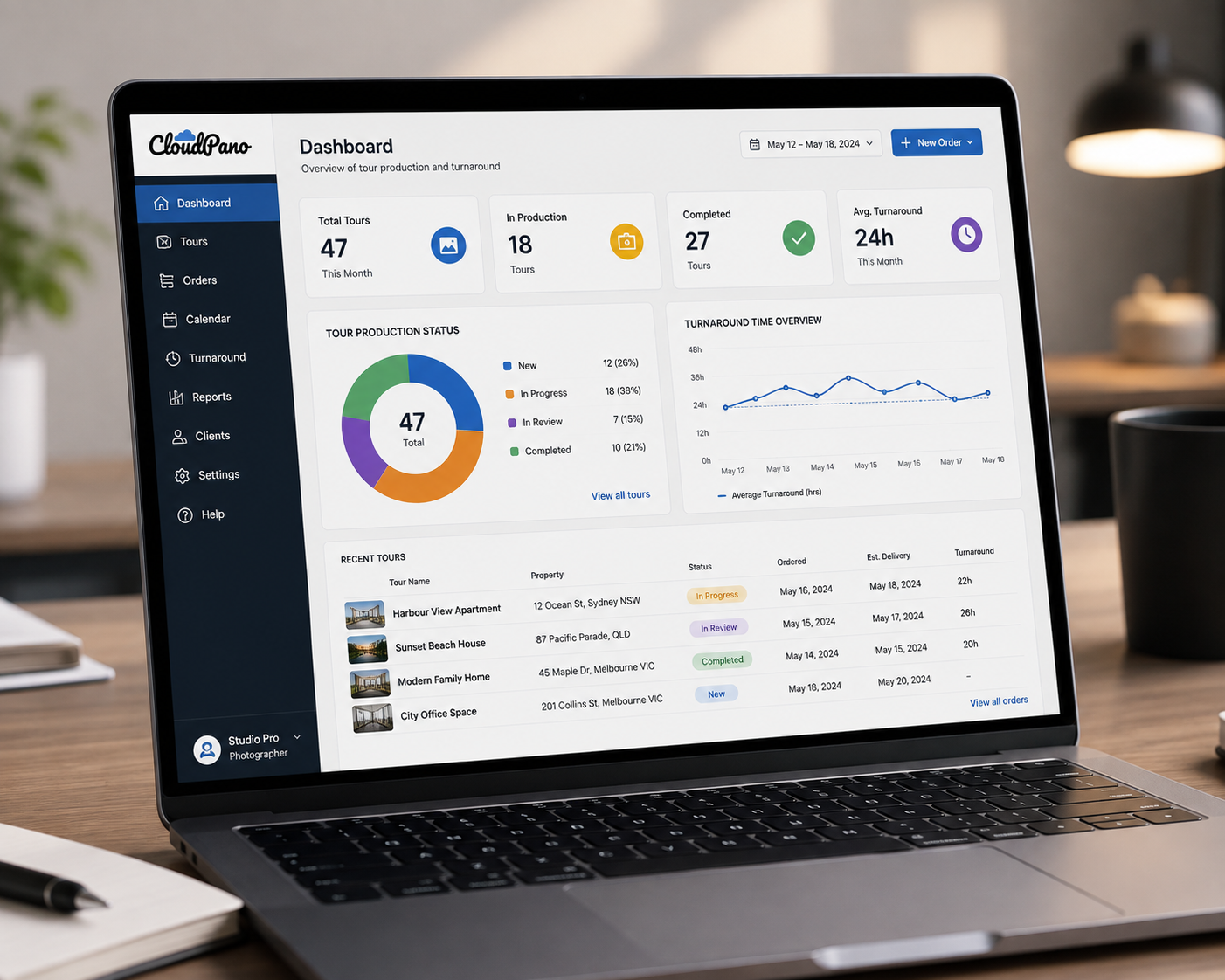
Once your pricing is dialed in, the natural next question is what you can realistically earn once you're booking consistent work at those rates — and building a workflow with software like CloudPano that keeps your production time efficient is a big part of protecting the margin your pricing is actually designed to deliver.


Compact, ready to go anywhere
Interchangeable lens that’s upgradeable
Dual 1-inch sensors for improved clarity and low light performance
Dynamic range and 6K 360° capture
360° photo resolution at 21MP

8K 360° video recording for ultra-detailed visuals.
4K single-lens mode for traditional wide-angle shots.
Invisible selfie stick effect for drone-like perspectives.
2.5-inch touchscreen with Gorilla Glass protection.
Waterproof up to 33ft for underwater shooting.

360° photo resolution in 23MP
Slim design at 24 mm thick
Built-in image stabilization for smooth video capture.
Internal 19GB storage for photo and video storage.
Wireless connectivity for remote control and sharing.

60MP 360° still images for high-resolution photography.
5.7K 360° video recording at 30fps.
2.25-inch touchscreen for intuitive control.
USB Type-C port for fast charging and data transfer.
MicroSD card slot for expandable storage.
.png)

.png)

Try it free. No credit card required. Instant set-up.






.svg)


.svg)