


.png)


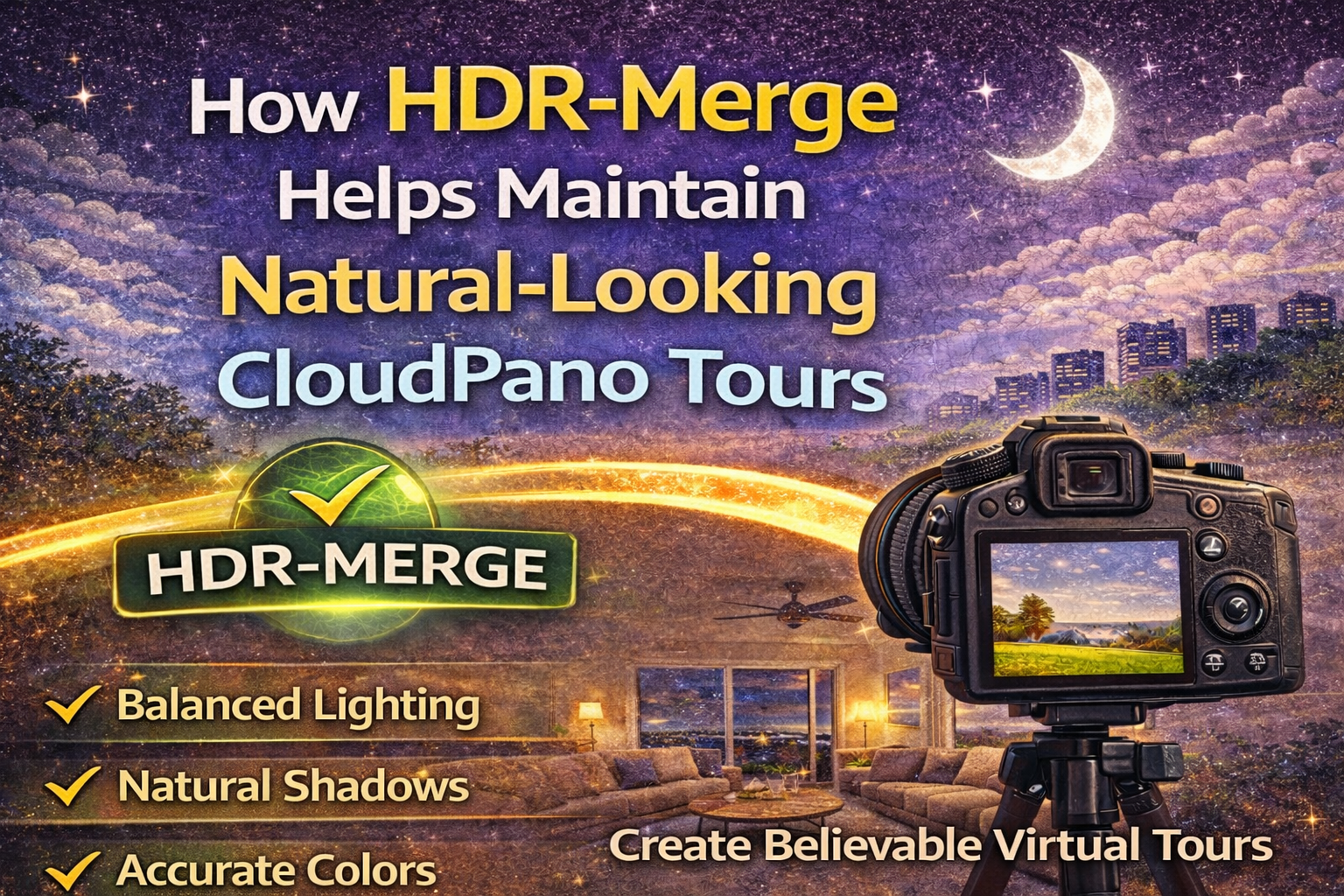
One of the biggest compliments a virtual tour can receive is, “It looks just like being there.” That sense of realism is exactly what photographers and tour creators aim for — and it’s where HDR-Merge CloudPano workflows make a powerful difference.
When HDR is done correctly, it enhances lighting and detail without making the image look artificial. The goal is not dramatic, stylized photos. The goal is Natural-looking CloudPano tours that feel bright, balanced, and true to life.
In this guide, we’ll explore how Real estate virtual tour HDR techniques support realism, share essential CloudPano HDR photography tips, and explain how HDR contributes to subtle but effective CloudPano tour image enhancement.
Let’s dive in. 🚀
Virtual tours are immersive. Viewers don’t just glance at a single image — they look around in every direction. If lighting feels fake or colors look unnatural, the illusion breaks instantly.
Overprocessed photos can create:
❌ Glowing halos around windows
❌ Flat, gray shadows
❌ Oversaturated colors
❌ Unrealistic lighting
For Natural-looking CloudPano tours, subtlety is key. HDR merge should correct lighting problems without calling attention to itself.

HDR (High Dynamic Range) merge combines multiple exposures of the same scene into one balanced image.
In real estate interiors, scenes often include:
☀️ Bright windows
💡 Artificial interior lights
🌑 Shadowed corners
A single exposure can’t capture detail in all these areas at once. HDR blending solves this by pulling highlight detail from darker exposures and shadow detail from brighter ones.
When done correctly, HDR-Merge CloudPano techniques produce images that feel naturally lit — not exaggerated.
HDR has a reputation problem because of overly dramatic edits seen online. But professional Real estate virtual tour HDR looks very different.
Realistic HDR should:
✔ Preserve window detail
✔ Maintain natural contrast
✔ Keep shadows slightly darker
✔ Avoid glowing highlights
✔ Retain accurate color tones
The aim is balance, not extreme brightness. That’s how HDR supports Natural-looking CloudPano tours.
Natural light rarely looks perfectly even. Some areas are brighter than others. Good HDR respects that.
Instead of flattening all light differences, use HDR to:
✨ Gently lift dark areas
🌤 Keep highlights from blowing out
🏠 Maintain a believable sense of depth
This balanced approach creates subtle CloudPano tour image enhancement without sacrificing realism.
Capturing 3–5 exposures ensures you have enough tonal data to create a smooth blend. Too few brackets can lead to harsh transitions.
Perfect alignment keeps edges sharp and prevents ghosting. Movement can cause blur that makes HDR look artificial.
Consistent color is essential for Natural-looking CloudPano tours. Avoid auto white balance, which can shift colors between exposures.
After merging, use gentle adjustments. Overusing clarity or contrast can make images look harsh.
These CloudPano HDR photography tips keep HDR subtle and believable.
Color accuracy plays a huge role in realism.
HDR merging can sometimes exaggerate colors. To maintain natural tones:
🌿 Keep greens from looking neon
🪵 Prevent wood from becoming too orange
🧱 Ensure walls remain neutral
Accurate color balance supports the illusion of real space in Real estate virtual tour HDR.
Shadows give rooms dimension. Removing them completely makes images look flat.
Good HDR should:
✔ Reveal detail in dark areas
✔ Still leave some natural shadow
✔ Avoid turning shadows gray
This subtle depth helps create Natural-looking CloudPano tours that feel three-dimensional.
Halos are bright outlines that appear when HDR blending is too aggressive. They’re one of the biggest signs of overprocessed HDR.
To avoid halos:
• Use gentle highlight recovery
• Avoid extreme local contrast adjustments
• Keep transitions between light and dark areas smooth
Clean window edges are essential for professional CloudPano tour image enhancement.
Rooms often include lamps, ceiling lights, and accent lighting. HDR should preserve their glow without overpowering the scene.
If lights look blown out or too intense, reduce highlight brightness slightly. Maintaining the natural feel of interior lighting supports Natural-looking CloudPano tours.
Viewers move from room to room. If one panorama looks overly bright and another looks dark, the tour feels inconsistent.
HDR helps create more uniform lighting, but editors must also:
✔ Match white balance across scenes
✔ Keep brightness levels similar
✔ Maintain consistent color tones
Consistency strengthens the overall realism of HDR-Merge CloudPano workflows.
It’s tempting to push HDR images to look dramatic, but virtual tours benefit from restraint.
Subtle edits:
🏠 Make rooms feel natural
👀 Keep viewer focus on the space
📸 Preserve professional appearance
Dramatic edits distract from the property itself. Subtlety is central to Real estate virtual tour HDR success.
Buyers and clients rely on virtual tours to understand a property. If a tour looks fake or overly processed, trust decreases.
Natural-looking HDR:
✔ Feels authentic
✔ Reflects real lighting conditions
✔ Builds confidence in what viewers see
Trust is one of the most important benefits of well-executed CloudPano tour image enhancement.
Some situations require extra restraint:
• Twilight interiors
• Rooms with very strong artificial lighting
• Scenes with reflective surfaces
In these cases, heavy HDR can look unnatural. Gentle blending is the key to maintaining Natural-looking CloudPano tours.
Because CloudPano tours are interactive, viewers can inspect every corner. Lighting inconsistencies become more noticeable.
Balanced HDR ensures:
✨ Smooth tonal transitions
🌤 Realistic light gradients
🏡 A cohesive, immersive experience
This is why HDR-Merge CloudPano techniques are so valuable.
Using HDR properly leads to:
📸 Consistent image quality
💼 Higher client satisfaction
🏠 More appealing property presentations
🔄 A reliable, repeatable editing process
Natural HDR supports scalability without sacrificing realism.
HDR merge is a powerful tool — but only when used with restraint. The goal is not to make images look dramatic. The goal is to make them look real.
By following smart CloudPano HDR photography tips, using balanced Real estate virtual tour HDR techniques, and focusing on subtle CloudPano tour image enhancement, you can create Natural-looking CloudPano tours that feel bright, inviting, and believable.
When HDR works quietly in the background, viewers focus on the space itself — and that’s exactly what a great virtual tour should do.


Compact, ready to go anywhere
Interchangeable lens that’s upgradeable
Dual 1-inch sensors for improved clarity and low light performance
Dynamic range and 6K 360° capture
360° photo resolution at 21MP

8K 360° video recording for ultra-detailed visuals.
4K single-lens mode for traditional wide-angle shots.
Invisible selfie stick effect for drone-like perspectives.
2.5-inch touchscreen with Gorilla Glass protection.
Waterproof up to 33ft for underwater shooting.

360° photo resolution in 23MP
Slim design at 24 mm thick
Built-in image stabilization for smooth video capture.
Internal 19GB storage for photo and video storage.
Wireless connectivity for remote control and sharing.

60MP 360° still images for high-resolution photography.
5.7K 360° video recording at 30fps.
2.25-inch touchscreen for intuitive control.
USB Type-C port for fast charging and data transfer.
MicroSD card slot for expandable storage.
.png)

.png)

Try it free. No credit card required. Instant set-up.






.svg)


.svg)