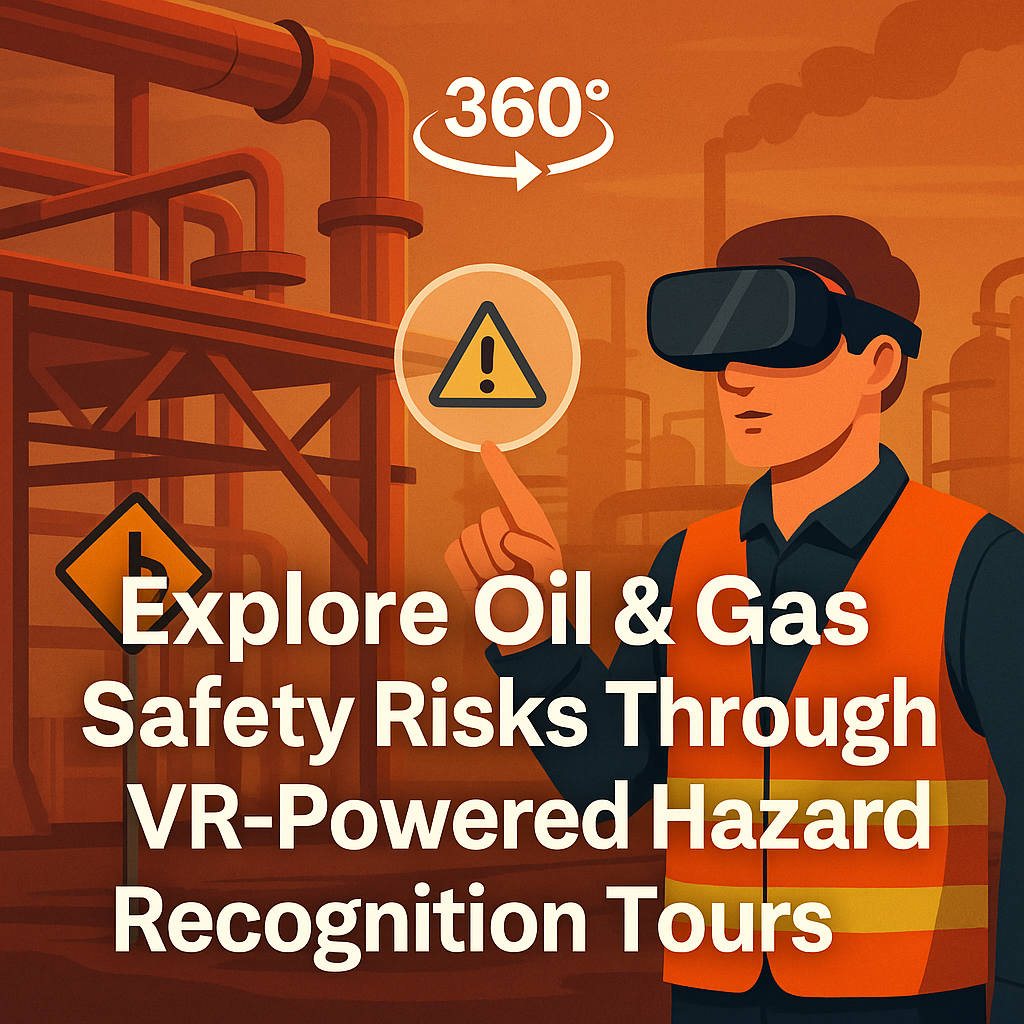
Explore Oil & Gas Safety Risks Through VR-Powered Hazard Recognition Tours

Cloudpano
July 24, 2025
5 min read
Share this post

🛢️ Explore Oil & Gas Safety Risks Through VR-Powered Hazard Recognition Tours 🥽

In the oil and gas industry, safety is non-negotiable. But how do you train teams to spot dangers that could cause catastrophic events—without putting them in harm’s way? The answer: VR-powered hazard recognition tours 🔍💡.

With immersive 360° environments, companies can now walk workers through potential danger zones, simulate real emergencies, and reinforce safety protocols — all without leaving the training room. In this blog post, we’ll explore how virtual tours are transforming safety culture in oil and gas through realistic, hands-on hazard recognition experiences.

🚧 Why Hazard Recognition Matters in Oil & Gas

From offshore rigs to refineries, oil and gas operations involve a complex web of safety risks:

  • Flammable chemicals 🔥
  • High-pressure equipment 💨
  • Confined spaces 🕳️
  • Slip and trip hazards ⚠️
  • Heavy machinery operations 🏗️

One missed sign, one unseen danger — and the consequences can be deadly. That’s why hazard recognition training is critical for everyone on-site, from new hires to seasoned supervisors.

Yet many companies still rely on static safety manuals and lectures to train their teams. Enter: VR-powered hazard tours — a better, smarter way to prepare your workforce.

🧠 What Is a VR Hazard Recognition Tour?

Imagine walking through a virtual oil rig, looking around in full 360°, spotting a spill on the floor, and clicking on it to identify it as a hazard. Then you’re quizzed: “What’s the proper cleanup protocol?” ✅

That’s a VR hazard recognition tour — a digitally simulated 360° training experience that:

  • Replicates real-world job sites 🛠️
  • Embeds safety hazards in scenes 🔎
  • Lets users interact with and identify dangers 👨‍🏫
  • Tests knowledge and decision-making 🧠

It’s the closest thing to real-world training — without the risk.

🔗 Related: Boost Safety in Oil and Gas with VR-Based Hazard Recognition Virtual Tours

💡 How VR Tours Improve Hazard Awareness

VR hazard recognition is more than cool tech. It’s a proven safety solution that:

🔍 1. Enhances Memory Retention

Studies show VR training improves learning retention by up to 75%. Because trainees experience danger zones interactively, the lessons stick.

⏱️ 2. Reduces Training Time

VR tours accelerate onboarding, helping new employees learn site-specific hazards before setting foot on-site.

🔗 Related: Train for Oil and Gas Emergencies with 360 Virtual Tours and Smart Documentation Tools

📊 3. Provides Real-Time Assessment

Trainee actions can be tracked, scored, and used for compliance reports — ensuring everyone is truly ready for the field.

🛡️ 4. Promotes Safe Behaviors

By reinforcing proper safety decisions in a virtual setting, VR helps develop muscle memory for hazard detection.

📍 What Types of Hazards Can You Simulate?

You can simulate nearly any oil and gas-related safety risk:

  • 🔥 Fire hazards from flammable vapors
  • 🧯 Missing or blocked fire extinguishers
  • 🧪 Leaking chemical drums or labeling issues
  • ⚡ Exposed wires or faulty electrical boxes
  • 🛑 Improperly stored equipment
  • 👷 PPE violations or unsafe behavior

Each hazard can be clickable, explained, and linked to training documentation — all within the virtual space.

🔗 Related: How Virtual Reality is Revolutionizing Hazard Detection in Oil and Gas Sites

🛠️ How to Create Your Own VR Safety Tour

Here’s how you can create your own hazard recognition experience:

🎥 1. Capture 360° Images

Use a 360° camera like Insta360 or Ricoh Theta to scan your facility.

💻 2. Upload to a Tour Platform

Platforms like CloudPano let you upload, customize, and build tours — no coding required.

🔗 3. Add Hazard Hotspots

Add clickable elements for hazards, training prompts, and safety documentation. Include quizzes, timers, and logic branches.

📤 4. Distribute for Training

Deploy via VR headsets, desktop, or mobile for on-demand access anywhere.

🔗 Related: How 360 Documentation Software Powers Oil and Gas Emergency Response Training

🧪 Real Example: Virtual Safety Drills in Action

One U.S.-based refinery implemented VR tours as part of their annual safety week. Workers went through a 5-minute hazard recognition walk-through before clocking in.

The results?

  • ✅ 50% increase in hazard reporting accuracy
  • 🧠 3x knowledge retention vs. previous year’s printed training
  • 🧯 0 incidents for 6 months in high-risk zones

🔗 Related: Disaster Drill Simulations for Oil and Gas Made Easy with 360 Virtual Tours

📄 Integration with Safety Docs & Protocols

Pair your VR tours with smart documentation software to digitize your full emergency response playbook:

  • Link SOPs and safety protocols inside each hotspot 📄
  • Track compliance and safety drills over time 📊
  • Update training instantly across all devices 🌐

🔗 Related: Digitize Oil and Gas Emergency Protocols with 360 Virtual Tour Software

🌍 Final Thoughts: VR = Safer, Smarter, Stronger Teams

Hazard recognition isn’t just about identifying risks — it’s about building a culture of safety. With VR-powered tours, you're giving your team the tools to spot, react, and respond before accidents happen.

It’s time to say goodbye to static slide decks and hello to realistic, interactive, and effective safety training.

🔗 Related: Oil and Gas Emergency Preparedness Enhanced: 360 Virtual Tours + Documentation Software

🚀 Ready to Build Your VR Hazard Recognition Tour?

Start creating 360° hazard tours today with CloudPano — no tech team required.

More to Explore:

Share this post
Cloudpano

Choose The Right 360° Camera

Insta360 ONE RS 1-Inch 360 Edition

  • Compact, ready to go anywhere

  • Interchangeable lens that’s upgradeable

  • Dual 1-inch sensors for improved clarity and low light performance

  • Dynamic range and 6K 360° capture

  • 360° photo resolution at 21MP

Learn More

Insta360 X4

  • 8K 360° video recording for ultra-detailed visuals.

  • 4K single-lens mode for traditional wide-angle shots.

  • Invisible selfie stick effect for drone-like perspectives.

  • 2.5-inch touchscreen with Gorilla Glass protection.

  • Waterproof up to 33ft for underwater shooting.

Learn More

Ricoh Theta Z1

  • 360° photo resolution in 23MP

  • Slim design at 24 mm thick

  • Built-in image stabilization for smooth video capture.

  • Internal 19GB storage for photo and video storage.

  • Wireless connectivity for remote control and sharing.

Learn More

Ricoh Theta X

  • 60MP 360° still images for high-resolution photography.

  • 5.7K 360° video recording at 30fps.

  • 2.25-inch touchscreen for intuitive control.

  • USB Type-C port for fast charging and data transfer.

  • MicroSD card slot for expandable storage.

Learn More
Property Marketing
Allows potential buyers to explore properties in detail from anywhere, enhancing the real estate marketing process.
Automotive Spins
Create an interactive virtual showroom and engage affluent digital buyers with live 360º video calls, all through the CloudPano mobile app for a complete automotive sales solution.
Interactive Floor Plans
Create 2D and 3D floor plans with measurements in 4 minutes or less, all from your phone. Download the Floor Plan Scanner app and get your first scan free.

360 Virtual Tours With CloudPano.com. Get Started Today.

Try it free. No credit card required. Instant set-up.

Try it free
Latest posts

See our other posts

Interviews, tips, guides, industry best practices, and news.

How Photographers Can Sell AI Listing Videos to Their Agent Clients

AI technology is transforming real estate media — and photographers who adapt early have a major competitive advantage. This in-depth guide explains how to sell AI listing videos to agent clients by positioning them as a premium marketing upgrade rather than a technical novelty. The article walks through practical sales strategies, pricing models, subscription opportunities, and common objections, while showing how AI-powered talking head videos can increase average order value and create recurring revenue. Readers will learn how to package AI listing videos into photo bundles, monthly content plans, and brokerage-wide solutions that elevate their services from simple media delivery to full marketing automation. If you’re a photographer looking to future-proof your business and increase profitability, this guide provides a clear roadmap to selling AI listing videos effectively.
Read post

How to Build a Recurring Revenue Stream Using AI Avatar Videos

AI avatar videos are transforming how real estate media professionals build stable, scalable businesses. In this comprehensive guide, we break down how to turn one-off video projects into a predictable recurring revenue real estate media model using AI-powered talking head technology. Instead of selling per-listing shoots, you’ll learn how to package automated listing videos, market updates, and branded content into monthly subscription offers that increase client retention and lifetime value. The article explores practical use cases, pricing strategies, workflow automation, competitive advantages, and common objections — all designed to help photographers, videographers, and marketing agencies shift from transactional income to recurring revenue. If you’re ready to move from freelancer to scalable media platform, this guide outlines a clear roadmap for building consistent monthly income in real estate marketing.
Read post

How to Create an AI Avatar Listing Video From One Headshot (Step-by-Step)

Learn how to create an AI avatar listing video from a single professional headshot using simple, step-by-step software tools. This guide walks real estate agents, brokers, and photographers through the exact process of turning one static image into a talking AI avatar that delivers listing presentations automatically. Discover how AI avatar listing videos save time, boost engagement, improve consistency across marketing channels, and help agents scale their video content without recording new footage. Perfect for anyone looking to modernize their real estate marketing with AI-powered automation.
Read post