Enterprise LLM Evaluation: Building Trustworthy AI for Production

Cloudpano
July 30, 2026
5 min read
Share this post

Enterprise LLM Evaluation: Building Trustworthy AI for Production

Technical evaluation results and organizational trust in a production deployment decision are two different things. Enterprise LLM evaluation succeeds when it produces both — not just accuracy and safety scores, but a documented process that legal, compliance, and leadership stakeholders can actually rely on when approving a model for real use.

Most technical evaluation work focuses on metrics and methods. This is about the governance layer around that work: who needs to sign off, what bias testing methodology actually satisfies enterprise risk requirements, and what documentation makes a deployment decision defensible later.

Why It Matters

A model that passes technical evaluation but lacks a documented, defensible evaluation process still creates organizational risk, because the question after deployment often isn't "did the model perform well" but "can we show how we knew that before we shipped it." Google Research's "Data Cascades" study documented how gaps in a data or evaluation process compound into larger problems, and an undocumented evaluation process is exactly the kind of gap that becomes expensive to address after the fact, when a model's behavior is questioned (Sambasivan et al., Google Research).
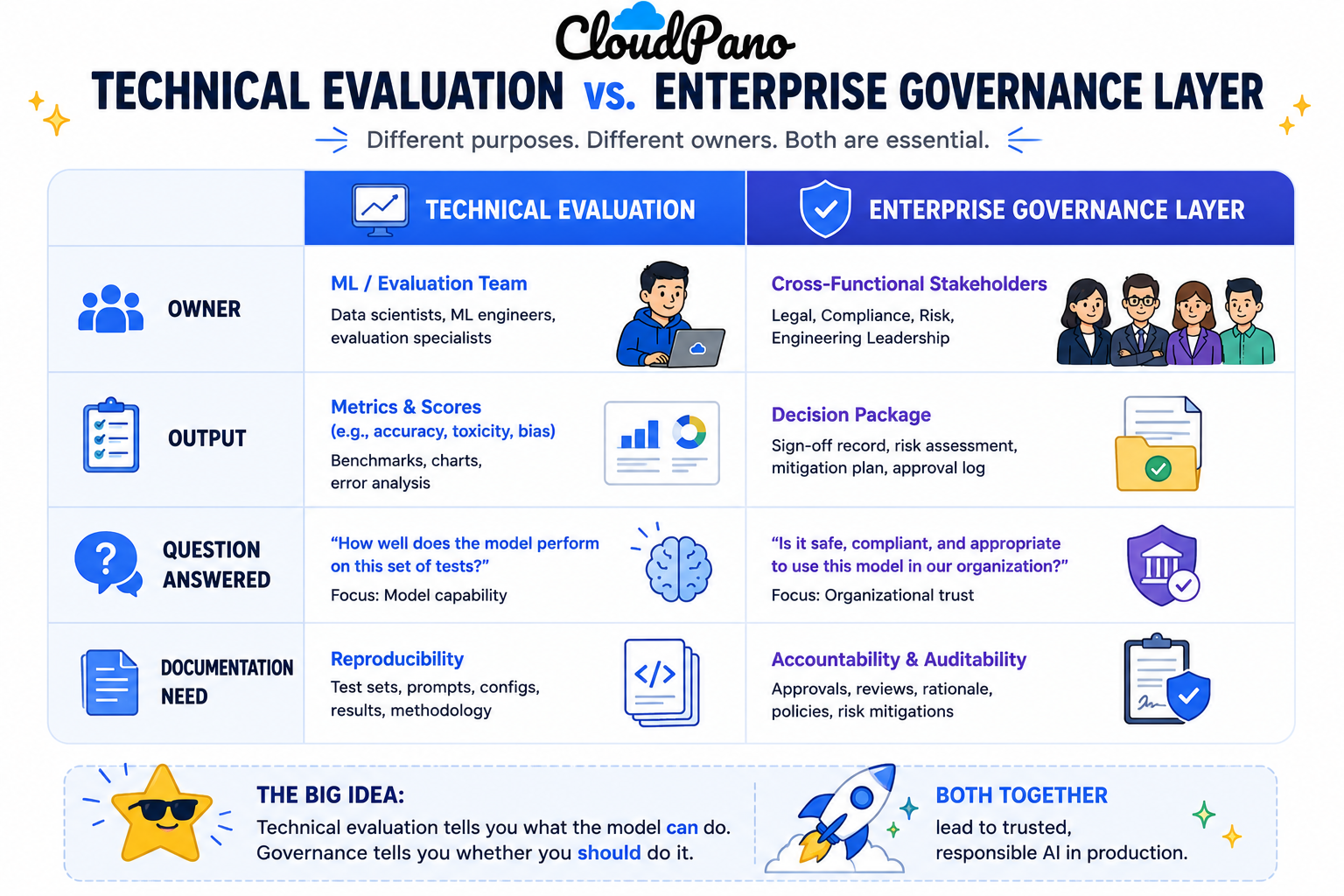
Comparison table of technical LLM evaluation vs enterprise governance layer

NIST's AI Risk Management Framework explicitly frames trustworthy AI as requiring documented governance processes, not just favorable technical metrics — a distinction directly relevant to AI bias evaluation specifically, since bias findings need a clear organizational response process, not just a number in a report (NIST AI RMF).

The stakes rise with how quickly enterprises are deploying language models into production. Stanford HAI's AI Index has tracked the accelerating pace of enterprise LLM adoption (Stanford HAI, AI Index Report), which means more deployment decisions are being made under time pressure — exactly when a defined governance process matters most to avoid skipping steps.

How It Works

Enterprise AI testing at the governance level layers on top of technical evaluation with three additional components.

Structured bias evaluation. Testing model outputs specifically across relevant demographic or use-case groups, using defined methodology — not just a general sense that outputs "seem fair," but documented comparison across the groups actually relevant to your deployment.

Formal safety sign-off. A defined process where specific stakeholders — legal, compliance, risk, engineering — review evaluation results against defined criteria and formally approve or reject deployment, rather than an informal team consensus.

Audit documentation. A record of what was tested, how, by whom, and what the results were, kept in a form that can be produced later if a model's behavior is questioned.

LLM safety evaluation at the enterprise level means these three components exist alongside the technical metrics, not instead of them — the governance layer is what turns a technical evaluation report into something the broader organization can actually stand behind.

Understanding how these workflows operate as an organizational process, not just a technical one, is what separates enterprise evaluation from a research-style evaluation report that satisfies an ML team but doesn't satisfy the broader organization's risk requirements.

Step-by-Step Workflow

Diagram of enterprise LLM evaluation sign-off stakeholders and their roles
  • Identify which stakeholders need to sign off on deployment. Legal, compliance, risk, and engineering leadership typically all need a defined role, not just the technical team.
  • Define bias evaluation methodology specific to your deployment context. Identify the relevant groups and scenarios to test against before evaluation begins, not after results come in.
Flowchart for designing a bias evaluation methodology in enterprise LLM testing
  • Run technical evaluation across accuracy, safety, and bias dimensions. Use the methods appropriate to each — this is where automated metrics and human evaluation from technical evaluation work feed into the governance process.
  • Document findings in a format stakeholders outside the ML team can review. Translate technical results into clear pass/fail criteria against pre-defined thresholds, not raw metric dumps.
  • Route findings through the defined sign-off process. Each responsible stakeholder reviews findings against their specific area of concern — legal risk, compliance requirements, safety thresholds.
  • Document the sign-off decision and its basis. Keep a clear record of who approved deployment, based on what evidence, and under what conditions.
  • Define a re-evaluation trigger for future model updates. Establish upfront what changes require the governance process to repeat, rather than assuming it applies only to the initial launch.

Industry Use Cases

  • LLM developers: Enterprise customers of an LLM developer's products increasingly expect documented bias and safety evaluation as part of procurement requirements.
  • Healthcare AI: Bias evaluation must specifically address clinical population representativeness, given the direct patient-safety and regulatory stakes involved.
  • Retail AI: Sign-off processes often include legal review of consumer protection and advertising-related risk alongside technical safety evaluation.
  • Government & defense: Formal documentation and audit trail requirements are often mandated by policy, making the governance layer as important as the technical evaluation itself.
  • Computer vision / robotics: These specific LLM governance processes don't map directly onto computer vision model approval, though analogous sign-off and documentation principles apply.
  • Autonomous vehicles: Similarly, this specific enterprise LLM governance model has limited direct application to core perception or control system approval processes.

Benefits

  • Organizational trust beyond the ML team. A documented governance process lets legal, compliance, and leadership stakeholders actually stand behind a deployment decision.
  • Defensible evidence if a model's behavior is questioned. Audit documentation provides a clear record of what was tested and why deployment was approved.
  • More consistent bias evaluation across projects. A defined methodology prevents ad hoc, inconsistent bias testing that varies by team or individual judgment.
  • Faster deployment decisions over time. A repeatable governance process, once established, moves faster than reinventing sign-off requirements for every new model.
  • Clearer accountability for deployment decisions. Defined stakeholder roles and documented sign-off make it clear who approved what, under what evidence.

Common Mistakes

  • Treating technical evaluation results as sufficient on their own. Assuming strong accuracy and safety metrics automatically satisfy legal, compliance, and leadership stakeholders without a formal review process.
  • Conducting bias evaluation without a defined methodology. Testing informally or inconsistently rather than against specific, pre-defined relevant groups and scenarios.
  • Skipping formal documentation of the sign-off process. Approving deployment through informal consensus rather than a documented decision with clear accountability.
  • Not defining re-evaluation triggers upfront. Treating governance as a one-time pre-launch step rather than a process that repeats for meaningful model updates.
  • Translating technical results poorly for non-technical stakeholders. Presenting raw metrics without clear pass/fail criteria that legal or compliance reviewers can actually evaluate.
  • Rushing the governance process under deployment timeline pressure. Skipping steps in the sign-off process to hit a launch date, which undermines the defensibility the process was meant to provide.

Best Practices

  • Identify all stakeholders who need a formal role in the sign-off process before evaluation begins, not after results are in.
  • Define bias evaluation methodology and relevant comparison groups specific to your deployment context upfront.
  • Translate technical evaluation results into clear, pre-defined pass/fail criteria that non-technical stakeholders can actually review.
  • Document the full sign-off process, including who approved deployment and based on what specific evidence.
  • Define upfront which types of model updates trigger a repeat of the governance process.
  • Treat the governance layer as equally important to the technical evaluation itself, not an afterthought once technical results look favorable.

FAQ

What does enterprise LLM evaluation include beyond technical testing?

A governance layer: structured bias evaluation with defined methodology, a formal sign-off process involving legal and compliance stakeholders, and audit documentation of what was tested and why deployment was approved.

How is AI bias evaluation different from general safety testing?

Bias evaluation specifically tests model outputs across relevant demographic or use-case groups using defined comparison methodology, while general safety testing covers a broader range of harmful or inappropriate output categories.

Who should be involved in enterprise LLM evaluation sign-off?

Typically legal, compliance, risk, and engineering leadership, each reviewing evaluation findings against their specific area of concern, rather than the technical team making the deployment decision alone.

What documentation should be kept from an enterprise LLM safety evaluation?

A record of what was tested, the methodology used, the results, and the specific sign-off decision with its basis, kept in a form that can be produced later if the model's behavior is questioned.

How often should enterprise AI testing and governance review be repeated?

Whenever a defined trigger is met — significant model updates, retraining, or expansion into a new use case — rather than treating governance as a one-time pre-launch requirement.

Can strong technical evaluation results replace formal governance sign-off?

No. Technical results are an input to the governance process, but formal sign-off from relevant stakeholders and documented decision-making are what actually make a deployment decision organizationally defensible.

How do I translate technical evaluation metrics for non-technical stakeholders?

Convert raw metrics into clear pass/fail criteria against pre-defined thresholds relevant to each stakeholder's area of concern, rather than presenting technical scores without that context.

Conclusion

Enterprise LLM evaluation works best as both a technical and organizational process. Bias testing methodology, formal sign-off, and audit documentation don't replace strong accuracy and safety metrics — they turn those metrics into a defensible, organization-wide deployment decision that legal, compliance, and leadership stakeholders can actually stand behind, not just the technical team that ran the tests.

Share this post
Cloudpano

Choose The Right 360° Camera

Insta360 ONE RS 1-Inch 360 Edition

  • Compact, ready to go anywhere

  • Interchangeable lens that’s upgradeable

  • Dual 1-inch sensors for improved clarity and low light performance

  • Dynamic range and 6K 360° capture

  • 360° photo resolution at 21MP

Learn More

Insta360 X4

  • 8K 360° video recording for ultra-detailed visuals.

  • 4K single-lens mode for traditional wide-angle shots.

  • Invisible selfie stick effect for drone-like perspectives.

  • 2.5-inch touchscreen with Gorilla Glass protection.

  • Waterproof up to 33ft for underwater shooting.

Learn More

Ricoh Theta Z1

  • 360° photo resolution in 23MP

  • Slim design at 24 mm thick

  • Built-in image stabilization for smooth video capture.

  • Internal 19GB storage for photo and video storage.

  • Wireless connectivity for remote control and sharing.

Learn More

Ricoh Theta X

  • 60MP 360° still images for high-resolution photography.

  • 5.7K 360° video recording at 30fps.

  • 2.25-inch touchscreen for intuitive control.

  • USB Type-C port for fast charging and data transfer.

  • MicroSD card slot for expandable storage.

Learn More
Property Marketing
Allows potential buyers to explore properties in detail from anywhere, enhancing the real estate marketing process.
Automotive Spins
Create an interactive virtual showroom and engage affluent digital buyers with live 360º video calls, all through the CloudPano mobile app for a complete automotive sales solution.
Interactive Floor Plans
Create 2D and 3D floor plans with measurements in 4 minutes or less, all from your phone. Download the Floor Plan Scanner app and get your first scan free.

360 Virtual Tours With CloudPano.com. Get Started Today.

Try it free. No credit card required. Instant set-up.

Try it free
Latest posts

See our other posts

Interviews, tips, guides, industry best practices, and news.

Why High-Quality Human Feedback Is Essential for LLM Fine-Tuning

Human evaluation for LLM fine tuning works best when reviewers are qualified specifically for the judgment task, not just recruited in volume. Domain expertise, consistency under a defined rubric, and calibration against known-good examples determine whether feedback data actually improves a model or just teaches it a different, still-inconsistent pattern.
Read post

Enterprise LLM Evaluation: Building Trustworthy AI for Production

Enterprise LLM evaluation goes beyond technical testing to include a governance structure — documented bias testing across relevant groups, formal safety sign-off, and audit trails that let legal, compliance, and leadership stakeholders trust a production deployment decision. It's the organizational process around evaluation, not just the metrics themselves.
Read post

How to Benchmark Large Language Models: Human vs. Automated Evaluation

LLM benchmarking compares models against each other using standardized test suites, either through automated scoring (including LLM-as-judge methods) or structured human evaluation. Automated benchmarking scales efficiently but is vulnerable to contamination and gaming; human evaluation catches nuance automated scoring misses but doesn't scale as easily across many model comparisons.
Read post