Enterprise Data Labeling: Build Your Own Team or Work With a Managed Provider?

Cloudpano
July 20, 2026
5 min read
Share this post

Enterprise Data Labeling: Build Your Own Team or Work With a Managed Provider?

Most breakdowns of in-house vs outsourced data labeling focus on cost per label. That's a fair comparison, but it skips the harder, more organizational question underneath it: what does actually building and running an internal annotation team require, beyond the labor rate?

Building in-house isn't just hiring annotators. It's designing roles, building a hiring pipeline, defining career progression so people don't leave after six months, and creating management structure for a function that didn't exist in your org chart before. A managed provider replaces all of that — but only if the fit is right.

Why It Matters

Getting the build-versus-partner decision wrong doesn't usually show up as a budget overrun first — it shows up as organizational strain. An in-house team without a real career path or management structure tends to see high turnover, which quietly erodes the domain expertise a technical or specialized labeling function depends on.

Google Research's "Data Cascades" study documented how small, unaddressed issues in data work compound into expensive downstream problems (Sambasivan et al., Google Research), and a churning, under-supported in-house team is exactly the kind of unaddressed organizational issue that produces this pattern.

NIST's AI Risk Management Framework treats data quality and provenance as foundational to trustworthy AI (NIST AI RMF), which means the organizational stability behind your labeling function — whichever model you choose — has real implications beyond headcount planning.

Stanford HAI's AI Index has tracked how quickly organizations are moving models into production (Stanford HAI, AI Index Report), and building a stable in-house function from scratch often takes longer than that timeline allows, which is a major reason managed providers exist in the first place.

How It Works

Building in-house data annotation means designing a real organizational function: defined roles (annotator, senior reviewer, QA lead), a hiring and onboarding pipeline, career progression that gives people a reason to stay, and a management layer responsible for guidelines, throughput, and quality.

Working with a managed provider means the workforce infrastructure — hiring, training, career paths, retention — already exists on the vendor's side. Your team defines requirements and reviews output; the provider owns the organizational overhead of running the labeling function itself.

Understanding how these workflows operate from an organizational standpoint, not just a cost standpoint, clarifies what you're actually choosing between: building a new internal function versus renting access to one that already exists and is already staffed.

A hybrid structure is common at enterprise scale: a small internal team owns the most sensitive or specialized data and its taxonomy, while a managed provider handles higher-volume work under that team's guidelines and oversight.
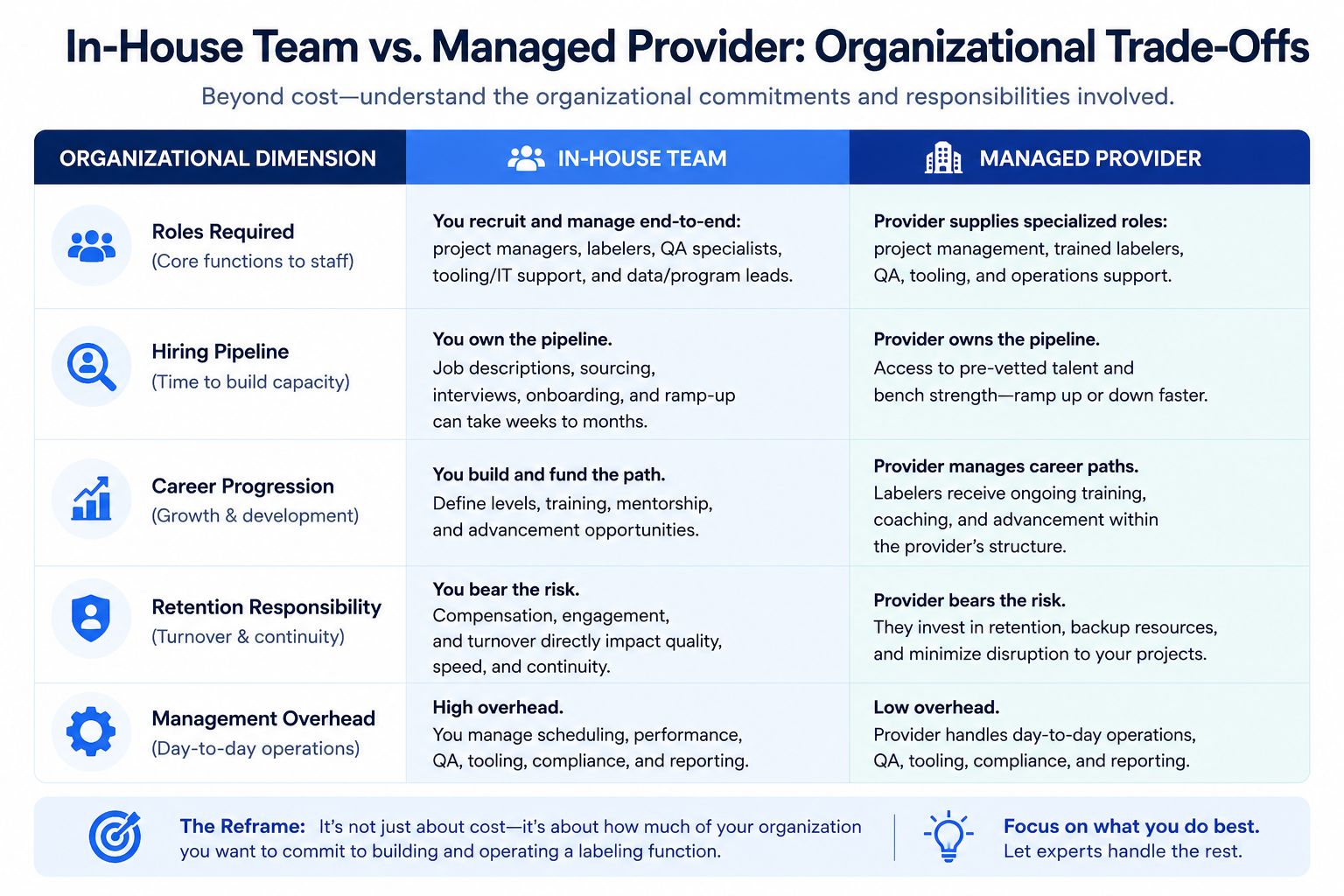
Diagram of the roles and reporting structure for an in-house data annotation team

Step-by-Step Workflow for Making the Call

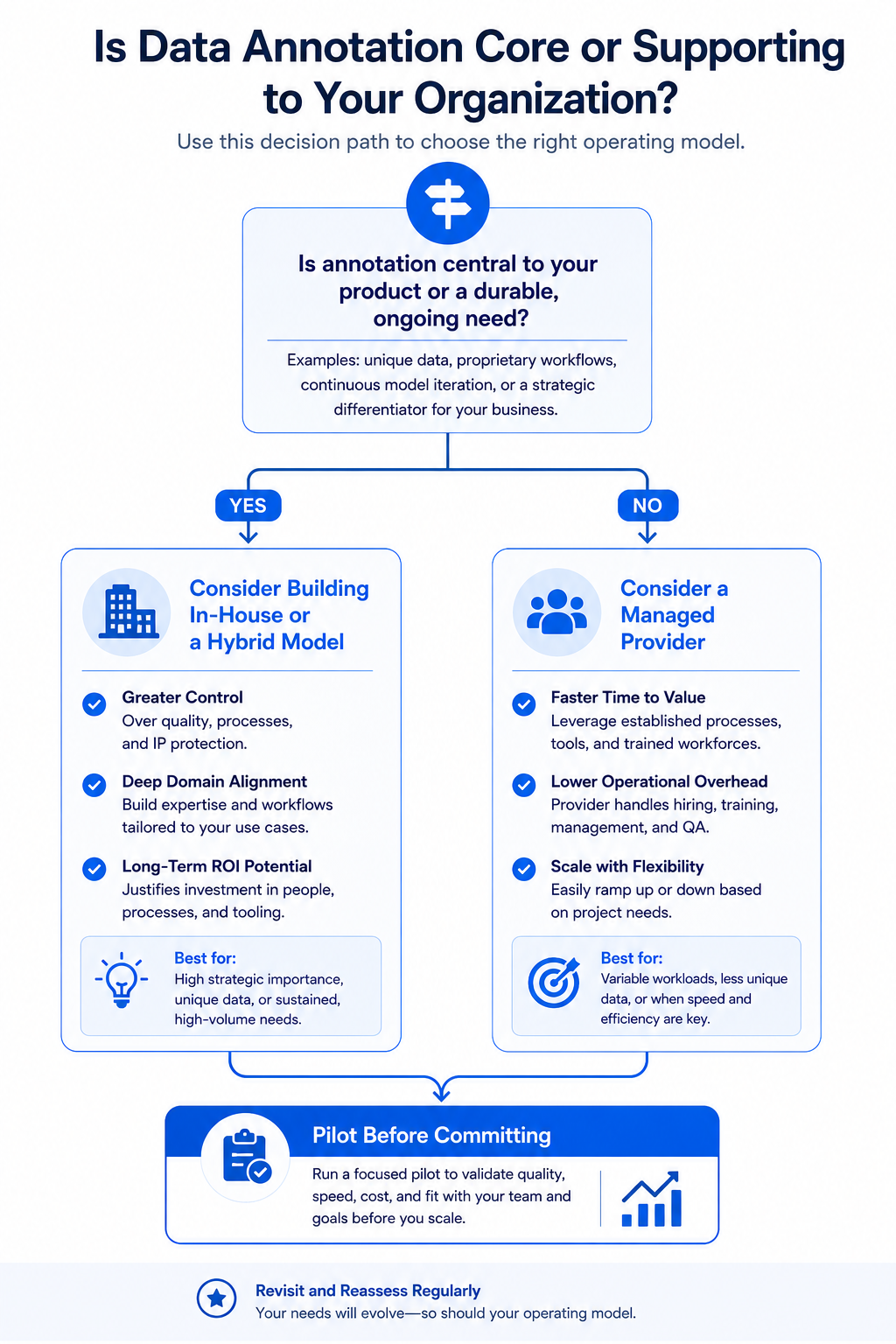
  1. Decide whether annotation is core or supporting to your organization. If it's a durable, ongoing function central to your product, building in-house may be worth the organizational investment. If it's project-based or peripheral, a managed provider likely fits better.
  2. Map the roles an in-house team would actually require. Annotator, senior reviewer, QA lead, and a manager — not just headcount, but a real reporting structure.
  3. Assess your ability to offer a real career path. Annotation roles with no growth path see high turnover, which erodes consistency and domain knowledge over time.
  4. Evaluate a managed provider's account structure as its own organizational entity. A dedicated account team and stable workforce assignment matter as much as price.
  5. Pilot whichever direction you lean toward. Organizational fit shows up in execution, not just planning — test it before committing headcount or a long-term contract.
  6. Define what oversight looks like either way. In-house still needs QA leadership; a managed provider still needs your team defining requirements and auditing output.
  7. Revisit the structure as your organization's needs change. A managed provider relationship that made sense at one stage of growth may shift toward a hybrid or in-house model as annotation becomes more central to your operations.

Industry Use Cases

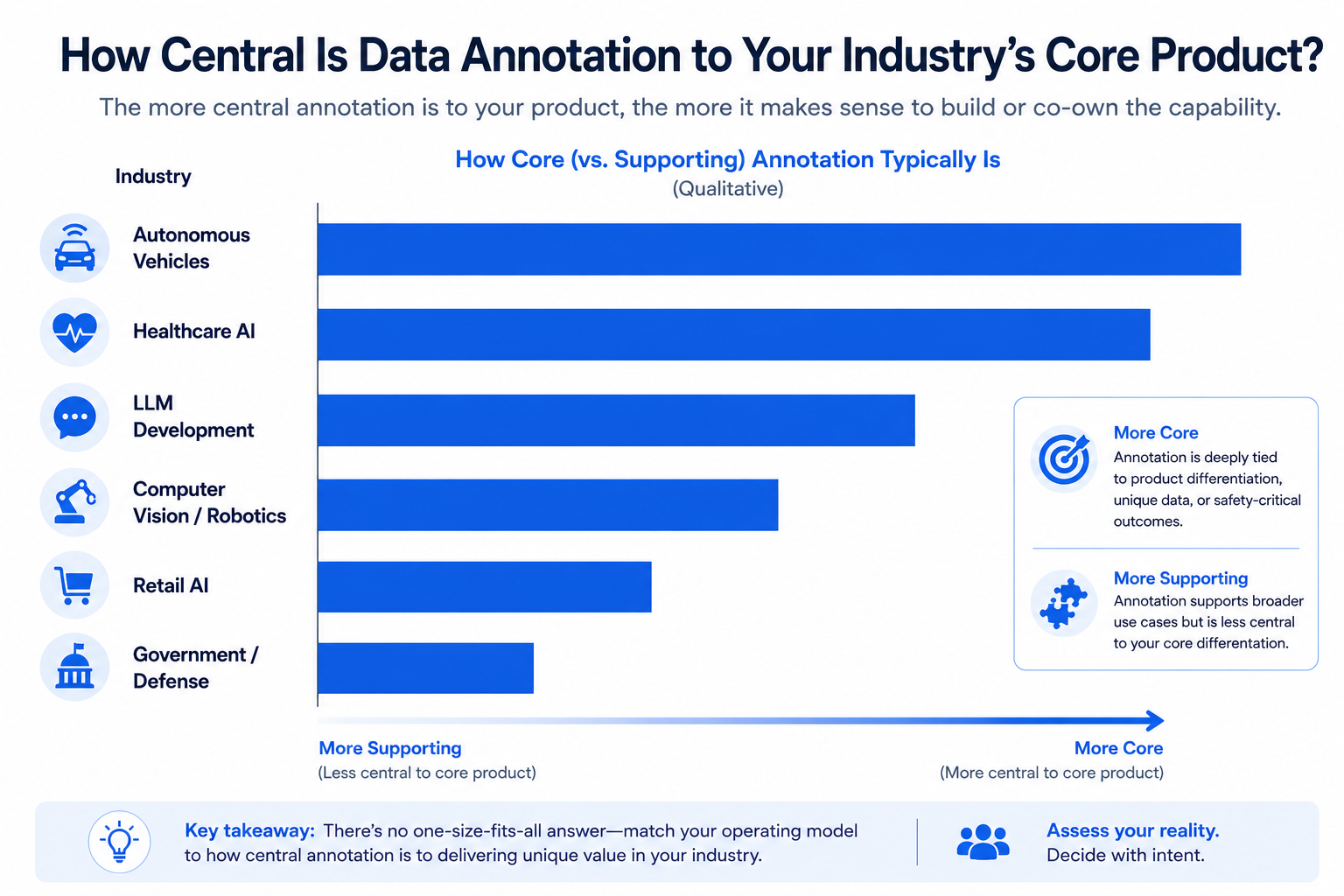
  • Computer vision / robotics: Often favors a managed provider for high-volume, less specialized annotation, with an internal team focused on model evaluation rather than labeling operations.
  • Autonomous vehicles: Frequently builds an internal team for safety-critical scenario labeling specifically, given how central that data is to the core product, while outsourcing broader volume.
  • Healthcare AI: Organizational stability matters enormously here — clinical annotation expertise takes time to build, and high turnover in an in-house team directly threatens labeling quality and compliance.
  • Retail AI: Annotation is usually a supporting function rather than a core organizational capability, making a managed provider relationship a common and sensible default.
  • LLM developers: Preference and safety labeling is often treated as core enough to justify an internal team, at least for the highest-sensitivity data, even when broader instruction labeling is outsourced.
  • Government & defense: Security clearance requirements often force an internal structure or a narrowly vetted provider relationship, regardless of how "core" the labeling function otherwise is.

Benefits

Building in-house offers:

  • Deep, retained institutional knowledge that stays with your organization over time
  • Direct control over career development and team culture around a function you consider core
  • Tighter integration between annotators and the product or model teams they support

Working with a managed provider offers:

  • Immediate access to existing workforce infrastructure without building an organization from scratch
  • Reduced management burden, since hiring, retention, and career development sit with the provider
  • Faster time to operational capacity, since there's no internal hiring pipeline to build first

A hybrid structure offers:

  • Institutional knowledge retained on the most sensitive or core data, without the overhead of building a full internal team
  • Flexibility to shift the ratio between internal ownership and managed capacity as organizational priorities evolve
Infographic of signals that a hybrid data annotation structure fits best

Common Mistakes

  • Building in-house without designing a real career path. Hiring annotators into a role with no growth trajectory, then being surprised by high turnover and its effect on quality.
  • Assuming a managed provider removes all internal responsibility. Skipping requirements definition and output auditing because "the provider handles it."
  • Treating the decision as purely financial. Comparing cost per label without considering whether annotation is organizationally core or supporting to your business.
  • Underestimating the management layer an in-house team requires. Focusing hiring plans on annotators alone without planning for senior reviewers and a QA lead.
  • Not revisiting the structure as the organization changes. Sticking with an original managed-provider or in-house choice long after annotation's role in the business has shifted.
  • Ignoring account structure quality when evaluating a managed provider. Focusing on price without confirming whether the provider offers a stable, dedicated team versus a rotating workforce.

Best Practices

  • Decide whether annotation is core or supporting to your organization before comparing cost.
  • If building in-house, design real roles and career progression from the start, not just headcount.
  • If working with a managed provider, define requirements and maintain independent output review regardless of how established the vendor is.
  • Consider a hybrid structure as a legitimate default, especially at enterprise scale, rather than a fallback.
  • Revisit the structure periodically as annotation's role in your organization evolves.
  • Pilot whichever direction you choose before committing headcount or a long-term contract. McKinsey's research on generative AI adoption notes that organizational readiness — including how deliberately companies structure the teams behind their data work — remains one of the most consistently underestimated factors in AI program outcomes (McKinsey, "The economic potential of generative AI").

FAQ

Is in-house vs outsourced data labeling really just a cost decision?

Not entirely. Cost is one input, but the more durable question is organizational: whether annotation is core enough to your business to justify building and retaining an internal team, versus partnering with a provider that already has that infrastructure in place.

What does building an in-house data annotation team actually require?

Defined roles beyond just annotators — senior reviewers and a QA lead — a hiring and onboarding pipeline, a real career progression path, and a management structure responsible for guidelines and throughput.

What does a managed provider replace that in-house doesn't need to build?

Workforce hiring, training, career development, and retention — the organizational infrastructure behind the annotation function itself, which your team no longer needs to design and run.

Does using a managed provider mean I don't need to manage anything?

No. Your team still needs to define requirements, set quality expectations, and independently review delivered output, even with a strong provider relationship in place.

When does a hybrid model make the most sense?

When some of your data is sensitive or core enough to justify in-house ownership, while the rest is higher-volume or lower-stakes work that a managed provider can handle under your team's guidelines.

How do outsourced data labeling services costs compare to building in-house?

It depends on volume and how long you need the capability; in-house carries fixed organizational costs (hiring, retention, management) that only make sense if annotation is a durable, ongoing function, while outsourced costs scale with the work itself.

How often should this decision be revisited?

Whenever the role of annotation in your organization changes materially — for example, if a function that was project-based becomes a permanent, ongoing need, or vice versa.

Conclusion

In-house vs outsourced data labeling is easier to decide once it's framed as an organizational question rather than a purely financial one. Building an internal team makes sense when annotation is core to your business long-term and you're willing to invest in the roles, career paths, and management structure that require. A managed provider makes sense when you need capability now without building an organization around it — and a hybrid model often captures the best of both as your needs evolve.

🚀 Your All‑In‑One Virtual Experience Stack
🎬
PhotoAIVideo
Turn photos into scroll‑stopping AI videos.
Get Started →
🏡
Pictastic
Instantly stage listings with AI.
Try Staging →
🌀
CloudPano
Create stunning 360° tours in minutes.
Launch Tour →
💰
VirtualTourProfit
Build a profitable virtual tour business.
Learn More →
🤝
CloudPano Reseller
Resell AI visual software without building it.
Become a Reseller →
🚗
Auto CloudPano
Sell more vehicles with 360° experiences.
Explore Auto →
🖼️
AutoBackgrounding
Replace backgrounds instantly with AI precision.
Try it Now →
📐
3D Measure
Capture accurate floor plans & 3D measurements.
Measure Now →
🧠
AI Training Data
Custom AI training data services.
Learn More →
Share this post
Cloudpano

Choose The Right 360° Camera

Insta360 ONE RS 1-Inch 360 Edition

  • Compact, ready to go anywhere

  • Interchangeable lens that’s upgradeable

  • Dual 1-inch sensors for improved clarity and low light performance

  • Dynamic range and 6K 360° capture

  • 360° photo resolution at 21MP

Learn More

Insta360 X4

  • 8K 360° video recording for ultra-detailed visuals.

  • 4K single-lens mode for traditional wide-angle shots.

  • Invisible selfie stick effect for drone-like perspectives.

  • 2.5-inch touchscreen with Gorilla Glass protection.

  • Waterproof up to 33ft for underwater shooting.

Learn More

Ricoh Theta Z1

  • 360° photo resolution in 23MP

  • Slim design at 24 mm thick

  • Built-in image stabilization for smooth video capture.

  • Internal 19GB storage for photo and video storage.

  • Wireless connectivity for remote control and sharing.

Learn More

Ricoh Theta X

  • 60MP 360° still images for high-resolution photography.

  • 5.7K 360° video recording at 30fps.

  • 2.25-inch touchscreen for intuitive control.

  • USB Type-C port for fast charging and data transfer.

  • MicroSD card slot for expandable storage.

Learn More
Property Marketing
Allows potential buyers to explore properties in detail from anywhere, enhancing the real estate marketing process.
Automotive Spins
Create an interactive virtual showroom and engage affluent digital buyers with live 360º video calls, all through the CloudPano mobile app for a complete automotive sales solution.
Interactive Floor Plans
Create 2D and 3D floor plans with measurements in 4 minutes or less, all from your phone. Download the Floor Plan Scanner app and get your first scan free.

360 Virtual Tours With CloudPano.com. Get Started Today.

Try it free. No credit card required. Instant set-up.

Try it free
Latest posts

See our other posts

Interviews, tips, guides, industry best practices, and news.

When to Switch from Matterport to CloudPano

Switching platforms is rarely an obvious, single-moment decision. It's usually a slow accumulation of small signals. Here's how to tell whether you're at that point, or just having a bad week with your current tool.
Read post

CloudPano vs Matterport Pricing: Which Platform Offers Better Value?

The cheaper plan isn't always the better deal. Here's how to compare Matterport and CloudPano on what you actually get for your money, not just the number on the pricing page.
Read post

CloudPano Case Study: Why Agencies Switched

It's one thing to compare features on a pricing page. It's another to see what actually happens when a real estate agency puts a new virtual tour platform to work day to day. Here's what that transition tends to look like in practice.
Read post